100g Red Dates vs 100g Pork Liver: The Iron Gap Is More Than 10-Fold
This article is for health education purposes only and is intended for informational reference. It does not constitute medical advice; if you have health concerns, please consult a professional physician.
When a bag of red dates appears on the fruit platter in autumn and winter, many people casually eat a dozen or so a day, with the rationale being "to nourish the blood." People whose hemoglobin comes back low on their health check report are even more likely to do this—each winter they accumulate a pile of date pits, and the next year the numbers on their checkup are just the same. The problem is not that red dates lack nutrition; it is that they have been assigned a job—iron supplementation—that they are not good at.
First, let's look at a set of China's own numbers. A national surveillance study covering 159,468 Chinese adults showed that the prevalence of anemia among adults is about 9%—4.9% in men and 13.2% in women—with the highest rate among young women aged 18 to 44, reaching 14.4%[1]. In other words, roughly one in every seven adult women is anemic.
I. At the Same 100 Grams, Iron Content Differs 10-Fold
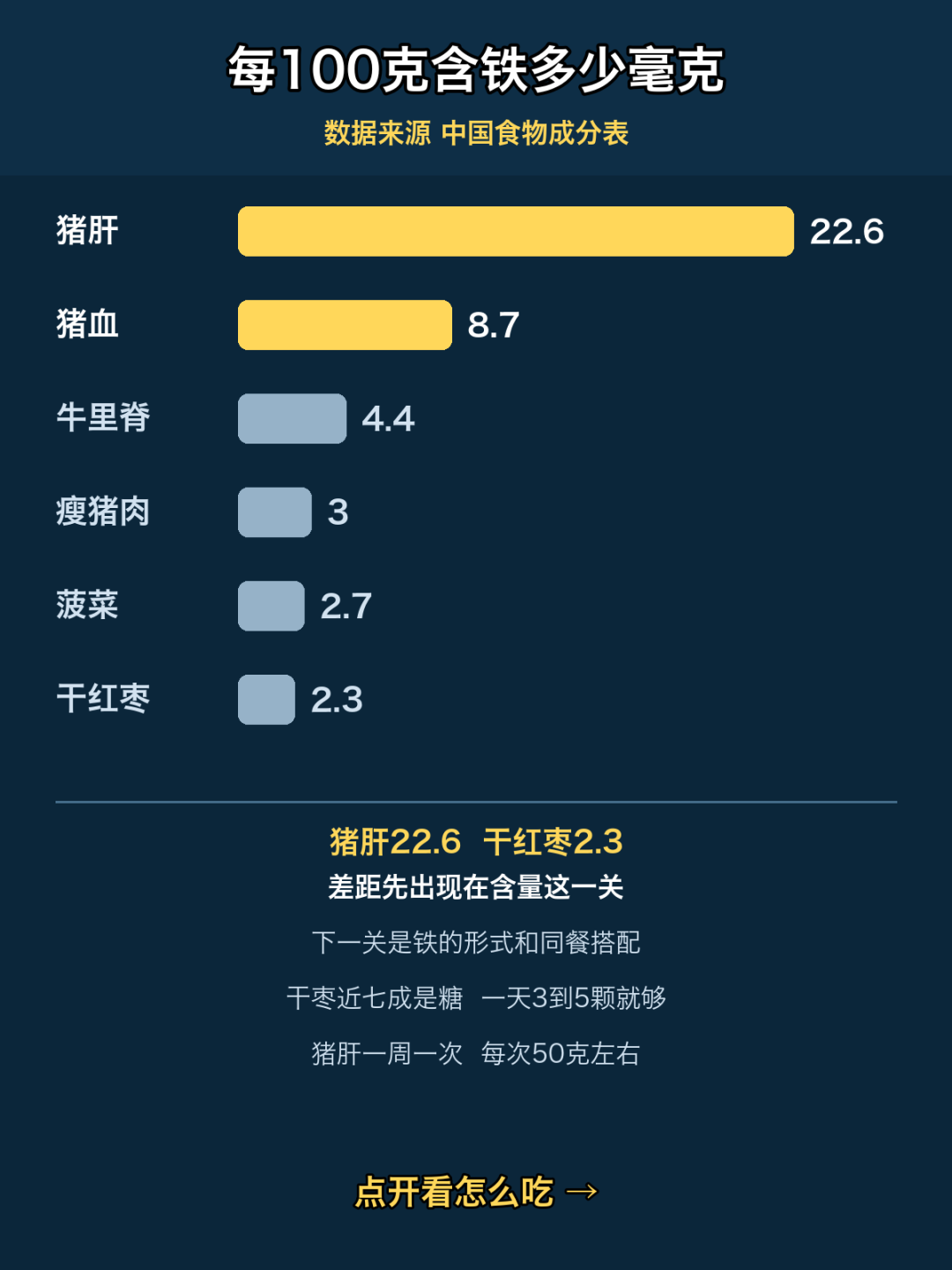
According to data from the China Food Composition Tables, the iron content per 100 grams of edible portion is roughly: pork liver 22.6 mg, pig blood 8.7 mg, beef tenderloin 4.4 mg, lean pork 3.0 mg, spinach 2.7 mg, dried red dates 2.3 mg (fresh dates have only 1.2 mg).
The gap is stark: the iron in 100 grams of pork liver is about 10 times that of 100 grams of dried red dates. And a single dried date weighs only 5 to 8 grams, so ten dates come to about 50 to 80 grams, providing just 1.2 to 1.8 mg of iron—and that's before accounting for the next hurdle.
II. The Real Gap Is at the "Iron Door," Not in the Content
Iron in food comes in two forms. The iron in meat, liver, and blood is called heme iron; the iron in plants is called non-heme iron, and they enter the body through different pathways. Reviews point out that heme iron from meat is absorbed significantly more efficiently than inorganic iron, and that "chelating agents" such as tea polyphenols and phytic acid have little effect on it, while their effect on plant iron is much greater[2][3].
In one sentence: iron from animal foods is high in content and passes through the door smoothly; iron from plant foods is low in content and depends on whether there are "helpers" in the same meal.
III. The Red Date Ledger Becomes Clear Once You Do the Math
Ten dried dates provide about 1.2 to 1.8 mg of iron. In a mixed diet, non-heme iron absorption is often below 20%, typically on the order of about 5% in daily life, which works out to only 0.06 to 0.09 mg. By contrast, 50 grams of pork liver provides about 11 mg of iron, with an absorption rate orders of magnitude higher, roughly working out to more than 1 mg.
This is not a precise medical conversion, but the direction is clear enough: to meet a daily iron requirement of a dozen-plus milligrams relying on red dates, you would need to eat over a jin (500+ grams). In addition, nearly 70% of dried dates is sugar—ten dates contain roughly 30 grams of sugar—so those watching their sugar intake should take note.
IV. One Meal's Pairing Can Amplify Plant Iron 2- to 4-Fold
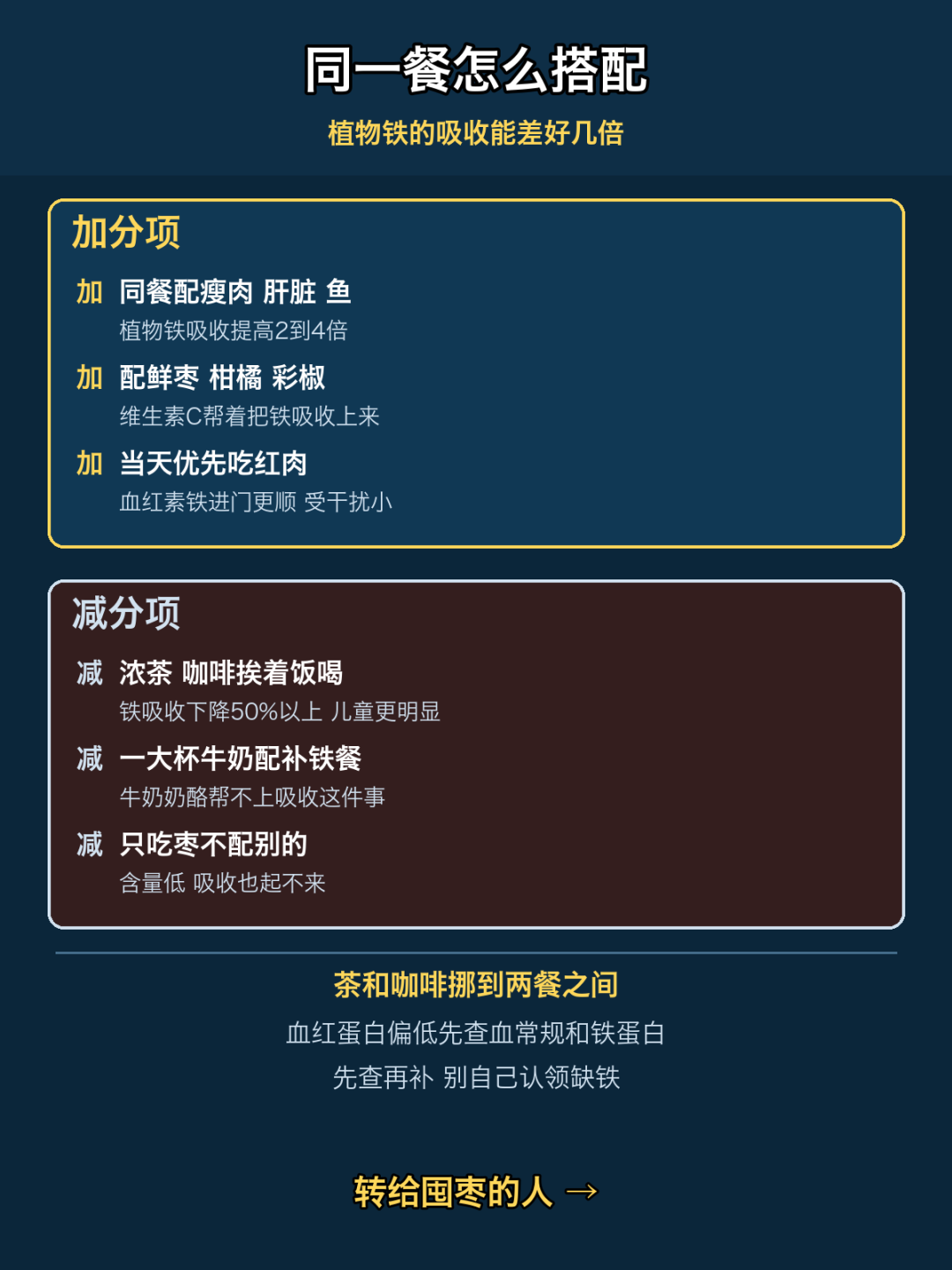
An absorption trial conducted on 70 volunteers found that when egg white protein was replaced with beef, lamb, pork, pork liver, fish, or chicken, non-heme iron absorption in the same meal increased 2- to 4-fold; replacing it with milk, cheese, or eggs had no such effect[4].
So it's not that red dates can't be eaten—it's that they shouldn't be eaten alone. Eaten in the same meal as lean meat or liver, paired with vitamin C-rich foods such as fresh dates, citrus, or bell peppers, plant iron absorption can rise by a notch; conversely, eating dates while drinking strong tea is wasted effort.
V. A Cup of Strong Tea Can Cut Absorption by More Than Half
In trials using stable isotopes, herbal teas with high polyphenol content reduced subjects' iron absorption by 50% to 56%, and the effect was even more pronounced in children, with reductions of 65% to 72%[5]. Tea itself is not the problem—the problem is timing: drinking it during or immediately after a meal carries the iron away.
It is recommended to move strong tea and coffee to between meals, separated from main meals by more than an hour. For people who are already anemic, this one tip may be worth more than how many red dates they eat.
VI. Find the Cause First, Then Discuss What to Supplement
The last layer is often overlooked. An absorption model based on complete diets shows that the main explanatory factor for differences in non-heme iron absorption across a population is an individual's iron stores (serum ferritin), while the influence of dietary factors is relatively much smaller[6].
In plain terms: whether you are actually deficient and by how much determines what to supplement and for how long. A complete blood count plus ferritin—two tests are enough to clarify the direction. Anemia also has causes other than iron deficiency—vitamin B12, folate, chronic inflammation, and occult blood loss are all possibilities. Claiming "iron deficiency" for yourself and supplementing for half a year is a common detour.
Five Things You Can Change Today
-
Pork liver once a week, about 50 grams each time; a palm-sized portion of lean meat every day.
-
Red dates as a snack, 3 to 5 a day—don't count on them as the main iron supplement.
-
When eating dates or spinach, pair them in the same meal with meat or vitamin C-rich fruits and vegetables.
-
Move strong tea and coffee to between meals, separated from main meals by more than an hour.
-
If hemoglobin is low, first check a complete blood count and ferritin, then decide whether and how to supplement.
It's not that red dates have no iron—it's that the iron has trouble getting through the door. When it comes to iron supplementation, test first, then supplement. Consider forwarding this article to the person in your household who stockpiles dates, or save it and pull it out before next year's health checkup.
If you found this helpful, give it a like or a "Wow," and feel free to leave a comment telling us what topics you'd like to see.
✦
Disclaimer: This article is for health education purposes only and is intended for informational reference. It does not constitute medical advice; if you have health concerns, please consult a professional physician.
Declaration of Interests: This article does not involve any recommendations for drugs or health supplements, and has no conflicts of interest with the research institutions mentioned in the text.
© 2026 Sun Shenghua (Beijing) Medical Technology Co., Ltd.
References
[1] Du C, Zhang M, Zhang X, et al. Association of Anaemia and Anthropometric Indices Among Chinese Adults: Based on the Sixth China Chronic Disease and Risk Factor Surveillance. Nutrients. 2025;17(19):3045. PMID: 41097123
[2] Uzel C, Conrad ME. Absorption of heme iron. Semin Hematol. 1998;35(1):27-34. PMID: 9460807
[3] West AR, Oates PS. Mechanisms of heme iron absorption: current questions and controversies. World J Gastroenterol. 2008;14(26):4101-4110. PMID: 18636652
[4] Cook JD, Monsen ER. Food iron absorption in human subjects. III. Comparison of the effect of animal proteins on nonheme iron absorption. Am J Clin Nutr. 1976;29(8):859-867. PMID: 941868
[5] Ndiaye NF, Idohou-Dossou N, Bürkli S, et al. Polyphenol-rich tea decreases iron absorption from fortified wheat bread in Senegalese mother-child pairs and bioavailability of ferrous fumarate is sharply lower in children. Eur J Clin Nutr. 2020;74(8):1221-1228. PMID: 32203231
[6] Armah SM, Carriquiry A, Sullivan D, et al. A complete diet-based algorithm for predicting nonheme iron absorption in adults. J Nutr. 2013;143(7):1136-1140. PMID: 23700342