This article is for health education purposes only and is intended for informational reference; it does not constitute medical advice. If you have any health concerns, please consult a professional physician.
✦ ✦ ✦
The 16:8 intermittent fasting that has become especially popular over the past two years: eat only within an 8-hour window each day and fast for the remaining 16 hours. Some say it can "repair metabolism," while others say it is "just going hungry." In 2022, a 12-month randomized controlled trial involving 139 people published in the New England Journal of Medicine provided data—today we address the 5 most frequently asked questions one by one with evidence.
✦ ✦ ✦
First, let's get acquainted: what exactly is 16:8?
Among the intermittent fasting family, the three most studied are alternate-day fasting, the 5:2 diet, and time-restricted eating. 16:8 belongs to the latter—eating only within a fixed 8-hour window each day and essentially not eating during the remaining 16 hours (except for zero-calorie drinks such as water and black coffee) [1]. It does not dictate what you eat; it simply turns "when to eat" into a simple rule.
Q1: Can 16:8 intermittent fasting really help you lose 8 kg in a year?
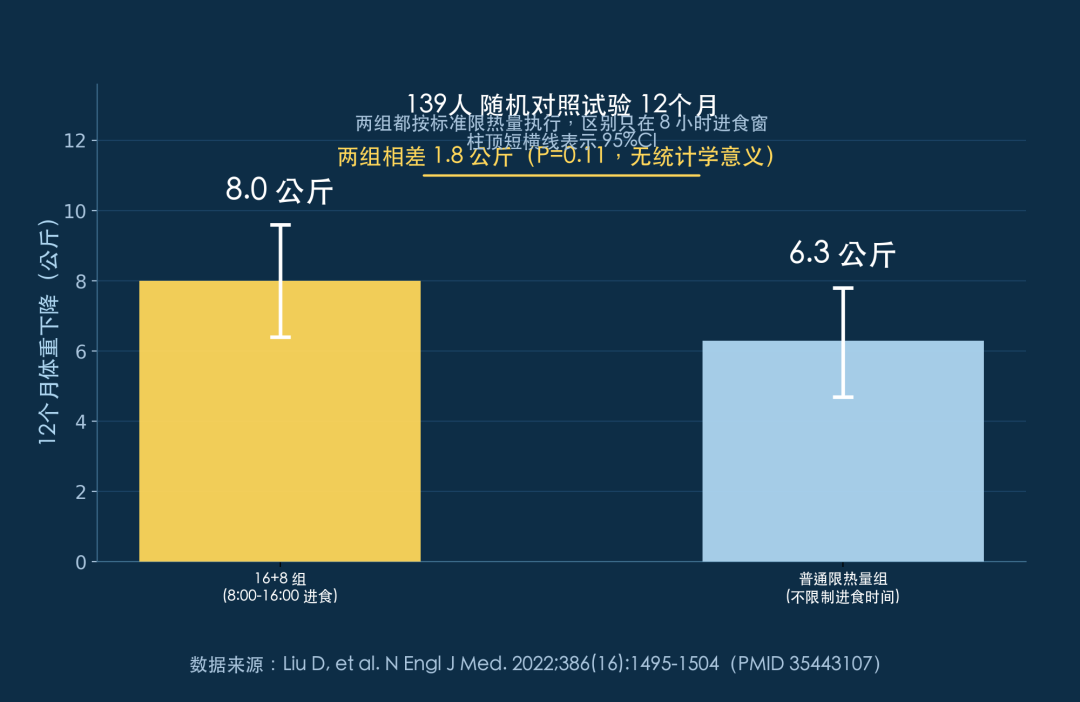
Yes, the data are real, but the full story needs to be told. In the 2022 New England Journal of Medicine randomized controlled trial, 139 adults with obesity were divided into two groups, both following standard calorie restriction (1,500–1,800 kcal per day for men and 1,200–1,500 kcal per day for women); one group additionally followed 16:8 (eating only between 8 a.m. and 4 p.m.), while the other group had no restriction on eating timing, and they continued for 12 months [2].
Results: the 16:8 group lost an average of 8.0 kg, while the ordinary calorie-restriction group lost 6.3 kg, a difference of 1.8 kg, but there was no statistically significant difference (P=0.11); waist circumference, body fat, blood pressure, and other indicators were basically consistent between the two groups [2].
So "losing 8 kg in a year" is true, but a more accurate way to put it is: keeping calories within a reasonable range can lead to this much weight loss, and 16:8 is not more magical than "eating less regularly"; a 2025 meta-analysis pooling 13 randomized trials and 612 women with overweight or obesity also found that it had no significant advantage over simple calorie restriction [3].
Then why is it still recommended? Because it turns "eating less" into a time rule that tells you to stop when the time comes, so you do not have to calculate calories at every meal or repeatedly negotiate with your appetite, and adherence is also better [3]. Weight loss is not about whether a method is mysterious; it is about who can stick with it longer.
Q2: If the weight loss comes from hunger, will it cause muscle loss?
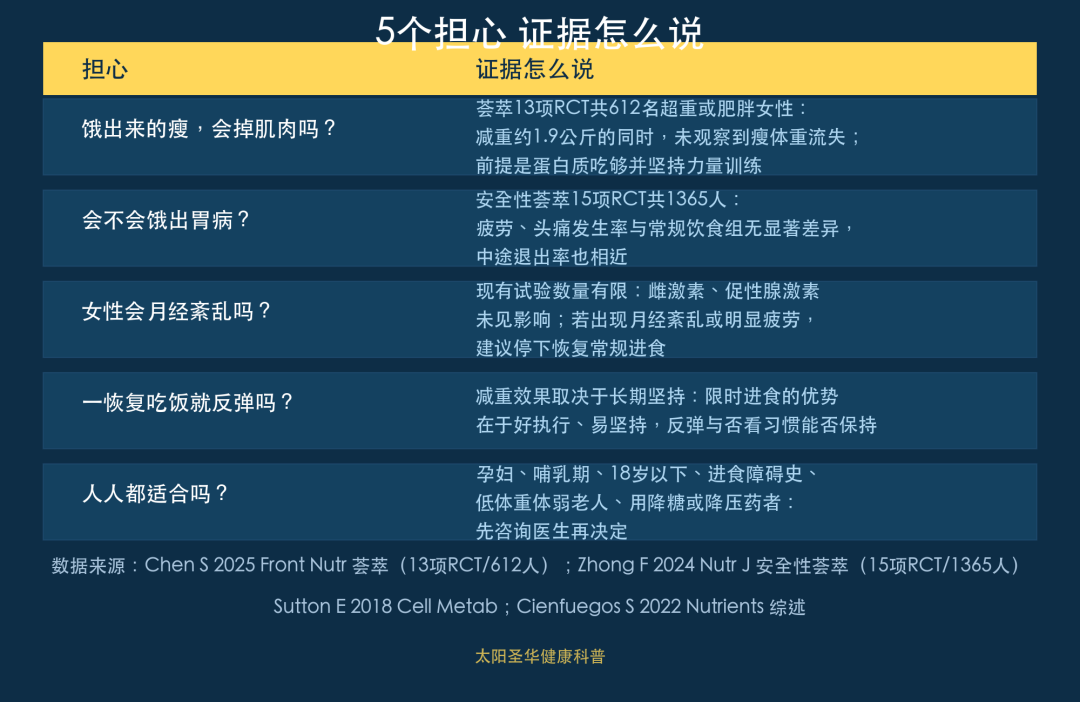
Weight lost during weight reduction inherently includes water and lean body mass; the key is whether it is reasonable. The meta-analysis of 612 women specifically examined body composition: the time-restricted eating group lost about 1.9 kg and had a decrease in fasting insulin, with no observed muscle loss [3]; in the NEJM trial, changes in lean body mass were also consistent between the two groups [2].
To preserve muscle: eat enough protein (about 1.2–1.6 g per kg of body weight per day, roughly one palm-sized portion of fish, meat, eggs, or soy products at each meal), plus resistance training 2–3 times per week. Relying only on hunger without exercise is where muscle loss is most likely to occur.
Q3: Are "repairing metabolism and anti-aging" just pseudoscience?
Half is evidence-based, and half is embellishment. Mechanistically, fasting triggers a cellular "energy-saving maintenance" mode: autophagy clears damaged components and reduces oxidative damage and inflammation [4]; compressing eating into the daytime and prolonging the overnight fast is also thought to improve metabolism [6].
Human trials are more solid: a 2018 randomized crossover study had 8 men with prediabetes eat within a 6-hour window each day (finishing before 3 p.m.), and even without weight change, insulin sensitivity, pancreatic β-cell response, and blood pressure improved significantly [5]—some of the metabolic benefits indeed do not depend on weight loss.
However, the evidence for "anti-aging and life extension" mainly comes from cell and animal experiments [4]. Treating it as "a tool to help metabolism work regularly" is supported by evidence; treating it as a "longevity drug" is premature.
Q4: For women practicing 16:8, will it affect endocrine function and menstruation?
This is a frequently asked question but one with the least data. A 2022 review pooling human trials found that in women with overweight, intermittent fasting was associated with decreases in androgen markers (testosterone, free androgen index) and increases in sex hormone-binding globulin, more evident with an early eating window of "finishing eating before 4 p.m."; no effects were observed on estrogen, gonadotropins, or prolactin. In men, some studies reported that testosterone decreased during fasting in lean young people who exercised regularly, but muscle mass and strength were not impaired [7].
The researchers emphasized that the number of trials is small, and it is still too early to draw conclusions [7]. It is recommended to start with a mild 12–14-hour fast rather than immediately adopting "no eating after noon"; if menstrual irregularities, obvious fatigue, or worsening mood occur, return to regular eating and do not force yourself to push through.
Q5: What can I drink when hungry? Who should not try it? How to start safely?
During the 16-hour fasting period, plain water, black coffee, and unsweetened tea (all without sugar or milk) are essentially zero-calorie and do not affect the core of "eating less." If hunger is uncomfortable, first drink a large glass of water and then wait 15 minutes—many times "hunger" is just thirst or boredom.
There are direct safety data: a 2024 meta-analysis pooling 15 randomized trials and 1,365 adults with overweight or obesity showed that the incidence of fatigue and headache in the intermittent fasting group was not significantly different from that in the conventional diet group, and the dropout rate was also similar; only the subgroup with non-early time-restricted eating had slightly more dizziness [8].
But these people should not try it on their own—consult a doctor first: pregnant and breastfeeding women, people under 18, those with a history of eating disorders, underweight or frail elderly people, and people with type 1 diabetes or those taking glucose-lowering or blood pressure-lowering medications—fasting may cause fluctuations in blood sugar and blood pressure and requires a doctor's evaluation; people with gallbladder disease or significant stomach problems should likewise ask a doctor first.
A safe start takes just three steps: Step one, first achieve a 12-hour fast (for example, stop eating after 7 p.m. and eat breakfast at 7 a.m.), and keep it up for one or two weeks; Step two, delay breakfast to 9-10 a.m., extending the fast to 14 hours; Step three, once your condition is stable, try 16+8. During the 8-hour eating window, don't eat revenge-style; eat enough protein, vegetables, and staple foods as usual.
Action advice: 16+8 is not magic; it is a tool for "turning eating less into a time rule." Those who want to try it should start with 12 hours, stick with it for two weeks first, and then decide whether to go to 16 hours.
Share this article with friends who are still agonizing over 16+8—there is no shortcut to weight loss, but there can be smarter rules.
If it helps you, give it a like or a "Wow," and feel free to leave a comment telling us what topics you want to see.
References
- Varady KA, Cienfuegos S, Ezpeleta M, Gabel K. Clinical application of intermittent fasting for weight loss: progress and future directions. Nat Rev Endocrinol. 2022;18(5):309-321. PMID: 35194176
- Liu D, Huang Y, Huang C, et al. Calorie Restriction with or without Time-Restricted Eating in Weight Loss. N Engl J Med. 2022;386(16):1495-1504. PMID: 35443107
- Chen S, Zhang X, Kortas J, Liu H. Effects of time-restricted eating on body composition and metabolic parameters in overweight and obese women: a systematic review and meta-analysis. Front Nutr. 2025;12:1664412. PMID: 41036194
- Longo VD, Mattson MP. Fasting: molecular mechanisms and clinical applications. Cell Metab. 2014;19(2):181-192. PMID: 24440038
- Sutton EF, Beyl R, Early KS, Cefalu WT, Ravussin E, Peterson CM. Early Time-Restricted Feeding Improves Insulin Sensitivity, Blood Pressure, and Oxidative Stress Even without Weight Loss in Men with Prediabetes. Cell Metab. 2018;27(6):1212-1221. PMID: 29754952
- Patterson RE, Sears DD. Metabolic Effects of Intermittent Fasting. Annu Rev Nutr. 2017;37:371-393. PMID: 28715993
- Cienfuegos S, Corapi S, Gabel K, et al. Effect of Intermittent Fasting on Reproductive Hormone Levels in Females and Males: A Review of Human Trials. Nutrients. 2022;14(11):2343. PMID: 35684143
- Zhong F, Zhu T, Jin X, et al. Adverse events profile associated with intermittent fasting in adults with overweight or obesity: a systematic review and meta-analysis of randomized controlled trials. Nutr J. 2024;23(1):72. PMID: 38987755
Disclaimer: This article is for health education purposes only and is intended for informational reference; it does not constitute medical advice. If you have any health concerns, please consult a qualified physician. If you have a chronic illness or are currently taking medication, please consult your doctor before starting time-restricted eating.
Declaration of Interests: The content of this article represents the author's views only and has no conflict of interest with any commercial entity.
© 2026 Sun Holy Hua (Beijing) Medical Technology Co., Ltd.