This article is for health education purposes only and is intended for informational reference; it does not constitute medical advice. If you have any health concerns, please consult a professional doctor.
✦ ✦ ✦
"After 30, your metabolism slows down—you gain weight just from drinking water." How many times have you heard this? A 2021 study published in the journal Science said: once body weight and muscle mass are accounted for, total energy expenditure stays steady from age 20 to 60—it does not suddenly turn downward at 30[1]. Today, we'll use one infographic to make sense of the "slowing metabolism" story.
✦ ✦ ✦
First, the data: how many calories do you burn a day, and where exactly is the turning point?
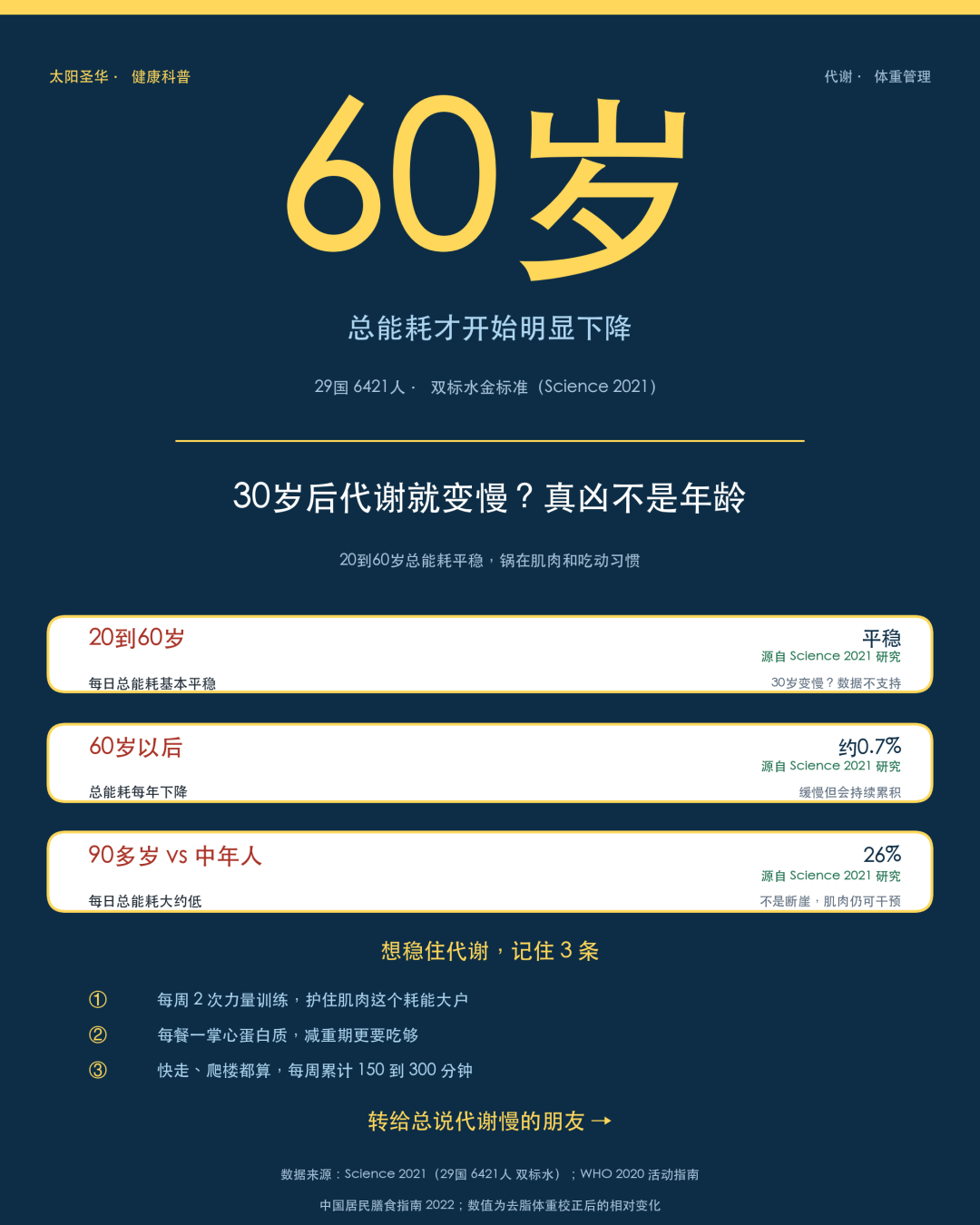
The data in this figure come from a large 2021 study in the journal Science: researchers pooled daily total energy expenditure measured with the "doubly labeled water method" from 6,421 people across 29 countries (ranging in age from 8 days to 95 years)—the gold standard for measuring how many calories a person actually burns in a day[1].
The results are quite counterintuitive: after removing the influence of body weight and muscle mass, total energy expenditure is essentially a flat line between age 20 and 60; the truly visible decline begins only after age 60, at a rate of about 0.7% per year—by the 90s, total energy expenditure is roughly 26% lower than in middle age[1].
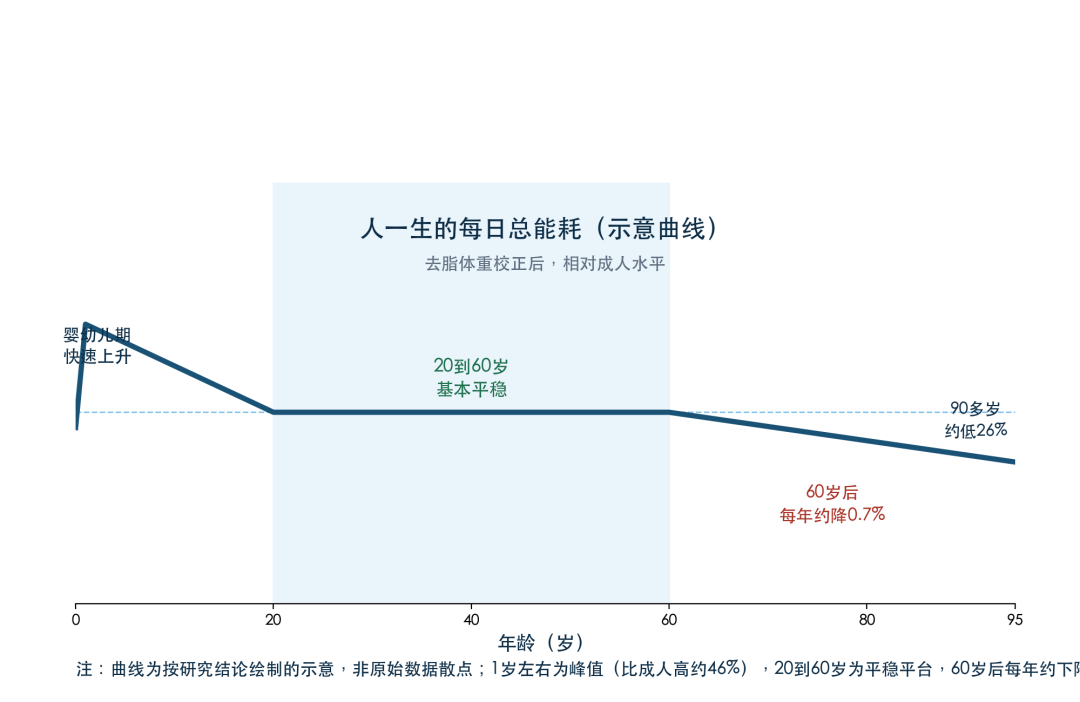
(The curve in the figure above is illustrative and drawn according to the study's conclusions.)
So where does the feeling that "it slows down at 30" come from?
Because what is really "quietly shrinking" in the body is muscle. Muscle is a major energy consumer: this study found that the amount of lean mass, including muscle, explained about 83% of the variation in daily expenditure between individuals[1]. Starting at age 30, without exercise, muscle mass gradually decreases—less muscle means fewer calories burned at rest; add to that more sitting, less activity, and eating more than before, and the ledger of "burning less and storing more each day" gets blamed on "a slowing metabolism."
In other words: from 30 to 60, the culprit isn't age—it's muscle mass, activity level, and the calories you take in.
After 60, that's when you need to pay more attention
After age 60, total energy expenditure declines by about 0.7% per year, which is a normal physiological change[1]. But the extent of the decline is related to the rate of muscle loss and reduced activity—and this part can be intervened on:
① Strength training twice a week: squats, dumbbells, resistance bands all work. Keep the muscle, and the "hardware" of metabolism stays intact (the World Health Organization recommends that adults do muscle-strengthening activities at least 2 days a week)[3].
② Eat enough protein: a palm-sized portion of fish, meat, eggs, or soy products at each meal; during calorie-restricted weight loss, aim for 1.2–1.7 grams of protein per kilogram of body weight to better preserve muscle[2].
③ Put activity back into daily life: brisk walking, stair climbing, and housework all count—aim for a cumulative 150 to 300 minutes of moderate-intensity activity per week[3].
One-sentence action advice
Don't rush to label yourself with "slow metabolism": starting tonight, track for one week what you eat and how many steps you take each day—most people will find the problem lies at the "intake" end, not in the "burning" furnace.
Share this infographic with the friend who always says "after 30, I gain weight just from drinking water"—30 is not the watershed for metabolism; "stopping moving" is.
If this was helpful, give it a like or a "Wow," and feel free to leave a comment telling us what topics you'd like to see.
✦ ✦ ✦
Disclaimer: The content of this article is compiled from publicly available academic literature and is intended for health education reference only; it does not constitute medical advice. For individual circumstances, please consult a professional doctor.
Conflict of interest statement: The author has no conflict of interest with the research mentioned in this article.
© 2026 Sun Shenghua (Beijing) Medical Technology Co., Ltd.
References
- Daily energy expenditure through the human life course. Science. 2021;373(6556):808-812. PMID:34385400
- The effects of high protein intakes during energy restriction on body composition, energy metabolism and physical performance in recreational athletes. Eur J Clin Nutr. 2025;79(6):544-552. PMID:40011662
- WHO guidelines on physical activity and sedentary behaviour. Geneva: World Health Organization; 2020.
- Dietary Guidelines for Chinese Residents (2022). Chinese Nutrition Society. Beijing: People's Medical Publishing House; 2022.