This article is for health education purposes only and is intended for informational reference; it does not constitute medical advice. If you have any health concerns, please consult a professional doctor.
✦ ✦ ✦
The 3 minutes you spend waiting for the elevator is enough time to climb 5 floors. On one side is a free "stairway gym," and on the other is brisk walking, suitable for all ages—between these two most everyday forms of exercise, which one is actually more "worth it"? A 2026 meta-analysis of 480,000 people has just provided new data: people who regularly climb stairs have about a 39% lower risk of cardiovascular death. Today we put stairs and brisk walking on the same scale.
✦ ✦ ✦
A new study of 480,000 people: stair climbers have a 39% lower risk of cardiovascular death
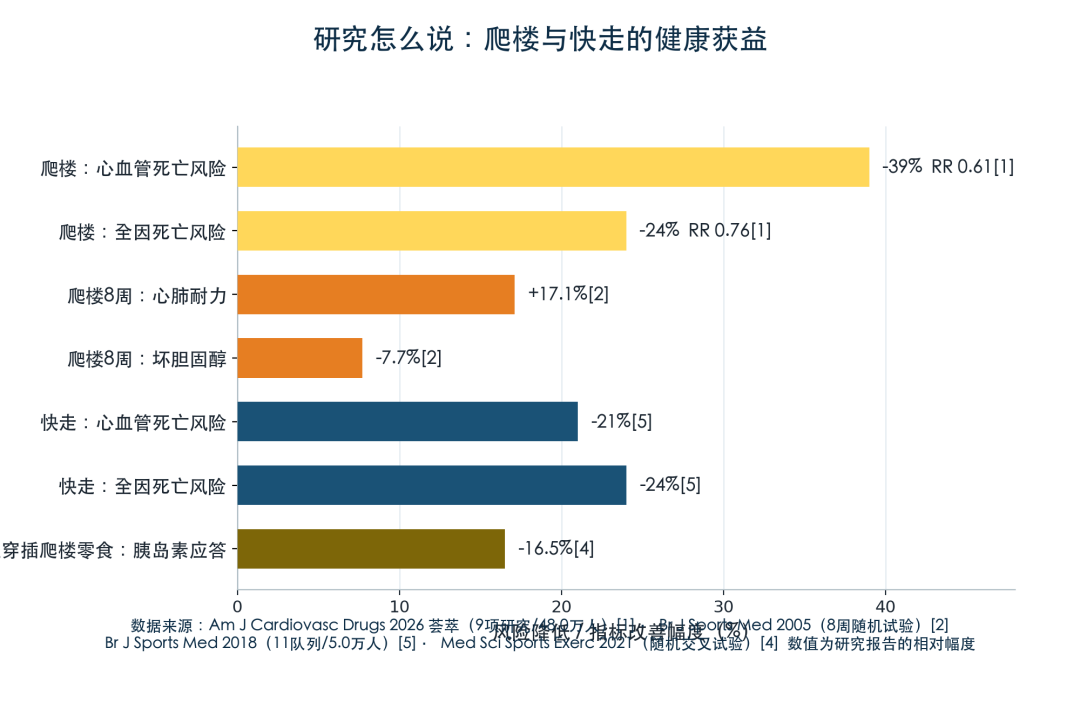
A systematic review and meta-analysis published in August 2026 in the American Journal of Cardiovascular Drugs (Am J Cardiovasc Drugs) screened 1,873 studies and ultimately included 9 studies with a total of 480,479 people. The pooled results showed that, compared with not climbing stairs, daily stair climbing was associated with a 39% lower risk of cardiovascular disease death (RR 0.61, 95%CI 0.48-0.79) and a 24% lower risk of all-cause death (RR 0.76, 95%CI 0.62-0.94)[1].
This overlooked "gym" in the stairwell has quite impressive data. But brisk walking is no slouch either—a pooled analysis of 11 UK cohorts including 50,225 walkers showed that, compared with slow walking, brisk walkers had a 24% lower risk of all-cause death and a 21% lower risk of cardiovascular disease death[5].

Round 1: Efficiency per unit time—stairs are about twice as efficient as brisk walking
Climbing stairs involves fighting gravity to "move" the body upward, so the intensity is naturally high. According to the MET values in the Compendium of Physical Activities (1 MET ≈ the energy expenditure of sitting quietly): slow stair climbing is about 8.0 MET, fast stair climbing about 8.8 MET, while brisk walking at a moderate pace is about 4.3 MET and slow walking only 2.5 MET[6]. In other words, in the same 10 minutes, stair climbing burns about twice as much energy as brisk walking.
For people short on time, stairs offer better "time cost-effectiveness."
Round 2: They train different things
Stair climbing = combined cardio and strength training. A randomized trial in Northern Ireland had sedentary young women climb 199 public stairs every day, 5 days a week, gradually increasing from 1 trip per day to 5 trips per day. After 8 weeks: maximal oxygen uptake (VO₂max, the core indicator of cardiorespiratory endurance) increased by 17.1%, and bad cholesterol (LDL-C) decreased by 7.7%[2]. A "exercise snack" study from McMaster University in Canada also found that climbing 3 floors quickly (60 steps) 3 times a day, 3 days a week, significantly improved cardiorespiratory endurance in sedentary young adults after 6 weeks[3].
Brisk walking = steady, reliable cardiorespiratory maintenance. Brisk walking has a low barrier to entry and is easy to sustain. Data from 50,225 people show that even if total exercise volume is not large, picking up the pace to the point of "slightly panting, able to talk but not sing" is associated with a significantly lower risk of death[5]. It has little impact on joints, making it a safer choice for people with higher body weight, middle-aged and older adults, and people with cardiovascular disease.
Round 3: Scenarios and risks
Stair climbing is high-intensity and places demands on the knee joints, balance, and cardiovascular reserve: people with old knee injuries, obvious chest tightness or shortness of breath, or unstable blood pressure control are not advised to make stair climbing their main form of exercise. Going downstairs is especially hard on the knees, so taking the elevator down is an option. Brisk walking has almost no contraindications; a 15-minute walk after a meal can also help reduce postprandial blood sugar fluctuations.
A smart compromise is the "exercise snack": when sitting for long periods, take 15-30 seconds each hour to climb a few flights of stairs. A randomized crossover trial found that in overweight adults, interspersing 8 short stair-climbing bouts during 9 hours of sitting reduced the total postprandial insulin response by 16.5% and free fatty acids by 21%[4]—something you can do in the spare moments while waiting for the elevator or coffee.
Conclusion: It's not either-or; it's about combining them
- Short on time and with healthy legs: climb stairs instead of squeezing into the elevator; for 3 floors or fewer, prioritize the stairs, and take the elevator down to protect your knees;
- Higher body weight, middle-aged and older adults, cardiovascular disease, or joint discomfort: make brisk walking the main activity, 30 minutes a day, walking until slightly panting;
- Sedentary office workers: 15-30 seconds of stair climbing as an "exercise snack" each hour + a 15-minute brisk walk after meals—stack the two.
Action suggestions: After work today, get off the subway one stop early and brisk walk that stop; starting tomorrow, for 3 floors or fewer, don't wait for the elevator. After a week, notice this: has your breathing during stair climbing become less labored—that's a sign your heart and lungs are getting stronger.
Share this article with the colleagues and family members who agonize every day over "elevator or stairs"—exercise isn't short on time; what's missing is that one moment of lifting your legs.
If this has been helpful to you, give it a like or a "Wow," and feel free to leave a comment telling us what topics you'd like to see.
References
- Paddock S, Veerni R, Bhalraam U, et al. Evaluating the Impact of Stair Climbing on Cardiovascular Risk Reduction: A Systematic Review and Meta-analysis. Am J Cardiovasc Drugs. 2026 Aug 13. PMID: 42587225
- Boreham CA, Kennedy RA, Murphy MH, et al. Training effects of short bouts of stair climbing on cardiorespiratory fitness, blood lipids, and homocysteine in sedentary young women. Br J Sports Med. 2005;39(9):590-593. PMID: 16118293
- Jenkins EM, Nairn LN, Skelly LE, Little JP, Gibala MJ. Do stair climbing exercise "snacks" improve cardiorespiratory fitness? Appl Physiol Nutr Metab. 2019;44(6):681-684. PMID: 30649897
- Rafiei H, Omidian K, Myette-Côté É, Little JP. Metabolic Effect of Breaking Up Prolonged Sitting with Stair Climbing Exercise Snacks. Med Sci Sports Exerc. 2021;53(1):150-158. PMID: 32555024
- Stamatakis E, Kelly P, Strain T, et al. Self-rated walking pace and all-cause, cardiovascular disease and cancer mortality: individual participant pooled analysis of 50 225 walkers from 11 population British cohorts. Br J Sports Med. 2018;52(12):761-768. PMID: 29858463
- Ainsworth BE, Haskell WL, Herrmann SD, et al. 2011 Compendium of Physical Activities: a second update of codes and MET values. Med Sci Sports Exerc. 2011;43(8):1575-1581. PMID: 21681120
Disclaimer: This article is for health education purposes only and is intended for informational reference; it does not constitute medical advice. If you have any health concerns, please consult a qualified physician. Patients with cardiovascular disease or bone and joint disorders should consult a doctor before starting any exercise program.
Declaration of Interests: The content of this article represents the views of the author only and has no conflict of interest with any commercial entity.
© 2026 Taiyang Shenghua (Beijing) Medical Technology Co., Ltd.