Only Above 65°C Counts as Hot: People Who Drink While It's Still Hot Have a 67% Higher Risk of Esophageal Cancer
This article is for health education and informational purposes only; it does not constitute medical advice. If you have health concerns, please consult a professional doctor.
✦ ✦ ✦
When the weather turns cold and hot soup or tea is set on the table, the first sip is always taken while it's still steaming. Many people feel that once it cools down, it just doesn't taste the same. But the lining of the esophagus doesn't have the kind of sensitive pain receptors that skin does to warn you—by the time it speaks up, it's often no longer just a "little burn."
A cohort study conducted by the University of Tehran and the American Cancer Society in the Golestan region followed 50,045 residents aged 40 to 75, with a median follow-up of 10.1 years, during which 317 cases of esophageal squamous cell carcinoma occurred. The study used thermometers to measure each person's tea temperature: those who preferred "very hot" tea had 2.41 times the risk of those who preferred warm or cool tea; those who drank their tea less than 2 minutes after pouring had a 51% higher risk than those who waited more than 6 minutes; and measured temperatures above 60°C carried a 41% higher risk than below 60°C. If they also drank more than 700 mL per day, the risk was about 90% higher than that of people who drank small amounts of warm beverages[2].
I. 65°C Is a Line Written Into the Assessment
In 2016, after convening experts for evaluation, the International Agency for Research on Cancer classified "drinking very hot beverages above 65°C" as Group 2A, meaning probably carcinogenic to humans; at the same time, coffee itself was removed from the "possibly carcinogenic" category and reclassified as having insufficient evidence[1]. In other words, the problem isn't tea or coffee—it's the temperature.
II. A Small Difference in Temperature, a Big Difference in Risk
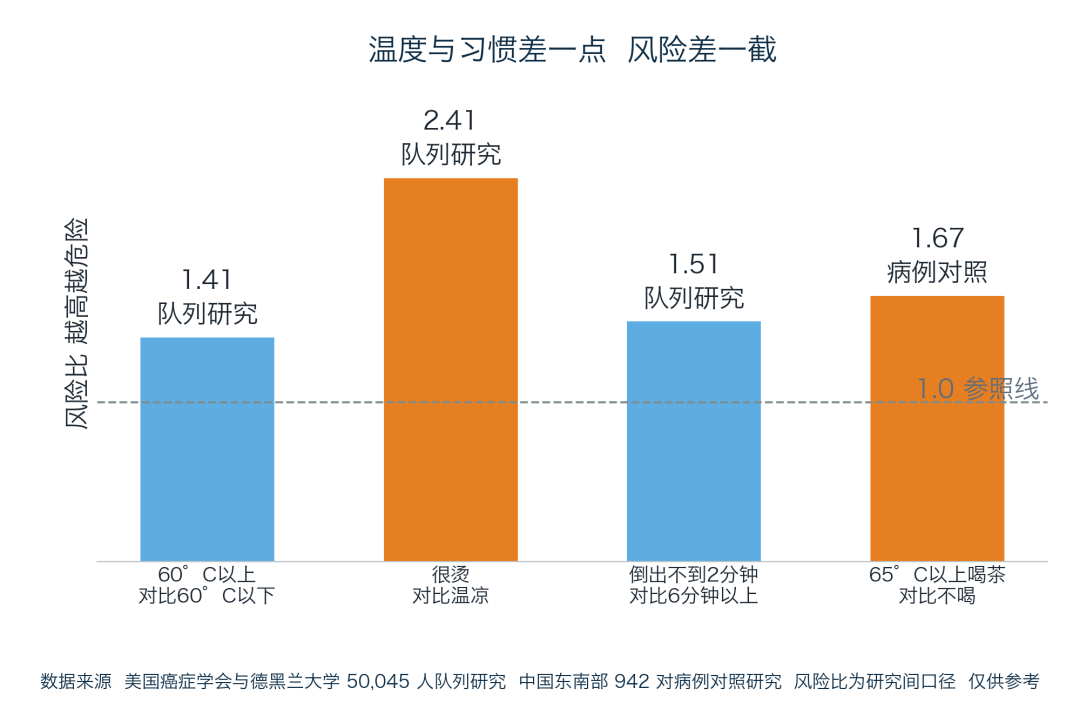
A systematic review pooling 59 studies points in the same direction: the amount you drink has no clear relationship with esophageal cancer, but how hot you drink it does[3]. This also explains why "I drink health tea" offers no protection—no matter how good the ingredients are, if the temperature is too high, it will still damage the mucosa.
III. A 942-Pair Case-Control Study in a High-Incidence Area of China Points the Same Way
In a high-incidence area for esophageal squamous cell carcinoma in southeastern China, researchers compared 942 confirmed patients with 942 age- and sex-matched community controls one by one: those who habitually drank hot tea above 65°C had 1.67 times the risk of non-tea drinkers; if they used more than 300 grams of tea leaves per month and always drank it above 65°C, the risk was more than 1.8 times higher[4].
IV. Why the Esophagus Gives Out First
With repeated exposure above 65°C, the mucosa is scalded and repaired again and again. Long-term thermal injury and the chronic inflammation that follows are considered the main explanatory pathway[1][3]. The esophagus is not like the mouth—you can actually feel that first sip going in, but the real site of injury is further down. By the time you feel a foreign-body sensation or difficulty swallowing and go for a check, it's usually no longer early.
V. This Matters Especially in Asia
In 2022, Asia bore about 75% of the world's new esophageal cancer cases (382,800) and deaths (329,800), concentrated among men and people over 50; based on population growth and aging alone, new cases are projected to increase by 89% and deaths by 97% by 2050[5].
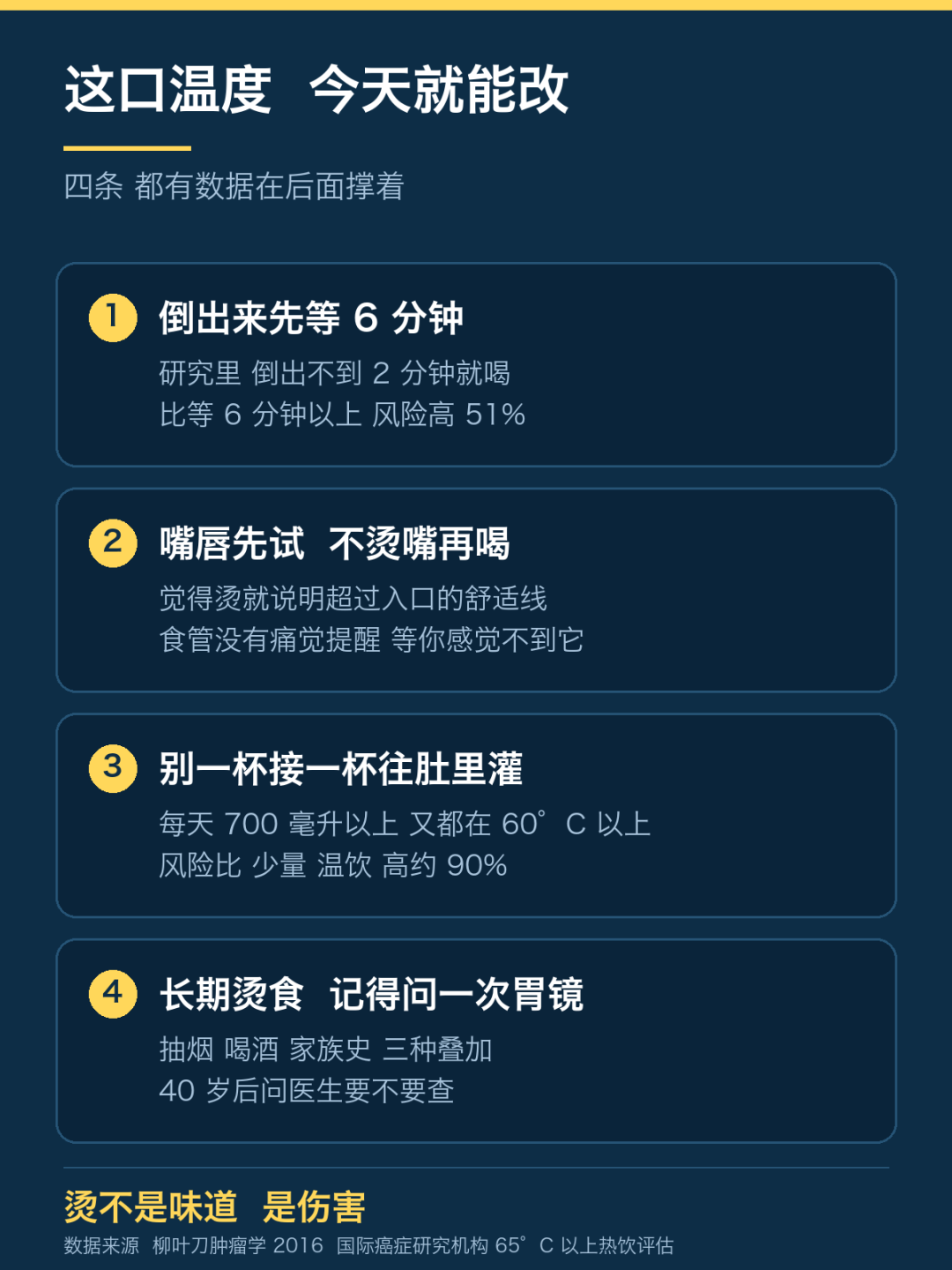
Four Things You Can Change Today
-
Wait 6 minutes after pouring. In the study, "within 2 minutes" versus "more than 6 minutes" made a 51% difference[2]—this is a zero-cost change.
-
Test with your lips first; drink only when it doesn't burn your mouth. If it feels hot, it's over the limit—don't use "I'm used to it" as your standard.
-
Don't gulp cup after cup. Temperature and total amount add up; drinking more than 700 mL per day, all above 60°C, raises risk by about 90%[2].
-
If you've eaten hot food for years and also smoke, drink alcohol, or have a family history, ask your doctor once after age 40 whether you should have an endoscopy.
Hot isn't a flavor—it's harm. Drinking it warm keeps you just as warm. Share this with the person in your family who always says "eat it while it's hot."
If this was helpful, give it a like or a "Wow," and feel free to leave a comment telling us what topics you'd like to see.
✦ ✦ ✦
Disclaimer: This article is for health education and informational purposes only; it does not constitute medical advice. If you have health concerns, please consult a professional doctor. If you experience swallowing discomfort or pain behind the breastbone, please seek medical attention promptly.
Declaration of Interests: This article is based on publicly published medical literature, and the author has no relevant conflicts of interest.
References
-
Loomis D, Guyton KZ, Grosse Y, et al. Carcinogenicity of drinking coffee, mate, and very hot beverages. Lancet Oncol. 2016;17(7):877-878. PMID:27318851
-
Islami F, Poustchi H, Pourshams A, et al. A prospective study of tea drinking temperature and risk of esophageal squamous cell carcinoma. Int J Cancer. 2020;146(1):18-25. PMID:30891750
-
Islami F, Boffetta P, Ren JS, et al. High-temperature beverages and foods and esophageal cancer risk--a systematic review. Int J Cancer. 2009;125(3):491-524. PMID:19415743
-
Lin S, Xu G, Chen Z, et al. Tea drinking and the risk of esophageal cancer: focus on tea type and drinking temperature. Eur J Cancer Prev. 2020;29(5):382-387. PMID:32740163
-
Yi H, Wen B, Zhao X, et al. Burden of Esophageal Cancer in Asia in 2022 and Projections for 2050. J Gastroenterol Hepatol. 2026;41(6):1777-1791. PMID:42056708
© 2026 Sunshenghua (Beijing) Medical Technology Co., Ltd.