This article is for health education and informational purposes only and does not constitute medical advice; if you have any health concerns, please consult a professional physician.
GLP-1 Does More Than "Suppress Appetite"? New Yale Finding: It Actually Activates Hunger Neurons
Semaglutide has helped tens of millions of people worldwide successfully lose 10%–15% of their body weight, but scientists have never fully understood why it "holds up" better than every weight-loss drug before it. On August 11, 2026, Yale University School of Medicine published a study in the
Proceedings of the National Academy of Sciences (PNAS) that offers a颠覆性 answer—GLP-1 drugs do not simply "turn off the hunger switch"; instead, they actively recruit AgRP neurons in the brain that drive hunger, putting the body into an efficient fat-burning mode resembling a "calorie deficit." This finding overturns the classic hypothesis that has dominated the field for nearly a decade.
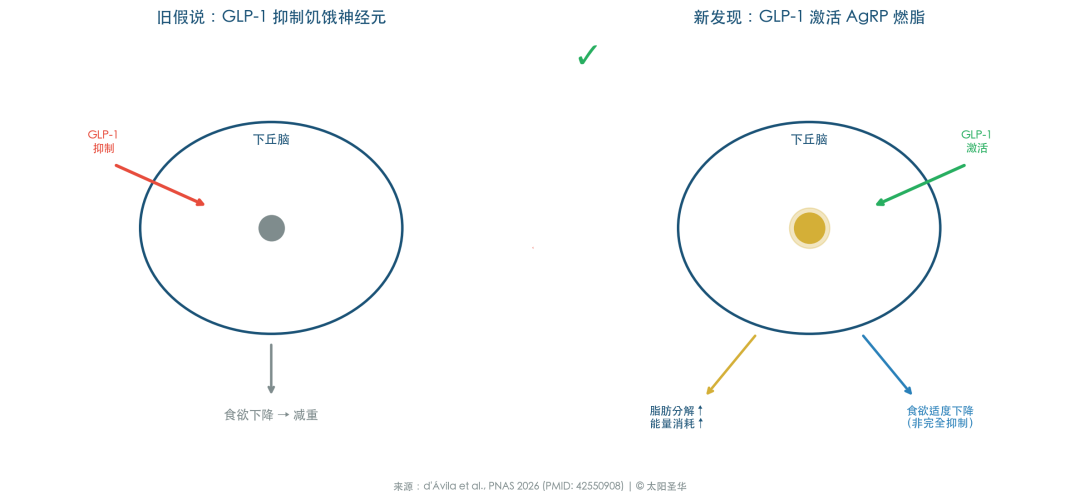
1. The Old Hypothesis: GLP-1 = Suppressing Hunger Neurons
The prevailing view in the field had been that GLP-1 receptor agonists reduce hunger by lowering AgRP neuron activity, thereby reducing food intake and body weight. This hypothesis has been widely cited, but it had never been directly tested in living animals receiving chronic dosing. AgRP neurons are located in the hypothalamus and are the body's strongest "appetite driver"—activate them and you will crave food intensely; destroy them and adult animals nearly stop eating. By conventional logic, a weight-loss drug should "turn them off."
2. The New Finding: Weight-Loss Drugs Are "Harnessing" Hunger Neurons
A team led by Mateus d'Ávila, a doctoral student in Tamas Horvath's laboratory at Yale University, conducted a key set of experiments using gene-knockout mice: Normal mice: after semaglutide injection, body weight continued to decline and fat decreased significantly; Mice with AgRP neurons knocked out: given the same semaglutide injections, the weight-loss effect could not be sustained—the drug lost its long-term fat-burning capacity. Electron microscopy, molecular biology, and electrophysiology experiments further confirmed that semaglutide does not inhibit AgRP neurons but activates them. Once activated, these "hunger neurons" not only did not cause the mice to eat more; instead, they coordinated a series of metabolic adaptations—increasing energy expenditure and promoting fat breakdown, similar to the survival program the body initiates during a natural calorie shortage.
"This completely changes our understanding of how these drugs work," d'Ávila said. "It opens up new ideas for developing more effective weight-loss drugs with fewer side effects."
3. Why Does This Matter?
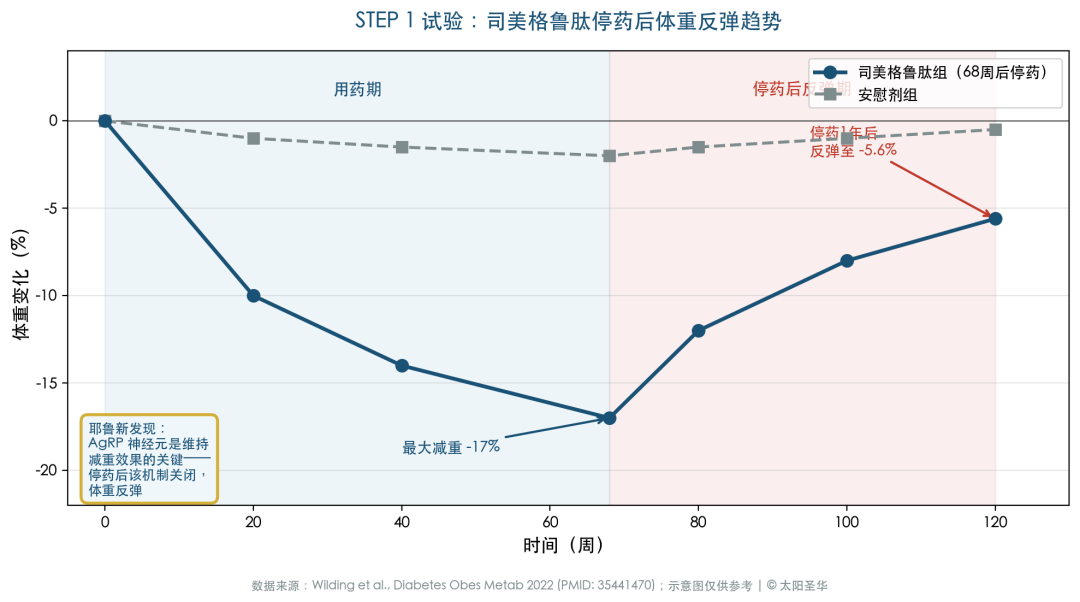
1. It explains the deeper reason behind "rebound after stopping the drug" The STEP 1 extension trial showed that one year after stopping semaglutide, patients regained on average about two-thirds of the weight they had lost (PMID: 35441470). If activation of AgRP neurons is key to the drug's sustained fat burning, then once the drug is withdrawn, this "simulated calorie deficit" program shuts down and the body quickly returns to energy-storage mode. 2. Next-generation weight-loss drugs may "precisely tune" AgRP Since AgRP neurons drive both hunger perception and fat breakdown, future drugs might selectively activate their "fat-burning branch" while blocking the "hunger branch," achieving more durable weight loss with controllable appetite. 3. Caution is still needed: mice ≠ humans This study was conducted in female mice, and the mechanism in humans still needs verification. AgRP neuron function in humans may be more complex, and animal experimental results cannot simply be extrapolated directly.
4. What Does This Mean for People Currently Using GLP-1?
Take medication continuously as prescribed: the long-term benefits of this class of drugs depend on sustained action, and stopping medication on one's own may lead to reversal of metabolic adaptation and weight rebound; lifestyle remains the cornerstone: with the aid of medication, a reasonable diet and exercise can help maintain the metabolic advantage brought about by AgRP activation; pay attention to long-term follow-up: long-term safety data for GLP-1 drugs are still accumulating, and regular check-ups and communication with doctors about the treatment plan are crucial. References: d'Ávila M, Cavalcanti-de-Albuquerque J, Collado-Pérez R, et al. AgRP neurons are required for the weight-lowering effects of GLP-1 receptor agonists in female mice.Proc Natl Acad Sci U S A. 2026 Aug 11. PMID: 42550908.Wilding JPH, Batterham RL, Davies M, et al. Weight regain and cardiometabolic effects after withdrawal of semaglutide: The STEP 1 trial extension.Diabetes Obes Metab. 2022 Aug;24(8):1553-1564. PMID: 35441470.Rubino D, Abrahamsson N, Davies M, et al. Effect of Continued Weekly Subcutaneous Semaglutide vs Placebo on Weight Loss Maintenance in Adults With Overweight or Obesity: The STEP 4 Randomized Clinical Trial.JAMA. 2021 Apr 13;325(14):1414-1425. PMID: 33755728.Disclaimer: The content of this article is based on publicly published scientific literature and news reports, and is intended solely for health science popularization; it does not constitute any diagnostic or treatment advice or medication guidance. Please consult professional medical personnel for personal health issues. Conflict of interest statement: The author of this article and Sun Sheng Hua (Beijing) Medical Technology Co., Ltd. have no conflict of interest with the above-mentioned research and drug manufacturers. © 2026 Sun Sheng Hua (Beijing) Medical Technology Co., Ltd.