This article is for health education purposes only and is intended for informational reference; it does not constitute medical advice. If you have any health concerns, please consult a professional doctor.
✦ ✦ ✦
"Just 4 minutes a day, as good as an hour of jogging" — anyone trying to lose weight would find it hard not to be tempted when scrolling past short videos like this. High-intensity interval training (HIIT) has indeed been a top trend in recent years: short sessions, lots of variety, plenty of sweat, and it looks like a better "deal" than jogging. But does it really burn more fat than jogging? A pooled study that precisely measured fat using dual-energy X-ray absorptiometry (DEXA) delivered an answer that surprised many.
✦ ✦ ✦
11 studies: when it comes to fat loss, HIIT doesn't win
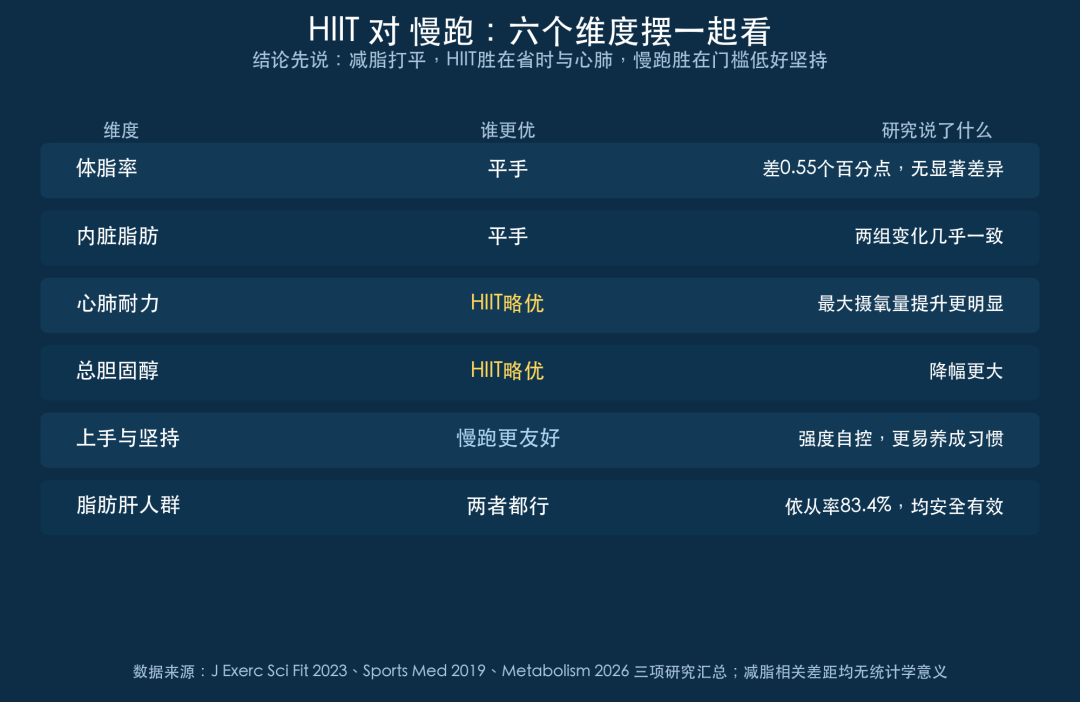
Let's start with the data. The researchers pooled 11 randomized controlled trials, all of which used DEXA to precisely measure body composition, in overweight and obese adults. The results showed that after training, the difference in body fat percentage reduction between the HIIT group and the continuous aerobic (jogging-type) group was only 0.55 percentage points, and this difference was not statistically significant (95% confidence interval from -1.42 to 0.31, crossing 0, p=0.209) [1]. Now look at what everyone cares about more — abdominal visceral fat: the changes in the two groups were also almost identical [1].
Another pooled analysis covering 47 studies reached the same conclusion: compared with moderate-intensity continuous training, "low-volume HIIT" with a low total weekly training volume showed no significant differences in the amount of fat lost, body fat percentage, or lean body mass [2].
Looking at fat loss alone, HIIT does not have the crushing advantage it is rumored to have.
The time equation: HIIT's real advantage is "saving"
So where exactly does HIIT's value lie? Two studies point in the same direction: cardiorespiratory endurance. In the pooled analysis of 11 studies, HIIT produced a greater improvement in maximal oxygen uptake (the core indicator of cardiorespiratory endurance) than continuous aerobic training [1]; the pooled analysis of 47 studies was even more direct — even though the total training volume was considerably lower than conventional programs, low-volume HIIT still outperformed moderate-intensity continuous training in improving cardiorespiratory endurance, making it a classic efficiency player that "trades less time for stronger cardiorespiratory fitness" [2].
The World Health Organization's 2020 guidelines also support this conversion: for adults, 150 to 300 minutes of moderate-intensity exercise per week is equivalent to 75 to 150 minutes of high-intensity exercise [4]. By this standard, the time cost of high-intensity exercise is about half that of moderate intensity. For people whose time is fragmented but who want to quickly build cardiorespiratory fitness, HIIT really does offer better value.
People with fatty liver: both work, and consistency is key
While we're at it, let's address a question commonly asked by people with metabolic conditions. A meta-analysis published in Metabolism in 2026, including 37 trials and 1,546 patients with fatty liver (metabolic dysfunction-associated steatotic liver disease), found that both HIIT and moderate-intensity continuous training significantly improved body composition, metabolic indicators, and liver function, and adherence rates were quite high: adherence 83.4%, completion rate 83.9%; among them, HIIT was superior in reducing total cholesterol [3].
For those who want to "lighten the load" on their liver, rather than agonizing over which to choose, it's better to just get moving — the program you can stick with is the effective one.
How to choose? Start by looking at your own starting point

- No exercise habit, high body weight, middle-aged or older, or with joint concerns: start with continuous aerobic exercise such as jogging. 5 days a week, 30 minutes each time, at an intensity where you "can talk but can't sing." Stick with it for 8 weeks to build the habit first, then consider stepping it up.
- Have an exercise base, fragmented time: you can go straight to HIIT. 2 to 3 times a week, 20 to 30 minutes each time (including warm-up). Starter formula: warm up with 2 minutes of slow walking or jogging, then run fast for 30 to 60 seconds, walk slowly for 60 to 90 seconds, and repeat for 6 to 8 rounds. For the first week, dial the intensity down to 70%, then add a little every two weeks.
- Whichever you choose: also schedule 2 strength training sessions per week — muscle is the foundation of metabolism, and doing only aerobic exercise can easily "burn off" muscle along with fat; the Chinese physical activity guidelines likewise recommend combining aerobic and strength training [5]. People with high blood pressure, heart disease, or old joint injuries should consult a doctor before starting; people with high body weight should reduce jumping movements.
On the road to weight loss, the program you can stick with is the truly good program. HIIT is responsible for efficiency, jogging for longevity — for most people, the answer is to put them both on the weekly schedule: 3 days of jogging as the base, 2 days of HIIT for a boost, and 2 more sessions for strength.
Share this with that friend who agonizes every day over "what kind of exercise is more effective": getting moving matters more than moving "fancy."
If this was helpful to you, give it a like or a "Wow," and feel free to leave a comment telling us what topics you'd like to see.
References
- Kramer AM, Martins JB, de Oliveira PC, Lehnen AM, Waclawovsky G. High-intensity interval training is not superior to continuous aerobic training in reducing body fat: A systematic review and meta-analysis of randomized clinical trials. J Exerc Sci Fit. 2023;21(4):385-394. PMID: 37927356
- Sultana RN, Sabag A, Keating SE, Johnson NA. The Effect of Low-Volume High-Intensity Interval Training on Body Composition and Cardiorespiratory Fitness: A Systematic Review and Meta-Analysis. Sports Med. 2019;49(11):1687-1721. PMID: 31401727
- Wang B, Zeng X, Deng H, et al. High-intensity interval training and moderate-intensity continuous training are effective, feasible, and safe for patients with metabolic dysfunction-associated steatotic liver disease (MASLD): A systematic review and meta-analysis. Metabolism. 2026;182:156677. PMID: 42297097
- World Health Organization. WHO guidelines on physical activity and sedentary behaviour. Geneva: WHO; 2020.
- Physical Activity Guidelines for the Chinese Population (2021). Released in December 2021.
Disclaimer: This article is for health education purposes only and is intended for informational reference; it does not constitute medical advice. If you have any health concerns, please consult a professional physician. Before starting a new exercise program, please assess your own health status and consult a physician if necessary.
Declaration of Interests: The content of this article represents the views of the author only and has no conflict of interest with any commercial entity.
© 2026 Sun Shenghua (Beijing) Medical Technology Co., Ltd.