This article is for health education and informational purposes only. It does not constitute medical advice; please consult a professional doctor if you have any health concerns.
As soon as winter comes, I crave carbs—it's not a lack of willpower, it's light changing the brain
Just four days after the Start of Winter, the sky goes dark as if someone turned off the lights early.
Many people start this week feeling like this: can't get up in the morning, groggy in the afternoon, and at night really craving a bowl of hot noodles.
This used to be blamed on "poor willpower." But research from the past two years has flipped this on its head—what light is changing is the very system that mood and appetite share.
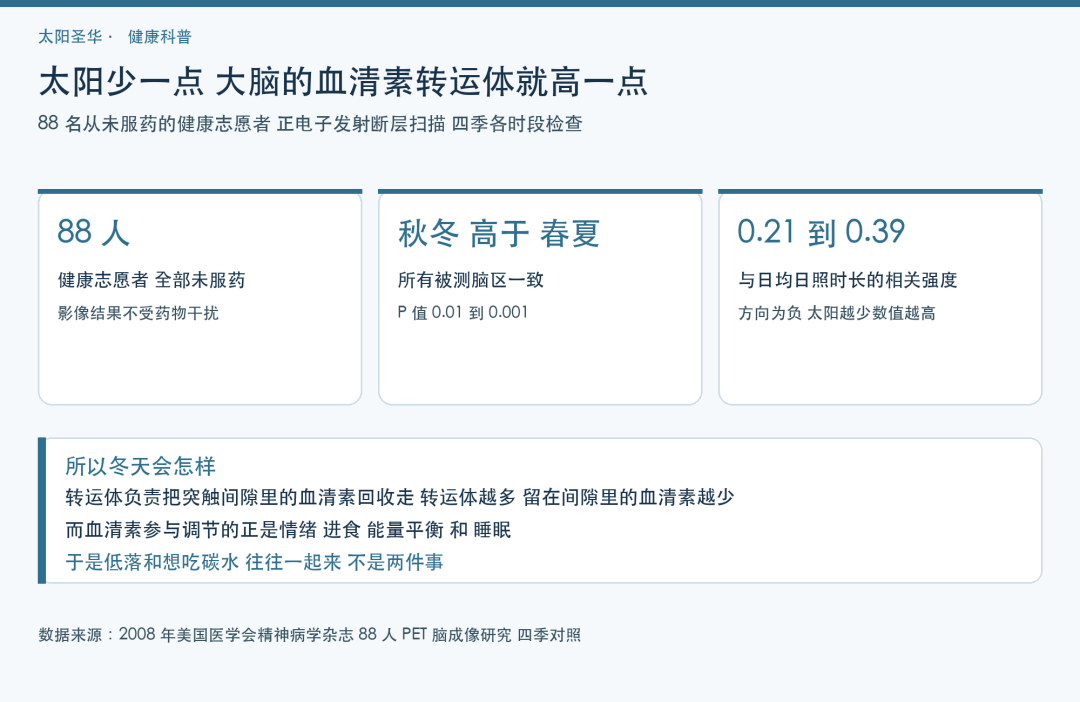
Image caption: Brain imaging of 88 people shows that serotonin transporter binding potential in autumn and winter is significantly higher than in spring and summer, and is negatively correlated with daylight duration.
Two new analyses put light at the forefront
A July 2025 network meta-analysis in Medicine pooled 17 randomized trials with 773 participants, comparing four types of visible light: white light showed greater improvement than the other three, and usual care outperformed green light[5]; another 2024 analysis in the Journal of Affective Disorders including 21 trials and 1,037 participants pointed in the same direction—light therapy was significantly better than other interventions and controls[4]. Light isn't just a "feeling"—it can change physiological markers.
The key 88 people: the less sun, the more transporters
A 2008 study in the Archives of General Psychiatry with a very clean design: 88 healthy volunteers who had never taken psychiatric medication underwent brain scans to measure serotonin transporter binding potential in various brain regions. Those scanned in autumn and winter had significantly higher levels in all measured brain regions than those scanned in spring and summer (P values 0.01 to 0.001); the values were negatively correlated with average daily sunlight duration before the scan (correlation coefficients 0.21 to 0.39)—the less sun, the higher the levels[2].
The job of the transporter is to recycle serotonin from the synaptic gap—the more transporters, the less serotonin remains in the gap, and serotonin is involved in mood, eating, energy balance, and sleep[2]. This is why that indescribable low mood in winter always comes bundled with "wanting something hot and hearty": they're not two separate things—it's one system being pushed in the same direction.
What people eat more of in winter is starchy food, not sugar
In 1988, a team in Basel, Switzerland, had patients with seasonal mood problems and healthy controls fill out a food frequency questionnaire once each in spring, summer, autumn, and winter[3].
The results were specific: patients ate starchy foods more frequently than controls, with a clear seasonal rhythm—more in winter, less in summer; high-protein foods were consumed equally by both groups with no seasonal variation; and patients actually had more meals per day.
But in the same study, the two groups showed no significant overall seasonal changes in weight or body mass index[3]. A change in eating patterns doesn't necessarily mean weight will follow: what really determines winter weight is total intake, activity level, and sleep combined—which is also why simply "cutting carbs" often doesn't work.
This isn't being dramatic, and it's not rare
Prevalence across 20 population studies ranged from 0% to 9.7%; except for one, all prospective studies found that mood varies with season and depressive symptoms peak in winter, and it's more common at higher latitudes[1]. The direction is consistent: seasons really do affect mood, and this has nothing to do with how tough you are.
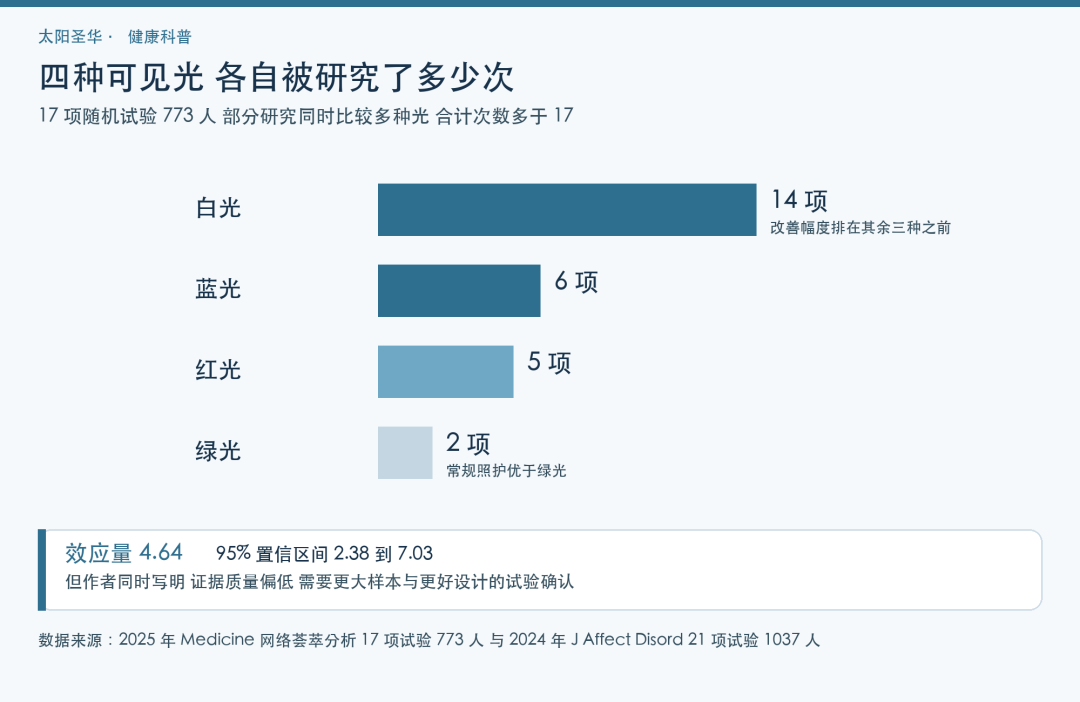
Image caption: How many times each of the four types of visible light has been studied, and the ranking direction given by the two analyses.
Light therapy works, but don't treat it as a cure-all
Effect size 4.64, 95% confidence interval 2.38 to 7.03—the numbers are striking, but the authors also noted that the quality of evidence is low and that larger, better-designed trials are needed to confirm[4]. "Effective, but evidence isn't solid" is the most honest reading: you can try it, but don't mythologize it; if it's already affecting work and daily life, see a doctor—don't just tough it out with a lamp on your own.
Four things you can do without buying a lamp
1. Schedule light exposure into your morning. Go outside within an hour of waking for ten to twenty minutes—even on cloudy days it's much brighter than indoors; ordinary indoor lighting and daylight aren't on the same scale.
2. A fixed wake-up time matters more than a fixed bedtime. The biological clock sets itself by that morning light—sleeping in more than two hours on weekends is like giving yourself jet lag once a week.
3. When you crave carbs, eat hot starchy foods—don't use sweets to soothe your mood. Sweets spike fast and crash fast, making you want more and more.
4. If low mood lasts more than two weeks and clearly affects work or relationships, get evaluated by a mental health professional. Don't self-medicate, and don't replace a doctor's visit with "getting more sun."
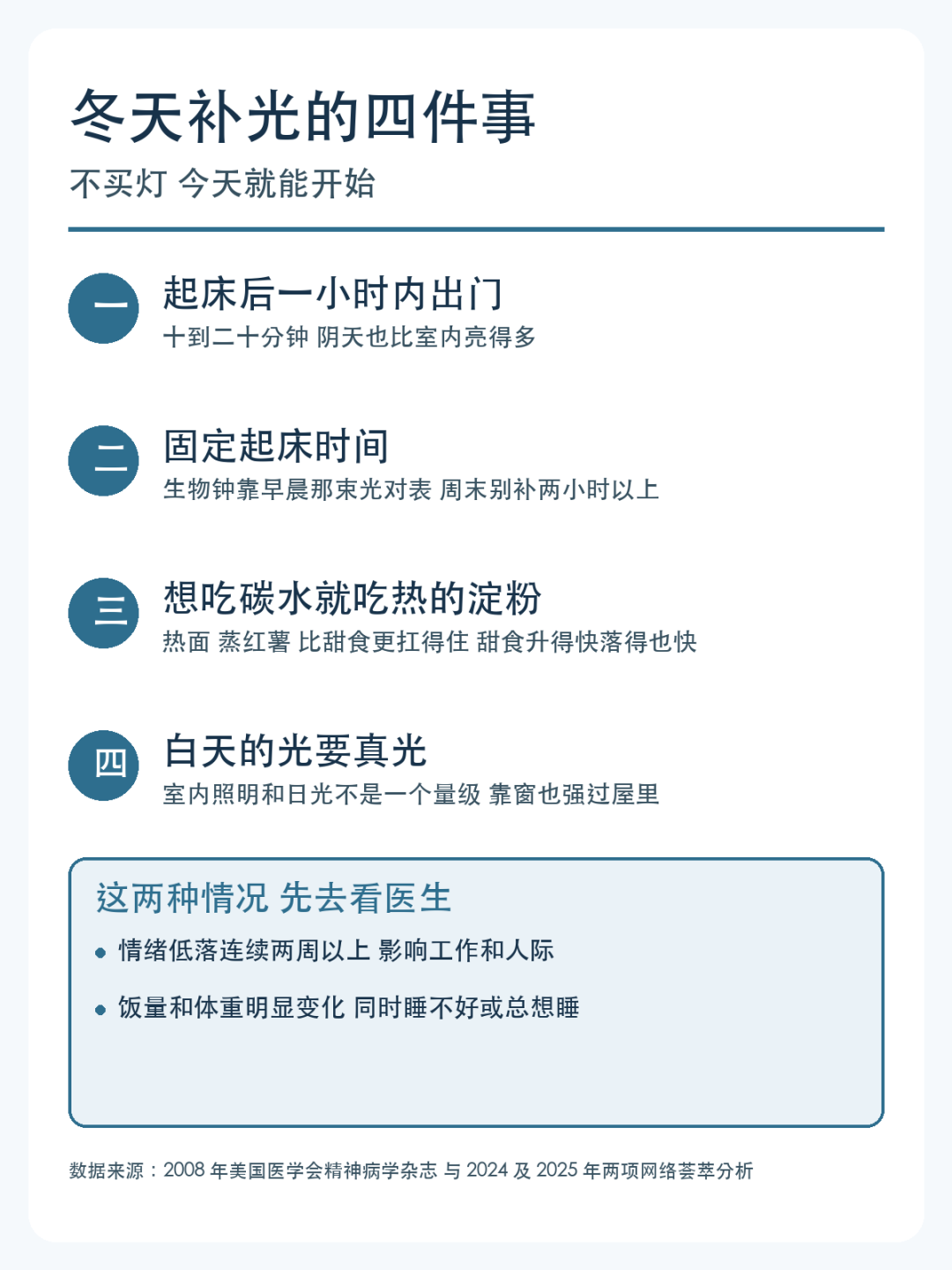
Image caption: Four ways to restore light exposure, and two situations where you must see a doctor first.
In closing
Craving a bowl of hot noodles in winter isn't you failing to control yourself—it's your brain following the old rules after light decreases.
What you can change isn't "whether you want to eat," but how much light you get during the day, what time you go to bed at night, and what you actually eat when you do.
If someone around you gets low in winter, eats more, and always blames themselves—share this with them. They think they're fighting themselves, but they're actually fighting the season.
If this was helpful, give it a like or a "reading," and feel free to leave a comment telling us what topics you'd like to see.
✦
Disclaimer: This article is for health education and informational purposes only. It does not constitute medical advice; please consult a professional doctor if you have any health concerns.
Conflict of interest statement: This article does not involve any product or drug recommendations, and has no conflict of interest with the research institutions and authors mentioned.
© 2026 Taiyang Shenghua (Beijing) Medical Technology Co., Ltd.
References
[1] Magnusson A. An overview of epidemiological studies on seasonal affective disorder. Acta Psychiatr Scand. 2000;101(3):176-184. PMID: 10721866
[2] Praschak-Rieder N, Willeit M, Wilson AA, et al. Seasonal variation in human brain serotonin transporter binding. Arch Gen Psychiatry. 2008;65(9):1072-1078. PMID: 18762593
[3] Kräuchi K, Wirz-Justice A. The four seasons: food intake frequency in seasonal affective disorder in the course of a year. Psychiatry Res. 1988;25(3):323-338. PMID: 3186862
[4] Chen ZW, Zhang XF, Tu ZM. Treatment measures for seasonal affective disorder: A network meta-analysis. J Affect Disord. 2024;350:531-536. PMID: 38220102
[5] Wan Y, Ding J, Fan M, et al. Effectiveness of visible light for seasonal affective disorder: A systematic review and network meta-analysis. Medicine (Baltimore). 2025;104(27):e43107. PMID: 40629637