Cold Hands and Feet Every Winter? 5 Questions Explain the Real Reasons
This article is for health education and informational purposes only. It does not constitute medical advice; please consult a professional doctor for any health concerns.
Once October passes, the office splits into two camps: one still in a single layer of clothing, the other armed with gloves and hot water bottles—yet their fingertips are still cold.
Many people attribute this to "poor constitution," but that explanation is too vague. Cold hands and feet are mostly the body conserving heat, but there are indeed a few conditions worth checking out. Five questions, explained at once.
First, a sense of scale. Raynaud's phenomenon (fingers turning white first, then purple, in response to cold or emotional stress) has a pooled prevalence of about 4.85% in the general population, based on a meta-analysis of 33 studies and 33,733 people; women have a 65% higher risk than men, and smokers have another 27% higher risk[2]. In other words, only a minority have genuinely pathological cold sensitivity—but a minority doesn't mean you should ignore it.
1. Are cold hands and feet a sign of "poor constitution"?
The body has one bottom line for temperature regulation: core temperature comes first. When it's cold, the body first constricts blood vessels in the skin of the hands and feet, diverting more blood back to the trunk to reduce heat loss. Fingertip temperature dropping faster than chest temperature is a byproduct of this mechanism—not a sign of bodily "weakness."
What matters is the pattern, not the sensation: if you warm up fairly quickly upon entering a warm place, if both sides are symmetric, and if there's no dramatic color change, it's most likely normal regulation. Conversely, if after half an hour in a heated room your fingers are still white, purple, or numb, or if only one hand is cold, it's worth a visit to the doctor (see the specific warning signs at the end).
2. Why is it more noticeable in women, thinner people, and those who sit for long periods?
One set of reasons is structural: women have thinner subcutaneous fat and a relatively larger body surface area, so they lose heat faster; in Raynaud's phenomenon, women's risk is 1.65 times that of men[2].
Another set of reasons involves the "heat-generating engine." Muscle is the body's biggest energy consumer at rest: imaging measurements in 26 non-obese adults showed a correlation coefficient of 0.89 between muscle mass and resting energy expenditure, with fat-free mass explaining 85% of individual variation[6]. People with less muscle have a weaker ability to generate their own heat and feel colder at the same temperature; sitting in a chair all day without moving your legs lowers heat production even further.
3. Could it be iron deficiency or anemia?
This one has specific data from a human trial. Eleven women reduced their iron stores to low levels through dietary restriction and blood draws (hemoglobin 12.0 g/dL, ferritin 5.5 ng/mL—not low enough to qualify as obvious anemia on a lab report), then were exposed to a 16°C environment: heat production dropped from 53.6 W/m² to 49.6 W/m², both core and peripheral temperatures fell faster, and shivering began sooner[1].
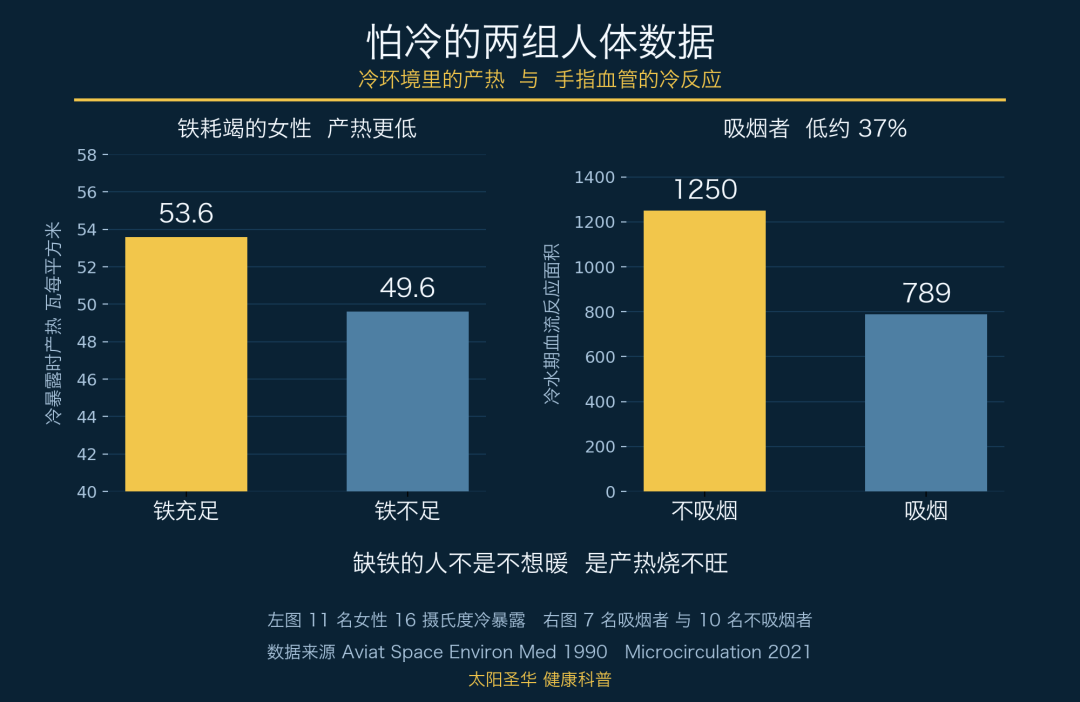
In plain terms: iron helps hemoglobin carry oxygen, and when oxygen supply is compromised, the body's furnace can't burn as hot. So women who are chronically cold-sensitive, easily fatigued, pale, and have heavy periods should get a complete blood count plus ferritin test; but don't take iron supplements long-term on your own—over-supplementation is also problematic.
4. Thyroid and smoking—which is more worth checking?
Clinical hypothyroidism affects roughly 1 in 300 people in the population, more common in women and older adults, and cold intolerance is one of its typical manifestations[4]. But a caveat: a 2024 Lancet review noted that about 10% of hypothyroidism patients still have persistent symptoms even after lab values return to normal[5]. So don't draw conclusions from a single lab test or a box of supplements—leave abnormal thyroid-stimulating hormone levels to an endocrinologist to evaluate.
Smoking is often overlooked. Seven smokers who smoked 12 or more cigarettes daily immersed their hands in 5°C cold water; the time for finger blood vessels to re-dilate was 4.5 minutes, versus 3.3 minutes in non-smokers; the blood flow response area over the entire cold-water period was 789 in smokers versus 1250 in non-smokers—about 37% lower[3]. And after 16 hours of abstinence plus a nicotine patch, this gap was not closed—indicating that nicotine's effect on peripheral blood vessels is chronic.
5. What actually helps warm up your hands?
The principle comes down to four words: generate more heat, lose less heat.
-
Train large muscle groups. Legs and glutes are the body's largest muscle groups—once they start moving, they're heat generators. 10 minutes of wall sits, stair stepping, or brisk walking produces heat through muscle contraction far faster than rubbing your hands together
-
Eat enough protein and iron-containing foods. Red meat, animal blood products, legumes, paired with vitamin C-rich fruits and vegetables; washing down meals with strong tea or coffee impairs iron absorption
-
Quit smoking or at least cut down. The evidence is in the data from the previous section
-
Keep extremities warm. Gloves, thick socks, shoes that don't squeeze your feet; avoid soaking hands in very hot water for long periods—you'll feel colder afterward
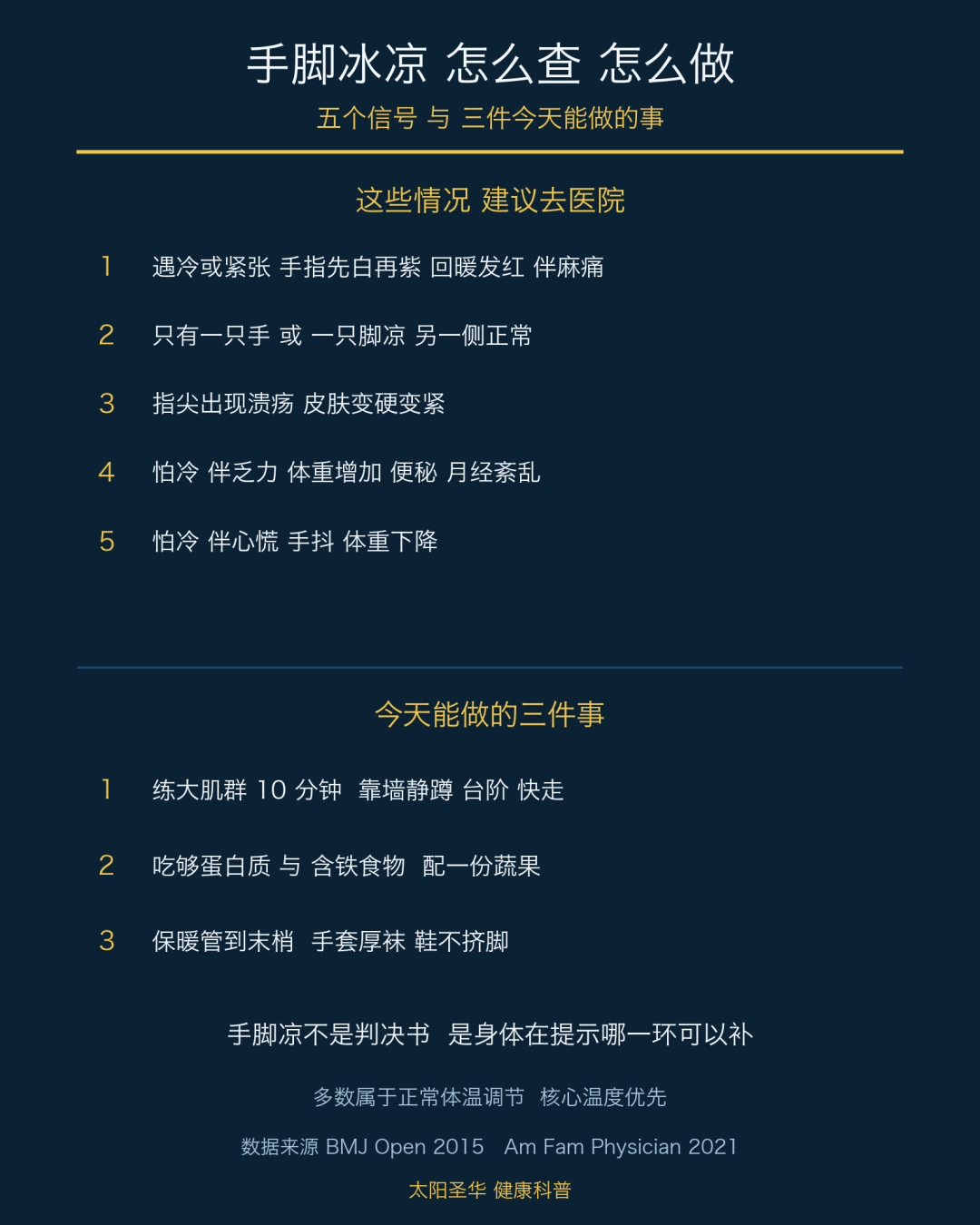
See a doctor if you have these signs
-
Fingers turn white first, then purple, then red upon warming, accompanied by numbness and pain when exposed to cold or stress
-
Only one hand or one foot is cold while the other side is completely normal
-
Ulcers appear on fingertips, or skin becomes hard and tight
-
Cold sensitivity accompanied by obvious fatigue, weight gain, constipation, or menstrual irregularities
-
Cold sensitivity accompanied by palpitations, hand tremors, or weight loss (the opposite direction, but equally worth checking)
One thing you can do today
Tonight before bed, do 10 minutes of wall sits or high knees in place to warm up your large muscle groups; put tomorrow's thick socks and gloves by the door. Pick one of these three to start—it's better than just hugging a hot water bottle.
Cold hands and feet are not a verdict on your constitution. They're more like the body's hint: which link can be strengthened—is it muscle, iron, thyroid, or that one cigarette?
If this was helpful, give it a like or a "reading" click, and feel free to leave a comment telling us what topics you'd like to see.
Disclaimer: This article is for health education and informational purposes only. It does not constitute medical advice; please consult a professional doctor for any health concerns.
Conflict of interest statement: This article does not involve any drug or product recommendations and has no financial relationship with the research institutions mentioned.
© 2026 Sunsheng Hua (Beijing) Medical Technology Co., Ltd.
References
[1] Lukaski HC, et al. Thermogenesis and thermoregulatory function of iron-deficient women without anemia. Aviat Space Environ Med. 1990;61(10):913-920. PMID: 2241732
[2] Garner R, et al. Prevalence, risk factors and associations of primary Raynaud's phenomenon: systematic review and meta-analysis of observational studies. BMJ Open. 2015;5(3):e006389. PMID: 25776043
[3] Lee K, et al. Cold-induced vasodilation in abstinent smokers with and without a 12-hour nicotine patch. Microcirculation. 2021;28(6):e12701. PMID: 33866635
[4] Wilson SA, et al. Hypothyroidism: Diagnosis and Treatment. Am Fam Physician. 2021;103(10):605-613. PMID: 33983002
[5] Taylor PN, et al. Hypothyroidism. Lancet. 2024;404(10460):1347-1364. PMID: 39368843
[6] Illner K, et al. Metabolically active components of fat free mass and resting energy expenditure in nonobese adults. Am J Physiol Endocrinol Metab. 2000;278(2):E308-E315. PMID: 10662716