Catch a cold every time the seasons change? 4 habits are dragging down your immune defenses
This article is for health education purposes only and is intended for informational reference; it does not constitute medical advice. If you have health concerns, please consult a professional physician.
Every autumn rain brings a chill. With dropping temperatures, the start of school, and crowds gathering, the seasonal peak of respiratory infections arrives right along with it.
Why is it that in the same office, some people never catch a cold all year, while others get sick three times a year? The answer isn't only in the virus—it's also in how you live each day.
Habit 1: Not enough sleep, and the defenses loosen first
164 healthy adults first wore wristbands for 7 consecutive days to record their sleep, then had rhinovirus dripped into their noses, and were subsequently isolated and observed for 5 days[1].
The results: people who slept less than 5 hours had 4.5 times the risk of developing a clinical cold compared with those who slept 7 hours or more; those who slept 5 to 6 hours had 4.2 times the risk[1].
The effect of insufficient sleep on immunity can also be seen with vaccines. 125 adults aged 40 to 60 received 3 doses of hepatitis B vaccine, and wristband records showed that the shorter a person's sleep, the lower the proportion who reached clinically protective levels after vaccination[2].
In plain terms: the late nights you pull—your immune system keeps a record of every one.
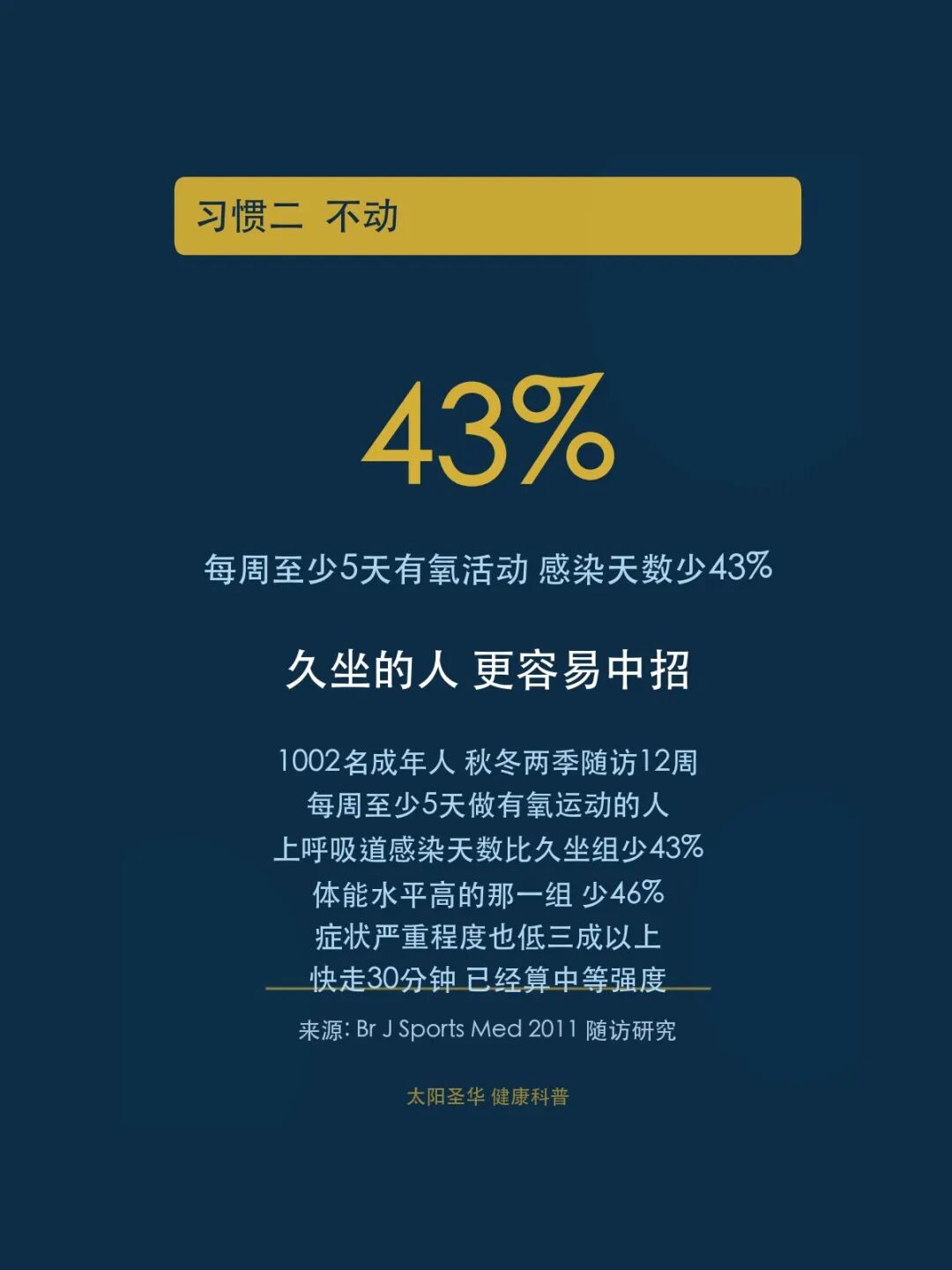
Habit 2: Not moving makes you more likely to get sick
1002 adults aged 18 to 85 were followed for 12 weeks during the autumn and winter seasons[3]. People who did aerobic exercise at least 5 days a week had 43% fewer days with upper respiratory tract infection symptoms than those who barely exercised; the group with higher fitness levels had 46% fewer days, and symptom severity was also more than 30% lower[3].
In plain terms: you don't need to train like an athlete. A brisk 30-minute walk every day, 5 days a week, is already lightening the load on your immune system.
Habit 3: Long-term stress also loosens the defenses
394 healthy people first filled out a psychological stress questionnaire, then were exposed to one of 5 respiratory viruses, and were then isolated and observed[4]. Grouped by stress from low to high, the incidence of clinical colds rose from about 27% to about 47%, and the infection rate rose from about 74% to about 90%—the higher the stress, the more likely people were to actually get sick[4].
In plain terms: people who are chronically tense are more likely to be defeated by viruses. Stress management isn't mysticism—it's an investment in immunity.
Habit 4: Too few relationships, and resistance is weaker too
276 volunteers aged 18 to 55 reported their level of participation in 12 types of social relationships—family, friends, coworkers, and community all counted—and were then exposed to rhinovirus[5]. People with more types of social relationships were less likely to catch colds, and their nasal mucosa cleared the virus more efficiently; meanwhile, among people with only 1 to 3 types of relationships, after adjusting for multiple confounding factors, the risk of catching a cold was 4.2 times that of those with 6 or more types of relationships[5].
In plain terms: don't shut yourself away in autumn and winter—a meal together or a walk together counts.
Protecting your immunity during seasonal changes: 4 things you can do today
- Get 7 hours of sleep, and don't let weekends and weekdays differ too much.
- Do 30 minutes of moderate-intensity exercise 5 days a week—a brisk walk is enough.
- Set aside 10 minutes a day to clear your mind, or chat with someone you know.
- If you already have a cold: 7 randomized trials involving 575 people showed that zinc lozenges shortened the course of illness by about one-third on average (95% confidence interval 21% to 45%)[6]. The formulation and dosage matter, so consult a doctor before use; long-term high-dose use is not recommended.
Immunity rarely collapses overnight—it's usually worn down day by day by habits. Share this with that person who catches something every time the seasons change, and have one fewer illness this autumn.
If this was helpful to you, give it a like or a "Wow," and feel free to leave a comment telling us what topics you'd like to see.
Disclaimer: This article is for health education purposes only and is intended for informational reference; it does not constitute medical advice. If you have health concerns, please consult a professional physician.
Declaration of interests: This article does not involve any recommendation of medications or health supplements, and has no conflicts of interest with the research institutions mentioned in the text.
© 2026 太阳圣华(北京)医疗科技有限公司
References
[1] Prather AA, Janicki-Deverts D, Hall MH, Cohen S. Behaviorally Assessed Sleep and Susceptibility to the Common Cold. Sleep. 2015 Sep 1;38(9):1353-9. PMID:26118561
[2] Prather AA, Hall M, Fury JM, et al. Sleep and antibody response to hepatitis B vaccination. Sleep. 2012 Aug 1;35(8):1063-9. PMID:22851802
[3] Nieman DC, Henson DA, Austin MD, Sha W. Upper respiratory tract infection is reduced in physically fit and active adults. Br J Sports Med. 2011 Sep;45(12):987-92. PMID:21041243
[4] Cohen S, Tyrrell DA, Smith AP. Psychological stress and susceptibility to the common cold. N Engl J Med. 1991 Aug 29;325(9):606-12. PMID:1713648
[5] Cohen S, Doyle WJ, Skoner DP, Rabin BS, Gwaltney JM Jr. Social ties and susceptibility to the common cold. JAMA. 1997 Jun 25;277(24):1940-4. PMID:9200634
[6] Hemilä H. Zinc lozenges and the common cold: a meta-analysis comparing zinc acetate and zinc gluconate, and the role of zinc dosage. JRSM Open. 2017 May 2;8(5):2054270417694291. PMID:28515951