Feeling Sluggish Every Autumn? 5 Questions That Explain "Autumn Fatigue" and How to Beat It
This article is for health education purposes only and is intended for informational reference; it does not constitute medical advice. If you have health concerns, please consult a professional doctor.
✦ ✦ ✦
The alarm goes off three times and you still can't get up, your eyelids droop at noon, and you find yourself nodding off at the screen all afternoon—many people blame this on "autumn fatigue." Is it really the season's fault, or is it your habits?
First, the conclusion: "autumn fatigue" is not a disease. It is mostly a normal response of your body clock, diet, and sleep habits to the change of seasons. But there are indeed ways to break down tiredness and drowsiness using research evidence.
A fascinating human trial conducted in the UK: 16 healthy people were given isocaloric high-fat and high-carbohydrate meals under standardized conditions. Post-meal sleepiness increased significantly after both meals, and the speed of falling asleep 1.5 hours after eating was markedly faster—regardless of whether the meal was heavy on fat or heavy on carbs[1]. In other words, afternoon drowsiness is a universal physiological phenomenon. Don't blame that piece of braised pork.
The following 5 frequently asked questions explain "autumn fatigue" in one go.
Question 1: Feeling sleepy as soon as autumn arrives—is something wrong with my body?
No. After autumn begins, daylight hours shorten and morning and evening light weakens, so the body clock and melatonin secretion rhythm need to readjust. Add to that the sleep debt accumulated during summer surfacing during the seasonal transition, and drowsiness and reduced concentration are very common.
The key to coping is not to "tough it out," but to fix the time you expose yourself to bright light after waking, so your body clock knows "it's daytime now."
Question 2: After lunch I'm so sleepy I can't keep my eyes open—can I skip the nap?
Yes, but you need to understand the principle. One to two hours after a meal is naturally the lowest point of alertness in the day. Drowsiness comes from the combination of post-meal physiological fluctuations and circadian rhythms. Skipping a meal won't solve the problem—what matters is how you arrange the time that follows.
Two proven effective options: take a 10-minute power nap, or take a walk in a bright place after eating.
An Australian study had 24 young people who had slept only about 5 hours the previous night take naps of 5, 10, 20, and 30 minutes respectively: after a 10-minute nap, subjective sleepiness, fatigue, vigor, and cognitive performance improved immediately, with some effects lasting up to 155 minutes; while a 30-minute nap left people groggier for a period after waking—known as "sleep inertia"[3].
In plain terms: it's fine to doze at your desk for a bit—set a 10-minute alarm, don't let it turn into a half-hour sleep.
Question 3: Drinking coffee to stay alert—what happens if you get the timing wrong?
Coffee can block drowsiness, but if you drink it at the wrong time, you'll pay for it with your night's sleep. A double-blind placebo-controlled study found that consuming caffeine equivalent to a double espresso dose 3 hours before habitual bedtime delayed the body's melatonin rhythm by about 40 minutes—and melatonin is the signal that tells the body "time to sleep"[2].
This means relying on coffee to survive the afternoon makes it harder to fall asleep that night, making you even more tired the next day—a vicious cycle.
Recommendation: If you're sensitive to caffeine or often complain about poor sleep at night, make your last cup of coffee before 3 PM. When you're already desperately sleepy, prioritize sunlight, walking around, or a 10-minute nap.
Question 4: I have an important meeting this afternoon—is there a way to wake up immediately?
Exposure to light is more effective than forcing yourself to stay awake. A trial at Monash University in Australia had subjects sleep only 5 hours for two consecutive nights. On the second day, one group received 1000 lux of bright light from noon to 5 PM, while the other group stayed in dim light below 5 lux all day: the bright light group showed significantly reduced subjective sleepiness and performed better on reaction time tests[4].
1000 lux is roughly equivalent to indoor brightness near a window during the day; outdoors on a cloudy day is often brighter.
Three things you can do right away: take a 10-minute outdoor walk after lunch; sit near a window in the office; stand in a bright place for a few minutes before a meeting. When the body receives the "bright light" signal, alertness is directly boosted.
Question 5: I feel tired every day—besides not getting enough sleep, what else could be the cause?
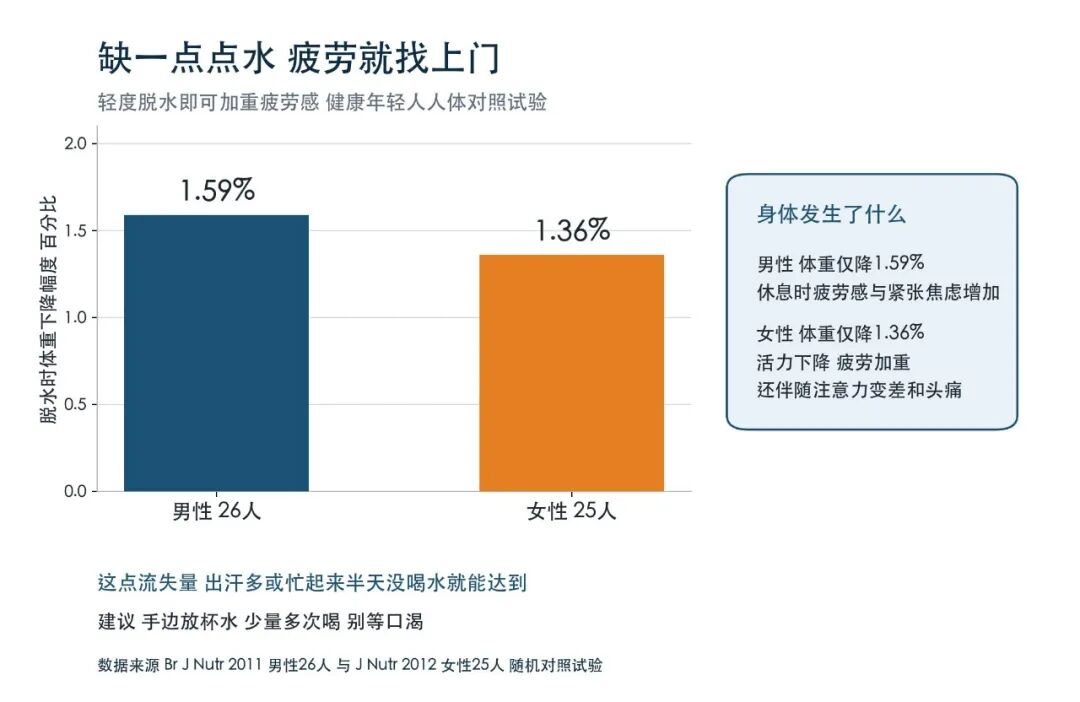
First, check your water glass. Two controlled trials in the US induced mild dehydration in 26 men and 25 healthy young women respectively: when men lost only about 1.59% of body weight, fatigue and tension/anxiety at rest increased significantly[6]; when women lost about 1.36% of body weight, vigor decreased, fatigue worsened, and attention declined along with headaches[7].
This level of fluid loss can be reached in half a day if you sweat a lot or forget to drink water when busy.
Another counterintuitive answer: the more sedentary and chronically tired you are, the more you need to move. A US randomized controlled trial assigned 36 sedentary young people with chronic fatigue but no illness to 6 weeks of exercise training, 3 times per week: both low-intensity and moderate-intensity exercise improved feelings of vigor, while the low-intensity group performed better at reducing fatigue—and the effect was independent of whether fitness improved[5].
In plain terms: when you're tired, don't just think about lying down. Non-strenuous exercise like brisk walking or cycling is actually a way to "recharge."
Four Things You Can Start Today
- Within 30 minutes of waking, get some natural light—even just standing by a window for a few minutes.
- After lunch, choose one: take a 10-minute outdoor walk, or set a 10-minute nap timer—don't exceed 20 minutes.
- Make your last cup of coffee before 3 PM; if you sleep poorly at night, move it even earlier.
- Keep a glass of water nearby and drink in small amounts throughout the day; schedule light exercise 3 times a week for at least 20 minutes each session.
The sleepiness that comes with a change of seasons is mostly not laziness—it's your body reminding you that light, sleep, water, and exercise need to be rearranged. Following your rhythm and doing these few small things is far more effective than downing two cups of coffee.
We suggest saving this "autumn fatigue coping checklist," and forwarding it to family members and colleagues who always feel sleepy in the afternoon.
If it helps you, give it a like or a "Wow," and feel free to leave a comment telling us what topics you'd like to see.
✦ ✦ ✦
References
[1] Wells AS, Read NW, Idzikowski C, Jones J. Effects of meals on objective and subjective measures of daytime sleepiness. J Appl Physiol (1985). 1998;84(2):507-515. PMID: 9475860
[2] Burke TM, Markwald RR, McHill AW, et al. Effects of caffeine on the human circadian clock in vivo and in vitro. Sci Transl Med. 2015;7(305):305ra146. PMID: 26378246
[3] Brooks A, Lack L. A brief afternoon nap following nocturnal sleep restriction: which nap duration is most recuperative? Sleep. 2006;29(6):831-840. PMID: 16796222
[4] Phipps-Nelson J, Redman JR, Dijk DJ, Rajaratnam SM. Daytime exposure to bright light, as compared to dim light, decreases sleepiness and improves psychomotor vigilance performance. Sleep. 2003;26(6):695-700. PMID: 14572122
[5] Puetz TW, Flowers SS, O'Connor PJ. A randomized controlled trial of the effect of aerobic exercise training on feelings of energy and fatigue in sedentary young adults with persistent fatigue. Psychother Psychosom. 2008;77(3):167-174. PMID: 18277063
[6] Ganio MS, Armstrong LE, Casa DJ, et al. Mild dehydration impairs cognitive performance and mood of men. Br J Nutr. 2011;106(10):1535-1543. PMID: 21736786
[7] Armstrong LE, Ganio MS, Casa DJ, et al. Mild dehydration affects mood in healthy young women. J Nutr. 2012;142(2):382-388. PMID: 22190027
✦ ✦ ✦
Disclaimer: This article is for health education purposes only and is intended for informational reference; it does not constitute medical advice. If you have health concerns, please consult a professional doctor.
Conflict of interest statement: This article does not involve any drug recommendations and has no conflict of interest with the research institutions mentioned in the text.
© 2026 Sun Sheng Hua (Beijing) Medical Technology Co., Ltd.