Cramming a Week's Exercise Into the Weekend: How Much Does the Benefit Drop? Data From 90,000 People With Wearables
This article is health education for informational purposes only and does not constitute medical advice; if you have health concerns, please consult a professional doctor.
Monday through Friday, from home to desk to sofa, you don't even walk 3,000 steps a day.
Saturday morning you make up for it with a game of ball, Sunday you go hiking, and at night your legs ache so much you can't sleep.
Many people quietly wonder: does this count—cramming it all into the weekend?
Now there's an answer, and it's better than most people think.
First, let's be clear about how this pattern is defined
The World Health Organization recommends that adults get 150 to 300 minutes of moderate-intensity activity per week, or 75 to 150 minutes of vigorous-intensity activity [6]. Brisk walking, cycling, and mopping the floor all count as moderate intensity.
A UK study put a wearable on 89,573 middle-aged and older adults for one week, then divided them into three groups based on how their activity was distributed [1]. Those who hit the weekly total of 150 minutes with more than half of it concentrated in 1 to 2 days were called weekend warriors; those who hit the total but spread it over three or more days were the regular-activity group; those who didn't hit the total were the inactive group.
The results were a bit surprising: weekend warriors made up 42.2% of this sample, the regular-activity group only 24.0%, and the remaining 33.7% didn't get enough exercise in a week [1].

1. On the heart front, the two groups are nearly neck and neck
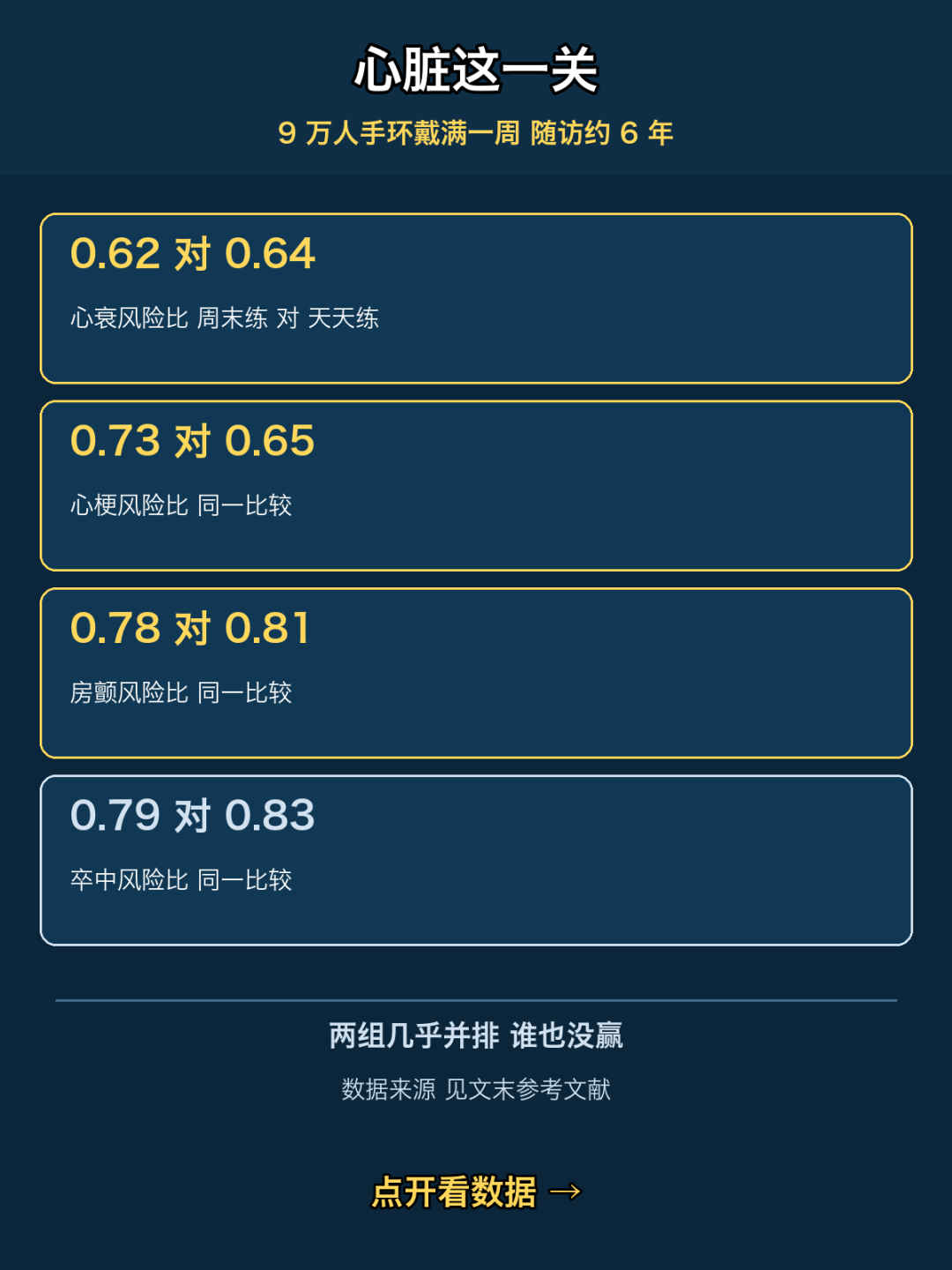
Again these 89,573 people, followed for a median of about 6 years, looking at four types of cardiovascular events [1].
Compared with those who didn't get enough exercise in a week, the weekend warrior group's heart failure hazard ratio was 0.62, and the regular-activity group's was 0.64; heart attack 0.73 vs 0.65; atrial fibrillation 0.78 vs 0.81; stroke 0.79 vs 0.83.
Put the four sets of numbers side by side, and the direction is consistent and the magnitude is similar—neither can be said to clearly beat the other. The researchers' conclusion was blunt: concentrating activity into 1 to 2 days and spreading it more evenly across the week are associated similarly with cardiovascular outcomes [1].
In other words, not being able to squeeze out time on weekdays doesn't mean the week was wasted.
2. Going through all 678 diseases one by one
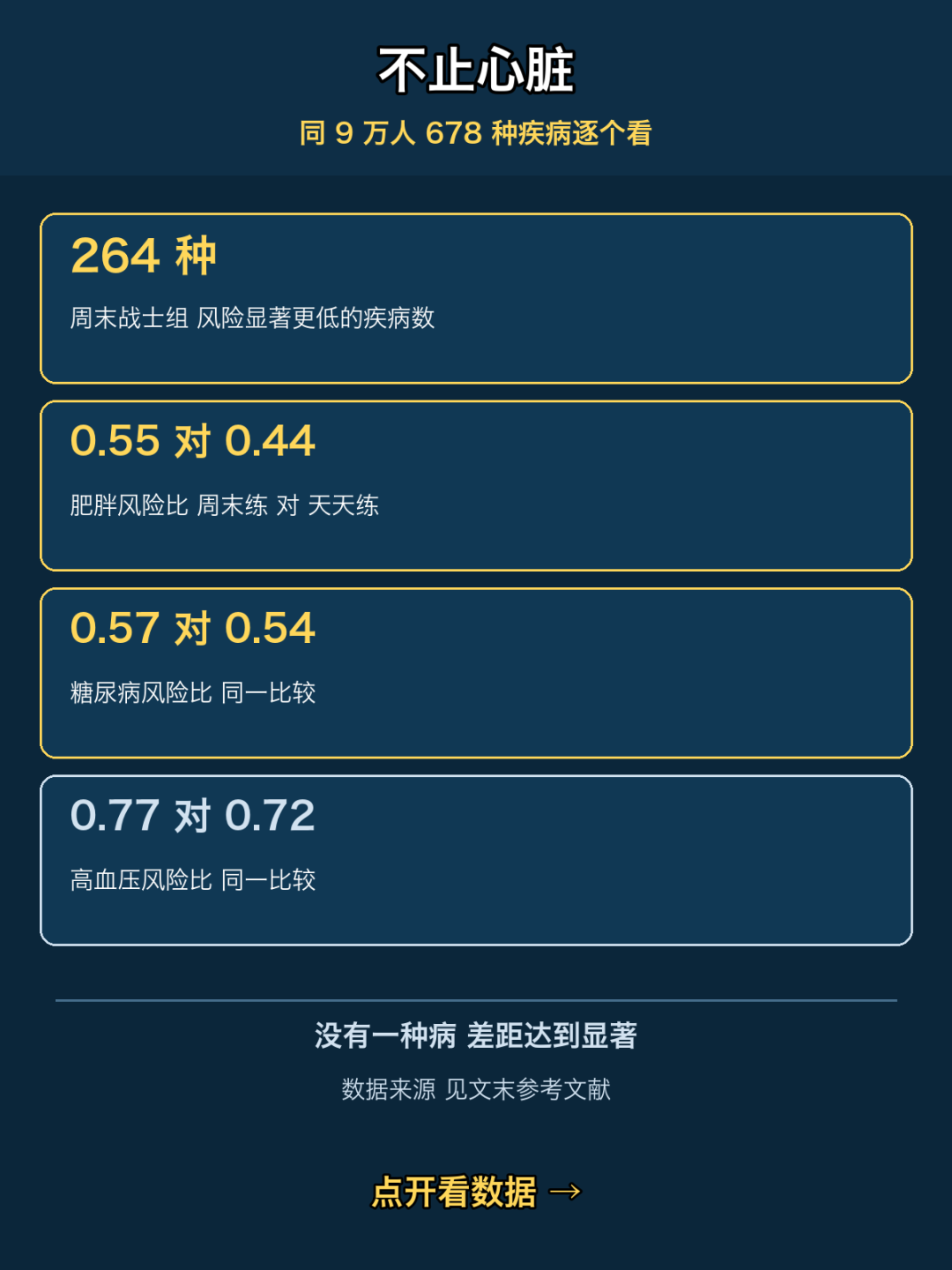
The second study used the same group of people but took a different approach: instead of just looking at the heart, it went through all 678 diseases [2].
Compared with the inactive group, the weekend warrior group had a significantly lower risk for 264 diseases; the regular-activity group, 205. The larger gaps clustered in the metabolic category—obesity hazard ratio 0.55 vs 0.44, diabetes 0.57 vs 0.54, hypertension 0.77 vs 0.72, sleep apnea 0.57 vs 0.49 [2].
Note the second half: comparing the two groups directly, not a single disease showed a statistically significant difference [2]. The regular-activity group was slightly ahead on metabolic indicators, but not enough to say that "you have to exercise every day for it to count."
3. On mortality risk, the evidence isn't fully consistent
There are two large-sample studies whose conclusions aren't entirely the same, and that has to be stated honestly.
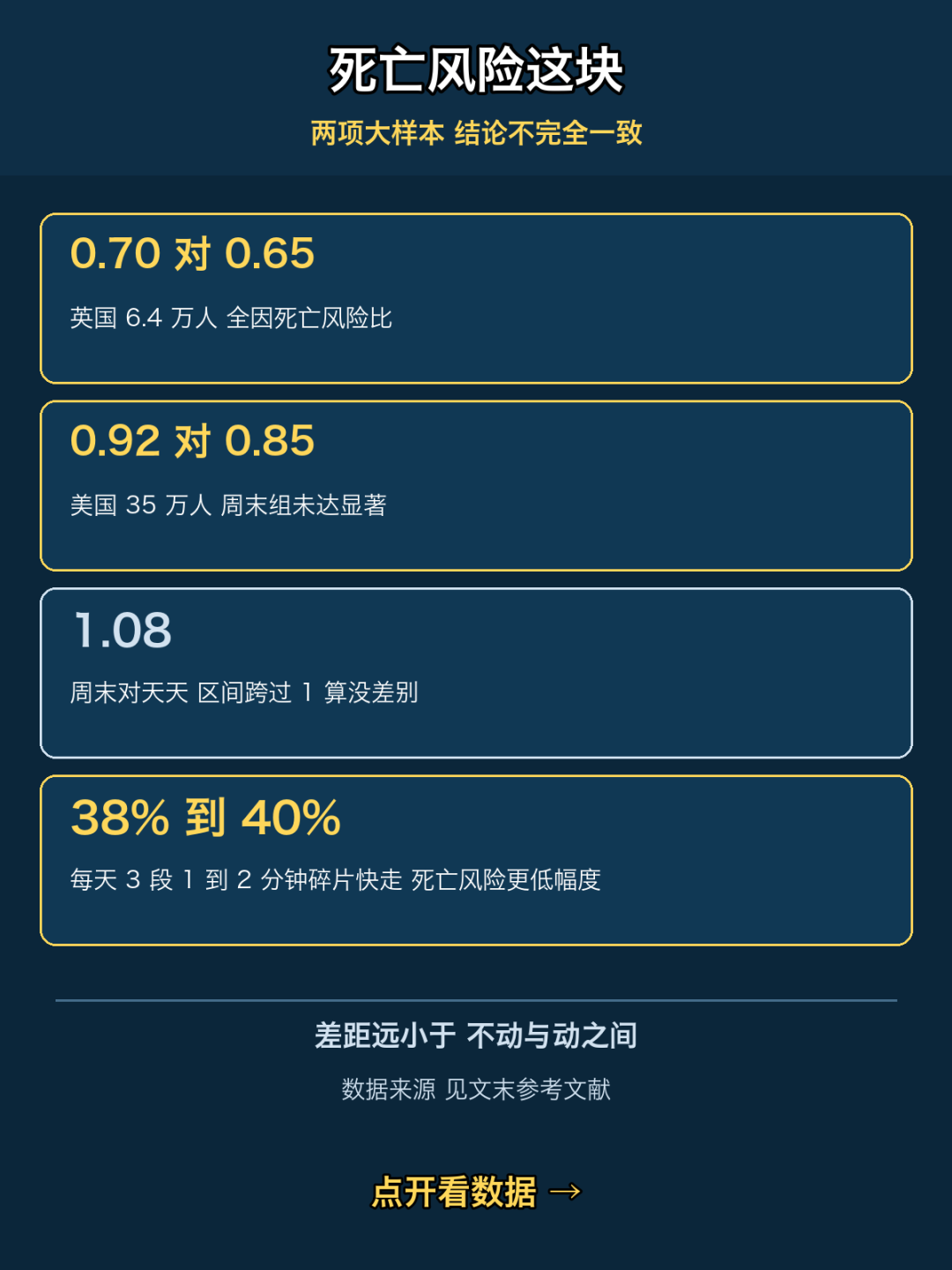
In a UK follow-up of 63,591 adults over 40, with 561,159 person-years, compared with the inactive group, the weekend warrior group's all-cause mortality hazard ratio was 0.70, and the regular-activity group's was 0.65; for cardiovascular death, both groups were 0.60 [3].
In the US study of 350,978 adults with a median follow-up of 10.4 years, the weekend warrior group's all-cause mortality hazard ratio was 0.92, with a confidence interval of 0.83 to 1.02, which did not cross the significance line; the regular-activity group was 0.85, which was significant. The hazard ratio for the direct comparison between the two groups was 1.08, with an interval of 0.97 to 1.20, indicating that when total activity volume is equivalent, the two patterns show no significant difference in mortality risk [4].
So the more prudent way to put it is: cramming exercise into the weekend does deliver real benefits, but may be slightly smaller than exercising every day; that gap is far smaller than the gap between "not moving at all" and "getting moving."
There's also some supplementary evidence. In 25,241 Britons who never exercised, wearing wearables, just 3 bouts per day of 1 to 2 minutes each of short bursts of exertion like brisk walking or stair climbing was associated with a 38% to 40% lower all-cause mortality risk and a 48% to 49% lower cardiovascular mortality risk [5].
You don't even need to carve out a whole block of time—a few minutes squeezed out of the day counts too.
4. Cramming exercise into the weekend: how to train so it isn't wasted
The most common pitfall for weekend warriors isn't training too little—it's training too hard.
First, split the volume across two days. Half on Saturday and half on Sunday, with each session ideally not exceeding 90 minutes, is much safer than piling it all into one day.
Second, warm up for 10 minutes first. For people who don't usually move, suddenly getting on the field on the weekend—strains and sprains mostly happen in this cold-start phase.
Third, split it half aerobic and half strength. If you only run or only hike, your muscles and bone density don't get that benefit; add two sets of squats, push-ups, or resistance bands—twenty minutes is enough.
Fourth, don't retaliate with a volume surge. Stay within 20% more than usual, stop if there's pain, and the next day's soreness shouldn't affect walking.
Fifth, people with chronic conditions should ask their doctor first. For those whose blood pressure and blood sugar aren't stable, starting with brisk walking is safer; if you experience chest tightness, chest pain, obvious shortness of breath, or dizziness during exercise, stop immediately and seek medical care.

One honest word
The threshold for exercise has never been "every day"—it's "did you do it this week."
Two days crammed into the weekend is still far better than a week on the sofa.
Share this with that friend who can only free up time on weekends, so they can stop feeling guilty about not moving on weekdays.
If this was helpful to you, give it a like or a "reading," and feel free to leave a comment telling us what topics you'd like to see.
✦ Disclaimer: This article is health education for informational purposes only and does not constitute medical advice; if you have health concerns, please consult a professional doctor.
Conflict of interest statement: This article does not involve any product recommendations and has no financial relationship with the research institutions mentioned in the text.
© 2026 Sun Saint Hua (Beijing) Medical Technology Co., Ltd.
References
[1] Khurshid S, Al-Alusi MA, Churchill TW, Guseh JS, Ellinor PT. Accelerometer-Derived "Weekend Warrior" Physical Activity and Incident Cardiovascular Disease. JAMA. 2023;330(3):247-252. PMID: 37462704
[2] Kany S, Al-Alusi MA, Rämö JT, Pirruccello JP, Churchill TW, Lubitz SA, Maddah M, Guseh JS, Ellinor PT, Khurshid S. Associations of "Weekend Warrior" Physical Activity With Incident Disease and Cardiometabolic Health. Circulation. 2024;150(16):1236-1247. PMID: 39324186
[3] O'Donovan G, Lee IM, Hamer M, Stamatakis E. Association of "Weekend Warrior" and Other Leisure Time Physical Activity Patterns With Risks for All-Cause, Cardiovascular Disease, and Cancer Mortality. JAMA Intern Med. 2017;177(3):335-342. PMID: 28097313
[4] Dos Santos M, Ferrari G, Lee DH, Rey-López JP, Aune D, Liao B, Huang W, Nie J, Wang Y, Giovannucci E, Rezende LFM. Association of the "Weekend Warrior" and Other Leisure-time Physical Activity Patterns With All-Cause and Cause-Specific Mortality: A Nationwide Cohort Study. JAMA Intern Med. 2022;182(8):840-848. PMID: 35788615
[5] Stamatakis E, Ahmadi MN, Gill JMR, Thøgersen-Ntoumani C, Gibala MJ, Doherty A, Hamer M. Association of wearable device-measured vigorous intermittent lifestyle physical activity with mortality. Nat Med. 2022;28(12):2521-2529. PMID: 36482104
[6] Bull FC, Al-Ansari SS, Biddle S, Borodulin K, Buman MP, Cardon G, et al. World Health Organization 2020 guidelines on physical activity and sedentary behaviour. Br J Sports Med. 2020;54(24):1451-1462. PMID: 33239350