Inflammation Without a Fever: Understanding Chronic Inflammation Through 5 Numbers
This article is for health education purposes only and is intended for informational reference. It does not constitute medical advice; please consult a professional doctor for any health concerns.
There's a test on your lab report called high-sensitivity C-reactive protein. Most people glance at it and move on.
When it's elevated, it doesn't hurt or itch, and it won't give you a fever—yet it's linked to cardiovascular risk over the next decade or more.
Chronic low-grade inflammation is exactly this kind of state: the fire isn't big, but it never goes out. The 5 cards below use 5 sets of numbers to explain it clearly.
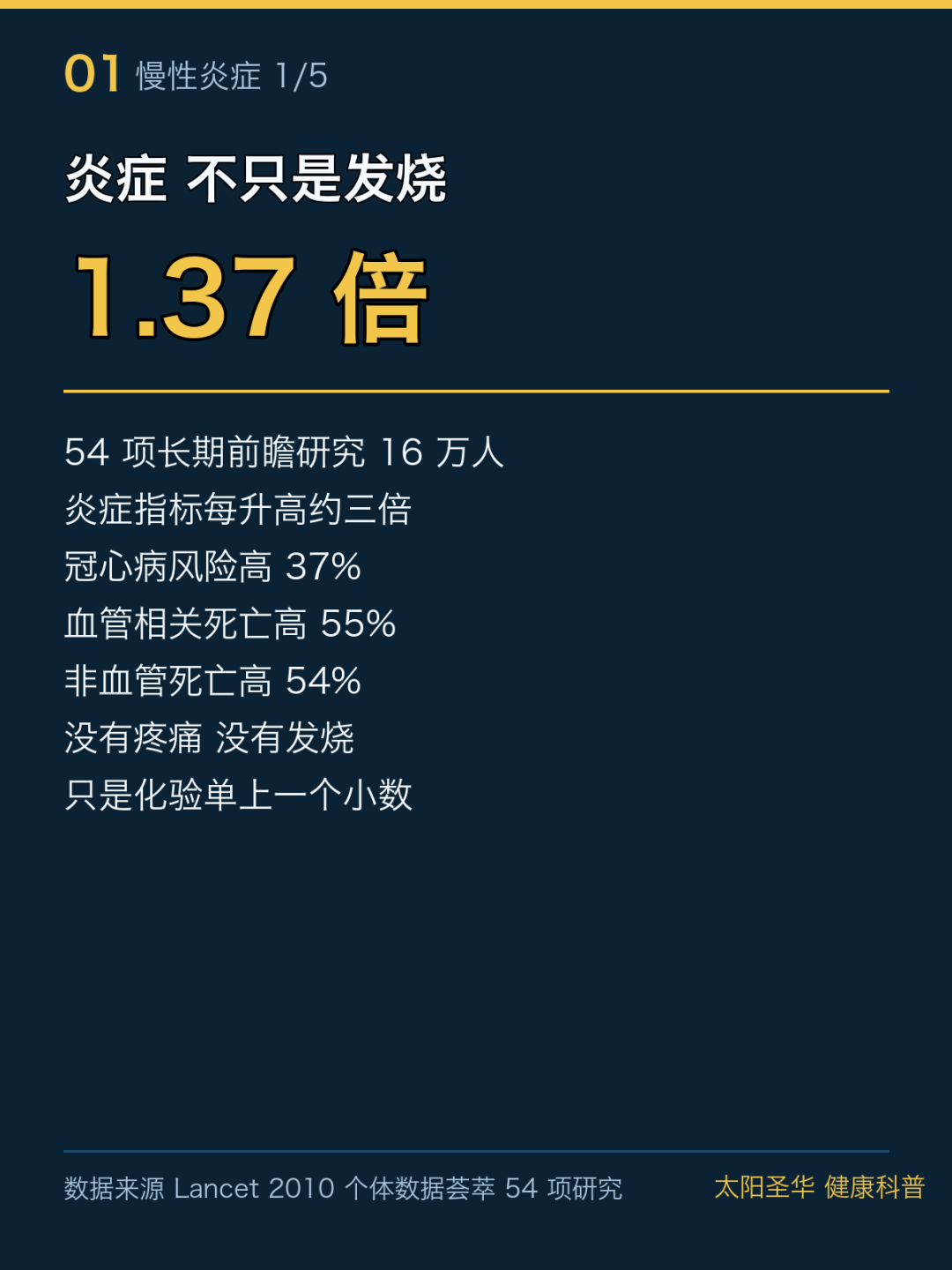
1. Inflammation Isn't Just the Kind That Comes With a Fever
Acute inflammation is visible: redness, swelling, heat, pain, fever, elevated white blood cells—and it's over in a few days.
Chronic low-grade inflammation is different. It has no obvious symptoms, and markers are only slightly elevated—things like C-reactive protein, interleukin-6, and tumor necrosis factor, proteins with tongue-twisting names.
A 2010 individual participant meta-analysis in The Lancet pooled 54 long-term prospective studies, 160,000 people, 1.31 million person-years of follow-up, and 27,769 endpoint events: for every roughly threefold increase in C-reactive protein, coronary heart disease risk was 37% higher, vascular-related death was 55% higher, and non-vascular death was 54% higher [1].
In plain terms: This marker and risk move in parallel—it doesn't mean "inflammation equals heart disease." It's a warning light, not a verdict.
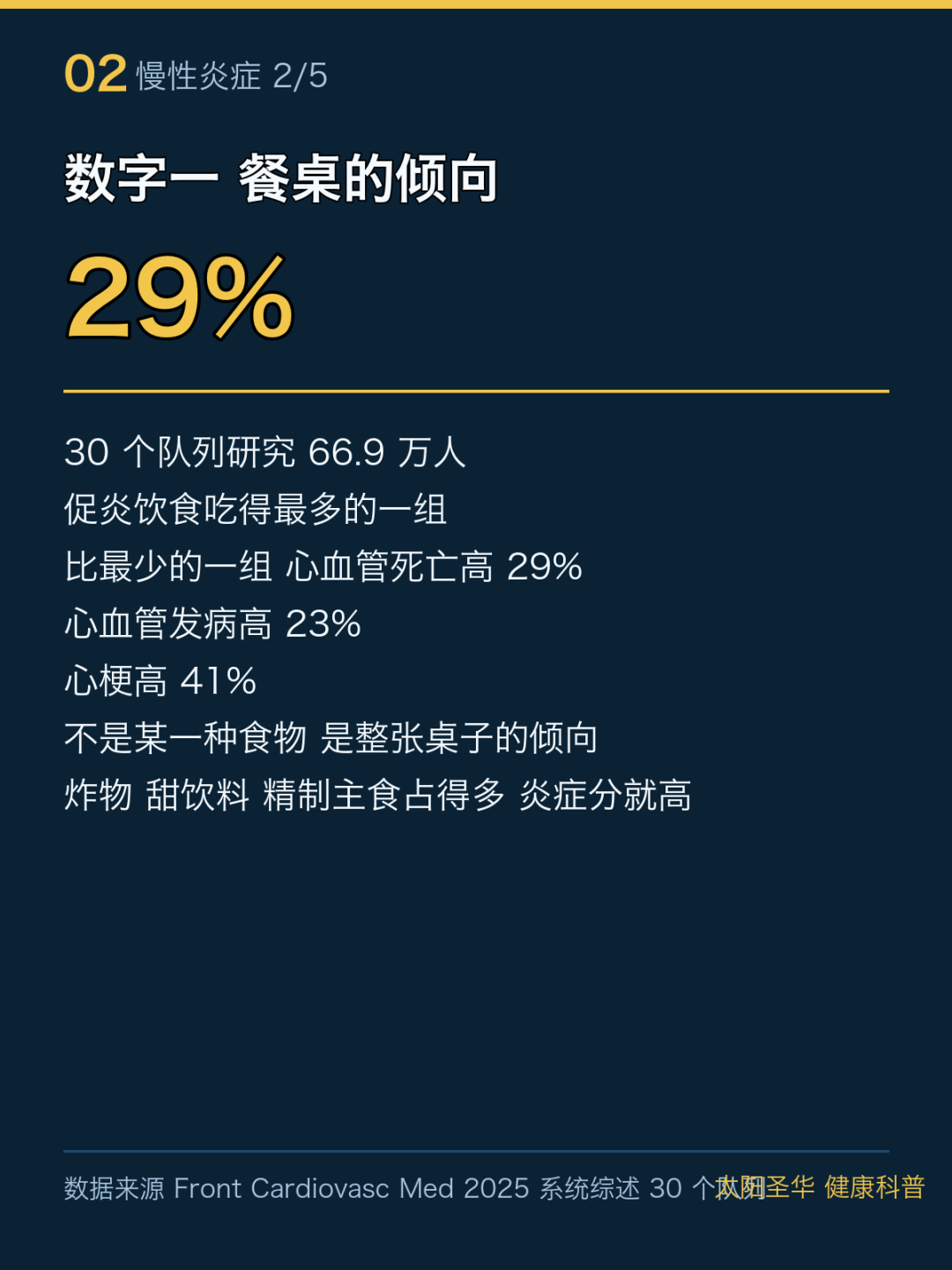
2. Number One: Look at the Tendency of the Whole Table, Not a Single Food
A 2025 updated systematic review pooled 30 cohorts and 669,000 people: the group with a higher dietary inflammatory index had 29% higher cardiovascular mortality, 23% higher cardiovascular incidence, and 41% higher heart attack risk compared with the lower group [2].
This index doesn't score any single food—it calculates an overall score for your daily diet along two directions: pro-inflammatory and anti-inflammatory. When fried foods, sugary drinks, and refined starches take up more space, the score goes up; when vegetables, legumes, nuts, fish, and olive oil take up more, the score goes down.
So there's no need to obsess over any single "anti-inflammatory food"—first look at which category takes up more space in your week.
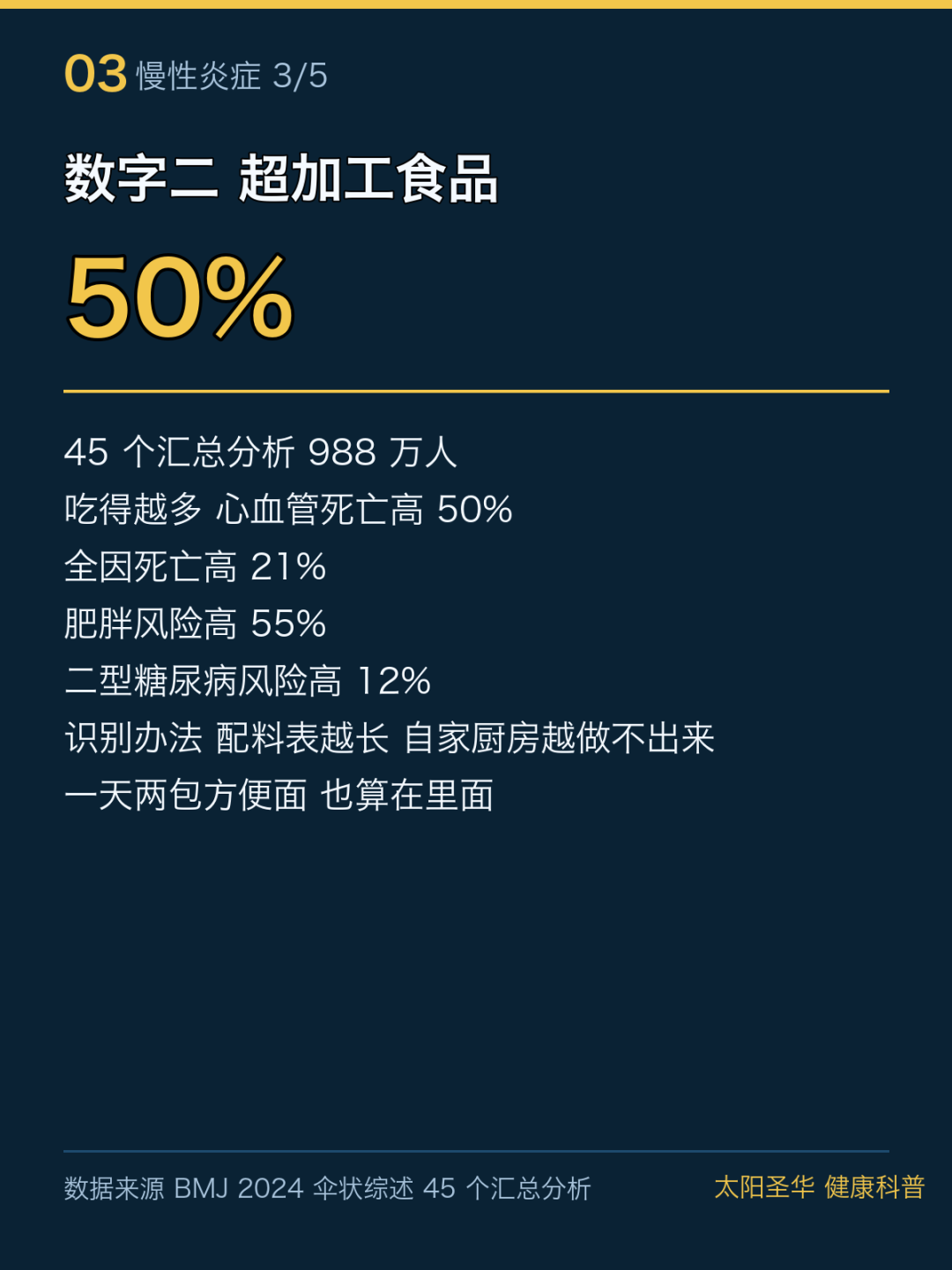
3. Number Two: Eat More Ultra-Processed Foods, and Risk Stacks Up Fast
A 2024 umbrella review in The BMJ looked at 45 pooled analyses covering 9.88 million people: the more ultra-processed foods consumed, the higher the cardiovascular mortality (50%), all-cause mortality (21%), obesity risk (55%), and type 2 diabetes risk by dose-response (12%) [3].
Ultra-processed foods aren't judged by whether they contain additives—they're judged by industrial formulation: a long ingredient list that you basically couldn't make in your own kitchen mostly counts. Instant noodles, ham sausages, sugary drinks, and packaged pastries all fall into this category.
The changes can be small: pick one item a day to swap for a food whose original form you can recognize—sugary drinks for water or unsweetened tea, ham sausages for eggs.
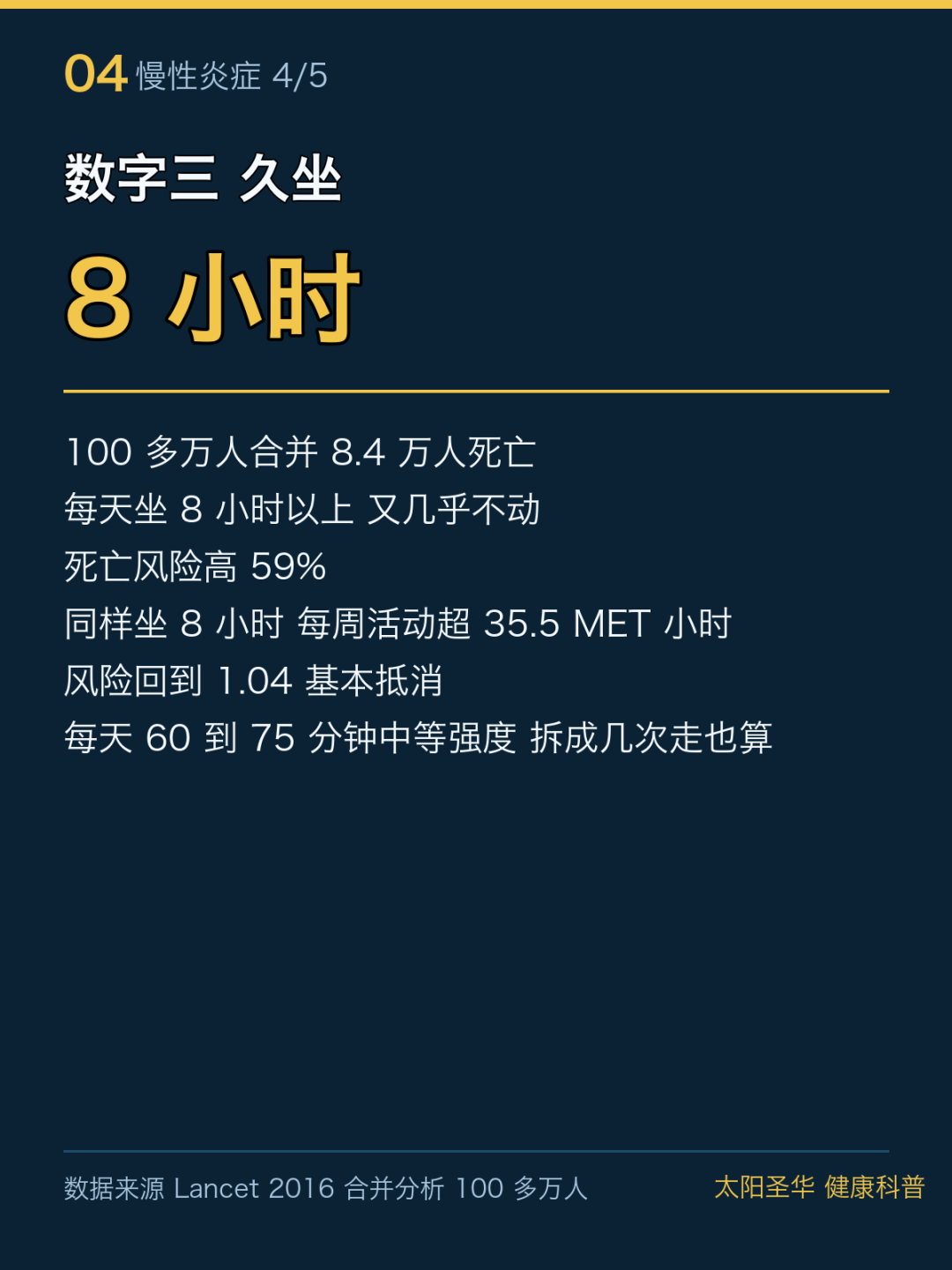
4. Number Three: The Risk of Sitting 8 Hours Can Be Offset by Physical Activity
A 2016 Lancet pooling of over 1 million people and 84,000 deaths: people who sat more than 8 hours a day and hardly moved had a 59% higher mortality risk [4].
But among people who also sat 8 hours, those who were active more than 35.5 MET-hours per week had a hazard ratio of 1.04—essentially back to the same level as people who sat little. Converted, that's about 60 to 75 minutes of moderate-intensity activity per day—brisk walking, cycling, stair climbing all count—and breaking it into two or three sessions works too.
Sitting a lot isn't a verdict; moving enough is what gives you a say.
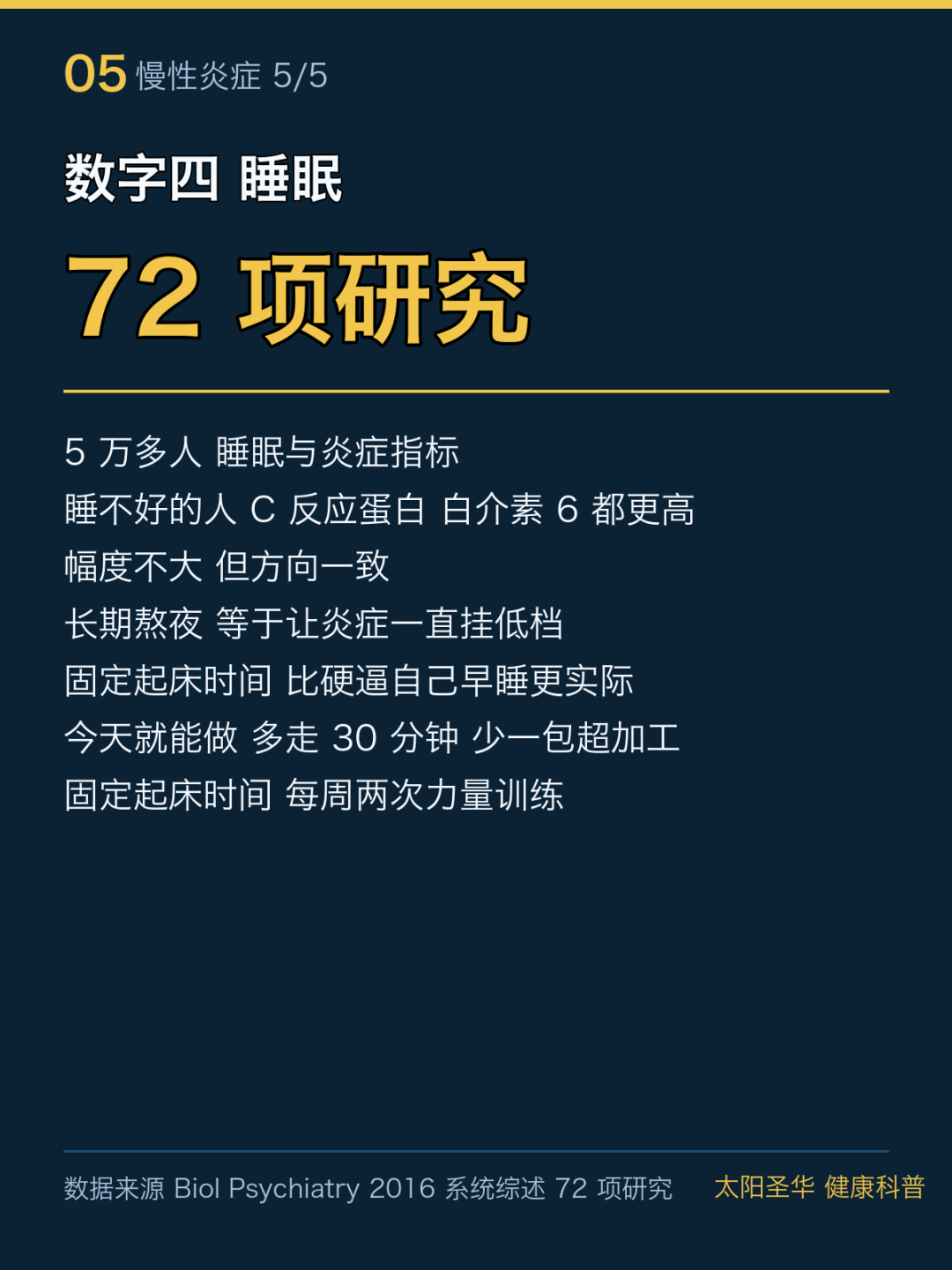
5. Number Four: People Who Sleep Poorly Also Have Higher Inflammation Markers
A 2016 systematic review in Biological Psychiatry pooled 72 studies and over 50,000 people: people with sleep disturbances had higher C-reactive protein and interleukin-6; both too-short and too-long sleep duration were each associated with elevated C-reactive protein [5].
The effect size isn't large, but the direction is consistent—and over months, it keeps inflammation parked at a low level.
In practice, fixing your wake-up time is easier than forcing yourself to go to bed early—and don't sleep two hours later on weekends than on weekdays. Moderate activity also helps sleep, so the two can be done together.
Four Things You Can Do Today
-
Change one food category first this week: swap sugary drinks for water or unsweetened tea.
-
Start with 30 minutes of brisk walking a day, and gradually build up to 60 minutes.
-
Every hour you sit, get up and walk for 2 to 3 minutes.
-
Fix your wake-up time, with no more than 1 hour of variation.
One final reminder: inflammation markers are clues, not diagnoses. If you do find persistently elevated high-sensitivity C-reactive protein, let a doctor look for the cause—infections, autoimmune problems, and periodontitis can all push it up. It's not recommended to self-treat with "anti-inflammatory" supplements.
What chronic inflammation asks you to change isn't anything earth-shattering—it's just your daily table, footsteps, and sleep. The fire isn't big, but it never goes out—and the things that can put it out are these small things too.
If this article is helpful to your family, forward it to them for a look; save it and pull it out to compare at your next checkup.
If it's helpful to you, give it a like or a "reading"—and feel free to leave a comment telling us what topics you'd like to see.
Disclaimer: This article is for health education purposes only and is intended for informational reference. It does not constitute medical advice; please consult a professional doctor for any health concerns.
Declaration of Interests: This article does not involve any product promotion or commercial collaboration, and has no conflict of interest with the research institutions mentioned in the text.
© 2026 Sun Sheng Hua (Beijing) Medical Technology Co., Ltd.
References
-
C-reactive protein concentration and risk of coronary heart disease, stroke, and mortality: an individual participant meta-analysis. Lancet. 2010;375(9709):132-140. PMID:20031199
-
Dietary inflammatory index and cardiovascular risk and mortality: an updated systematic review and meta-analysis. Frontiers in Cardiovascular Medicine. 2025;12:1626523. PMID:41357093
-
Ultra-processed food exposure and adverse health outcomes: umbrella review of epidemiological meta-analyses. BMJ. 2024;384:e077310. PMID:38418082
-
Does physical activity attenuate, or even eliminate, the detrimental association of sitting time with mortality? A harmonised meta-analysis of data from more than 1 million men and women. Lancet. 2016;388(10051):1302-1310. PMID:27475271
-
Sleep Disturbance, Sleep Duration, and Inflammation: A Systematic Review and Meta-Analysis of Cohort Studies and Experimental Sleep Deprivation. Biological Psychiatry. 2016;80(1):40-52. PMID:26140821