This article is for health education purposes only and is intended for informational reference; it does not constitute medical advice. If you have any health concerns, please consult a professional doctor.
To lose weight, you gave up rice, noodles, steamed buns... and for the first three days the scale really cooperated, with the numbers dropping fast.
But don't celebrate too soon—most of those pounds are not fat.
Stretch the timeline out to a year and you'll find: the fierce determination to "quit staple foods" did not translate into a bigger victory.
✦ ✦ ✦
First, two sets of data:
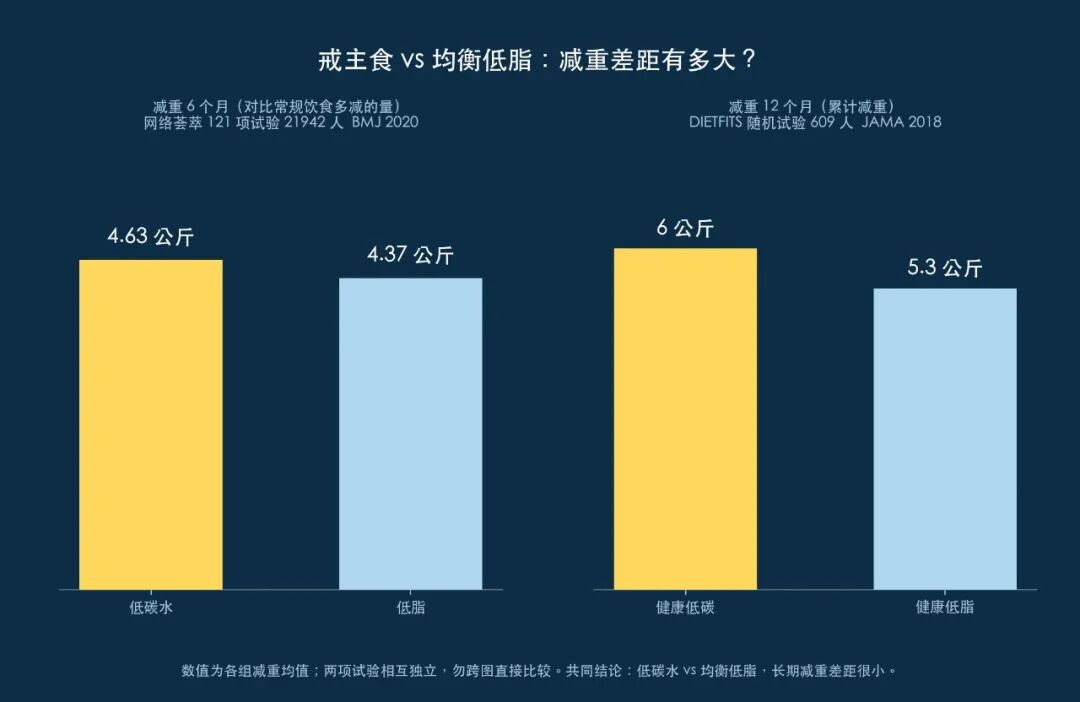
- A network meta-analysis pooling 121 randomized controlled trials and nearly 22,000 people showed: at 6 months of weight loss, low-carb diets reduced weight by an average of 4.63 kg and low-fat diets by 4.37 kg—a difference of about 0.26 kg, essentially negligible [1];
- The 1-year DIETFITS randomized trial of 609 overweight adults showed: the healthy low-carb group lost 6.0 kg and the healthy low-fat group lost 5.3 kg—a 0.7 kg difference that was not statistically significant [2].
The conclusion in one sentence: "You lose weight faster without staple foods" only holds for the first few days; stretched to a year, the advantage basically disappears.
Q1: Why does the scale drop so fast in the first few days after quitting staple foods?
Because what you lose at the start is mainly not fat—it's glycogen and water.
The body converts the carbohydrates in staple foods into glycogen for storage, and glycogen is stored "soaked in water." Once you quit staple foods, glycogen is quickly depleted and a large amount of water is excreted along with it—losing two pounds in three days mostly comes from this.
So two phenomena make sense:
- The rapid drop is concentrated in the first 3-5 days, after which the pace immediately slows;
- Once you resume eating staple foods, weight rebounds by one or two kilograms—don't panic, that's water coming back, not "getting fat again."
To judge whether you're really losing fat, don't just stare at the scale in the first few days—waist circumference and the four-week average weight are more reliable.
Q2: Will avoiding staple foods long-term lead to more weight loss?
The data don't support it. The two trials above already show: whether at 6 months or a year, the weight-loss difference between low-carb and balanced diets is very small; and the pooled analysis also found that after 12 months, the weight-loss magnitude of all diet plans generally diminishes [1].
The more realistic question is "can you stick with it":
- Cut staple foods too drastically, and many people have rebound carb cravings after a week or two; once they break the rule, binge eating is easy and weight goes on a roller coaster;
- If you cut both staple foods and protein, you lose not just fat but also muscle—during weight loss, protein intake should reach about 1.2-1.7 grams per kilogram of body weight to preserve lean mass as much as possible [4].
Weight loss is a long battle; a plan you can't sustain is useless no matter how "fast" it is.
Q3: So how exactly should staple foods be eaten?
Remember eight words: Don't exceed the total; prioritize quality.
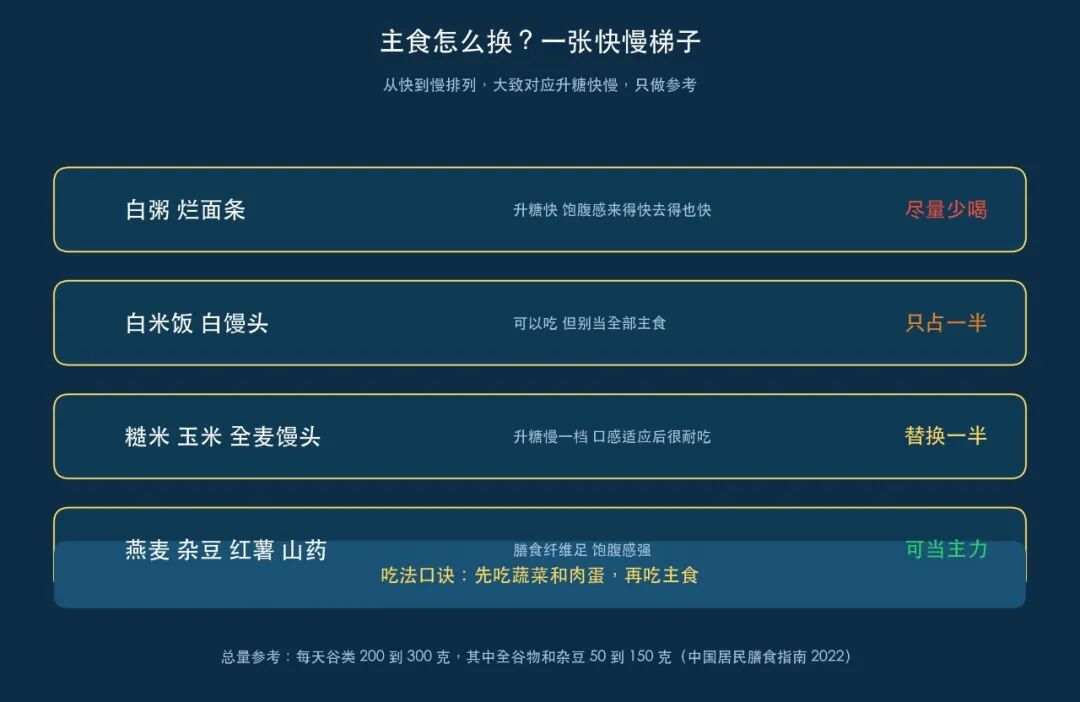
- How much: The Chinese Dietary Guidelines (2022) recommend that adults eat 200-300 grams of cereal foods per day, including 50-150 grams of whole grains and mixed beans and 50-100 grams of tubers [5]—roughly one fist-sized portion of staple food per meal;
- What to swap in: Replace half of the refined rice and white flour with "slow carbs" like brown rice, oats, corn, mixed beans, and sweet potatoes—more satiating and gentler on blood sugar;
- Why: Asians are accustomed to white rice as the main staple, and a study pooling more than 350,000 people found that people with high white rice intake had a 55% higher risk of type 2 diabetes than those with low intake [3]—white rice isn't forbidden, just don't eat only white rice.
Q4: If I want variety, how should I rank staple foods?
Here's a "fast-slow ladder" for reference, roughly ordered from fast to slow in terms of digestion and blood sugar rise:
- White congee, overcooked noodles: fast blood sugar rise, satiety comes and goes quickly—eat and drink as little as possible;
- White rice, white steamed buns: fine to eat, but best kept to no more than half of total staple intake;
- Brown rice, corn, whole-wheat steamed buns: one notch slower on blood sugar; once you adapt to the taste, they're very sustainable;
- Oats, mixed beans, sweet potatoes, Chinese yam: rich in dietary fiber and highly satiating—suitable as the mainstay of staple foods.
One-sentence action advice: Starting today, swap half of each meal's staple food for coarse grains and mixed beans; eat vegetables and meat/eggs first, then staple foods. If you occasionally slip and eat a big bowl of noodles, don't blame yourself—just get back on track at the next meal.
Forward this to that family member or friend who is "quitting staple foods"—weight loss doesn't have to be miserable, but it shouldn't be misery for nothing.
If this was helpful to you, give it a like or a "Wow," and feel free to leave a comment telling us what topics you'd like to see.
✦ ✦ ✦
Disclaimer: This article is compiled from publicly available academic literature and is for health education reference only; it does not constitute medical advice. For individual circumstances, please consult a professional doctor.
Disclosure of Interests: The authors have no conflicts of interest related to the studies mentioned in this article.
© 2026 Sunsheng Hua (Beijing) Medical Technology Co., Ltd.
References
- Comparison of dietary macronutrient patterns of 14 popular named dietary programmes for weight and cardiovascular risk factor reduction in adults: systematic review and network meta-analysis of randomised trials. BMJ. 2020;369:m696. PMID:32238384
- Effect of Low-Fat vs Low-Carbohydrate Diet on 12-Month Weight Loss in Overweight Adults and the Association With Genotype Pattern or Insulin Secretion: The DIETFITS Randomized Clinical Trial. JAMA. 2018;319(7):667-679. PMID:29466592
- White rice consumption and risk of type 2 diabetes: meta-analysis and systematic review. BMJ. 2012;344:e1454. PMID:22422870
- The effects of high protein intakes during energy restriction on body composition, energy metabolism and physical performance in recreational athletes. Eur J Clin Nutr. 2025;79(6):544-552. PMID:40011662
- Dietary Guidelines for Chinese Residents (2022). Chinese Nutrition Society. Beijing: People's Medical Publishing House; 2022.