Not Thirsty, So Don't Drink? Data on 15,000 People Over 25 Years: The Body Ages Faster
This article is for health education and informational purposes only; it does not constitute medical advice. If you have health concerns, please consult a professional doctor.
✦ ✦ ✦
After winter sets in, many people drink less than two glasses of water a day. It's not that they're holding back—they genuinely aren't thirsty. Once the heating comes on, the air gets so dry that lips start to peel, yet the glass of water on the desk sits there from morning until afternoon.
On the health check report, serum sodium reads 143, and the doctor glances at it and says it's normal. And it is normal—the reference range is 135 to 146. But a set of data from a 25-year follow-up says there's a bit of information hidden inside that "normal," and quite a lot of it.
I. 15,000 People Followed for 25 Years, and the Numbers Are a Bit Surprising
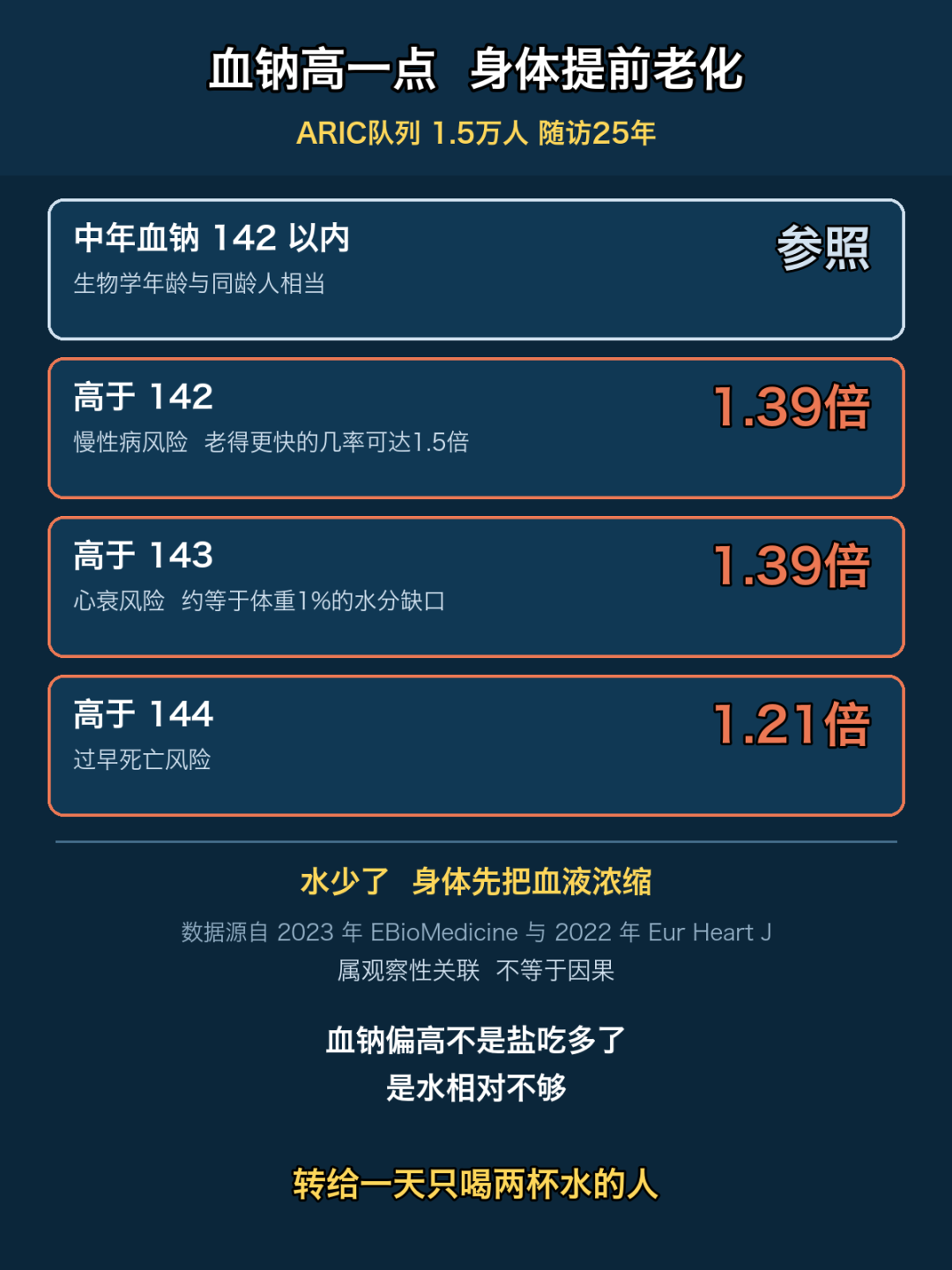
The US ARIC cohort study enrolled 15,752 people aged 45 to 66 and followed them for 25 years. The researchers didn't directly ask "how much water do you drink each day"; instead, they used midlife serum sodium as a proxy for drinking habits—because when water is low, the blood becomes relatively concentrated and sodium concentration rises.
Results: people whose midlife blood sodium was above 142 mmol/L had a 39% higher risk of developing chronic disease later[1]; those above 144 mmol/L had a 21% higher risk of premature death[1]. Among those with blood sodium above 142, the odds that biological age was running ahead of chronological age could reach 1.5 times[1].
Biological age is calculated from a set of biomarkers that change with age, and can be understood as "the body's actual degree of wear and tear." In the study, people with higher biological age had a 70% higher risk of subsequent chronic disease[1].
II. Why Use Blood Sodium to Gauge Whether Water Is Enough
The normal range for serum sodium is 135 to 146 mmol/L. When you drink too little water, the body first activates water-conservation mechanisms: antidiuretic hormone rises, the kidneys reabsorb water, urine becomes more concentrated, and sodium concentration rises accordingly.
So even within the same "normal range," people at 139 and 143 may differ considerably in their drinking habits. The researchers' conversion: a blood sodium of 143 mmol/L roughly corresponds to a 1% water deficit relative to body weight[2]. For a 60 kg person, that's about 0.6 kg of water. A single instance doesn't sound like much, but this is a year-round, cumulative state—not one day of drinking one glass less.
One point needs to be made clear: higher blood sodium does not equal eating too much salt. It reflects more the ratio of water to sodium—that is, water being relatively insufficient.
III. The Heart Is One of the First Organs Affected
In the same dataset, researchers selected 11,814 middle-aged adults without diabetes, obesity, or heart failure for a separate analysis. Those whose midlife blood sodium exceeded 143 mmol/L had a 39% higher risk of developing heart failure later[2].
Looking back again at ages 70 to 90: those whose midlife blood sodium exceeded 143 had a 107% higher chance of being diagnosed with left ventricular hypertrophy and a 54% higher chance of heart failure[2]. Even in the bracket where blood sodium was between 142.5 and 143, the chance of left ventricular hypertrophy was already 62% higher[2].
Left ventricular hypertrophy is a structural change in which the heart chronically counters a load; it has no symptoms early on, and by the time shortness of breath and fatigue become obvious, it has often been progressing for some time.
IV. Mechanisms Seen in Animal Experiments
Mice subjected to lifelong water restriction didn't just get "thirsty": their lifespan shortened, and they developed cardiac fibrosis, glomerular damage, accelerated decline in neuromuscular coordination, and elevated markers related to inflammation and coagulation[3]. No obvious abnormalities appeared in the first 14 months; after that, things deteriorated sharply[3].
The same paper used ARIC human data for comparison: hydration status in midlife was associated with coagulation and inflammation markers and could predict the occurrence of multiple age-related diseases 24 years later[3]. The authors estimated that if hydration status were maintained well throughout life, the scale of degenerative diseases would be markedly reduced, with the most notable effects on dementia, heart failure, and chronic lung disease[3].
A 2024 review connected the chain: insufficient water intake raises antidiuretic hormone, sodium concentration, and urine osmolality; this compensatory response, when chronically activated, may be linked to chronic disease, accelerated aging, and increased risk of premature death; however, causality is still being verified in intervention trials[4]. In other words, what we see now is a strong association, not proven causation.
V. Stones and Cognition: The Evidence Is More Direct
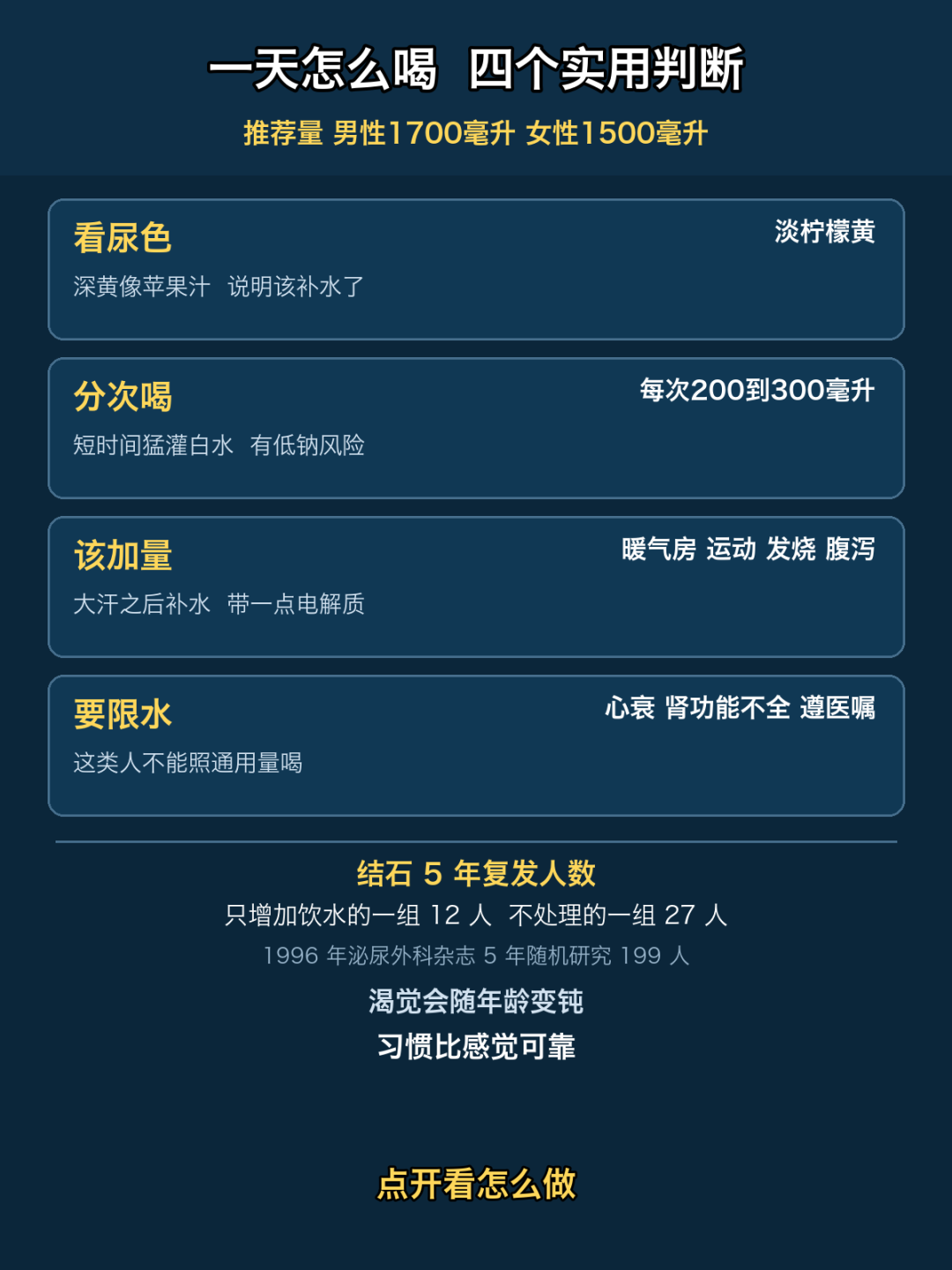
A 5-year randomized study in the Journal of Urology in 1996: 199 men with a first episode of idiopathic calcium stones were divided into two groups—one only increased water intake without changing diet, and the other received no intervention. Within 5 years, 12 of 99 people in the higher-water group had a recurrence, versus 27 of 100 in the control group[5].
This study has a detail worth remembering: at baseline, the 24-hour urine volume of stone patients was already lower than that of healthy controls—1,057 vs. 1,401 mL in men, and 990 vs. 1,239 mL in women[5]. In other words, many people don't start drinking little water only after getting sick; they've been drinking little for a long time.
On cognition, a randomized trial of 64 young adults in Baoding: after 12 hours of water deprivation, participants were given 100, 200, or 500 mL of plain water, or no water. Those given 200 to 500 mL had significantly relieved thirst and also showed improvements in cognitive performance and mood[6]. The sample is small, but the direction is consistent with the data above.
VI. Why It's Easier to Become Dehydrated in Winter
First, thirst perception becomes blunter. Thirst perception declines with age, and middle-aged and older adults often are already dehydrated without yet having a clear sense of thirst.
Second, water loss goes unnoticed. In heated rooms and air-conditioned rooms, the air is dry, and insensible water loss through breathing and skin is constantly occurring, while sweating is zero—making it easy to mistakenly think you're "not losing anything."
Third, what people drink changes. When it's cold, people crave hot tea, hot coffee, and hot soup more, and the amount of plain water actually drops.
VII. How Much to Drink, and How to Drink It
The Chinese Dietary Guidelines recommend that adult men drink 1,700 mL of water per day and women 1,500 mL, referring to plain water or tea, not including water in food. This is a baseline amount, not a task precise to the milliliter.
Looking at urine color is more practical than counting glasses. Pale lemon-yellow means you're roughly getting enough; dark yellow, like apple juice, means it's time to rehydrate. Having darker urine first thing in the morning is normal.
Drink in divided amounts, don't gulp it all at once. Downing a large amount of plain water in a short time dilutes blood sodium, and in extreme cases carries a risk of hyponatremia—be especially careful when you're drenched in sweat right after exercise; at times like this, replenish with a little electrolyte.
Situations where you should increase the amount: spending all day in a heated room, sweating from exercise, fever, diarrhea, eating a very salty meal.
People who need to restrict fluids are a different matter. Those with heart failure, renal insufficiency, cirrhotic ascites, and patients whose doctors have explicitly instructed fluid restriction should not drink according to the amount above—follow medical advice.
Three things you can do today
-
Put a graduated cup on your desk—you can only remember it if you can see it.
-
One cup after getting up, one cup between each meal—attach drinking water to habits you already have.
-
Drink only a small half-cup before bed, not a big cup—getting up in the middle of the night means you're shortchanging your sleep again.
By the time thirst appears, your body has actually been short of water for a while. It isn't the start of a reminder—it's the late arrival.
Forward this to that family member who drinks only two cups of water a day, especially the elderly at home.
If this has been helpful to you, give it a like or a "Wow," and feel free to leave a comment telling us what topics you'd like to see.
✦ ✦ ✦
Disclaimer: This article is health education for informational reference only and does not constitute medical advice; if you have health problems, please consult a professional doctor.
Conflict of interest statement: This article does not involve any product, drug, or brand recommendations, and has no conflict of interest with the research institutions mentioned in the text.
© 2026 Sunshenghua (Beijing) Medical Technology Co., Ltd.
References
[1] Dmitrieva NI, Gagarin A, Liu D, et al. Middle-age high normal serum sodium as a risk factor for accelerated biological aging, chronic diseases, and premature mortality. EBioMedicine. 2023;87:104404. PMID: 36599719
[2] Dmitrieva NI, Liu D, Wu CO, Boehm M. Middle age serum sodium levels in the upper part of normal range and risk of heart failure. Eur Heart J. 2022;43(35):3335-3348. PMID: 35348651
[3] Allen MD, Springer DA, Burg MB, et al. Suboptimal hydration remodels metabolism, promotes degenerative diseases, and shortens life. JCI Insight. 2019;4(17):e129734. PMID: 31484829
[4] Dmitrieva NI, Boehm M, Yancey PH, et al. Long-term health outcomes associated with hydration status. Nat Rev Nephrol. 2024;20(5):275-294. PMID: 38409366
[5] Borghi L, Meschi T, Amato F, et al. Urinary volume, water and recurrences in idiopathic calcium nephrolithiasis: a 5-year randomized prospective study. J Urol. 1996;155(3):839-843. PMID: 8583588
[6] Zhang J, Zhang N, He H, et al. Different Amounts of Water Supplementation Improved Cognitive Performance and Mood among Young Adults after 12 h Water Restriction in Baoding, China: A Randomized Controlled Trial (RCT). Int J Environ Res Public Health. 2020;17(21):7882. PMID: 33114364