No Running Needed: 2 Minutes of Wall Sits Lowers Blood Pressure by 8 mmHg
This article is for health education purposes only and is intended as general information; it does not constitute medical advice. Please consult a professional doctor if you have any health concerns.
✦ ✦ ✦
Cold weather arrives, your running plan keeps getting postponed, and the numbers on the blood pressure monitor haven't come down either.
Many people assume the only exercises that lower blood pressure are brisk walking, jogging, and swimming.
A 2023 analysis pooling 270 randomized trials offers another answer: holding still with your back against a wall lowers blood pressure more noticeably than running.
Let's start with the numbers. This network meta-analysis, published in the British Journal of Sports Medicine, included 270 randomized controlled trials with 15,827 participants: isometric exercise (sustained muscle contraction without a change in muscle length—wall sits fall into this category) reduced resting systolic blood pressure by an average of 8.24 mmHg and diastolic blood pressure by 4.00 mmHg; in the same dataset, aerobic exercise produced reductions of 4.49 and 2.53, dynamic resistance training 4.55 and 3.04, high-intensity interval training 4.08 and 2.50, and combined exercise 6.04 and 2.54. Ranked by effectiveness, isometric exercise placed near the top among the five exercise categories, and the wall sit was the subtype with standout performance for lowering systolic blood pressure[1].
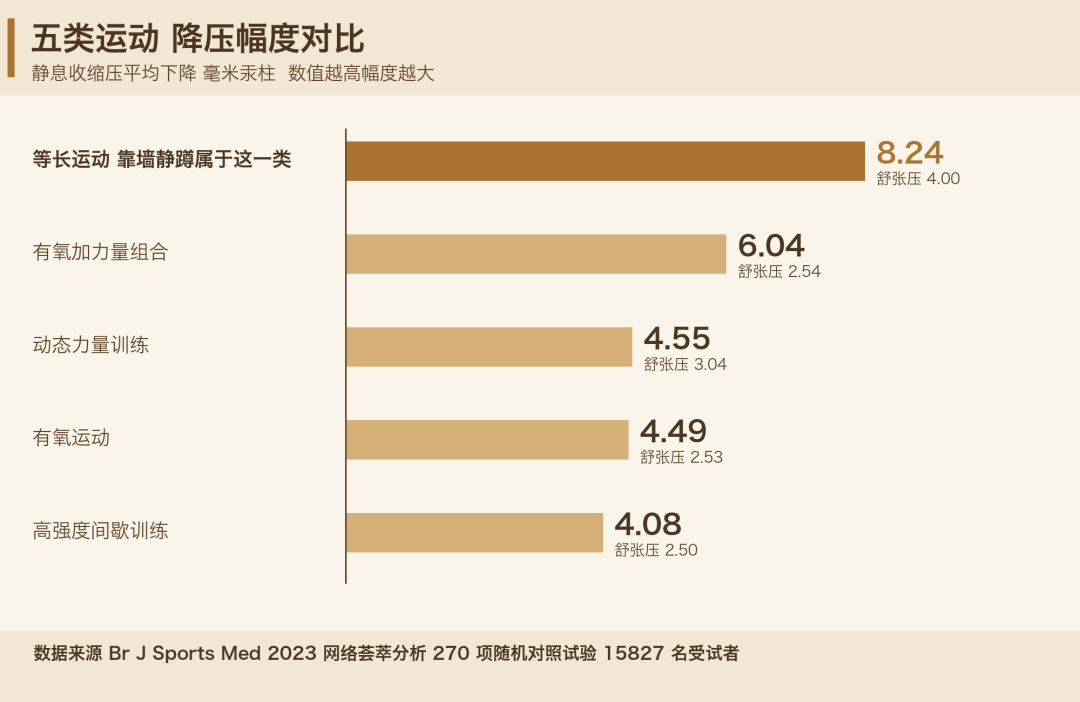
Caption: Comparison of blood pressure reductions across five exercise categories. Isometric exercise ranks near the top for both systolic and diastolic blood pressure, and the wall sit is the subtype with standout performance for lowering systolic blood pressure.
The differences may look small, but at the population level they matter. The China Hypertension Survey covered 31 provinces and more than 450,000 adults: the prevalence rate among those aged 18 and older was 23.2%, or about 244.5 million people; the awareness rate was 46.9%, the treatment rate 40.7%, and the control rate only 15.3%[2]. In other words, fewer than half of those affected have been diagnosed, and fewer than one in six actually has their blood pressure under control.
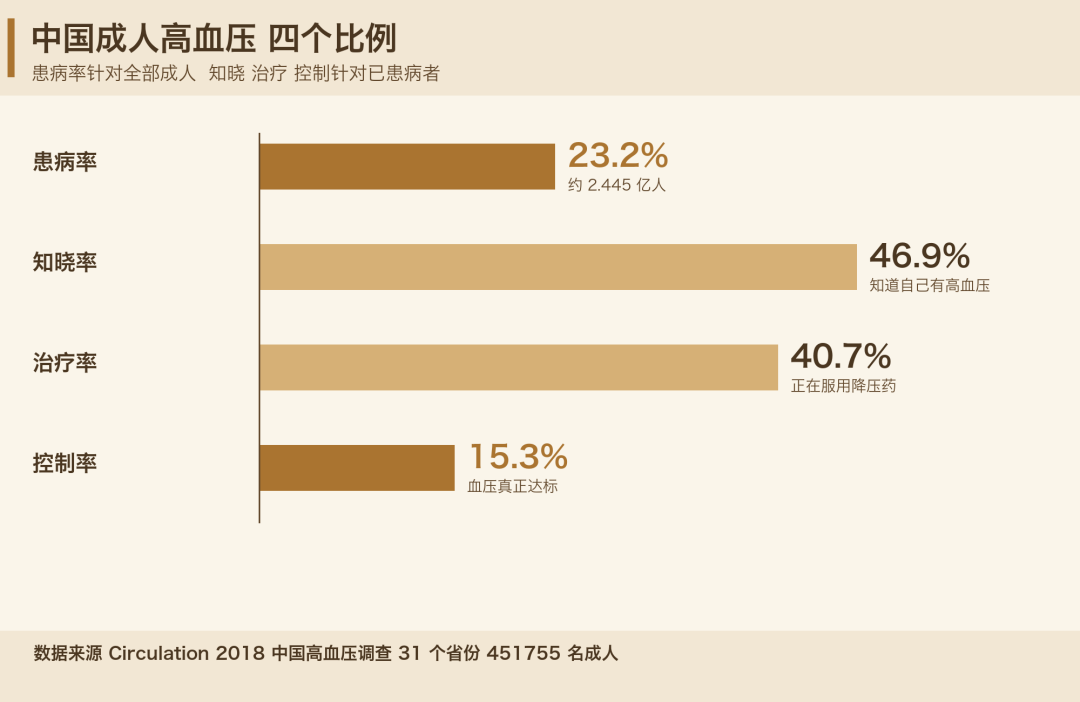
Caption: The four rates for hypertension among Chinese adults—prevalence, awareness, treatment, and control. The affected population is large, yet the control rate is only 15.3%.
1. Why Does Holding Still in a Squat Lower Blood Pressure?
When muscles contract continuously, they temporarily compress blood vessels. Upon relaxation, local blood flow increases, the regulatory function of the blood vessel lining improves, peripheral resistance drops, and resting blood pressure comes down accordingly.
Readings rise briefly during exercise—this is a normal response. The key is not to hold your breath: stop breathing and blood pressure surges even higher. Breathe in slowly through your nose and out slowly through your mouth the entire time; the right intensity is one at which you can still speak a short sentence.
In terms of practicality, the wall sit has a very low barrier to entry: no equipment, no changing clothes or going outside, a small range of knee flexion, and no weather requirements. For people who are heavier, who hardly exercise, or who don't want to go outside in winter, being able to stick with it matters more than how much you do in one session. The trials included in the 2023 analysis all required interventions to last at least 2 weeks[1], showing that short-term adherence can produce changes—but keeping blood pressure stable over the long term still depends on regularity.
2. How to Do a 2-Minute Wall Sit
Stand with your back against a wall, step your feet half a step forward at shoulder width, and slide slowly down the wall until your knees bend. The smaller the knee angle and the deeper the squat, the greater the intensity and the more pronounced the cardiovascular response; you can adjust between 90 and 135 degrees to suit yourself[3].
Start with 2 minutes per set, do 2 to 3 sets, rest 2 minutes between sets, 3 times per week. In a 2024 four-week home-based trial, participants who used ratings of perceived exertion to control intensity lowered systolic blood pressure by an average of 9 mmHg, and all participants achieved an improvement of at least 5 mmHg within 4 weeks. However, this trial involved only 30 people and was a small-scale pilot study, so the conclusions need confirmation from larger studies[4]. Once you've adapted, add more sets—don't squat until your legs shake right from the start.
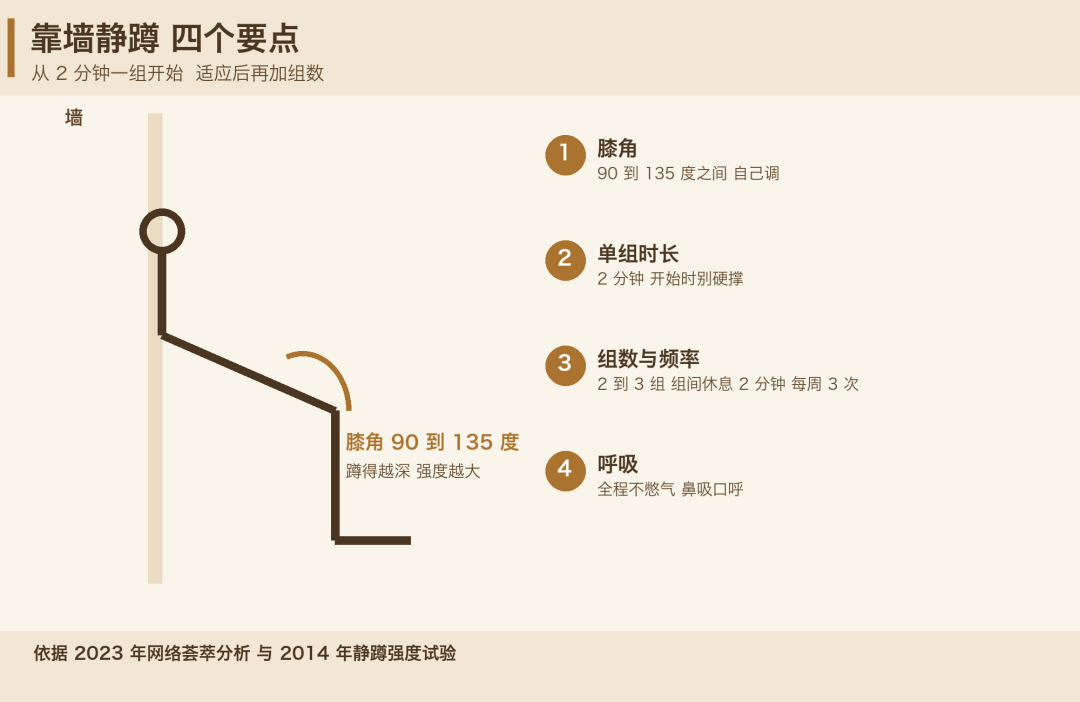
Caption: Four key points for the wall sit—knee angle range, time per set, sessions per week, and breathing method. Memorize them once and you can start.
Four common mistakes worth avoiding from the start:
First, holding your breath. Many people instinctively hold their breath when exerting force, which actually drives blood pressure higher and can easily cause dizziness.
Second, squatting too shallow. If your thighs aren't really working, you're basically leaning against the wall chatting—without enough intensity, there's no training effect.
Third, squatting too long in one go. Start with 2 minutes; forcing yourself to push through once your legs are shaking will leave your knees and thighs regretting it the next day.
Fourth, squatting without measuring. Without a baseline there's no comparison, and after three weeks of training you won't know whether it's working.
3. Before You Squat, Measure Your Blood Pressure Correctly
Measure at a fixed time—after waking up or before dinner is fine, but keep it the same time every day; sit quietly for 5 minutes before measuring, without talking or scrolling on your phone; use an upper-arm blood pressure monitor with the cuff level with your heart; take two readings each time, 1 minute apart, and average them; record for 7 consecutive days and look at the weekly average, not single readings.
The reason is that blood pressure fluctuates on its own and is greatly affected by mood, sleep, and temperature. A single higher reading doesn't mean the plan has failed—it's when the weekly average trends upward that you need to adjust.
4. Ask Your Doctor First in These Situations
If your blood pressure is uncontrolled (for example, repeatedly measuring above 180/110), if you've recently had a heart attack, stroke, or unstable angina, if you have a clear knee injury, or during the first few weeks of adjusting medication, it's best to confirm with your doctor before starting. Exercise is an adjunct—you must not reduce or stop blood pressure medication on your own. The World Health Organization also recommends that adults do muscle-strengthening activities at least 2 days per week and get up and move every hour when sitting for long periods[5].
One Try You Can Do Today
While waiting for water to boil, do one wall sit and note your knee angle and time; measure your blood pressure at the same time a week later and look at the trend, not a single reading.
When it comes to blood pressure, slow is fast.
If this was helpful, give it a like or a "Wow," and feel free to leave a comment telling us what topics you'd like to see.
✦ ✦ ✦
Disclaimer: This article is for health education purposes only and is intended as general information; it does not constitute medical advice. Please consult a professional doctor if you have any health concerns. Those with significantly elevated blood pressure, chest pain or dizziness, or a history of cardiovascular or cerebrovascular disease should seek medical evaluation before exercising.
Conflict of Interest Statement: This article is based on publicly published medical literature and has no conflict of interest with the research institutions mentioned; it does not involve any product recommendations.
© 2026 Sunshenghua (Beijing) Medical Technology Co., Ltd.
References
-
Edwards JJ, Deenmamode AHP, Griffiths M, Arnold O, Cooper NJ, Wiles JD, O'Driscoll JM. Exercise training and resting blood pressure: a large-scale pairwise and network meta-analysis of randomised controlled trials. Br J Sports Med. 2023;57(20):1317-1326. PMID: 37491419
-
Wang Z, Chen Z, Zhang L, Wang X, Hao G, Zhang Z, Shao L, Tian Y, Dong Y, Zheng C, Wang J, Zhu M, Weintraub WS, Gao R. Status of Hypertension in China: Results From the China Hypertension Survey, 2012-2015. Circulation. 2018;137(22):2344-2356. PMID: 29449338
-
Goldring N, Wiles JD, Coleman D. The effects of isometric wall squat exercise on heart rate and blood pressure in a normotensive population. J Sports Sci. 2014;32(2):129-136. PMID: 23879248
-
Lea JWD, O'Driscoll JM, Wiles JD. The implementation of a home-based isometric wall squat intervention using ratings of perceived exertion to select and control exercise intensity: a pilot study in normotensive and pre-hypertensive adults. Eur J Appl Physiol. 2024;124(1):281-293. PMID: 37458822
-
Bull FC, Al-Ansari SS, Biddle S, Borodulin K, Buman MP, Cardon G, et al. World Health Organization 2020 guidelines on physical activity and sedentary behaviour. Br J Sports Med. 2020;54(24):1451-1462. PMID: 33239350