Chinese People Get Only Half the Potassium They Need: Switching Salt Reduced Stroke by 14%
This article is for health education purposes only and is intended for informational reference. It does not constitute medical advice; please consult a professional doctor if you have health concerns.
✦ ✦ ✦
Most people follow that line on their checkup report: "Blood pressure is a bit high—recommend a low-salt diet." The pickles come off the table, soy sauce is halved, and only a tiny pinch of salt goes into the wok.
Three months later at the follow-up, the blood pressure reading hasn't budged.
The problem may not be too much salt—it may be the other side of the equation: too little potassium.
In 2024, the American Journal of Clinical Nutrition published a national survey by the Chinese Center for Disease Control and Prevention, in which 10,114 adults provided 24-hour urine collections. The average daily sodium excretion was 4,121 mg and potassium excretion was 1,534 mg [1]. The World Health Organization recommends that adults get 3,510 mg of potassium per day from food—the Chinese average reaches only 44% of that. In the same urine test, sodium was 2.7 times potassium.
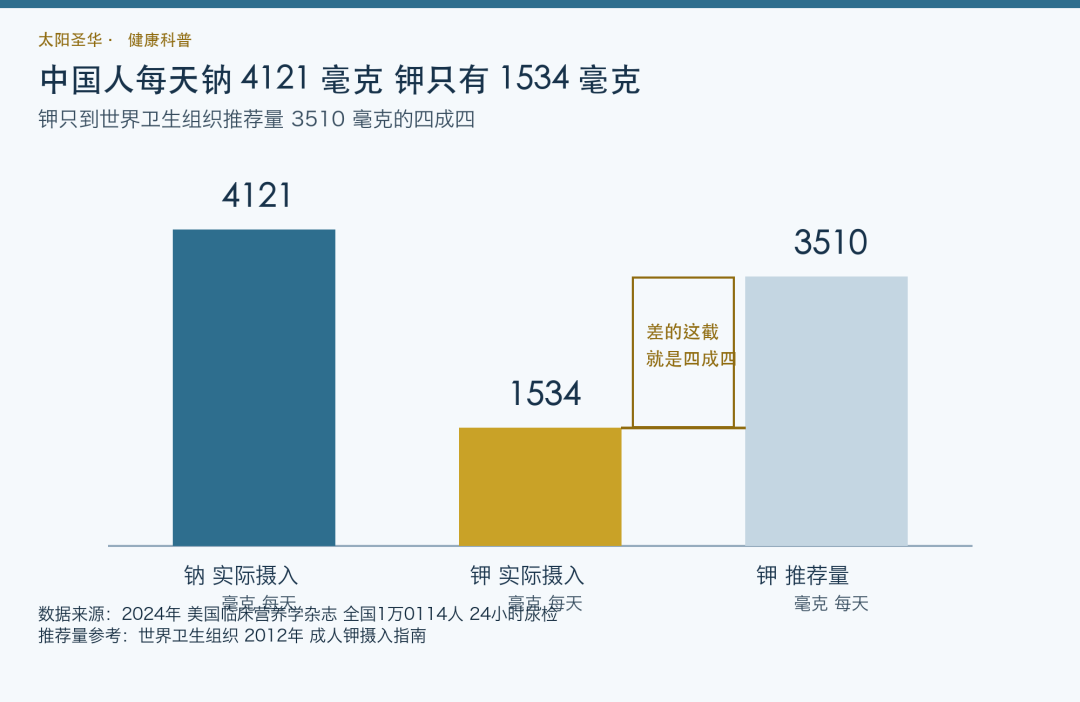
Caption: Chinese people average 4,121 mg of sodium and 1,534 mg of potassium per day—potassium reaches only 44% of the World Health Organization's recommended 3,510 mg.
I. Potassium Is Not Just Another Salt—It Does the Opposite Job
Sodium tenses vascular smooth muscle and makes the body retain water. Potassium does the opposite: it drives the kidneys to excrete excess sodium while relaxing blood vessel walls. The protein machine responsible for this inside cells is called the sodium-potassium pump—each cycle, it moves sodium out of the cell and potassium in, consuming energy.
This is also why some people eat salty food and their blood pressure doesn't budge, while others see it rise with the first bite—the difference often isn't the absolute amount of salt, but whether the sodium and potassium sides are in balance.
A 2017 survey of 1,424 people in Zhejiang quantified this: for every 1,000 mg increase in 24-hour urinary potassium, systolic blood pressure was on average 3.07 mmHg lower (95% confidence interval 4.57 to 1.57) and diastolic blood pressure 0.94 mmHg lower; people in the highest quartile of urinary potassium had 0.54 times the hypertension risk of those in the lowest quartile (0.35 to 0.84). In this dataset, sodium's independent effect was actually not significant—for every 1-unit increase in the sodium-to-potassium ratio, systolic blood pressure rose 0.78 mmHg and hypertension risk rose to 1.71 times (1.16 to 2.51) [2]. In the same urine sample, the ratio explains more than either number alone.
II. 22 Randomized Trials Plus 11 Cohorts: How Much Blood Pressure Drops, How Much Stroke Is Prevented
A systematic review commissioned by the World Health Organization in 2013 pooled this evidence: 22 randomized controlled trials (1,606 people) plus 11 cohorts (127,038 people). After increasing potassium intake, systolic blood pressure dropped by an average of 3.49 mmHg (1.82 to 5.15) and diastolic by 1.96 (0.86 to 3.06); this effect was only evident in people with high blood pressure and not detectable in those with normal blood pressure. When daily potassium intake was raised to the 90–120 mmol range, the systolic reduction in hypertensive individuals reached 7.16 mmHg (1.91 to 12.41) [3].
More noteworthy is stroke: people with high potassium intake had 0.76 times the stroke risk of the lowest group (0.66 to 0.89)—that is, 24% lower—with moderate-quality evidence. Coronary heart disease and total cardiovascular risk were not statistically significant. The same review also examined safety—in people with normal kidney function, increased potassium intake had no adverse effects on kidney function, blood lipids, or catecholamines.
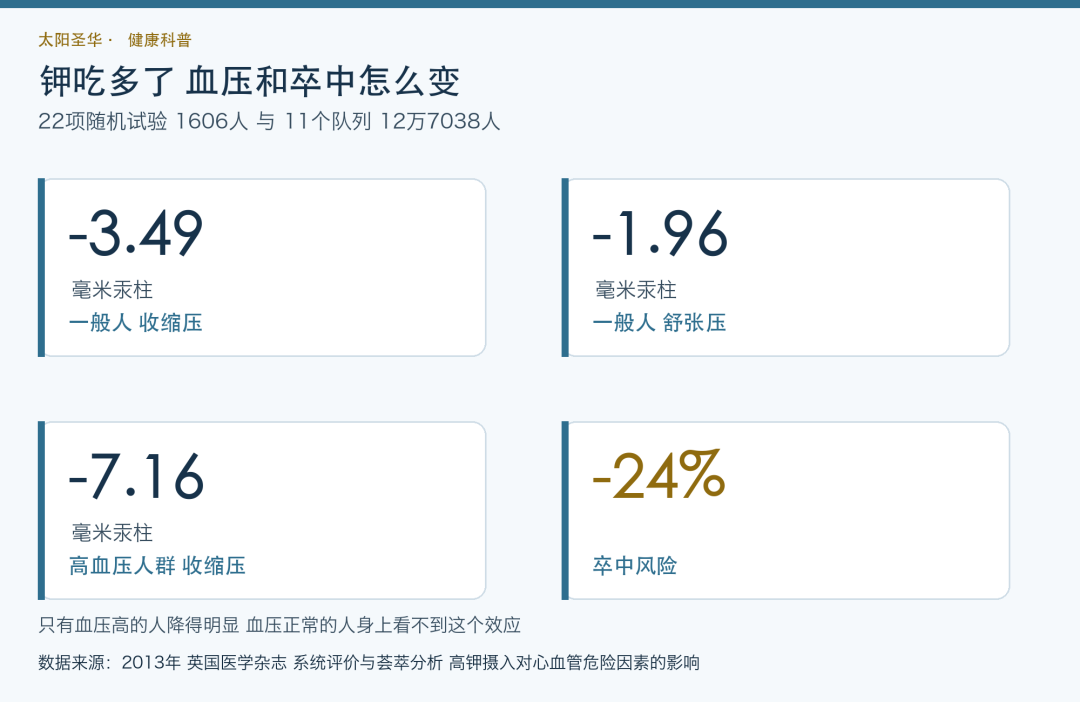
Caption: Changes in blood pressure and stroke with increased potassium intake—systolic blood pressure drops more in hypertensive individuals.
The dose-response relationship is even clearer in another pooled analysis. Ten prospective studies, 268,276 people, 8,695 stroke cases: for every 1,000 mg increase in daily potassium intake, stroke risk dropped 11% (relative risk 0.89, 0.83 to 0.97), with consistent results for ischemic stroke (0.89, 0.81 to 0.97) [4].
III. 20,000 People Ate Low-Sodium Salt for Over 4 Years: 14% Fewer Strokes, 12% Fewer Deaths
Everything above describes "what happens when you eat more potassium"—but has anyone actually run an intervention trial? Yes, and it was done in rural China.
The SSaSS trial in the New England Journal of Medicine in 2021 covered 600 villages and 20,995 people, average age 65.4, with 72.6% having a history of stroke and 88.4% having hypertension. Villages were randomly assigned to two groups: one swapped household salt for a low-sodium salt containing 75% sodium chloride plus 25% potassium chloride, while the other continued with regular salt, with 4.74 years of follow-up [5].
Results: the low-sodium salt group had a stroke incidence of 29.14 per 1,000 person-years versus 33.65 in the regular salt group, rate ratio 0.86 (0.77 to 0.96)—about 14% fewer; major cardiovascular events 49.09 versus 56.29, rate ratio 0.87; all-cause death 39.28 versus 44.61, rate ratio 0.88—about 12% fewer.
Safety also came with numbers: serious adverse events due to hyperkalemia were 3.35 versus 3.30 per 1,000 person-years in the two groups, rate ratio 1.04 (0.80 to 1.37)—no significant difference. The researchers therefore concluded that salt substitution was safe in this population.
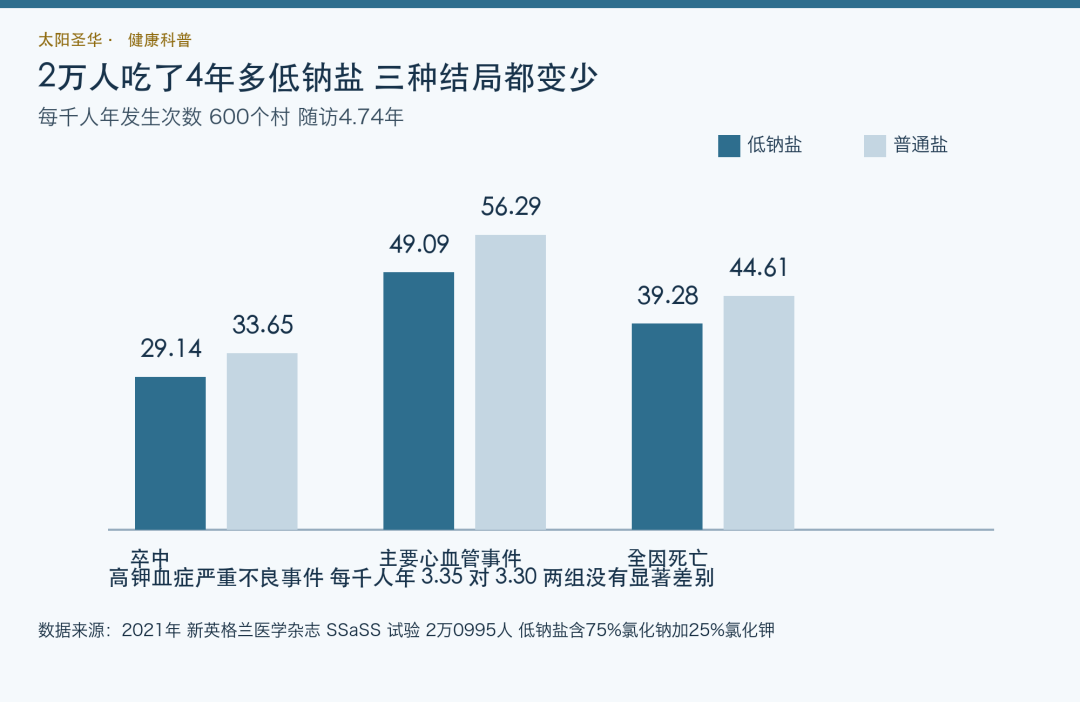
Caption: Comparison of stroke, cardiovascular events, and all-cause mortality rates between the low-sodium salt group and the regular salt group, and the comparable rates of serious hyperkalemia adverse events in both groups.
IV. What's More Worth Looking At Than Eating Less Salt Is the Sodium-to-Potassium Ratio
The US Third National Health and Nutrition Examination Survey followed 12,267 people for 14.8 years, recording 2,270 deaths. For every 1,000 mg increase in sodium intake, the all-cause mortality hazard ratio was 1.20 (1.03 to 1.41); for every 1,000 mg increase in potassium intake, the hazard ratio was 0.80 (0.67 to 0.94). The gap became even more pronounced when the two were combined into a ratio: people in the highest quartile of sodium-to-potassium ratio had 1.46 times the all-cause mortality risk of those in the lowest quartile (1.27 to 1.67), 1.46 times for cardiovascular death (1.11 to 1.92), and 2.15 times for coronary heart disease death (1.48 to 3.12) [6].
Internationally, the direction is the same. The PURE study across 17 countries and 101,945 people found average urinary potassium of only 2.12 grams per day; over 3.7 years of follow-up, compared with those getting less than 1.5 grams of potassium daily, those with higher potassium had a lower composite risk of death and cardiovascular events [7].
To be clear: what these cohorts show is association. People who eat more potassium also tend to eat more vegetables and fruits and fewer processed foods, and these factors are hard to fully tease apart. But the results of randomized trials and the direction of blood pressure as an intermediate marker are consistent.
V. How to Supplement: Put Potassium Back on the Plate—No Need to Buy a Bottle of Potassium Pills
The Chinese Dietary Guidelines recommend 300 to 500 grams of vegetables and 200 to 350 grams of fruit per day; most vegetables and fruits contain 200 to 400 mg of potassium per 100 grams. Potatoes, sweet potatoes, and other tubers; soybeans, black beans, and other legumes; spinach, mushrooms, and tomatoes—all are high in potassium. Get your vegetables up to half a kilogram a day and your fruit to two fist-sized portions, and potassium rises substantially.
If your household uses a lot of salt, consider switching to low-sodium salt. The formula used in SSaSS was 75% sodium chloride plus 25% potassium chloride, and the ingredient lists of low-sodium salts in supermarkets fall roughly in this range.
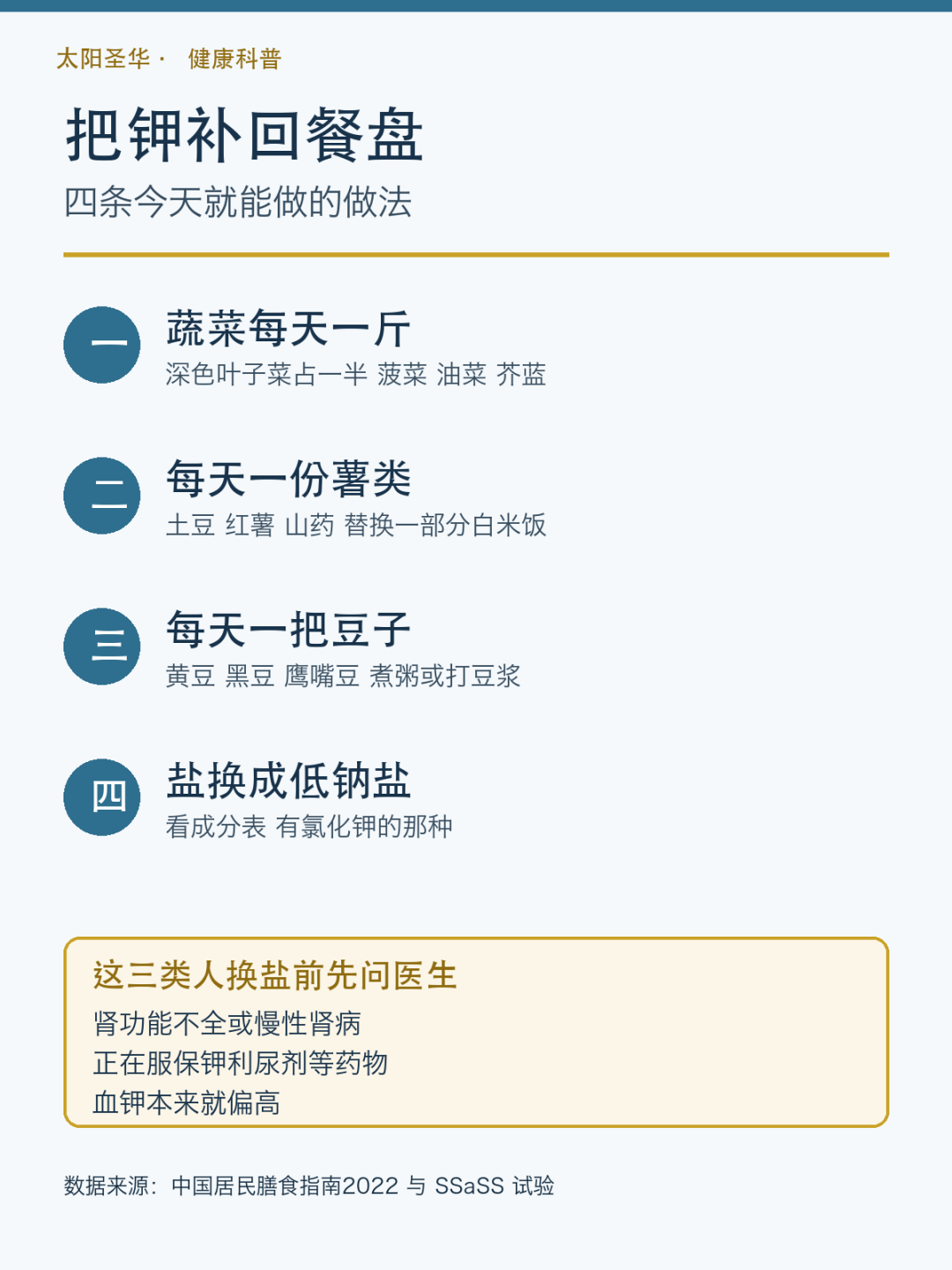
Caption: Four concrete ways to put potassium back on the plate, and the three groups of people who must ask a doctor before switching salt.
There are several situations where you should ask a doctor first and not switch on your own: people with impaired kidney function or chronic kidney disease, whose potassium excretion capacity is reduced, so supplementing potassium could turn into hyperkalemia; people taking potassium-sparing diuretics or similar medications; and people whose blood potassium is already on the high side. Potassium supplements are also not recommended for self-purchase and use—potassium in food is absorbed slowly and is buffered, and a potassium pill offers no such buffer.
Three Things You Can Do Today
One: next time you buy salt this week, check the ingredient list—look at the sodium content and whether potassium chloride is included.
Two: add one high-potassium food every day: a portion of tubers, a handful of beans, or a bowl of dark leafy vegetables.
Three: if your next checkup only tests sodium and potassium in the blood, ask your doctor whether a urine test should be added. The sodium-to-potassium ratio in urine reflects your usual diet better than the numbers in your blood.
Cutting salt is turning down the faucet; supplementing potassium is clearing the drain. Do both together, and the blood pressure ledger will finally balance.
Share this with the family member whose low-sodium salt has been sitting in the kitchen for six months while their blood pressure still falls just short.
If this was helpful to you, give it a like or a "Wow," and feel free to leave a comment telling us what topics you'd like to see.
✦ ✦ ✦
Disclaimer: This article is for health education purposes only and is intended for informational reference. It does not constitute medical advice; please consult a professional doctor if you have health concerns.
Declaration of Interests: This article involves no product recommendations or commercial partnerships, and has no conflicts of interest with the research institutions mentioned.
© 2026 Sun Saint Hua (Beijing) Medical Technology Co., Ltd.
References
[1] Liu Z, Man Q, Li Y, Yang X, Ding G, Zhang J, Zhao W. Estimation of 24-hour urinary sodium and potassium excretion among Chinese adults: a cross-sectional study from the China National Nutrition Survey. Am J Clin Nutr. 2024;119(1):164-173. PMID: 38176776
[2] Du X, Fang L, Xu J, Chen X, Bai Y, Zhong J. Association between 24-h urinary sodium and potassium excretion and blood pressure among Chinese adults aged 18-69 years. Sci Rep. 2021;11(1):3474. PMID: 33568767
[3] Aburto NJ, Hanson S, Gutierrez H, Hooper L, Elliott P, Cappuccio FP. Effect of increased potassium intake on cardiovascular risk factors and disease: systematic review and meta-analyses. BMJ. 2013;346:f1378. PMID: 23558164
[4] Larsson SC, Orsini N, Wolk A. Dietary potassium intake and risk of stroke: a dose-response meta-analysis of prospective studies. Stroke. 2011;42(10):2746-2750. PMID: 21799170
[5] Neal B, Wu Y, Feng X, et al. Effect of Salt Substitution on Cardiovascular Events and Death. N Engl J Med. 2021;385(12):1067-1077. PMID: 34459569
[6] Yang Q, Liu T, Kuklina EV, et al. Sodium and potassium intake and mortality among US adults: prospective data from the Third National Health and Nutrition Examination Survey. Arch Intern Med. 2011;171(13):1183-1191. PMID: 21747015
[7] O'Donnell M, Mente A, Rangarajan S, et al. Urinary sodium and potassium excretion, mortality, and cardiovascular events. N Engl J Med. 2014;371(7):612-623. PMID: 25119607