This article is for health education and informational purposes only and does not constitute medical advice; please consult a professional doctor for any health concerns.
✦ ✦ ✦
A day in the life of an office worker: sit for 8 hours at work, sit for another hour commuting, then collapse on the couch for 2 hours at home—prolonged sitting has long become the "national posture." But a large meta-analysis of 1.006 million people offers a reminder: the risks of prolonged sitting can actually be "offset" by exercise. After reading this card, share the 3 ways to break up sitting with colleagues and family members who sit all day.
✦ ✦ ✦
One Card to Understand: Prolonged Sitting and Mortality Risk
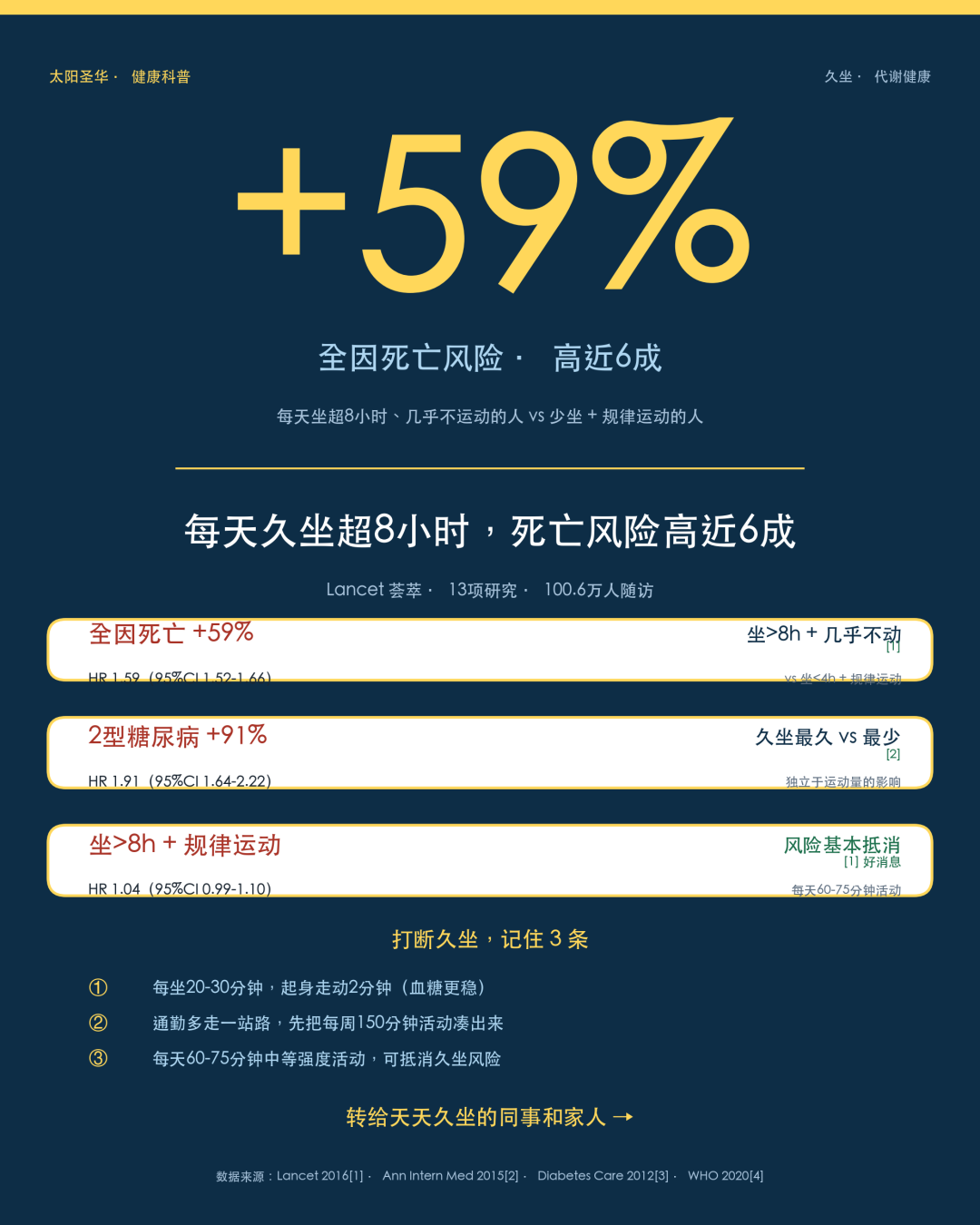
People who sit more than 8 hours a day and hardly exercise have a 59% higher risk of all-cause death than those who "sit less + exercise regularly"[[1]].
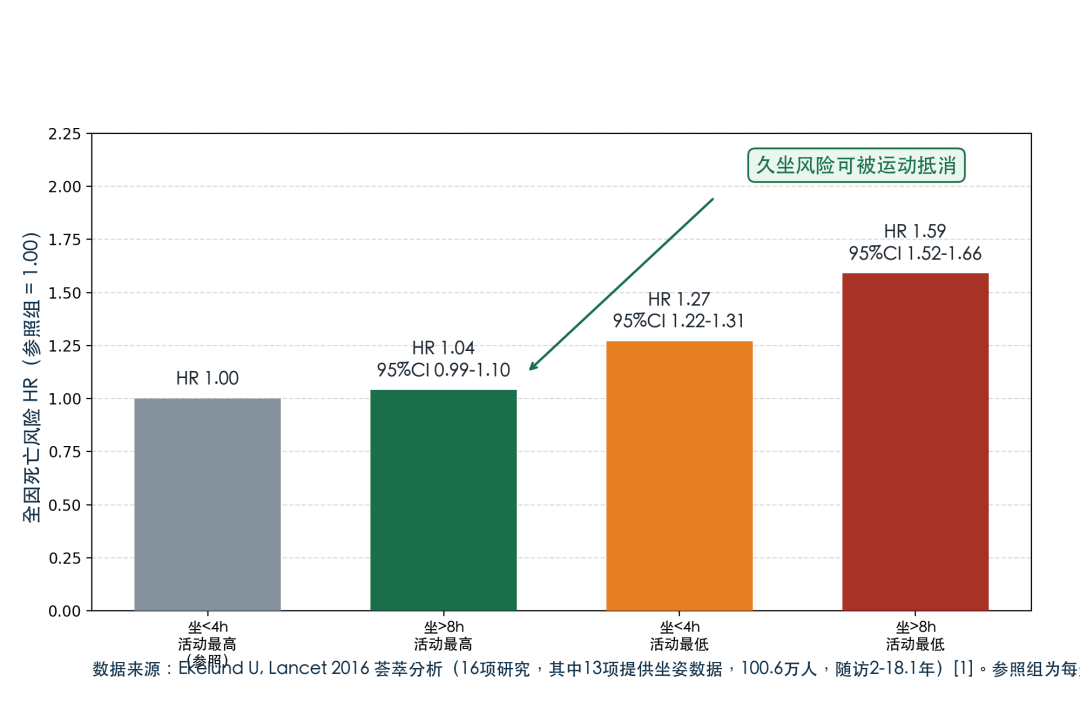
A meta-analysis published in The Lancet in 2016 pooled 13 studies that provided sitting data, with 1.006 million participants and follow-up ranging from 2 to 18.1 years. Compared with people who sat less than 4 hours a day and had the highest activity levels (HR=1.00), those who sat more than 8 hours a day and hardly exercised had a 59% higher risk of all-cause death (HR 1.59, 95%CI 1.52-1.66)[[1]].
The people who sit the longest have nearly double the risk of type 2 diabetes[[2]].
A systematic review of 47 studies showed that even after excluding the influence of physical activity levels, people with the longest sitting time still had a 91% higher risk of type 2 diabetes than those with the shortest sitting time (HR 1.91, 95%CI 1.64-2.22)[[2]].
Good news: 60-75 minutes of moderate-intensity activity a day basically offsets the risk of sitting more than 8 hours[[1]].
Among people who also sat more than 8 hours but had the highest activity levels (about 60-75 minutes of moderate-intensity activity per day), mortality risk was barely elevated (HR 1.04, 95%CI 0.99-1.10)[[1]]. In other words: if you can't avoid sitting, exercise can "hedge" it.
✦ ✦ ✦
To Break Up Sitting, Remember These 3 Tips
-
Every 20-30 minutes of sitting, get up and walk for 2 minutes—in a randomized crossover trial, overweight adults who got up and walked for 2 minutes every 20 minutes had postprandial blood glucose responses about 25% lower than those who stayed seated[[3]];
-
Get off one stop earlier on your commute and take a 10-minute brisk walk at lunch—first work up to 150 minutes of moderate-intensity activity per week[[4]][[5]];
-
If possible, raise the goal to 60-75 minutes per day—this is the activity level shown in research to "offset" the risks of prolonged sitting[[1]].
✦ ✦ ✦
Action advice: Set a 30-minute alarm on your phone. Every time it goes off, stand up, pour a glass of water, and take a few steps. Prolonged sitting can't be avoided, so use exercise to "hedge" it.
If this was helpful, give it a like or tap "Wow," and feel free to leave a comment telling us what topics you'd like to see. Share it with family and colleagues who sit all day, and lower the risk together.
✦ ✦ ✦
Disclaimer: The content of this article is compiled from publicly available academic literature and is for health education reference only. It does not constitute medical advice; please consult a professional doctor for your individual situation.
Conflict of interest statement: The author has no conflicts of interest with the studies mentioned in this article.
© 2026 Sun Saint Hua (Beijing) Medical Technology Co., Ltd.
References
-
Does physical activity attenuate, or even eliminate, the detrimental association of sitting time with mortality? A harmonised meta-analysis of data from more than 1 million men and women. Lancet. 2016;388(10051):1302-1310. PMID:27475271
-
Sedentary time and its association with risk for disease incidence, mortality, and hospitalization in adults: a systematic review and meta-analysis. Ann Intern Med. 2015;162(2):123-132. PMID:25599350
-
Breaking up prolonged sitting reduces postprandial glucose and insulin responses. Diabetes Care. 2012;35(5):976-983. PMID:22374636
-
World Health Organization (WHO). WHO Guidelines on Physical Activity and Sedentary Behaviour (2020).
-
Physical Activity Guidelines for the Chinese Population (2021). Issued by the Chinese Center for Disease Control and Prevention and others.