Thyroid Nodules on Your Checkup Report: 24.8% of People Have Them, and Most Only Need Follow-Up
This article is for health education purposes only and is intended as general information; it does not constitute medical advice. If you have any health concerns, please consult a professional doctor.
When checkup season arrives, ultrasound reports often come back with an extra line: thyroid nodules.
Many people, upon seeing these three words, immediately think: Is it cancer? Should I get it removed right away?
Let's put the conclusion up front: the vast majority of nodules require neither surgery nor biopsy. What they truly need is follow-up at the right intervals.
One in Every Four People Has Them
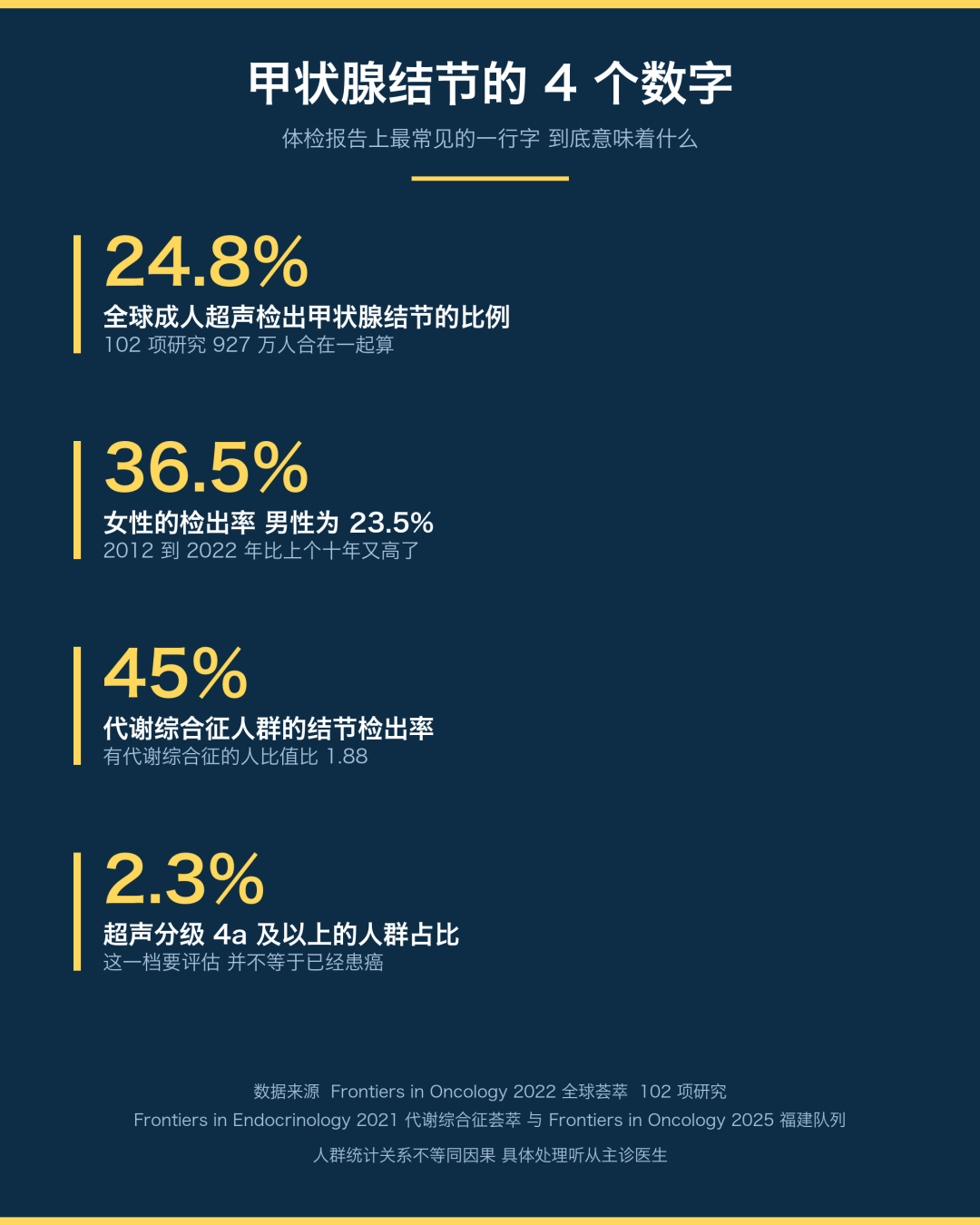
Pooling 102 studies covering 9.27 million people, the global detection rate of thyroid nodules among adults is 24.8% [1].
In plain terms: about one in every four people will have nodules show up on their report.
The rate is higher in women at 36.5%, versus 23.5% in men [1]. Earlier meta-analysis data from China put the figure at 22.7%, with a marked rise after 2002 [5].
Bigger Numbers Aren't Entirely Bad News
The detection rate from 2012 to 2022 was 29.29%, compared with 21.53% in the previous decade [1].
Part of the reason is that ultrasound keeps getting clearer—even small nodules of a few millimeters can no longer hide. The other part is that checkups are becoming more common.
Being found doesn't mean becoming more dangerous. In a natural-population study of 6,221 people in Fujian, the detection rate was as high as 67.2%, but only 2.3% were graded 4a or above on ultrasound and needed further evaluation [4].
Look at the Grade on the Report
The ultrasound doctor will assign a TI-RADS grade, which is far more useful than the three words "has nodules."
In the same study, grade 3 made up the majority, at 39.2% of the population [4]; this tier is usually managed mainly with regular follow-up.
Grade 4a and above means there are features in the appearance that warrant caution—such as ill-defined borders, a greater tall-than-wide shape, or microcalcifications—and at this point a specialist needs to decide whether a biopsy is needed.
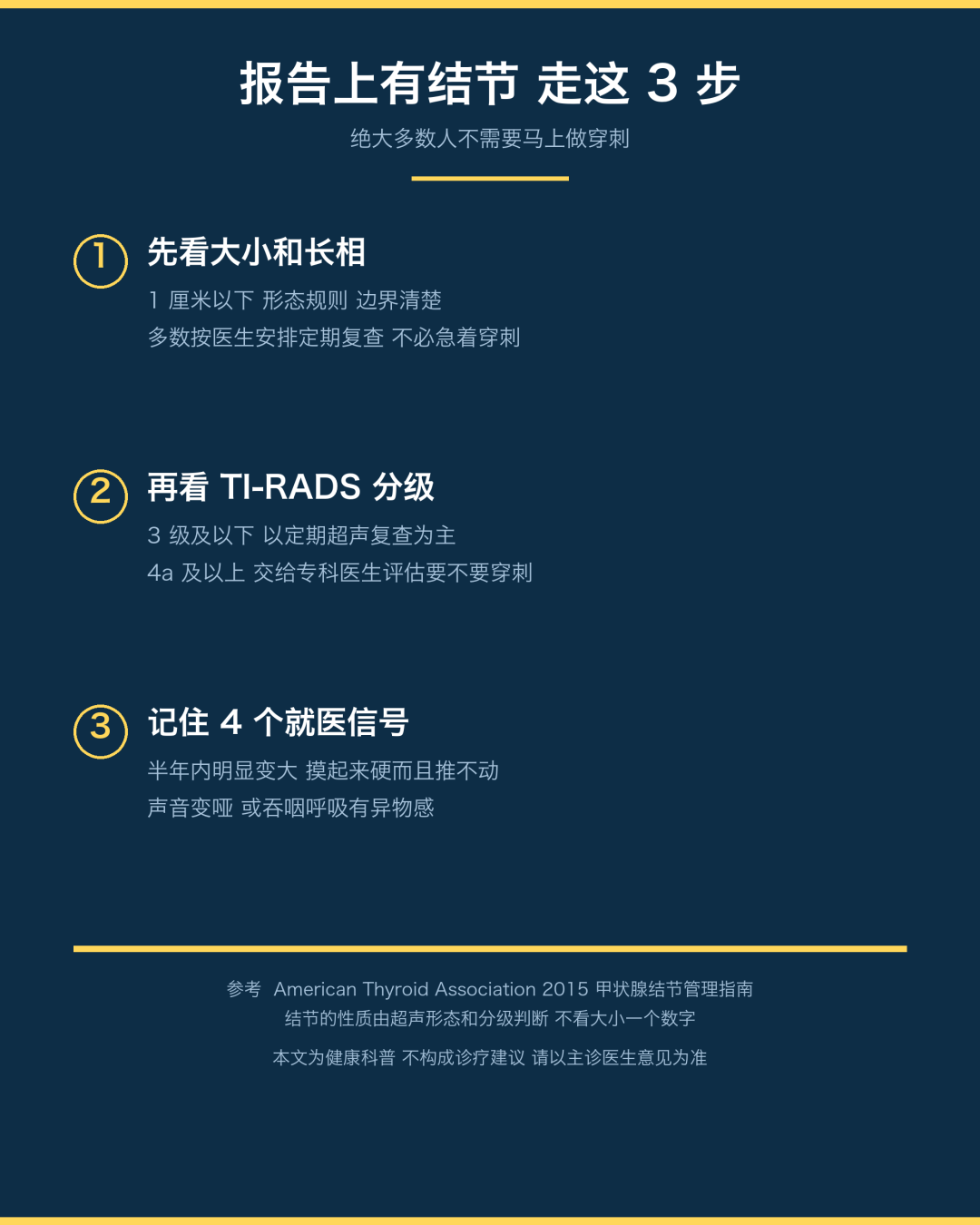
Size alone isn't enough. Nodules under 1 cm with regular shape and clear borders are mostly followed up first; conversely, even a small nodule with suspicious features will prompt a doctor to recommend further investigation.
Weight and Metabolism Really Do Affect the Thyroid
A meta-analysis of 13 studies showed that people with metabolic syndrome had an odds ratio of 1.88 for developing nodules, and the nodule detection rate in this population reached 45% [2].
In a cross-sectional survey in Tianjin, an iodine-sufficient area, the detection rate was 40.00% in adults and 21.72% in children; childhood obesity was associated with nodule risk, with an odds ratio of 1.53 in the high-BMI group [3].
It should be noted that in the same study, no clear association was seen between obesity and nodules in adults [3]. So it's more like this: managing your waistline, blood sugar, and blood lipids takes load off the thyroid—it's not that losing weight will make nodules disappear.
Iodine: No Need to Deliberately Avoid It, and Don't Overdo Supplements
A Chinese meta-analysis suggests that both iodine deficiency and iodine excess may be associated with thyroid problems [5].
For most people, eating iodized salt normally and eating seafood normally is enough. There's no need to switch to non-iodized salt long-term because of nodules, and large amounts of kelp and nori aren't recommended either.
The people who truly need to adjust iodine intake are those whose doctors have explicitly told them to.
Three Things You Can Do Today
First, go through your report and find the TI-RADS grade, nodule size, and follow-up time—don't just remember "has nodules."
Then follow the grade: for grade 3 and below, get follow-up ultrasound at the interval your doctor gives; for grade 4a and above, make an appointment at an endocrinology or thyroid surgery clinic.
Finally, remember four signals to see a doctor: noticeable enlargement within six months, a hard nodule that won't move when pushed, a hoarse voice, or a foreign-body sensation when swallowing or breathing.
While you're at it, treat weight and waist circumference as a long-term account to manage—it pays off for both metabolism and the thyroid.
Final Thoughts
A nodule is a record the body has left behind, not a verdict. It reminds you to get follow-ups on time and to manage your metabolism well; the rest, leave to time and your doctor.
If someone in your family just got their checkup report this year, forward this to them—it's better than letting them work themselves into a panic searching online.
If this was helpful, give it a like or a "Wow," and feel free to leave a comment telling us what topics you'd like to see.
✦ Disclaimer: This article is for health education purposes only and is intended as general information; it does not constitute medical advice. If you have any health concerns, please consult a professional doctor. Conflict of interest statement: This article does not involve any drug or device recommendations and has no financial relationship with the research institutions mentioned in the text. © 2026 Sunshenghua (Beijing) Medical Technology Co., Ltd.
References
[1] Mu C, Ming X, Tian Y, et al. Mapping global epidemiology of thyroid nodules among general population: a systematic review and meta-analysis. Front Oncol. 2022;12:1029926. PMID: 36439513
[2] Zhang C, Gao X, Han Y, Teng W, Shan Z. Correlation Between Thyroid Nodules and Metabolic Syndrome: A Systematic Review and Meta-Analysis. Front Endocrinol (Lausanne). 2021;12:730279. PMID: 34603208
[3] Zhang D, Wang Y, Li W, Duan Y, Li F, Cui Y. Association between obesity and thyroid nodules in children and adults living in iodine-sufficient areas: analysis of cross-sectional data from Tianjin, China. BMJ Open. 2024;14(12):e091494. PMID: 39806693
[4] Wang W, Xiao L, He M, et al. Prevalence of thyroid nodules and canceration risk assessment in TIRADS, and their relationships to obesity and dysglycemia. Front Oncol. 2025;15:1658717. PMID: 41089509
[5] Zhao W, Han C, Shi X, et al. Prevalence of goiter and thyroid nodules before and after implementation of the universal salt iodization program in mainland China from 1985 to 2014: a systematic review and meta-analysis. PLoS One. 2014;9(10):e109549. PMID: 25313993
[6] Haugen BR, Alexander EK, Bible KC, et al. 2015 American Thyroid Association Management Guidelines for Adult Patients with Thyroid Nodules and Differentiated Thyroid Cancer. Thyroid. 2016;26(1):1-133. PMID: 26462967