Fatty Liver Found on a Health Checkup—Can You Fix It by Cutting Out Oil? 5 Questions Explained Clearly
This article is health education for informational purposes only and does not constitute medical advice; if you have health concerns, please consult a professional doctor.
✦ ✦ ✦
When the words "fatty liver" appear on a health checkup report, many people instinctively think: I'll eat less oil from now on.
Then they eat as usual, stay up late as usual, sit as usual—and the next year's checkup report still shows those same three words. It doesn't hurt or itch, but the progress bar keeps moving.
Laying out five questions clearly is more useful than a single phrase like "eat less oil."
First, the scale: this is not a problem for a minority
About 25.24% of adults worldwide have fatty liver—a result pooled from 86 studies, 8.51 million people, and 22 countries [1].
Among people who are overweight and obese, this proportion is as high as 69.99%: 151 studies, 101,000 people [2].
China's numbers are similarly unflattering: among 229,000 lean or non-obese adults across 25 studies, fatty liver was 13.77% in the non-obese population and 8.98% in lean individuals [3]. Community populations at 14.19% and health-checkup populations at 13.55% are almost identical [3].
Q1 Is fatty liver caused by eating too much oil?
It's not about oil alone. The role of sugar and total calories has been underestimated.
In the Framingham Heart Study, 2,634 people underwent liver CT: those who drank at least 1 serving of sugar-sweetened beverages per day had 1.61 times the odds of fatty liver compared with non-drinkers, with a range of 1.04 to 2.49; the more they drank, the more pronounced the trend [6]. This association persisted even after adjusting for body mass index—indicating it's not simply a matter of "getting fat from drinking sweet beverages."
Liquid sugar doesn't contribute to satiety, goes down quickly, and reaches the liver quickly. That's what makes it more worth being wary of than a piece of cake.
Now look at who stands beside it: among people with fatty liver, 69.16% have comorbid dyslipidemia, 51.34% have comorbid obesity, 39.34% have comorbid hypertension, and 22.51% have comorbid type 2 diabetes [1].
So this is not an isolated liver problem—it's a metabolic problem manifesting in the liver.
Q2 Can lean people get it too?
Yes, and it's easily missed.
In the Chinese data set mentioned earlier, fatty liver was 8.98% in lean individuals and 13.77% in non-obese individuals [3]. These people have normal weight and unremarkable waistlines, and at checkups they may only get a passing "watch your diet."
Fatty liver in lean people is often accompanied by higher visceral fat, lower muscle mass, or long-term sedentary behavior and high-sugar diets. What the scale can't show, an ultrasound can.
So don't give yourself a free pass based on weight.
Q3 Will it progress to cirrhosis or liver cancer?
It can progress, but not quickly; and what truly determines the trajectory is not "whether there is fat" but "whether there is fibrosis."
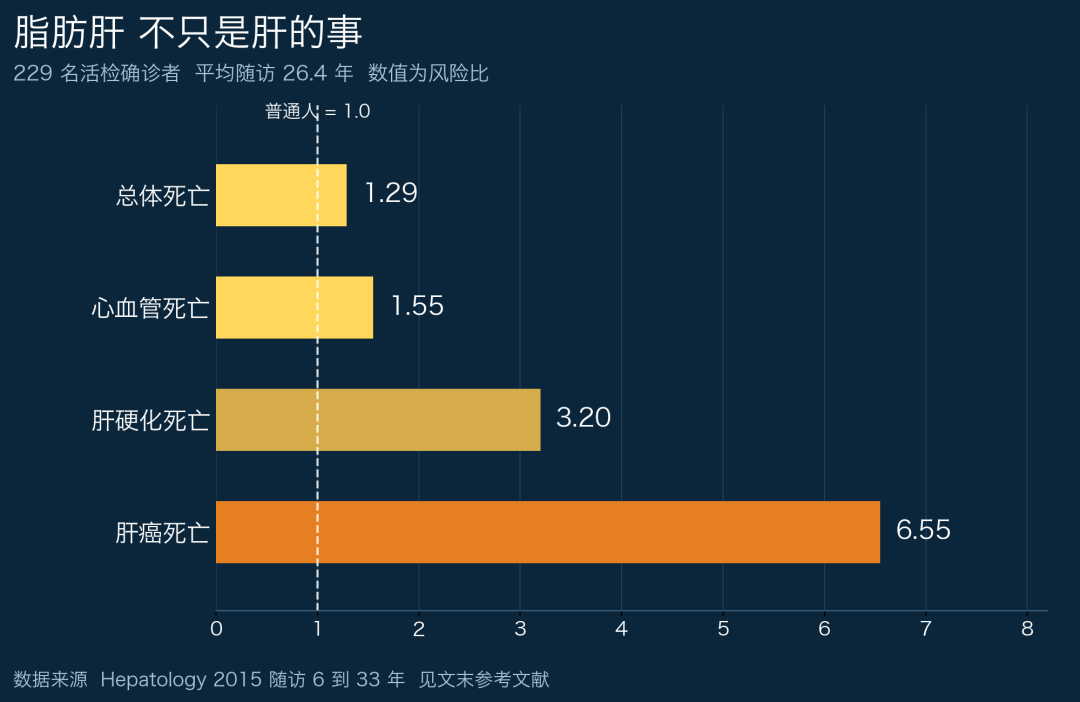
In 229 patients with biopsy-confirmed fatty liver, followed for a mean of 26.4 years: overall mortality risk was 29% higher than the general population, cardiovascular death was 55% higher, cirrhosis death was 3.2 times higher, and liver cancer was 6.55 times higher [4].
The dividing line is clear: in people with fibrosis stage 0 to 2, even if inflammation scores were high, overall mortality was not significantly elevated; once fibrosis reached stage 3 to 4, regardless of inflammation score, mortality risk was 3.3 times higher [4].
So when you get the report, don't stop at the three words "fatty liver"—it's worth asking one more question: Is there fibrosis in the liver, and should further evaluation be done?
Q4 How much weight loss is enough to help?
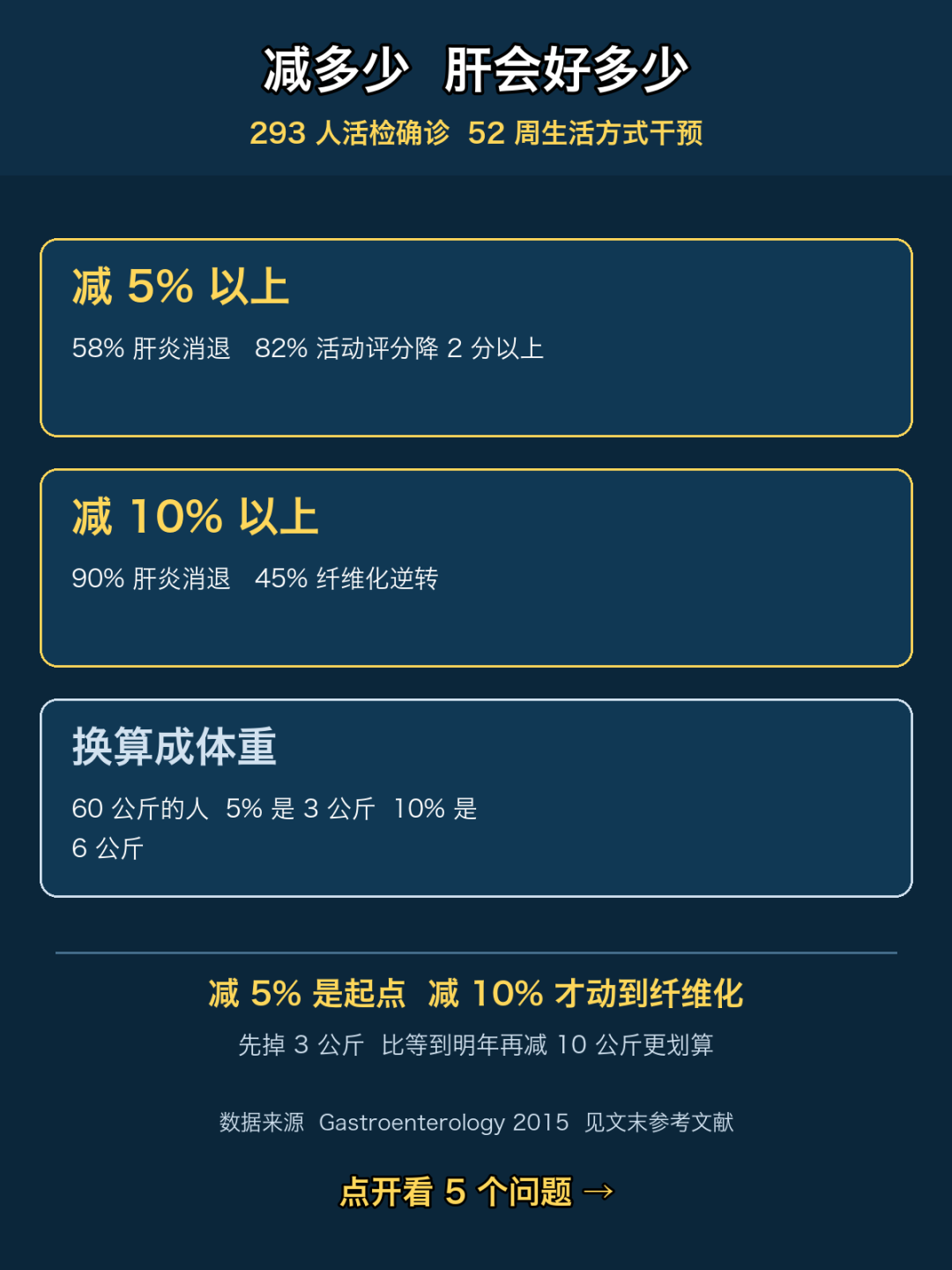
In 293 patients with biopsy-confirmed steatohepatitis who underwent a 52-week lifestyle intervention: 30% of participants lost 5% or more of their body weight [5].
In the group that lost 5% or more, 58% had resolution of steatohepatitis, and 82% had a decrease of 2 or more points in liver activity score [5].
Among those who lost 10% or more, all had decreases in activity scores, 90% had resolution of steatohepatitis, and 45% had fibrosis regression [5].
Converted to body weight: for a 60 kg person, 5% is 3 kg and 10% is 6 kg. These are not unreachable goals—they are amounts that can show visible change within a few months.
Q5 Specifically, how should you eat and move?
You don't need to cut out oil entirely. There are four things you can actually do.
First, replace sugar-sweetened beverages. Plain water, unsweetened tea, and sparkling water all work. This is the lowest-cost and fastest-acting of the measures [6].
Second, get moving—don't fixate on weight first. The American College of Sports Medicine consensus recommends: patients with fatty liver should get at least 150 minutes of moderate-intensity exercise per week, or 75 minutes of vigorous-intensity exercise; benefits can appear even without significant weight loss [7].
Third, ensure adequate protein and vegetables. Mix some whole grains and legumes into your staple foods, and reserve half the plate for vegetables at each meal.
Fourth, pick one day each week to weigh yourself in the morning and measure your waistline—look only at the four-week trend, not day-to-day fluctuations.
One more reminder: don't buy liver-protection products to take on your own. Whether fatty liver needs medication and whether fibrosis evaluation is needed should be left to a gastroenterologist or hepatologist.
Final thoughts
Fatty liver is not a verdict—it's more like a progress bar. It gives you years, even a decade or more, to make changes; every bit you change, it regresses a bit.
Consider sharing this with someone who also has those three words on their checkup report. Bookmark it and review it before your next checkup.
If this was helpful, give it a like or a "reading" click, and feel free to leave a comment telling us what topics you'd like to see.
✦ ✦ ✦
Disclaimer: This article is health education for informational purposes only and does not constitute medical advice; if you have health concerns, please consult a professional doctor.
Conflict of interest statement: This article does not involve any drug or product recommendations and has no financial relationship with the research institutions mentioned in the text.
© 2026 Sunsheng Hua (Beijing) Medical Technology Co., Ltd.
References
-
Global epidemiology of nonalcoholic fatty liver disease-Meta-analytic assessment of prevalence, incidence, and outcomes. Hepatology. 2016;64(1):73-84. PMID: 26707365
-
Global prevalence of non-alcoholic fatty liver disease and non-alcoholic steatohepatitis in the overweight and obese population: a systematic review and meta-analysis. Lancet Gastroenterol Hepatol. 2023;8(1):20-30. PMID: 36400097
-
Epidemiology of lean/non-obese nonalcoholic fatty liver disease in China: A systematic review and meta-analysis. Saudi Med J. 2023;44(9):848-863. PMID: 37717964
-
Fibrosis stage is the strongest predictor for disease-specific mortality in NAFLD after up to 33 years of follow-up. Hepatology. 2015;61(5):1547-1554. PMID: 25125077
-
Weight Loss Through Lifestyle Modification Significantly Reduces Features of Nonalcoholic Steatohepatitis. Gastroenterology. 2015;149(2):367-378. PMID: 25865049
-
Sugar-sweetened beverage, diet soda, and fatty liver disease in the Framingham Heart Study cohorts. J Hepatol. 2015;63(2):462-469. PMID: 26055949
-
Physical Activity and Nonalcoholic Fatty Liver Disease: A Roundtable Statement from the American College of Sports Medicine. Med Sci Sports Exerc. 2023;55(9):1717-1726. PMID: 37126039