Weight Plateaus Aren't About Eating Too Much: 5 Places Where Your Body Secretly Saves Energy
This article is for health education purposes only and is intended for informational reference. It does not constitute medical advice; please consult a professional doctor if you have any health concerns.
The number on the scale hasn't budged in three weeks.
You've counted calories, walked ten thousand steps, and cut half a bowl of rice from dinner.
The problem may not be what you're doing less of—but what your body is quietly burning less of.

The first place it saves energy: basal metabolism gets turned down
A six-year follow-up study published in Obesity in 2016 tracked 14 contestants from a weight-loss competition who lost an average of 58.3 kg over 30 weeks. Six years later, their resting metabolic rate was still 499 kcal per day lower than what would be predicted from their body weight and composition at the time [1].
The calories the body needs to maintain heartbeat, breathing, and body temperature had been turned down—and the drop exceeded what the weight loss alone should have caused. That extra gap is metabolic adaptation.
It's not permanent damage, but it's real. Another study went further: in people who had maintained weight loss for over a year, total energy expenditure remained below what would be expected for their body weight—and the difference was even more pronounced at low activity levels [2].
This is why the same amount of food that helped you lose weight in week one leaves the scale frozen by week eight. A plateau isn't a moral failing of "not trying hard enough"—it's your body doing what it's always done: saving energy.

Caption: Six years after weight loss, resting metabolism remains 499 kcal below what body composition would predict—the body's energy-saving switch stays off longer than you'd think.
The second place it saves energy: small movements quietly decrease
Non-exercise activity thermogenesis refers to the energy burned through walking, standing, and doing chores—activities that don't count as exercise. Research has found that among people of the same weight, the difference in this energy expenditure can be as much as 2,000 kcal per day. People with higher body weight sit an average of 2.5 more hours per day than those with normal weight; if that time were made up, it would burn roughly 350 extra kcal per day [3].
350 kcal isn't an abstract concept: it's roughly a bowl of rice plus an egg.
When weight drops and the body becomes more "efficient," sitting time quietly increases. This is the most hidden leak during a plateau—and the part the scale can't see.
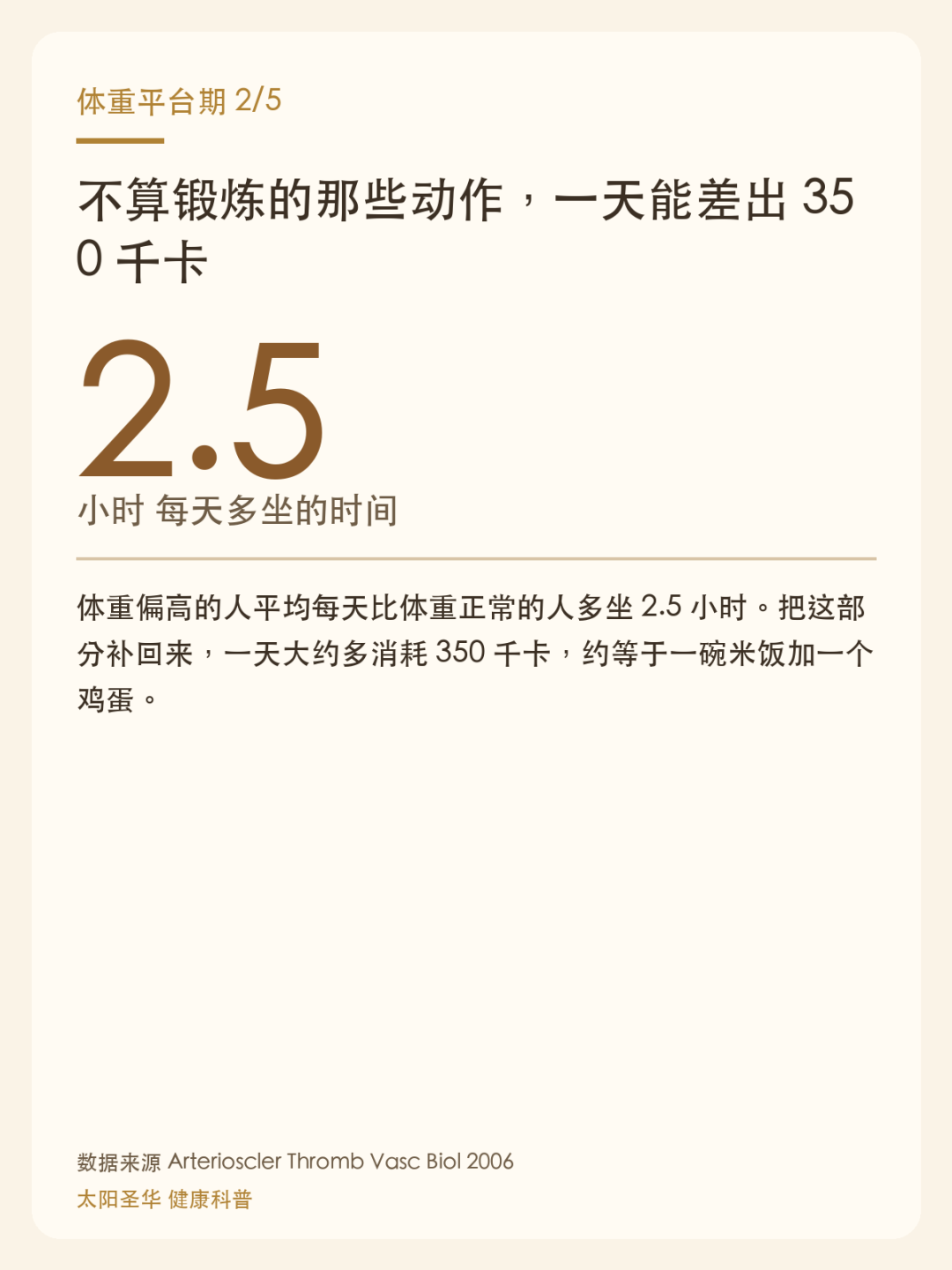
Caption: The relationship between sitting 2.5 extra hours per day and 350 kcal, and the direction for restoring non-exercise energy expenditure.
The third place it saves energy: satiety signals become dulled
A trial published in the American Journal of Clinical Nutrition increased the protein intake of the same group of people from 15% to 30% while keeping carbohydrate ratios unchanged. After twelve weeks, they spontaneously ate 441 fewer kcal per day, lost 4.9 kg of body weight, and lost 3.7 kg of fat [4].
No one told them to eat less—their sense of fullness strengthened on its own.
If you don't eat enough protein during weight loss, your body will come collecting with "more hunger." A common range is 1.2 to 1.6 grams per kilogram of body weight per day, spread across three meals—about 20 to 30 grams of protein per meal: an egg plus a glass of milk, or a palm-sized piece of fish, poultry, or tofu.
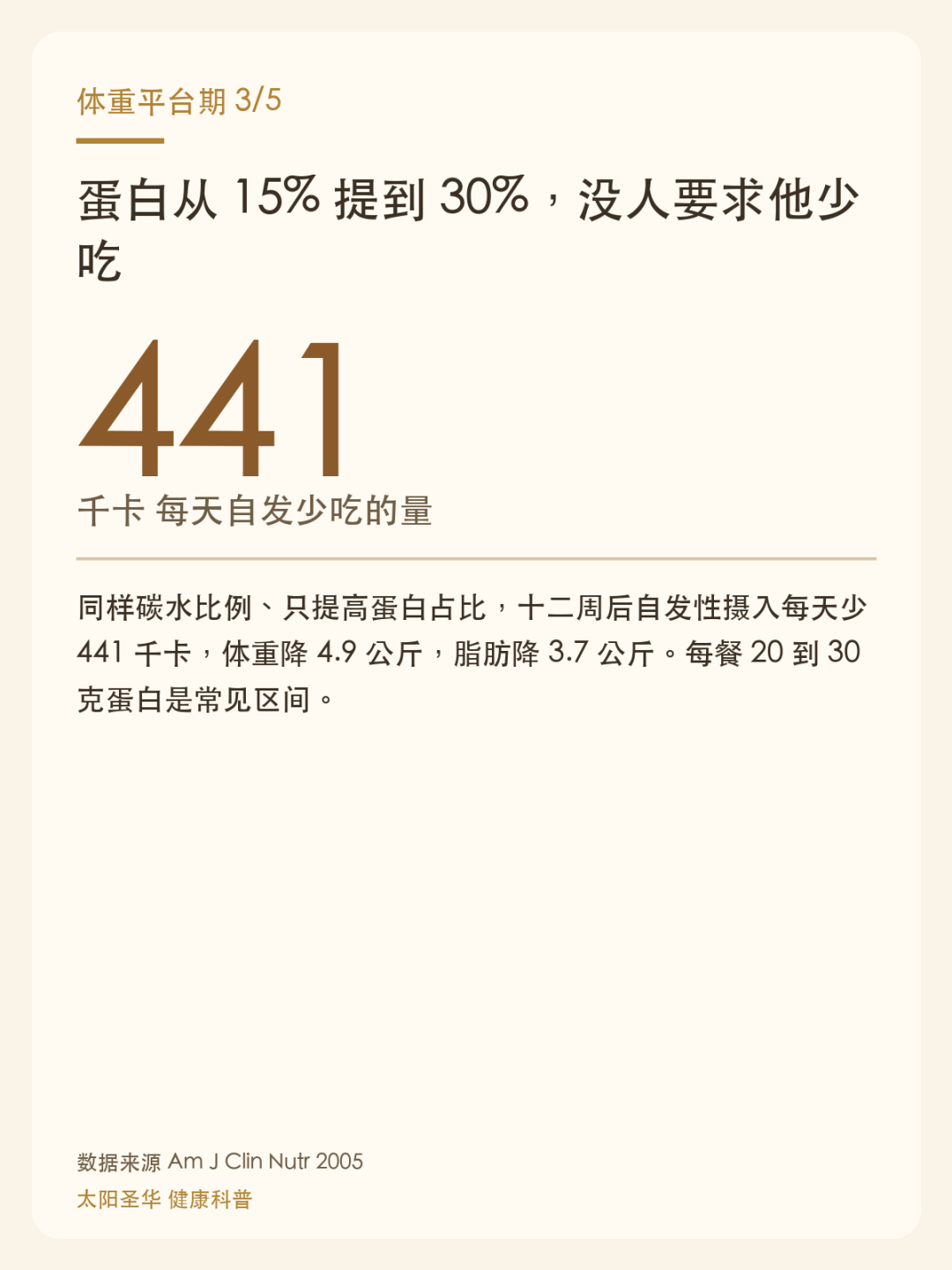
Caption: Raising only the protein ratio while keeping carbs unchanged led to 441 fewer kcal of spontaneous intake per day, with body weight and fat declining in tandem.
The fourth place it saves energy: not enough sleep means you lose more muscle
With the same calorie restriction, one group slept 8.5 hours per night while another slept only 5.5 hours. In the sleep-deprived group, fat made up 55% less of the weight lost (0.6 kg vs. 1.4 kg), while lean mass including muscle was lost 60% more (2.4 kg vs. 1.5 kg) [5].
The scale can't show this difference, but your metabolic rate can—less muscle means lower basal expenditure, and the next plateau arrives sooner.
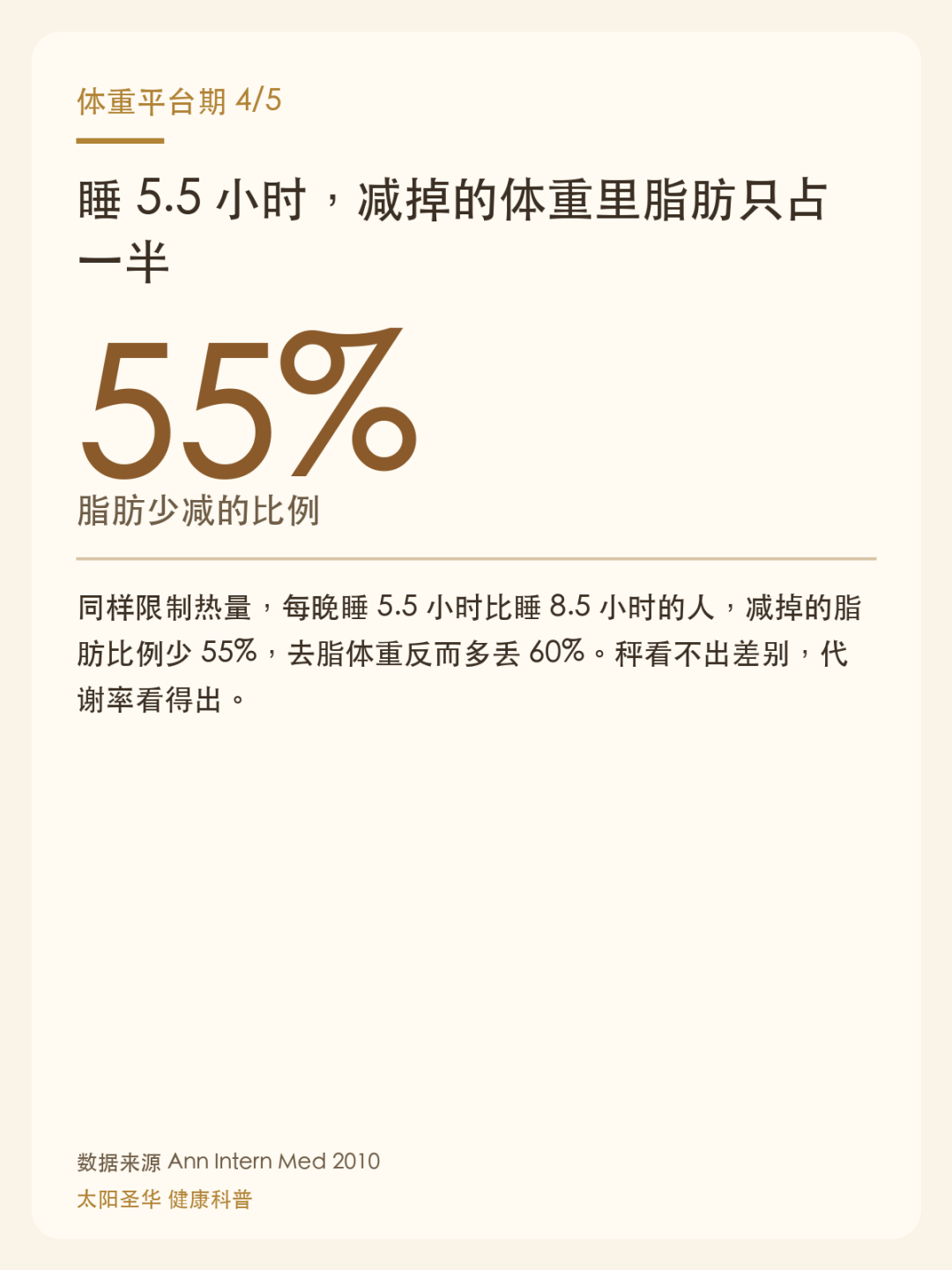
Caption: With identical calorie restriction, the impact of 5.5 hours vs. 8.5 hours of sleep on fat loss and lean mass.
The fifth place it saves energy: blind spots in your food log
A systematic review pooling 22 studies found a consistent association between self-monitoring and weight-loss outcomes, though methodological limitations meant the evidence could only be rated as limited [6].
This doesn't prevent a simple conclusion: people typically underestimate how much they eat. What's most often missed isn't staple foods—it's cooking oil, salad dressing, a handful of nuts, and that drink that "doesn't have much."
Also, body weight fluctuates naturally: a salty meal, a high-carb day, or the days around a woman's menstrual cycle can all push the scale up by one to two kilograms—that's not fat.

Caption: The four most commonly overlooked items in food logs, and the normal range of daily weight fluctuation.
What to change during a plateau—these five things, not cutting food in half again
-
Don't cut calories first: Raise protein to 20–30 grams per meal, sleep at least 7 hours, and observe for two weeks before making changes.
-
Change only one variable per week: Weigh yourself at the same time and under the same conditions—after waking and emptying your bladder, in the same clothes—and look at the seven-day average, not single days.
-
Make up for the non-exercise part: Take phone calls standing up, take a ten-minute slow walk after meals, stand up once every hour.
-
Log what you eat, not just how many calories: Record oil, sauces, drinks, and nuts on separate lines.
-
Accept normal weight fluctuation: A one-kilogram swing within a week is mostly water.
A plateau isn't your body betraying you—it's running on lower costs. What you need to do is raise the costs back up, not cut your food in half again.
Share this with someone who's stuck at the same number and has started to doubt themselves.
If this was helpful, give it a like or a "reading" mark, and feel free to leave a comment telling us what topics you'd like to see.
✦ ✦ ✦ ✦ ✦ ✦ ✦ ✦ ✦ ✦
Disclaimer: This article is for health education purposes only and is intended for informational reference. It does not constitute medical advice; please consult a professional doctor if you have any health concerns.
Conflict of interest statement: This article does not involve any drug, product, or brand recommendations, and has no financial relationship with the research institutions mentioned in the text.
© 2026 Sun Saint Hua (Beijing) Medical Technology Co., Ltd.
References
[1] Fothergill E, Guo J, Howard L, et al. Persistent metabolic adaptation 6 years after "The Biggest Loser" competition. Obesity (Silver Spring). 2016;24(8):1612-1619. PMID: 27136388
[2] Rosenbaum M, Hirsch J, Gallagher DA, Leibel RL. Long-term persistence of adaptive thermogenesis in subjects who have maintained a reduced body weight. Am J Clin Nutr. 2008;88(4):906-912. PMID: 18842775
[3] Levine JA, Vander Weg MW, Hill JO, Klesges RC. Non-exercise activity thermogenesis: the crouching tiger hidden dragon of societal weight gain. Arterioscler Thromb Vasc Biol. 2006;26(4):729-736. PMID: 16439708
[4] Weigle DS, Breen PA, Matthys CC, et al. A high-protein diet induces sustained reductions in appetite, ad libitum caloric intake, and body weight despite compensatory changes in diurnal plasma leptin and ghrelin concentrations. Am J Clin Nutr. 2005;82(1):41-48. PMID: 16002798
[5] Nedeltcheva AV, Kilkus JM, Imperial J, Schoeller DA, Penev PD. Insufficient sleep undermines dietary efforts to reduce adiposity. Ann Intern Med. 2010;153(7):435-441. PMID: 20921542
[6] Burke LE, Wang J, Sevick MA. Self-monitoring in weight loss: a systematic review of the literature. J Am Diet Assoc. 2011;111(1):92-102. PMID: 21185970