This article is for health education purposes only and is intended as general information. It does not constitute medical advice; if you have health concerns, please consult a professional physician.
Weigh yourself once before heading out in the morning, then again after getting home in the evening—the numbers often don't match.
Some people take this to mean that the day's exercise was wasted; others simply suspect the scale is broken.
But what the scale measures within the same hour is actually the combined result of four things stacked together. Fat is only one of them, and it changes slowly.
First, a data point worth taking seriously
A prospective cohort study in Korea followed 3,678 adults for 16 years, with checkups every 2 years. The researchers calculated each person's "successive change magnitude" in body weight: for every 1-unit increase in this magnitude, the risk of all-cause mortality was 46% higher (hazard ratio 1.46, 95% confidence interval 1.32 to 1.62) [4].
To be clear, this is not about fluctuations "within a single day," but about ups and downs between checkups over several years. Both phenomena are real, but their causes and how to respond to them are completely different—they need to be looked at separately.
1. What changes within a day is mainly water and contents
Glycogen and water are bound together. When glycogen is stored in muscle, it brings water along with it, so after a few days of eating less carbohydrate, glycogen and water both go down, and the scale drops quickly [3].
Conversely, once you eat carbohydrates again, glycogen is replenished, water comes back with it, and the scale immediately goes up. This isn't getting fat again—it's restocking.
Menstruation brings half-kilogram-level fluctuations. A study of 42 women measured body weight and body composition twice a week: body weight during menstruation was 0.45 kg higher than during the week the cycle began, of which extracellular water increased by 0.474 kg [5].
What went up was almost entirely water—not an ounce of fat moved.
Salt, gut contents, and the water you drink that day are also on the scale. A heavy-flavored meal, a missed bowel movement, or a large bottle of water after exercise can all change the next day's number. In plain terms: this portion of change is the body's "water level" and "inventory," not "stock quality."
So when morning and evening differ by a chunk on the same day, or when things swing up and down over a month, most of the time you're looking at water level, not fat.
2. Long-term ups and downs are the real risk signal
In that same cohort of 3,678 people over 16 years, those with greater fluctuation magnitude had a significantly higher risk of death during follow-up [4]. The value of this kind of research isn't to scare people, but to remind us: weight management is about the direction over a year, not the number on a single day.
Another study also clarified the population characteristics. Among 77,424 people in the Korean National Health Insurance database, each of whom had 5 checkups between 2009 and 2013, among those in the top quartile of fluctuation magnitude: those under 40 had more than double the rate of those over 65 (odds ratio 2.17), women had a higher rate than men (odds ratio 1.67), and among men, those with lower income had nearly double the rate of those with higher income (odds ratio 1.97) [6].
High fluctuation in women was also associated with heavy drinking (odds ratio 1.50) and current smoking (odds ratio 1.97) [6]. In other words, high fluctuation is often not an isolated phenomenon—it's frequently accompanied by several habits that can be changed.
3. Weighing yourself is useful, but it depends on how you use it
First, the conclusion: the scale itself isn't magical—it's the scale plus "what you do after seeing the number" that's useful.
A systematic review of 17 prospective longitudinal studies found that regular self-weighing was associated with greater weight loss and did not produce adverse psychological outcomes such as depression or anxiety [1].
A meta-analysis of randomized controlled trials calculated the effect sizes more precisely: advice to weigh alone, without any accompanying program, produced 0.5 kg more weight loss, but the difference was not significant; adding weighing and recording to a full behavioral program produced 1.7 kg more weight loss than without it (95% confidence interval 2.6 to 0.8); behavioral interventions that included weighing produced 3.4 kg more weight loss compared with control groups receiving little to no intervention (95% confidence interval 4.2 to 2.6) [2].
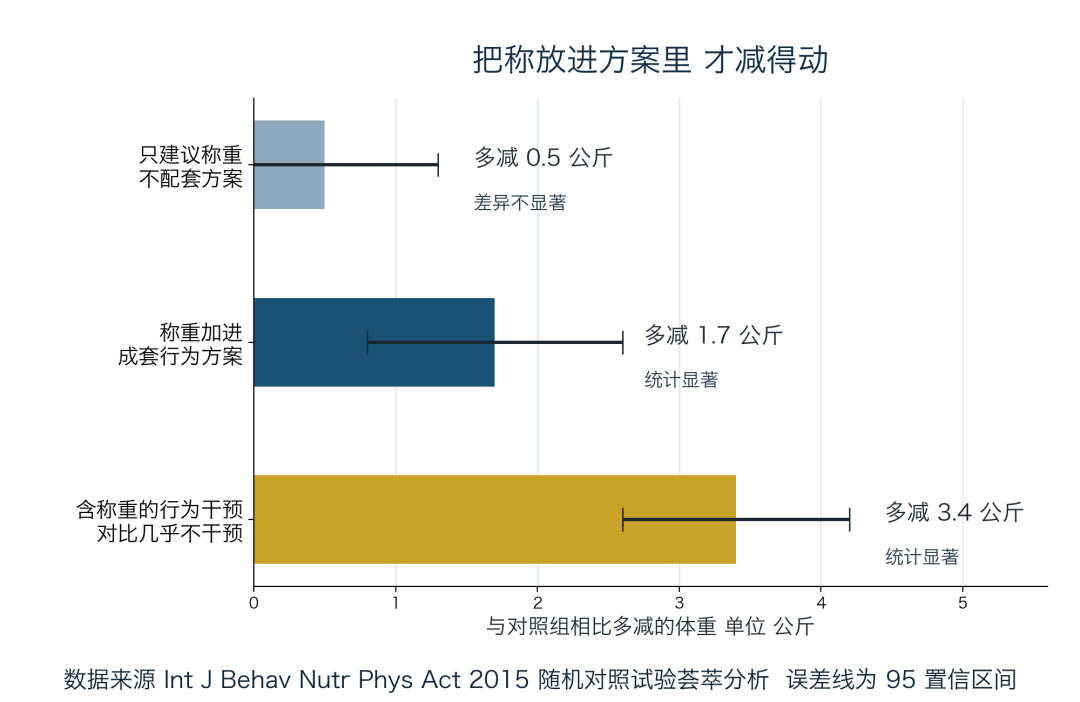
The same meta-analysis also found no significant difference between daily and weekly weighing; however, interventions with an "accountability" design—such as sharing the number with a coach or peer—produced greater weight loss (P=0.03) [2].
This conclusion is good news for people who fear the scale: frequency is negotiable; what matters is whether someone sees it and whether anything happens after seeing it.
4. How to weigh so the number carries information

One, fix the conditions. Morning, after using the toilet, on an empty stomach, same scale, same floor surface. If the conditions change, comparison becomes meaningless.
Two, record only the weekly average. Keep daily numbers to observe trends, but use the seven-day average to judge progress—it's more stable than any single day.
Three, don't weigh twice a day. Once in the morning and once in the evening will only lead you to make useless judgments about water.
Four, add waist circumference and photos to your records. Weight is the sum of four things; waist circumference changes more decisively.
Five, if fluctuations suddenly increase, look for the cause first. Have you been eating saltier, eating more carbs, drinking more alcohol, sleeping less, or having irregular bowel movements lately? All five are common and all five can be changed.
5. When to go to a clinic
If any of these occur, stop adjusting things on your own: significant weight loss in a short period without deliberate dieting; weight fluctuations accompanied by bilateral ankle or eyelid swelling, shortness of breath, or changes in urine output; persistent fatigue, palpitations, or hair loss during weight loss.
These do not fall under "water level changes" and require a doctor's evaluation.
Three things you can do today
One, move the scale to a fixed location and, starting tomorrow, weigh only under fixed conditions.
Two, change your recording method from "today's number" to "this week's average."
Three, find someone who can see your numbers and send them the number once a week—research found that this alone is worth several kilograms.
The scale is not a judge; it's a dashboard.
If this article helped you feel a little less anxious about the number on the scale, feel free to share it with that person who weighs three times a day and agonizes over it every time.
If you found this helpful, give it a like or a "reading" mark, and feel free to leave a comment telling us what topics you'd like to see.
Disclaimer: This article is for health education purposes only and is intended as general information. It does not constitute medical advice; if you have health concerns, please consult a professional physician.
Conflict of interest statement: This article does not involve any drug or product recommendations, and the author has no financial relationship with the research institutions mentioned in the text.
© 2026 Sun Saint Hua (Beijing) Medical Technology Co., Ltd.
References
[1] Zheng Y, Klem ML, Sereika SM, et al. Self-weighing in weight management: a systematic literature review. Obesity (Silver Spring). 2015;23(2):256-265. PMID: 25521523
[2] Madigan CD, Daley AJ, Lewis AL, et al. Is self-weighing an effective tool for weight loss: a systematic literature review and meta-analysis. Int J Behav Nutr Phys Act. 2015;12:104. PMID: 26293454
[3] Shiose K, Takahashi H, Yamada Y. Muscle Glycogen Assessment and Relationship with Body Hydration Status: A Narrative Review. Nutrients. 2022;15(1):155. PMID: 36615811
[4] Oh TJ, Moon JH, Choi SH, et al. Body-Weight Fluctuation and Incident Diabetes Mellitus, Cardiovascular Disease, and Mortality: A 16-Year Prospective Cohort Study. J Clin Endocrinol Metab. 2019;104(3):639-646. PMID: 30500906
[5] Kanellakis S, Skoufas E, Simitsopoulou E, et al. Changes in body weight and body composition during the menstrual cycle. Am J Hum Biol. 2023;35(11):e23951. PMID: 37395124
[6] Han K, Kim MK. Factors Affecting High Body Weight Variability. J Obes Metab Syndr. 2023;32(2):163-169. PMID: 37189229