This article is for health education purposes only and is intended for informational reference. It does not constitute medical advice; if you have health concerns, please consult a professional doctor.
Normal Weight, High Triglycerides? It's Probably These 3 Habits
When you flip to the blood lipids section of your health check report, everything else looks stable—only triglycerides have an upward arrow next to them.
You might even defend yourself: I'm not overweight, I don't eat much fatty meat, and I've even switched to small bottles of cooking oil. How is this number still high?
Because triglycerides don't come from "eating oil." In the blood, they're more like a transport fleet, mainly hauling sugar the body has nowhere to put and the alcohol you drink.
First, some numbers: A pooled analysis of 41 studies of Chinese adults covering 1.31 million people found an overall detection rate of dyslipidemia of 42.1%, including 15.4% with high triglycerides—about 1 in every 6 to 7 adults. But only 18.2% of people knew they had a lipid problem, and only 5.4% actually achieved control targets.[1]
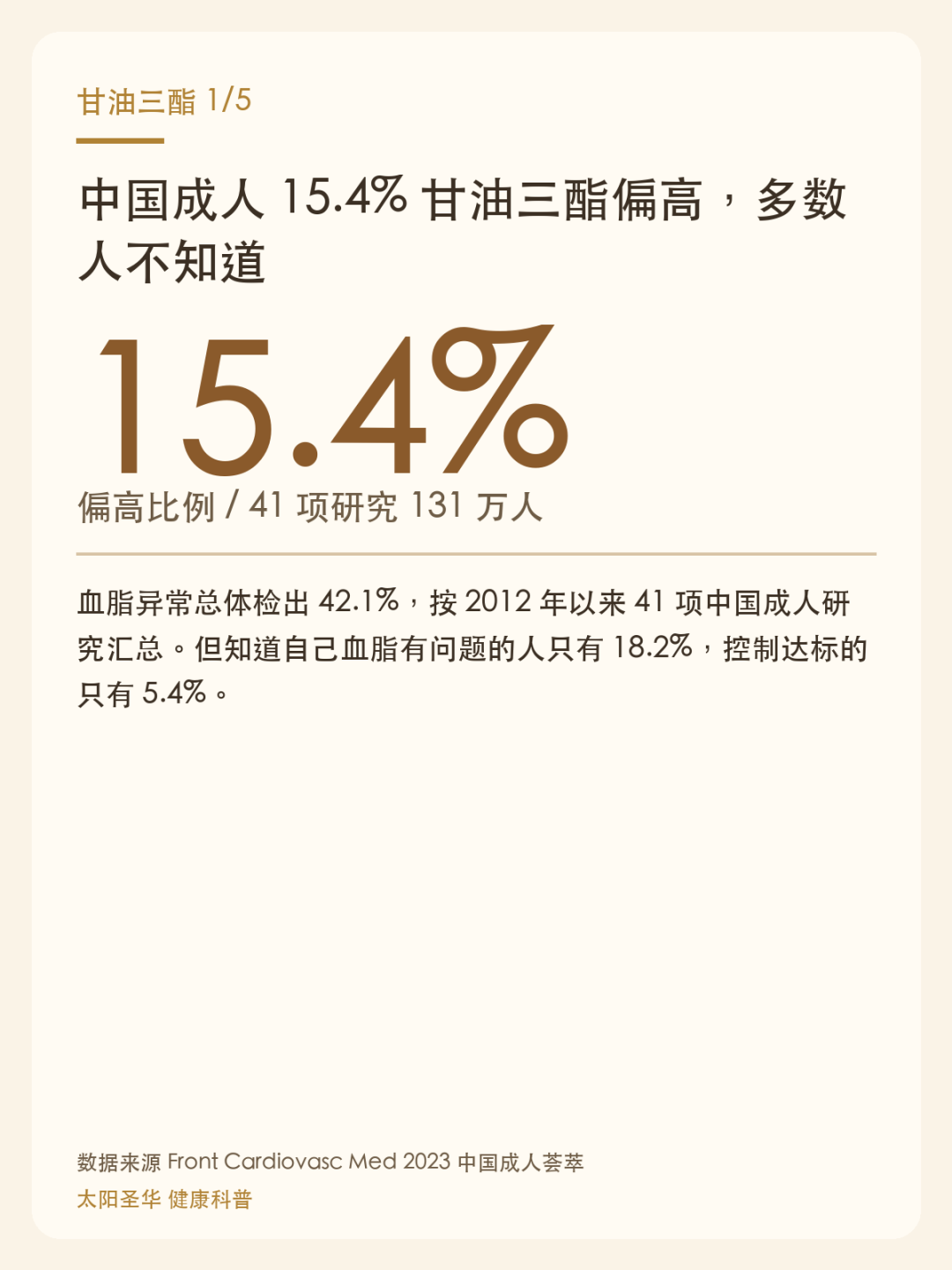
Figure caption: The lipid ledger of 1.31 million Chinese people—elevated triglycerides account for 15.4%, while awareness and control rates are only 18.2% and 5.4%, respectively.
1. The "freight trucks" in your blood are carrying sugar and alcohol
Triglycerides are a form of energy storage: when the energy you take in exceeds what you need right now, the excess gets packaged into triglycerides and transported through the blood to fat tissue for storage. So whether they're high depends on how much sugar and alcohol are in the "incoming shipments," and whether you're burning enough.
A pooled analysis of 39 randomized controlled trials is quite direct: under the same total calorie intake, the group eating more sugar had triglycerides on average 0.11 mmol/L higher than the group eating less sugar (95% interval 0.07 to 0.15). The key point is that this difference is independent of whether body weight changes—you can raise triglycerides without gaining weight.[2]
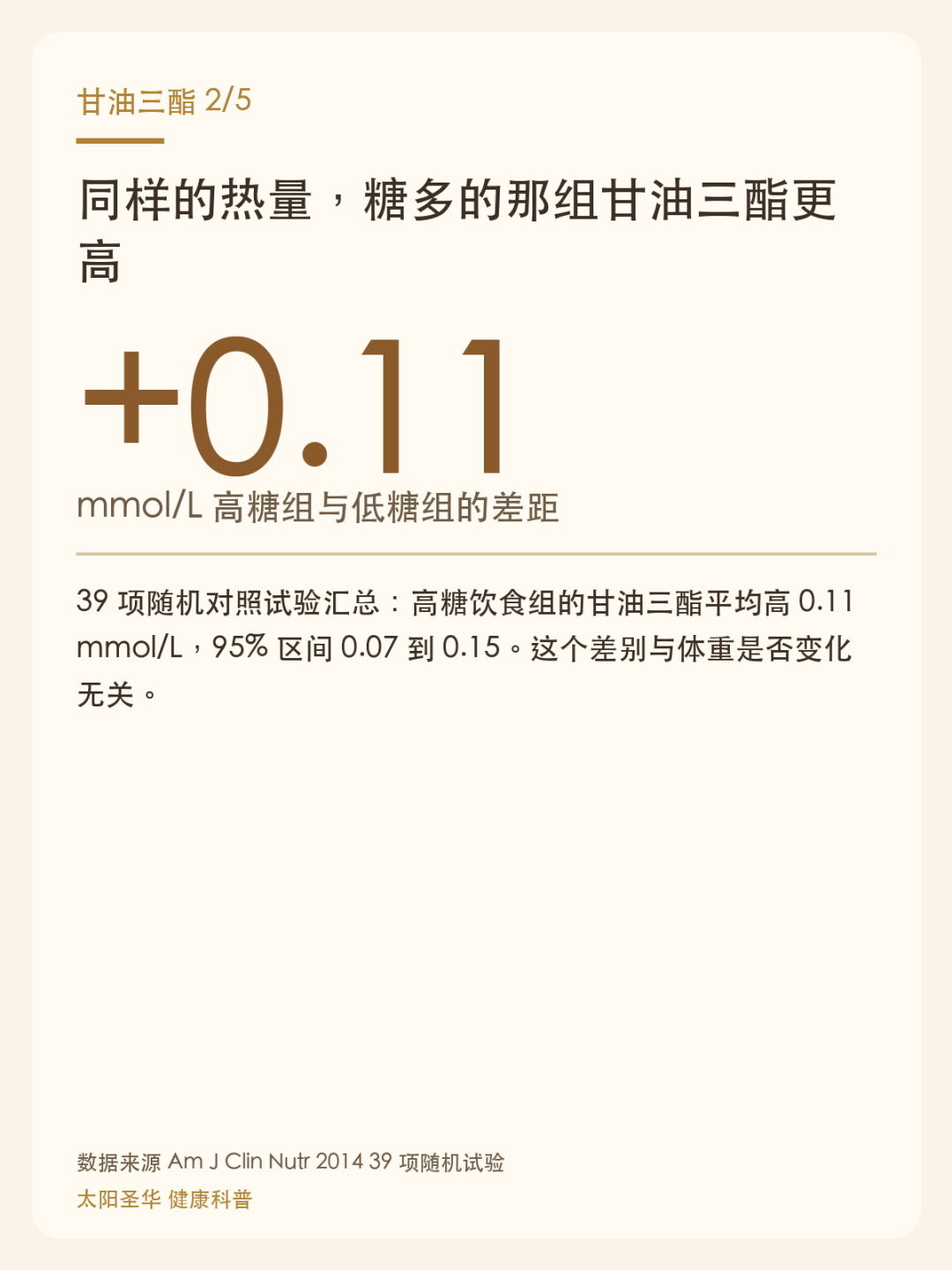
Figure caption: Under isocaloric conditions, the high-sugar diet group had triglycerides on average 0.11 mmol/L higher than the low-sugar group, independent of weight change.
2. Habit one: Liquid sugar—every sip is spoonfuls of sugar
Sweetened beverages, juice, sweetened milk tea, and flavored coffee—the sugar is dissolved in water and drunk directly, absorbed quickly, with almost zero satiety. The same spoonful of sugar, eaten versus drunk, is processed by the body at completely different speeds; and liquid sugar leaves almost no trace on hunger, making it very easy to overconsume.
Carbonated drinks, fruit-flavored beverages, concentrated juice, and coffee with added syrup all count. If you want something sweet, start by swapping your cup for plain water or unsweetened tea, then check your health report again in two weeks.
3. Habit two: Alcohol, especially "just a little every day"
Alcohol directly drives the liver to synthesize triglycerides. Among 300 people with triglycerides above 11.3 mmol/L, 24% had a history of long-term heavy drinking; among those in the upper quartile of triglycerides, this proportion rose to 43%.[4] "Heavy" here means men exceeding 210 grams of pure alcohol per week—roughly 420 mL of 50-proof baijiu; women exceeding 140 grams.
If your health report already says "elevated triglycerides," stopping alcohol first is a step with quick returns: designate two days a week with absolutely no drinking—this is easier to achieve than "drinking a little less every day."
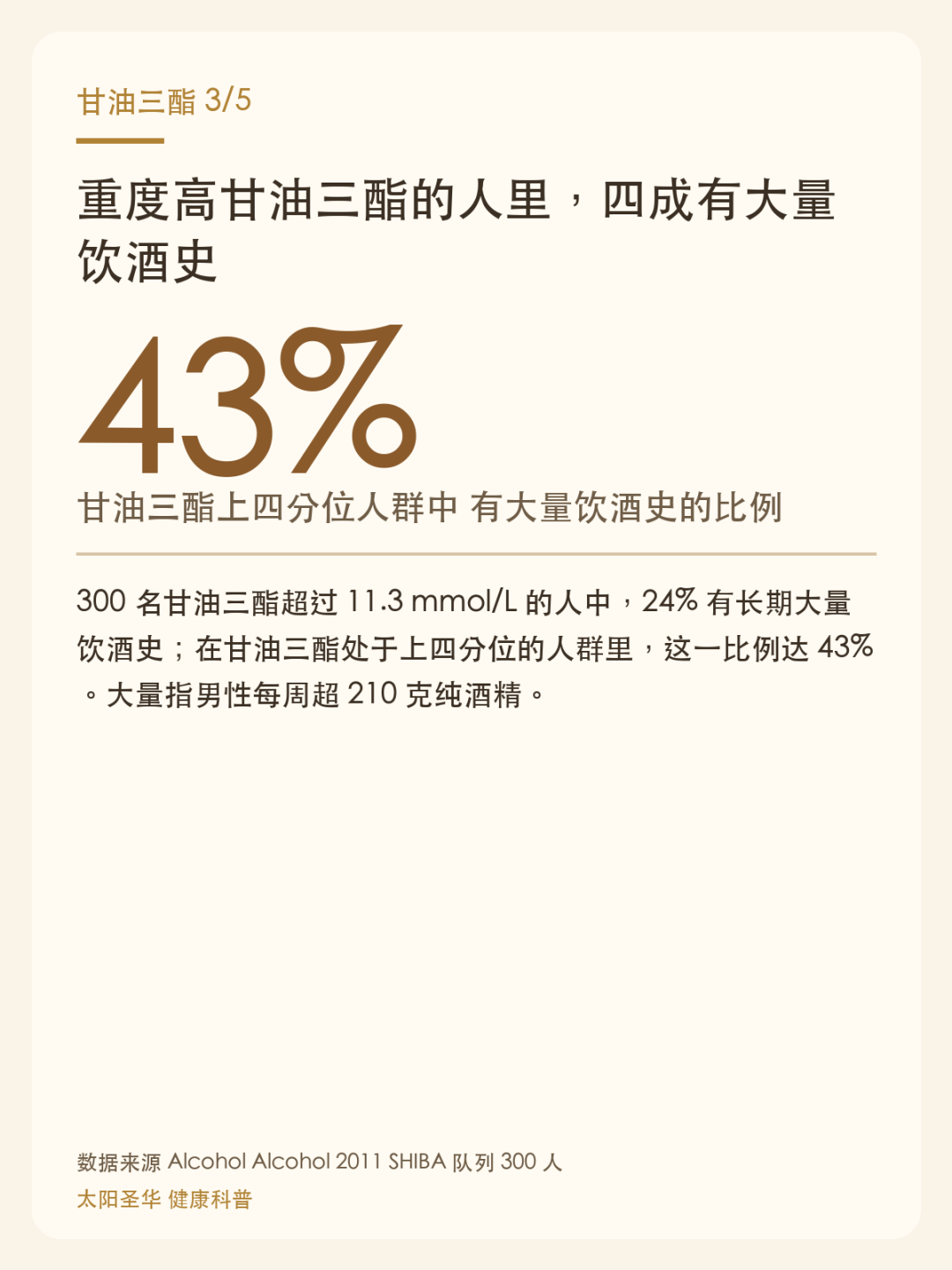
Figure caption: Among 300 people with severe hypertriglyceridemia, 24% had a history of heavy drinking; among those in the upper quartile of triglycerides, this proportion reached 43%.
4. Habit three: Waist circumference and prolonged sitting slow down your "processing capacity"
You can have high triglycerides at a normal weight because what determines them isn't just the number on the scale, but also how much abdominal fat you have and how well your muscles can burn energy.
A pooled analysis of 70 studies shows that the more weight you lose, the more triglycerides drop—for every 1 kg lost, an average reduction of about 0.007 mmol/L.[3] Even more direct is exercise: a pooled analysis of 12 studies with 859 overweight and obese adults found that aerobic exercise combined with dietary adjustment reduced triglycerides by an average of 13.1 mg/dL (95% interval 21.2 to 5.0).[5]
You don't need to run a marathon. 150 minutes of brisk walking per week plus twice-weekly strength training—do it consistently for one month, then recheck.
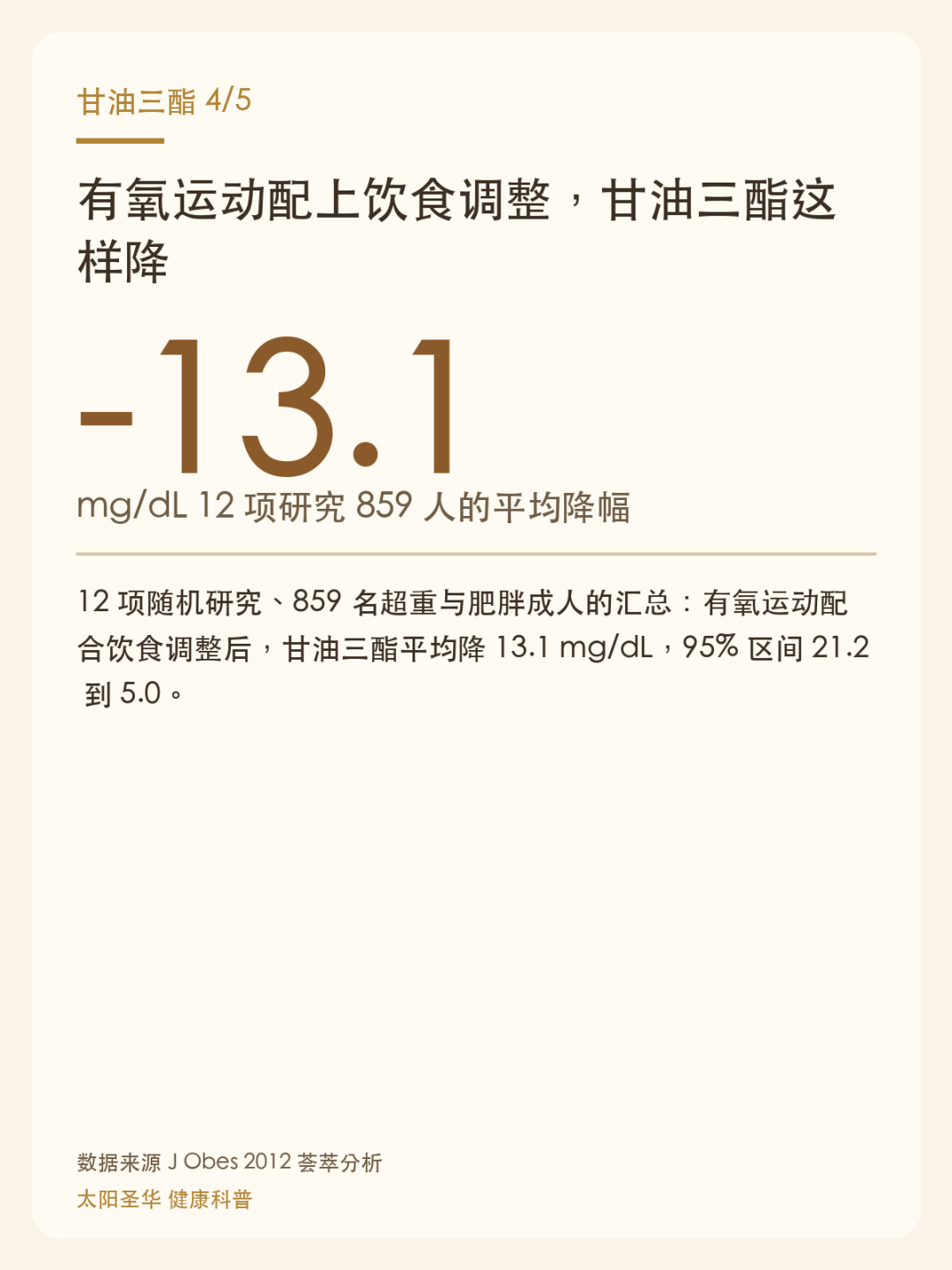
Figure caption: A pooled analysis of 12 studies with 859 participants found that aerobic exercise combined with dietary adjustment reduced triglycerides by an average of 13.1 mg/dL.
5. When you must see a doctor
The Chinese Guidelines for Lipid Management (2023) set fasting triglycerides below 1.7 mmol/L as the appropriate level, 1.7 to 2.3 as borderline elevated, and above 2.3 as elevated. Most people with mild to moderate elevation can improve through dietary and exercise adjustments.
But don't try to tough out these situations on your own: fasting triglycerides above 5.6 mmol/L; or persistent severe upper abdominal pain radiating to the back, accompanied by nausea and vomiting—severe hypertriglyceridemia is a common cause of acute pancreatitis, accounting for about one-tenth of all pancreatitis cases, with an even higher proportion among people with triglycerides above 11.3 mmol/L.[6] If you're already taking lipid-lowering medication, don't stop it on your own because you "want to adjust through diet"—discuss the plan with your doctor.
Four things you can do today
-
Swap sweet drinks for plain water or unsweetened tea—aim for five days a week to start.
-
Replace half your staple foods: swap half of your white rice and white noodles for oats, mixed beans, or corn.
-
Have two alcohol-free days per week—achieve that first, then talk about reducing intake.
-
Measure your waist: 90 cm for men and 85 cm for women are warning lines—measure once a month on the same day.

Figure caption: Four things you can start within a week—swap drinks, replace half your staples, have two alcohol-free days per week, and measure your waist once a month.
One sentence to remember: High triglycerides aren't from eating too much oil—they're from too much sugar and alcohol, and too little movement.
A health check report isn't a verdict—it's more like a bill. Change what you're bringing in, and the next bill will tell the story. Consider sharing this with that family member who "never gains weight no matter what they eat, but always has arrows on their health check."
If this was helpful, give it a like or a "reading" and feel free to leave a comment telling us what topics you'd like to see.
✦
Disclaimer: This article is for health education purposes only and is intended for informational reference. It does not constitute medical advice; if you have health concerns, please consult a professional doctor.
Conflict of interest statement: This article does not involve any drug or product recommendations and has no conflict of interest with the studies cited.
© 2026 Sunsheng Hua (Beijing) Medical Technology Co., Ltd.
References
[1] Xia Q, Chen Y, Yu Z, et al. Prevalence, awareness, treatment, and control of dyslipidemia in Chinese adults: a systematic review and meta-analysis. Front Cardiovasc Med. 2023;10:1186330. PMID: 37476570
[2] Te Morenga LA, Howatson AJ, Jones RM, et al. Dietary sugars and cardiometabolic risk: systematic review and meta-analyses of randomized controlled trials of the effects on blood pressure and lipids. Am J Clin Nutr. 2014;100(1):65-79. PMID: 24808490
[3] Dattilo AM, Kris-Etherton PM. Effects of weight reduction on blood lipids and lipoproteins: a meta-analysis. Am J Clin Nutr. 1992;56(2):320-328. PMID: 1386186
[4] Bessembinders K, Wielders J, van de Wiel A. Severe hypertriglyceridemia influenced by alcohol (SHIBA). Alcohol Alcohol. 2011;46(2):113-116. PMID: 21245063
[5] Kelley GA, Kelley KS, Roberts S, et al. Combined effects of aerobic exercise and diet on lipids and lipoproteins in overweight and obese adults: a meta-analysis. J Obes. 2012;2012:985902. PMID: 22523670
[6] Valdivielso P, Ramírez-Bueno A, Ewald N. Current knowledge of hypertriglyceridemic pancreatitis. Eur J Intern Med. 2014;25(8):689-694. PMID: 25269432