This article is for health education purposes only and is intended for informational reference; it does not constitute medical advice. If you have any health concerns, please consult a professional doctor.
✦ ✦ ✦
Does a normal weight mean you're necessarily healthy?
Not necessarily. Many people don't look overweight and have a normal BMI, yet have a bulging belly—in medicine this is called "normal-weight central obesity," commonly known as "skinny fat" (TOFI: thin outside, fat inside). The fat around your waist predicts longevity better than the number on the scale. Today, with 5 cards, we'll teach you how to measure your "waist age." Bookmark this, and share it with that family member who "doesn't look overweight but has a belly."
✦ ✦ ✦
1 / 5 The conclusion first: normal weight but a big belly means an 87% higher risk of death

A long-term follow-up of 15,184 adults in NHANES found that men with a normal BMI but an elevated waist-to-hip ratio had 1.87 times the risk of all-cause mortality compared with those with a normal waist circumference (95%CI 1.53-2.29)—even higher than that of people who were overweight/obese by BMI; for women, the figure was 1.48 times[1]. In other words, "skinny fat" is not safe—fat stored in the belly is far more dangerous than fat stored on the thighs.
✦ ✦ ✦
2 / 5 How to measure: a soft tape measure, 30 seconds to calculate your "waist age"

Remember one indicator more practical than body weight: the waist-to-height ratio (waist circumference ÷ height). A systematic review of 78 studies showed that when this ratio exceeds 0.5, the risk of diabetes and cardiovascular disease rises significantly, and its predictive power is stronger than that of BMI[3]. The Chinese standard is even more direct: a waist circumference of ≥90cm for men and ≥85cm for women counts as central obesity[5]. Remember it in one sentence—your waist circumference should not exceed half your height.
✦ ✦ ✦
3 / 5 The data: every 10cm increase in waist circumference raises the risk of death by 11%
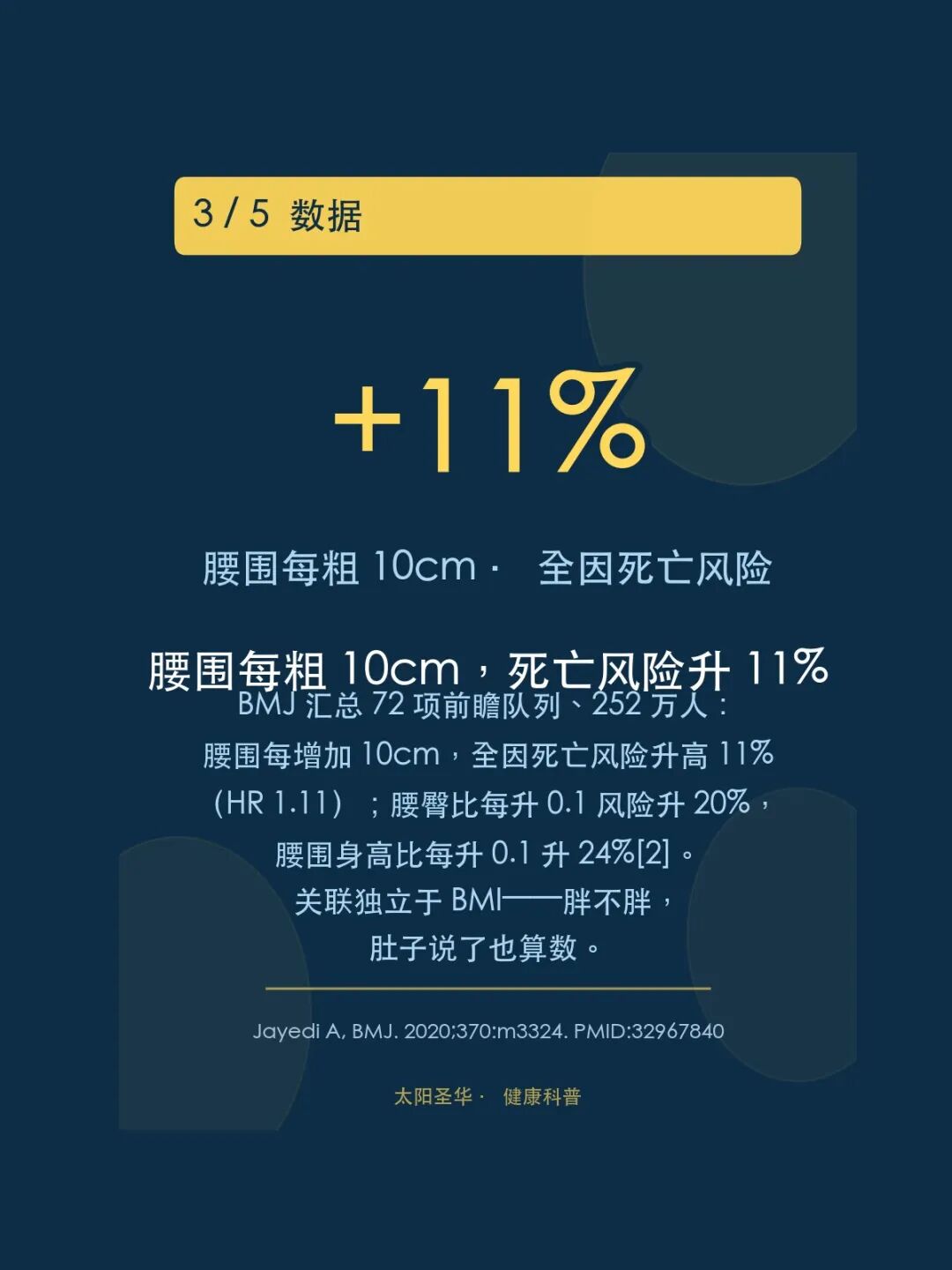
BMJ pooled data from 72 prospective cohort studies covering 2.52 million people: for every 10cm increase in waist circumference, the risk of all-cause mortality rose by 11% (HR 1.11); for every 0.1 increase in waist-to-hip ratio, the risk rose by 20%; for every 0.1 increase in waist-to-height ratio, the risk rose by 24%[2]. Crucially, these associations exist independently of BMI—whether you're overweight can't be judged by the scale alone; your belly counts too.
✦ ✦ ✦
4 / 5 How to reduce it: visceral fat is active, and regular exercise can shrink it

The good news is that the fat wrapping around the internal organs is metabolically active and responds noticeably to lifestyle interventions. A study pooling 13 trials with 354 participants found that even with a normal BMI, regular exercise can significantly reduce visceral fat (SMD -1.59), with aerobic exercise having the most consistent effect, and greater effects with adherence for more than 5 months[4]. Add one serving of high-quality protein to each meal and swap sugary drinks for water, and your waist circumference will often start to shrink before your body weight does.
✦ ✦ ✦
5 / 5 What you can do today: three things to tighten your belly

① Measure once: waist circumference ÷ height, with a target below 0.5; ② Get moving: 150 minutes of brisk walking or jogging per week, plus 2 sessions of strength training[6]; ③ Eat in the right order: vegetables and meat first, then staple foods, and swap sugary drinks for water. Even if the number on the scale doesn't change, your waistline can shrink first.
✦ ✦ ✦
Action advice: Before your shower tonight, find a soft tape measure and wrap it around your waist at the level of your navel (at the end of a normal exhale, without pulling it tight), then divide by your height. If it's over 0.5, don't panic—start with a brisk walk tomorrow and one less milk tea, then measure again after 4 weeks.
If this has been helpful to you, give it a like or a "Wow," and feel free to leave a comment telling us what topics you'd like to see. We suggest sharing it with that family member who "doesn't look overweight but has a belly," and measuring your "waist age" together.
✦ ✦ ✦
Disclaimer: The content of this article is compiled from publicly available academic literature and is intended for health education reference only; it does not constitute medical advice. For individual circumstances, please consult a professional doctor.
Declaration of interests: The author has no conflicts of interest with the studies mentioned in this article.
© 2026 太阳圣华(北京)医疗科技有限公司
References
- Sahakyan KR, et al. Normal-Weight Central Obesity: Implications for Total and Cardiovascular Mortality. Ann Intern Med. 2015;163(11):827-835. PMID:26551006
- Jayedi A, et al. Central fatness and risk of all cause mortality: systematic review and dose-response meta-analysis of 72 prospective cohort studies. BMJ. 2020;370:m3324. PMID:32967840
- Browning LM, Hsieh SD, Ashwell M. A systematic review of waist-to-height ratio as a screening tool for the prediction of cardiovascular disease and diabetes: 0·5 could be a suitable global boundary value. Nutr Res Rev. 2010;23(2):247-269. PMID:20819243
- Arazi H, Bagherpour F, Tinsley GM. Impact of Different Exercise Modalities on Visceral Adipose Tissue in Normal Weight and Low-Overweight Individuals: A Systematic Review and Meta-Analysis. Biol Res Nurs. 2026. PMID:42284156
- National Health Commission of the People's Republic of China. Guidelines for the Prevention and Control of Overweight and Obesity in Chinese Adults. Beijing: People's Medical Publishing House.
- World Health Organization. WHO guidelines on physical activity and sedentary behaviour. Geneva: WHO; 2020.