This article is for health education purposes only and is intended for informational reference; it does not constitute medical advice. If you have any health concerns, please consult a professional doctor.
✦ ✦ ✦
Have you noticed: the number on the scale hasn't changed much, but your pant legs have gotten looser, your arms have gotten thinner, and your legs feel weak when you climb stairs? Don't rush to celebrate "not gaining weight is a win"—this may be muscle quietly wasting away while fat quietly takes its place. A review points out that when muscle is lost, fat deposits within the muscle, so body weight often shows no change[1]. Today's self-check list—5 signals and 3 actions—will help you catch the "invisible loss."
✦ ✦ ✦
First, some data: muscle loss is more common than you think
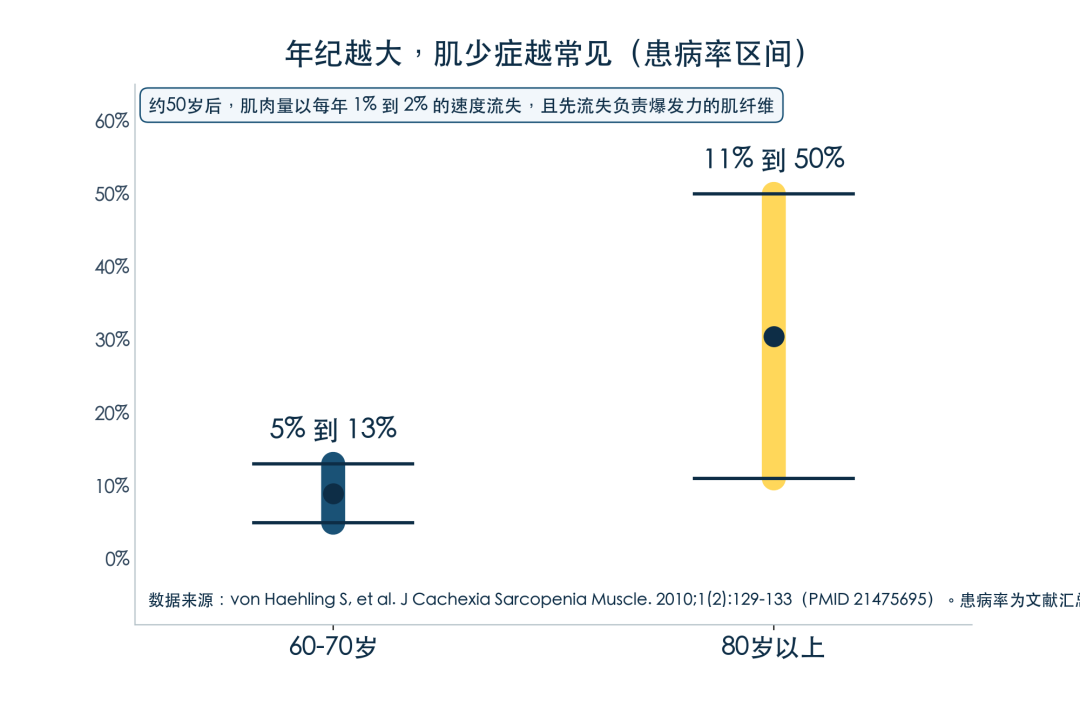
After about age 50, muscle mass declines at an average rate of 1%-2% per year, and what is lost first is mostly the fast-twitch fibers responsible for explosive power, affecting grip strength, standing up, and stair climbing[1]. Pooled estimates show that about 5%-13% of people aged 60-70 have sarcopenia, rising to 11%-50% among those over 80—meaning that among the very elderly, as many as 1 in every 2 to 4 people may be affected[1].
Having less muscle isn't just about "feeling weak": research repeatedly suggests that people with reduced muscle strength have a significantly higher risk of falls[1]. For older adults, a single fall can mean the beginning of fractures and bed rest.
Signal self-check: 5 simple tests you can do at home
Signal 1 | Struggling to twist off a bottle cap, can't wring a towel dry
Grip strength is the "barometer" of muscle strength. Clinics measure it with a dynamometer (Asian standards: men below 28 kg and women below 18 kg warrant attention[3]). At home, you can do a simple self-test: being unable to twist off a new bottle cap with one hand, never being able to wring a towel dry, or finding a 10-jin (5 kg) bag of rice heavy to carry all suggest declining grip strength.
Signal 2 | Walking has slowed down; you have to jog to cross the street
Gait speed is widely recognized as a "vital sign." The warning threshold given by the Asian consensus is less than 1 meter per second—translated into action: use your phone timer, and if it takes more than 6 seconds to walk 6 meters, your gait speed is on the slow side[3]. If you notice that peers your age walk effortlessly while you have to jog to keep up, don't just dismiss it as "being naturally slow"—it's worth paying attention to.
Signal 3 | You need to hold on to something to get up from a chair
The five-times sit-to-stand test is a classic measure of muscle strength. The standard is: with arms crossed over your chest, stand up from a chair and sit back down; taking more than 12 seconds for 5 repetitions suggests insufficient lower-limb strength[3]. An even more intuitive signal is: needing to use the armrest or push off your knees to stand up—this is often not "laziness" but legs that have lost their strength.
Signal 4 | Measure calf circumference: below 34 cm for men, below 33 cm for women
This is the first-line screening indicator recommended by the Asian consensus on sarcopenia, and a soft tape measure is all you need[3]. Wrap the tape around the thickest part of the calf: if it is below 34 cm for men or below 33 cm for women, muscle loss should be considered, and further evaluation by a doctor is recommended (grip strength, gait speed, and muscle mass testing).
Signal 5 | No deliberate dieting, yet you always feel tired and fear falling when walking
Fatigue, unsteady walking, and having had a fall in the past year are all "peripheral signals" of declining muscle strength[1]. In particular, the combination of body weight that hasn't changed or is even increasing while the limbs get thinner and thinner—less muscle and more fat—is more insidious than simple obesity and warrants even greater vigilance.

Hit 2 or more? 3 things you can do right now
If you hit 2 or more of the 5 items above, consider making an appointment with geriatrics or rehabilitation medicine for a muscle strength assessment—don't wait until the day you fall. For daily maintenance, remember these three things:
① Eat enough protein: 1.0-1.2 grams per kilogram of body weight per day. The expert group of the European Society for Clinical Nutrition and Metabolism recommends that healthy older adults consume no less than 1.0-1.2 grams of protein per kilogram of body weight per day[4]. To put it in perspective: a 60 kg person needs about 60-70 grams a day, roughly equivalent to "a palm-sized portion of meat/fish at each meal + one egg and one glass of milk a day." For older adults with poor digestion, eat smaller, more frequent meals and use tender, easy-to-chew cooking methods—don't just eat congee and noodles.
② Do strength training 2-3 times a week, starting with "chair exercises." Resistance training is one of the few interventions repeatedly proven to reverse declines in muscle strength—a Cochrane systematic review confirms that progressive strength training can genuinely improve muscle strength and physical function in older adults[5]. You don't need a gym to start: wall sits (30-60 seconds each time), chair-assisted squats (10-12 reps per set), lifting two bottles of mineral water, and resistance band pulls—do 2-3 sets of each exercise.
③ Build an aerobic base and prioritize fall prevention. WHO recommends that adults aged 65 and over get at least 150-300 minutes of moderate-intensity aerobic activity per week, plus muscle-strengthening exercises on 2 or more days per week[6]. Brisk walking, tai chi, and square dancing all count; put "walking steadily without falling" ahead of "walking a lot"—tidying up rugs and cords at home and adding non-slip mats in the bathroom can save lives more than walking an extra 10,000 steps.
One-sentence action: Tonight, find a soft tape measure and measure your calf circumference once, and record the number in your phone's notes; measure again 3 months later. If your leg circumference holds steady and opening a bottle cap is no effort, that is evidence your muscles are holding up.
Forward this checklist to your parents and that person in the family who "always says they have no energy"—muscle is not the exclusive domain of bodybuilders; it is the foundation that lets us walk on our own and use the toilet on our own in later life.
If you find this helpful, give it a like or a "Wow," and feel free to leave a comment telling us what topics you would like to see.
References
- von Haehling S, Morley JE, Anker SD. An overview of sarcopenia: facts and numbers on prevalence and clinical impact. J Cachexia Sarcopenia Muscle. 2010;1(2):129-133. PMID: 21475695
- Cruz-Jentoft AJ, Bahat G, Bauer J, et al. Sarcopenia: revised European consensus on definition and diagnosis. Age Ageing. 2019;48(1):16-31. PMID: 30312372
- Chen LK, Woo J, Assantachai P, et al. Asian Working Group for Sarcopenia: 2019 consensus update on sarcopenia diagnosis and treatment. J Am Med Dir Assoc. 2020;21(3):300-307. PMID: 32033882
- Deutz NE, Bauer JM, Barazzoni R, et al. Protein intake and exercise for optimal muscle function with aging: recommendations from the ESPEN Expert Group. Clin Nutr. 2014;33(6):929-936. PMID: 24814383
- Liu CJ, Latham NK. Progressive resistance strength training for improving physical function in older adults. Cochrane Database Syst Rev. 2009;(3):CD002759. PMID: 19588334
- World Health Organization. WHO Guidelines on physical activity and sedentary behaviour. Geneva: WHO; 2020.
Disclaimer: This article is health science popularization, provided for informational reference only, and does not constitute medical advice; if you have health problems, please consult a professional doctor. Those who suspect sarcopenia or have chronic diseases or joint discomfort should consult a doctor before starting strength training.
Declaration of interests: The content of this article represents the author's views only and has no conflict of interest with any commercial organization.
© 2026 Sun Shenghua (Beijing) Medical Technology Co., Ltd.