This article is for health education purposes only and is intended for informational reference. It does not constitute medical advice; please consult a professional doctor if you have any health concerns.
You've been squatting for twenty minutes and still nothing. The next day your belly feels bloated, your breath is off, and your whole body feels heavy.
Most people first think of eating a few more bananas, and if that doesn't work, buying a box of laxative tea.
But constipation has clear medical criteria and clear dietary evidence — and that evidence doesn't quite match most people's intuition.
First, one number: 8.5%.
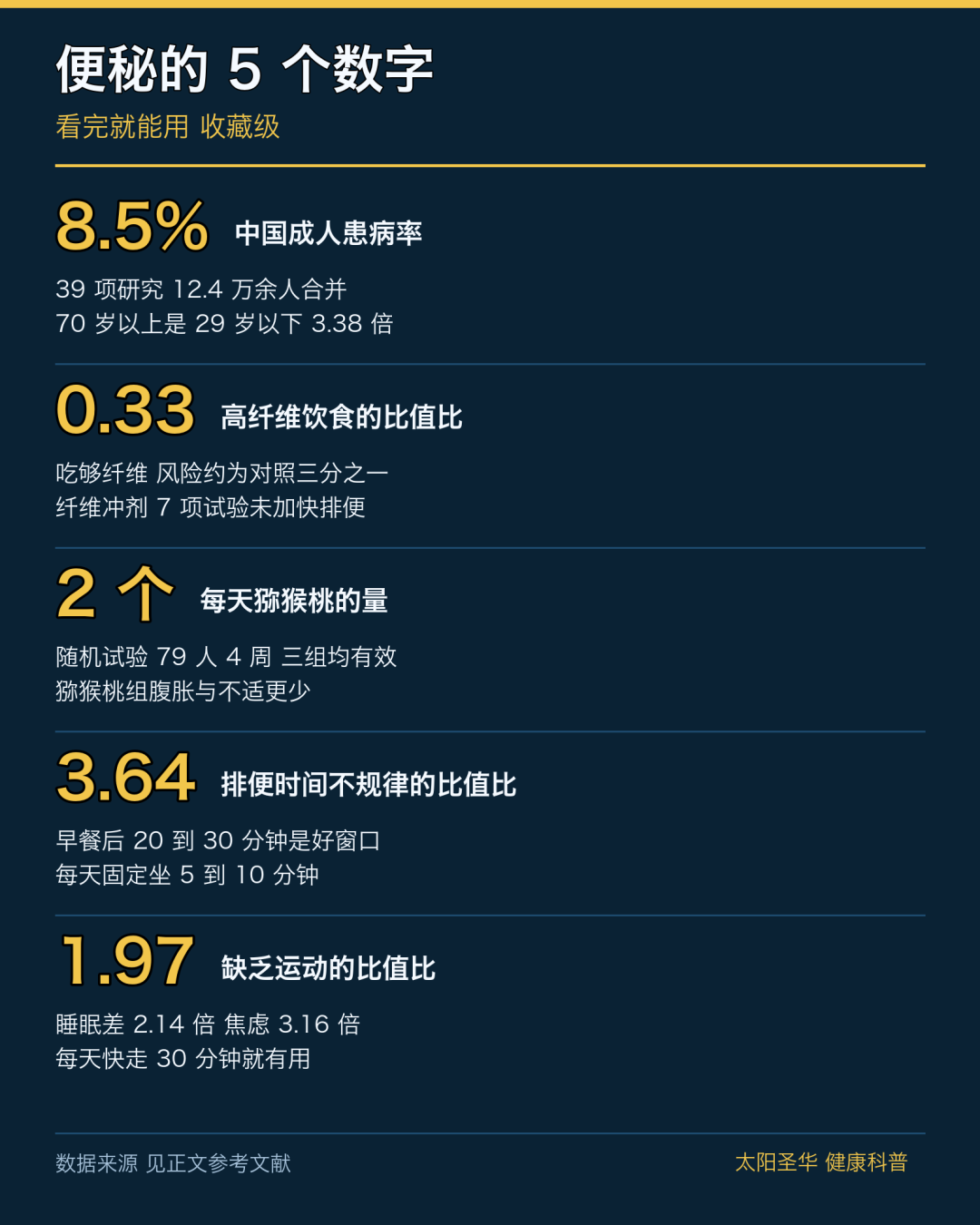
Pooling 39 population studies from China covering more than 124,000 adults, the prevalence of functional constipation is 8.5%[1] — roughly 1 in every 12 people. And that number is climbing: studies from 1991 to 2000 found 5.5%, while studies from 2011 to 2020 have already reached 10.9%[1].
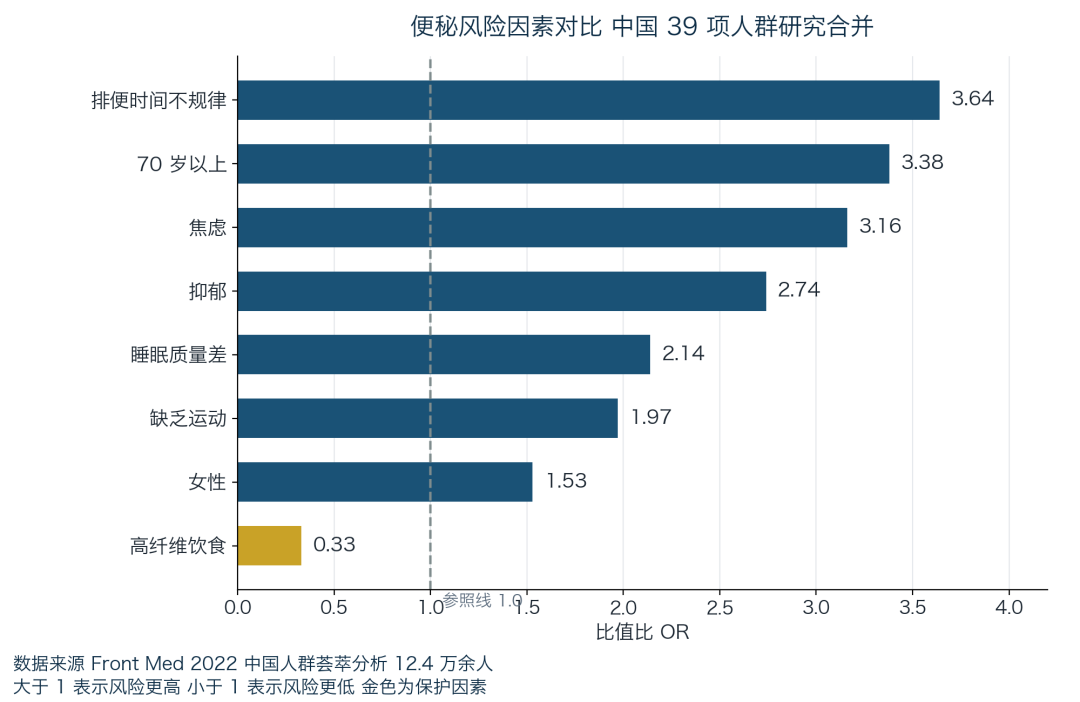
It's not "internal heat," and it's not "being dramatic." Women have about 1.53 times the risk of men, and people over 70 have 3.38 times the risk of those under 29[1]. So when an older family member says they have trouble passing stool, it's often not in their head — it's the combined result of declining gut motility, physical activity, and water intake.
Number one: 0.33 — People who eat enough fiber have only one-third the risk
In the same meta-analysis, people with high-fiber diets had significantly lower constipation risk (OR 0.33)[1].
But there's an easily overlooked detail here: fiber "supplements" are not the same as "eating enough fiber." A 2025 meta-analysis focused on older adults included 7 randomized controlled trials with 187 participants and found that fiber supplementation did not significantly improve weekly bowel movement frequency (SMD 0.25, P=0.507), though it did clearly reduce the use of laxatives and enemas while increasing intestinal Bifidobacteria[2].
In plain terms: fiber is more like "the foundation that feeds your gut," not "a laxative that works the same day." Expecting a scoop of fiber powder to make things smooth by tomorrow will likely disappoint you; but consistently eating enough vegetables, beans, and whole grains delivers real, solid benefits.
Number two: 2 — Two kiwifruits a day
A 2021 US randomized trial divided 79 adults with chronic constipation into three groups: 2 green kiwifruits per day, 100 grams of prunes per day, and 12 grams of psyllium per day, for 4 weeks. All three groups showed significant increases in complete spontaneous bowel movements per week compared with baseline (P≤0.003), with the kiwifruit group performing better on bloating scores, adverse event rates, and satisfaction[3].
A 2022 meta-analysis of 7 randomized controlled trials with 399 participants also found that, compared with psyllium, kiwifruit produced 1.01 additional spontaneous bowel movements per week (95% confidence interval -0.02 to 2.04, moderate-certainty evidence)[4]. The lower bound of this interval crosses 0, meaning the evidence isn't yet "set in stone," but at least it's a conclusion drawn from real trial comparisons.
Number three: 3.64 — Irregular timing means 3.64 times the risk
Among all lifestyle factors, "irregular bowel movement timing" has a notably stronger association than the others (OR 3.64)[1].
The reason lies in the gastrocolic reflex: after a meal, the stomach stretches, sending a signal to the colon that pushes stool downward. The 20 to 30 minutes after breakfast is a window when the body's urge to defecate is relatively strong. Many people rush through it and hold it in — once or twice is fine, but day after day, the rectum's sensitivity to the urge to go will decline.
The approach is simple: sit down at a fixed time each day for 5 to 10 minutes, go when you feel the urge, and don't hold it in. Don't scroll on your phone while sitting — when your attention is elsewhere, the sphincter is actually harder to relax.
Number four: 1.97 — Inactive people have nearly double the risk
People who lack physical activity have about 1.97 times the constipation risk of controls[1].
Three other numbers are equally worth remembering: poor sleep quality 2.14 times, anxiety 3.16 times, depression 2.74 times[1]. The gut-brain axis isn't mysticism — emotions and sleep really do affect gut motility. That's why there's a cycle of "the more tense you are, the more constipated you get, and the more constipated you get, the more tense you become."
A 30-minute brisk walk each day, or swapping after-meal sitting for a 10-minute stroll, has a low barrier to entry and steady benefits.
What about bananas? They're not on the guideline's named list
In 2025, the British Dietetic Association published a set of dietary management guidelines for chronic constipation, based on 4 systematic reviews and 75 randomized controlled trials, forming 59 recommendations. In the "foods" category, the items named were kiwifruit, prunes, and rye bread; among beverages, water with higher mineral content was named[5].
Bananas aren't useless. Ripe bananas contain fiber and pectin and are fine as an everyday fruit. But they don't have randomized controlled trial support at the level kiwifruit does. Don't pin all your hopes on them.
Three things you can do today
-
20 minutes after breakfast, sit down at a fixed time for 5 to 10 minutes, without looking at your phone.
-
Swap today's fruit for 1 to 2 kiwifruits, or about 100 grams of prunes.
-
Get vegetables to around 500 grams a day, and replace half your staple grains with whole grains or beans — build up fiber through food, not powders.
If these situations appear, don't self-adjust
Blood in the stool or black stool; unexplained weight loss; anemia; new-onset constipation after age 50, or a marked change in bowel habits; severe abdominal pain or progressively worsening bloating. These require a hospital visit to investigate the cause — they can't be solved through diet alone.
The gut is a creature of habit: give it time, and it will give you regularity.
Consider saving this article, and feel free to share it with that older family member who always says they have "internal heat."
If you found this helpful, give it a like or a "reading" mark, and feel free to leave a comment telling us what topics you'd like to see.
Disclaimer: This article is for health education purposes only and is intended for informational reference. It does not constitute medical advice; please consult a professional doctor if you have any health concerns.
Declaration of interests: This article does not involve any drug or product recommendations and has no conflicts of interest with the research institutions mentioned in the text.
© 2026 Sunshenghua (Beijing) Medical Technology Co., Ltd.
References
[1] Chen Z, Peng Y, Shi Q, et al. Prevalence and Risk Factors of Functional Constipation According to the Rome Criteria in China: A Systematic Review and Meta-Analysis. Front Med (Lausanne). 2022;9:815156. PMID:35252254
[2] Xi N, Yang X, Liu J, et al. Effects of Dietary Fiber Supplementation on Chronic Constipation in the Elderly: A Systematic Review and Meta-Analysis of Randomized Controlled Trials. Foods. 2025;14(13):2315. PMID:40647069
[3] Chey SW, Chey WD, Jackson K, et al. Exploratory Comparative Effectiveness Trial of Green Kiwifruit, Psyllium, or Prunes in US Patients With Chronic Constipation. Am J Gastroenterol. 2021;116(6):1304-1312. PMID:34074830
[4] Eltorki M, Leong R, Ratcliffe EM. Kiwifruit and Kiwifruit Extracts for Treatment of Constipation: A Systematic Review and Meta-Analysis. Can J Gastroenterol Hepatol. 2022;2022:7596920. PMID:36247043
[5] Dimidi E, van der Schoot A, Barrett K, et al. British Dietetic Association Guidelines for the Dietary Management of Chronic Constipation in Adults. J Hum Nutr Diet. 2025;38(5):e70133. PMID:41081513