Gaining Weight as Winter Sets In? Remember 6 Numbers to Keep Your Weight Steady This Winter
This article is for health education purposes only and is intended as general information; it does not constitute medical advice. If you have health concerns, please consult a professional doctor.
As soon as the weather turns cold, hot pot, stews, and hot milk tea come calling—and sweaters happen to hide your belly. Many people only discover when they take off their coats in spring: the weight has crept back up.
Winter weight gain isn't entirely your fault—but it can absolutely be prevented in advance.

How Much Weight Do We Actually Gain in Winter?
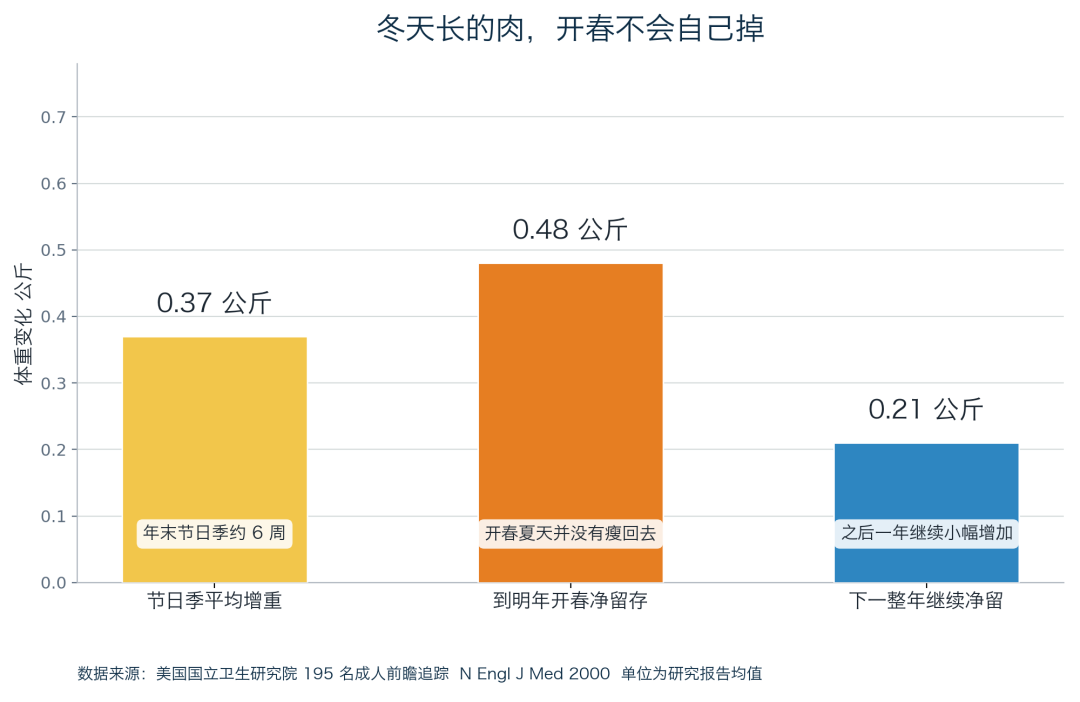
A classic study by the US National Institutes of Health followed 195 adults, weighing them from autumn through the following year: average weight gain during the year-end holiday season was 0.37 kg. That doesn't seem like much, but the key point is that they did not lose it in spring and summer—leaving a net gain of 0.48 kg over the year[1]. The weight adults put on over many years is often accumulated exactly this way, pound by pound.
A systematic review pooling 16 studies also found that among non-agricultural populations, body weight and body fat are generally higher in the cold autumn and winter seasons than in warm seasons[2]. The good news: a 2025 review pooling multiple trials showed that people who did weight-management interventions during the holidays gained on average about 1 kg less than those who didn't[3]—with the right approach, you can completely avoid gaining weight in winter.
The 6 numbers below all come from formally published research—just follow them.
Number One: Step on the Scale Once a Week
The first step to preventing winter weight gain is to see it coming. Weigh yourself at the same time each week, in the same clothing, and record it. During the holiday season, keep the increase within 0.5 kg and adjust your diet immediately rather than waiting until spring. Short-term fluctuations within 1 kg are mostly water—focus on the trend over several consecutive weeks.
Number Two: 500 mL of Water Before Every Meal
A 12-week trial that randomized 48 middle-aged and older adults into two groups found that, while eating less to lose weight, the group that drank 500 mL of plain water before each of the three meals lost about 2 kg more than the group that didn't drink water—losing weight about 44% faster[4]. Note: it must be plain water, drunk before meals; sugary drinks and milk tea don't count—they actually add extra calories.
Number Three: Start with a Bowl of Low-Energy Thick Soup
A Pennsylvania State University trial had 60 participants eat a bowl of low-energy soup made mainly of vegetables and clear broth before lunch, then eat their meal 15 minutes later. As a result, total intake at that meal dropped by an average of about 20%, equivalent to eating 134 kcal less—and the effect was similar whether the soup was thick or thin[5]. The key points: low oil, low salt, no starch thickening—cream soups don't count.
Number Four: Walk 15 Minutes After Meals, 3 Times a Day
A randomized crossover trial in older adults with elevated blood sugar found that walking 15 minutes after each of breakfast, lunch, and dinner controlled blood sugar throughout the day better than a single 45-minute walk—especially the walk after dinner[6]. In cold weather, you can walk indoors, stroll through the supermarket, or stand while watching TV for a while—the key is not to sit or lie down right away.
Number Five: Burn an Extra 350 kcal a Day with "Incidental Activity"
A study in the journal Science used sensors to record the posture of 20 people every half second and found that heavier people sat on average 2 hours more per day than lean people; if they adopted the lean people's daily pattern of more standing and moving around, it was estimated they could burn about 350 kcal more per day[7]. Get off one stop early on your commute, pace back and forth during phone calls, take the stairs instead of the elevator—it all adds up.
Number Six: Sleep Enough—Don't Let Hunger Hormones Go Haywire
A randomized crossover trial at the University of Chicago had 12 healthy men sleep only 4 hours for two consecutive nights: leptin, which suppresses appetite, dropped by an average of 18%; ghrelin, which stimulates hunger, rose by an average of 28%; subjective hunger increased by 24%; and cravings for high-carb, high-calorie foods increased by 33% to 45%[8]. Winter nights are long, so make an even greater effort to sleep a regular 7 to 8 hours. Craving sweets intensely after staying up late isn't a lack of willpower—it's your hormones pushing you.

Three Things You Can Start Today
-
Set a fixed weekly "weigh-in day" on your phone.
-
Before lunch and dinner tomorrow, drink 300 to 500 mL of plain water, or a bowl of clear soup.
-
After dinner, don't rush back to the sofa—take the family downstairs for a 15-minute walk.
Winter isn't a season destined for weight gain—it's a season that tests your habits. Save these 6 numbers, and feel free to share them with family and friends who complain every winter that "even water makes me gain weight."
If you found this helpful, give it a like or a "Wow," and feel free to leave a comment telling us what topics you'd like to see.
✦ ✦ ✦
References:
[1] Yanovski JA, et al. N Engl J Med. 2000;342(12):861-867. PMID: 10727591
[2] Tan SY, et al. Eur J Nutr. 2022;61(5):2255-2278. PMID: 35098326
[3] Guerrero-Magaña DE, et al. Obes Rev. 2025;26(1):e13836. PMID: 39275907
[4] Dennis EA, et al. Obesity (Silver Spring). 2010;18(2):300-307. PMID: 19661958
[5] Flood JE, Rolls BJ. Appetite. 2007;49(3):626-634. PMID: 17574705
[6] DiPietro L, et al. Diabetes Care. 2013;36(10):3262-3268. PMID: 23761134
[7] Levine JA, et al. Science. 2005;307(5709):584-586. PMID: 15681386
[8] Spiegel K, et al. Ann Intern Med. 2004;141(11):846-850. PMID: 15583226
✦ ✦ ✦
Disclaimer: This article is for health education purposes only and is intended as general information; it does not constitute medical advice. If you have health concerns, please consult a professional doctor. People with kidney disease or special dietary requirements such as fluid or salt restriction should consult their doctor before following the pre-meal water-drinking or soup plans.
Conflict of interest statement: The content of this article is based on publicly published medical literature, and the author has no relevant conflicts of interest.
© 2026 Sunsheng Hua (Beijing) Medical Technology Co., Ltd.