This article is for health education purposes only and is intended for informational reference; it does not constitute medical advice. If you have any health concerns, please consult a professional physician.
Gaining weight after the start of autumn? 90 minutes of strength training per week linked to 13% lower risk of death
After autumn begins, many people notice that their appetite hasn't changed, yet their weight starts creeping up. This is not an illusion. A one-year follow-up study found that daily calorie intake in autumn averages 86 kcal more than in spring, physical activity drops to its lowest level of the year in winter, and body weight peaks in winter[5]. Autumn is precisely the "starting point of the uphill climb" for weight.
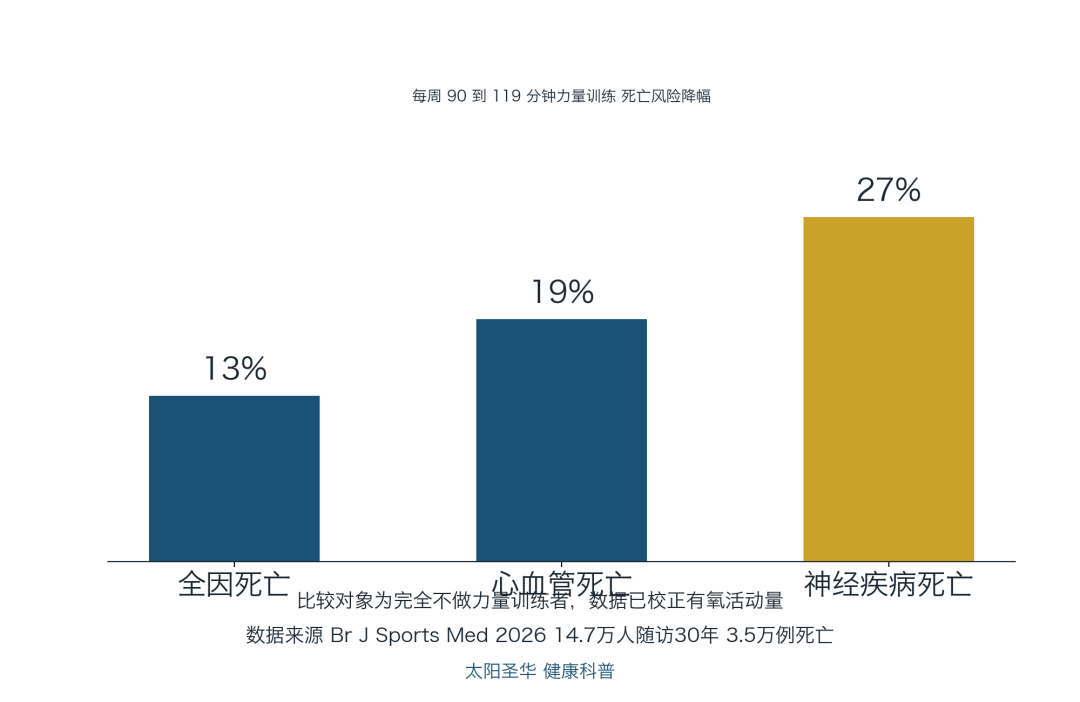
A new study published in June 2026 in the British Journal of Sports Medicine offers a new answer: it tracked 147,000 people with follow-up of up to 30 years and recorded 35,000 deaths—people who did 90 to 119 minutes of strength training per week had a 13% lower risk of all-cause death than those who did none at all[1]. This suggests that the capital we need to bank in autumn is muscle.
1. This new study clarifies three things
First, the reduction is not limited to "all-cause death." In the same study, people who did 90 to 119 minutes of strength training per week had a 19% lower risk of death from cardiovascular disease and a 27% lower risk of death from neurological diseases (including dementia and others)[1].
Second, you don't need to train more. The study showed that beyond 120 minutes per week, the risk of all-cause death no longer continued to decline[1]. Two previous meta-analyses gave similar ranges: muscle-strengthening activity showed a "J-shaped" association with all-cause mortality risk, with reductions of about 10% to 20%, concentrated at about 30 to 60 minutes per week[2]; in dose-response analyses of resistance training, the reduction reached 27% at about 60 minutes per week[3].
Third, "strength training" and "walking" should be done together. People who met aerobic activity targets and also did 60 to 119 minutes of strength training had about a 45% lower risk than those who were "insufficiently active aerobically and did no strength training"[1]. The two are not an either-or choice; they add up.
2. In autumn, build muscle rather than diet first
Autumn weight gain is mostly not a matter of willpower: seasonal changes simultaneously drive up appetite and drive down activity levels[5]. Holidays and weekends are the year's concentrated weight-gain windows—a 12-month tracking study showed that body weight rose by an average of 0.65% during the Christmas and New Year period, and weekends were also significantly higher than Fridays[6].
At this point, if you rely only on eating less, you lose not just fat but also muscle. Muscle is the body's "metabolic savings account": when muscle mass declines, basal metabolism declines along with it, and the same amount of food is more likely to turn into fat—this is why many people "rebound more easily the more they diet."
The problems brought by low muscle mass are not just about weight. A study of 5,888 older adults (mean age 69.5 years) found that 11.1% had possible sarcopenia (low grip strength) and 2.2% had confirmed sarcopenia; compared with people without sarcopenia, those with possible sarcopenia had a 29% higher risk of all-cause death and those with confirmed sarcopenia had a 93% higher risk; if excess fat was also present, the risk rose further[4]. In other words, even if the number on the scale is normal, you may still have a "muscle deficit."

3. How to train: no gym needed, three 30-minute sessions per week
- Frequency and duration: 2 to 3 times per week, 30 minutes each time, totaling around 90 minutes—right at the starting point of the optimal range observed in the study[1].
- Cover all four movement categories: "push, pull, squat, lift": wall push-ups, resistance-band rows, squats or sit-to-stands, and lifting water buckets. Do 2 to 3 sets of 8 to 12 reps per movement, stopping when the last two reps feel slightly challenging.
- Train every other day: allow 48 hours of recovery for the same muscle group; this is easier to sustain than training every day.
- Start with body weight: for people over 40 who don't usually exercise, start with sit-to-stands and wall push-ups, and add resistance bands once the movements are stable.
- Eat enough protein: include a palm-sized portion of meat, eggs, or soy products at each meal, and don't deliberately skip meals on training days.
4. One thing you can do this week
Write three 30-minute strength-training sessions into your schedule (Monday, Wednesday, and Saturday after dinner), and keep your daily 30-minute brisk walk—the combined benefits are greater[1].
If you have cardiovascular disease, serious joint problems, or are taking medications that affect blood sugar or blood pressure, it is advisable to consult a doctor before starting strength training; if you experience chest pain, obvious shortness of breath, or dizziness during exercise, stop immediately.
Autumn is the cost-effective time to bank muscle: the muscle you build in autumn will help shield you from the decline in weight and metabolism during winter. Consider sharing this article with that family member who "gains a size every winter."
Disclaimer: This article is for health education purposes only and is intended for informational reference; it does not constitute medical advice. If you have any health concerns, please consult a professional physician.
Declaration of interests: This article does not involve any drug recommendations and has no conflicts of interest with the research institutions mentioned in the text.
© 2026 Sun Shenghua (Beijing) Medical Technology Co., Ltd.
If this has been helpful to you, give it a like or a "Wow," and feel free to leave a comment telling us what topics you'd like to see.
References
[1] Zhang Y, Lee DH, Rezende LFM, Ma Y, Giovannucci E. Long-term resistance training with all-cause and cause-specific mortality: assessing dose-response and joint associations with aerobic physical activity. Br J Sports Med. 2026 Jun 12;60(12):874-883. PMID: 42230125
[2] Momma H, Kawakami R, Honda T, Sawada SS. Muscle-strengthening activities are associated with lower risk and mortality in major non-communicable diseases: a systematic review and meta-analysis of cohort studies. Br J Sports Med. 2022 Jul;56(13):755-763. PMID: 35228201
[3] Shailendra P, Baldock KL, Li LSK, Bennie JA, Boyle T. Resistance Training and Mortality Risk: A Systematic Review and Meta-Analysis. Am J Prev Med. 2022 Aug;63(2):277-285. PMID: 35599175
[4] Benz E, Pinel A, Guillet C, et al. Sarcopenia and Sarcopenic Obesity and Mortality Among Older People. JAMA Netw Open. 2024 Mar 4;7(3):e243604. PMID: 38526491
[5] Ma Y, Olendzki BC, Li W, et al. Seasonal variation in food intake, physical activity, and body weight in a predominantly overweight population. Eur J Clin Nutr. 2006 Apr;60(4):519-28. PMID: 16340952
[6] Maher C, Ferguson T, Curtis R, et al. Weekly, Seasonal, and Festive Period Weight Gain Among Australian Adults. JAMA Netw Open. 2023 Jul 3;6(7):e2326038. PMID: 37498598