This article is for health education purposes only and is intended for informational reference; it does not constitute medical advice. If you have any health concerns, please consult a professional physician.
✦ ✦ ✦
Does blood pressure quietly rise after the start of autumn? Once Chushu (End of Heat) passes, the temperature difference between day and night begins to widen—you may think it is just the weather turning cooler, but for people with hypertension, blood pressure may be "climbing uphill" as the weather cools.
What do the data say? A pooled analysis of 47 studies and 856,000 people shows that from summer to winter, systolic blood pressure rises by an average of 5–6 mmHg[2]; among older adults, the difference in systolic blood pressure between the coldest and warmest temperature groups can reach 8 mmHg[1]. Data from the China Hypertension Survey of 397,000 people likewise suggest that for every 2.28°C fluctuation in the day-night temperature difference, systolic blood pressure rises by approximately 0.41 mmHg[3].
Those most affected are older adults and people with hypertension, especially those currently taking medication—seasonal fluctuations are more pronounced in them.
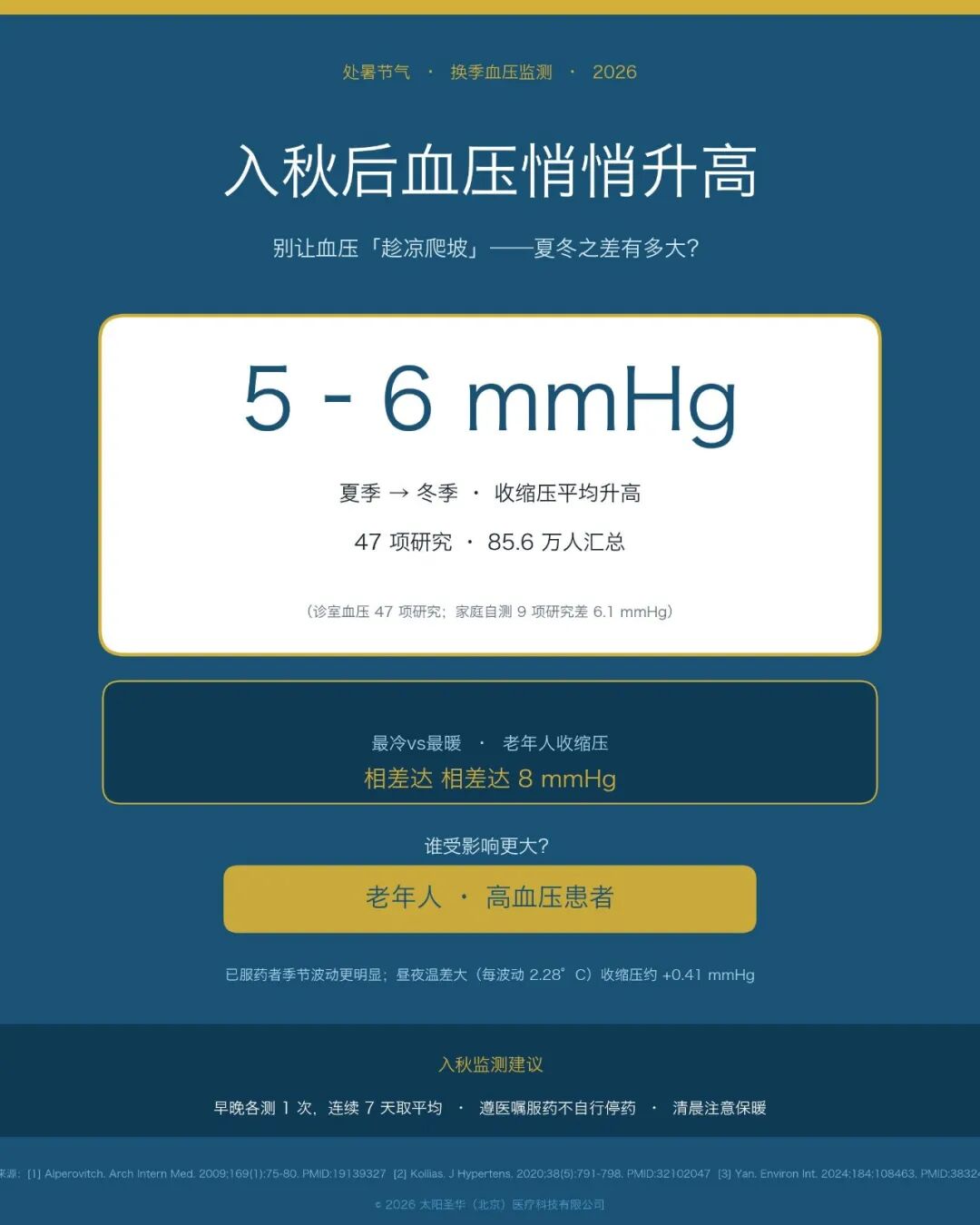
Monitoring recommendations for early autumn:
- Measure blood pressure on at least 3 days per week, once in the morning and once in the evening, and take the average over 7 consecutive days
- For those taking medication: take medication regularly as prescribed, do not stop or reduce the dose on your own
- Keep warm when going out in the early morning and avoid direct stimulation from cold air
Share this with the older adults in your family—blood pressure "changing seasons" needs closer attention than weight "changing seasons." If this has been helpful to you, give it a like or click "Wow," and feel free to leave a comment telling us what topics you would like to see.
✦ ✦ ✦
References
1. Alperovitch A, Lacombe JM, Hanon O, et al. Relationship between blood pressure and outdoor temperature in a large sample of elderly individuals: the Three-City study. Arch Intern Med. 2009;169(1):75-80. PMID: 19139327.
2. Kollias A, Kyriakoulis KG, Stambolliu E, et al. Seasonal blood pressure variation assessed by different measurement methods: systematic review and meta-analysis. J Hypertens. 2020;38(5):791-798. PMID: 32102047.
3. Yan X, Li J, Wu J, et al. Association between short-term daily temperature variability and blood pressure in the Chinese population: From the China hypertension survey. Environ Int. 2024;184:108463. PMID: 38324925.
Disclaimer: The content of this article is intended solely for health education and information sharing and does not constitute any medical advice or medication guidance. All data in this article come from publicly available peer-reviewed studies, and citations have been marked with their sources.
Conflict of interest statement: This article was produced by Taiyang Shenghua (Beijing) Medical Technology Co., Ltd. The author has no conflict of interest with the studies cited in this article.
© 2026 Taiyang Shenghua (Beijing) Medical Technology Co., Ltd.