This article is for health education purposes only and is intended for informational reference; it does not constitute medical advice. If you have any health concerns, please consult a professional doctor.
✦ ✦ ✦
More and more people do the same thing before buying snacks: they turn the package over to look at the "nutrition facts" panel. When the words "trans fat 0 g" pop out, many people feel reassured and toss it into their shopping cart. But you may not know—this "0" has its own calculation rules, and trans fat is especially good at "changing its disguise." Today's article teaches you how to recognize it in the ingredients list.
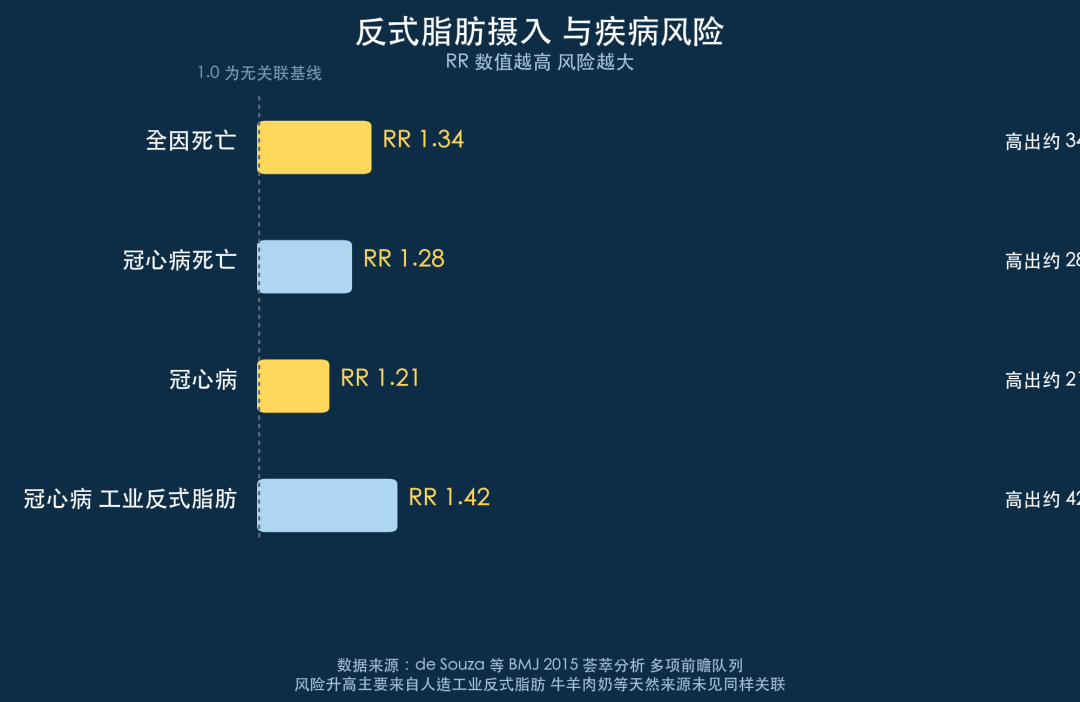
First, a set of numbers: the World Health Organization estimates that about 500,000 people worldwide die prematurely from cardiovascular disease each year due to trans fat intake [3]. This is not simply a matter of "eating too much fat"—a meta-analysis pooling multiple prospective cohort studies showed that trans fat intake is associated with an increased risk of all-cause mortality (RR 1.34, 95%CI 1.16-1.56), and its associations with coronary heart disease death and coronary heart disease are equally clear (RR 1.28, 1.21) [1]. More critically: this risk comes almost entirely from "man-made" industrial trans fat—the RR for industrial sources and coronary heart disease reached 1.42, while no such association was found for natural sources such as beef, mutton, and dairy [1]. Trans fat also raises "bad cholesterol," lowers "good cholesterol," and triggers inflammatory responses [2].
In plain terms: of the same trans fat, the man-made industrial version is the one to avoid; trace amounts from natural sources need not be overly worried about. And it is not the same thing as total fat—eating less fat does not mean you have avoided it.
✦ ✦ ✦
First, clear up a misunderstanding: "0 trans fat" does not mean there is none at all
According to the national standard GB 28050, if trans fat does not exceed 0.3 g per 100 g of food, it is permitted to be labeled "0" [5]. So this "0" is a threshold of "low enough to be negligible," not a mathematical zero. Looking at any single item alone may be fine, but if milk tea, cookies, cake, and fried chicken rotate through your day, several "0"s stacked together add up to a not-insignificant amount.
So, don't just look at the big words on the front—turn to the back and check two things: first, the "trans fat" line in the nutrition facts panel; second, whether the ingredients list contains the following 5 words. The ingredients list is required by national standards to be ordered from most to least; the earlier a word appears, the higher the content, and the more attention you should pay [6].
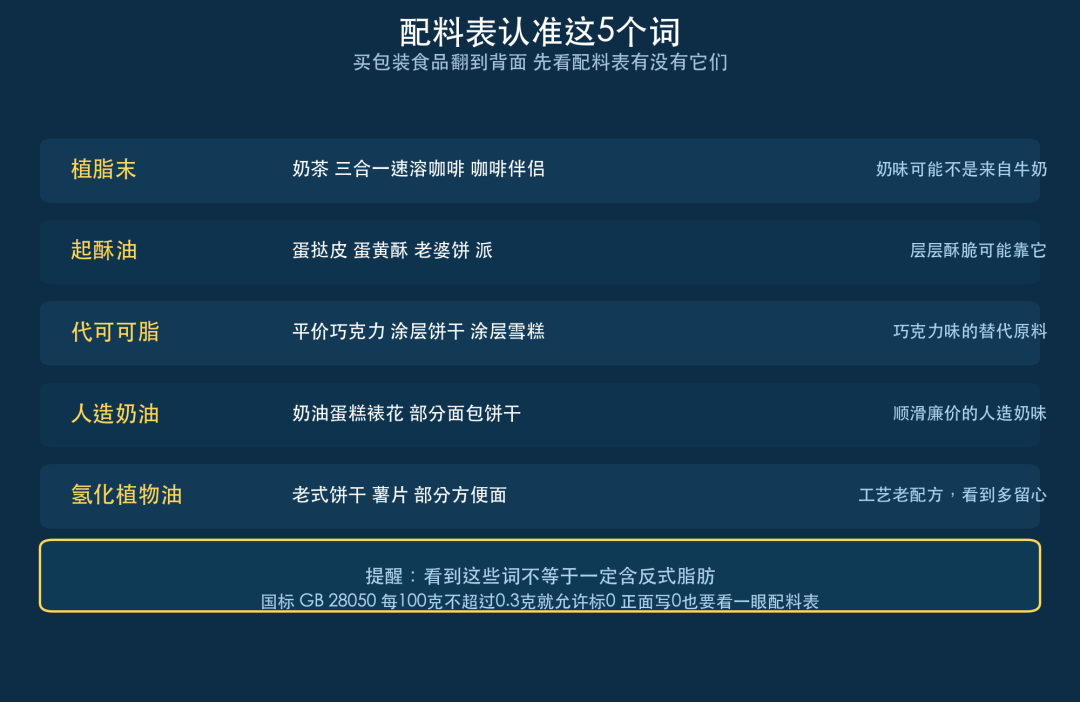
Word 1: Non-dairy creamer—the secret to the "silkiness" in milk tea and instant coffee
Non-dairy creamer, also called creamer, was traditionally made from hydrogenated vegetable oil to mimic the smooth mouthfeel of milk. It is very common in 3-in-1 instant coffee, coffee mate, and the "creamer" used in milk tea shops. Many products nowadays have changed their processes and also label "0 trans fat," but if "non-dairy creamer" appears among the first few ingredients, it at least means the "milky taste" of this cup may not come from milk.
Word 2: Shortening—the driving force behind the "layer upon layer of flakiness" in egg tart shells and salted egg yolk pastries
Shortening makes pastries form layers and become flaky; egg tart shells, salted egg yolk pastries, sweetheart cakes, various pies, and some cookies and breads all rely on it. The more "flaky to the point of crumbling" an industrial pastry is, the more likely it uses shortening. When you crave flaky pastries, prioritize freshly made ones with simple ingredients; for packaged pastries, turn to the back and check the ingredients.
Word 3: Cocoa butter substitute—the "stand-in" for budget chocolate
Cocoa butter substitute is a vegetable fat used to replace cocoa butter, commonly found in budget chocolate, chocolate-coated cookies, and ice cream bars. The texture is close but the cost is much lower. If you want to buy chocolate for your child, it is worth a look whether the first ingredient is "cocoa butter" or "cocoa butter substitute."
Word 4: Margarine—hidden in the frosting of cream cakes
Margarine, also called oleomargarine, is cheaper than dairy cream and holds its shape well, making it the raw material for much of the frosting on cream cakes and some breads and cookies. Whether the cream on a cake feels "coating in the mouth" or refreshing is often the difference between margarine and dairy cream. Asking ahead "what kind of cream do you use?" for a birthday cake is nothing to be ashamed of.
Word 5: Hydrogenated vegetable oil—the "old face" in old-recipe snacks
Hydrogenated vegetable oil is the classic source of trans fat and was once widely used in cookies, potato chips, and instant noodles. Today many large companies have switched to non-hydrogenated processes, but it remains an ingredient in some old-recipe snacks and bulk pastries. When you see the word "hydrogenated," judge it together with the "trans fat" line in the nutrition facts panel—don't just look at the front.
A reminder: seeing these words does not necessarily mean trans fat is present—after process improvements, many products have already achieved very low levels. It is more like a signal "worth a second look": when the front says "0" but the first few ingredients on the back include these words, choose a simpler alternative.
✦ ✦ ✦
There is also a category not found in the ingredients list: oil repeatedly heated at high temperatures for frying
Oil repeatedly heated at high temperatures at fried chicken, french fry, and fried dough stick stalls can also generate trans fat under high heat [2]—it won't be written in the ingredients list, and can only be avoided by "eating less." This is probably also why the WHO recommends putting fried foods in the "eat occasionally" category.
Action suggestions (you can do them today): ① When buying packaged food, turn to the back: if "trans fat" in the nutrition facts panel is not 0, put it down first; if it is labeled 0, take another glance at whether the first few ingredients in the ingredients list include those 5 words [5]; ② When ordering milk tea or coffee, say "no creamer, switch to fresh milk," and choose dairy cream for cakes; ③ For repeatedly fried foods like fried chicken and french fries, no more than once a week, and when cooking at home, use less shortening for making flaky pastries [4].
For those who love milk tea and stockpile snacks, save this image: the front says "0," but the back tells the story in the ingredient list. We also suggest forwarding it to whoever does the grocery shopping in your family—next time you're at the supermarket, this is a ready-made "shopping reference sheet."
If you find this helpful, give it a like or a "Wow," and feel free to leave a comment telling us what topics you'd like to see.
✦ ✦ ✦
Disclaimer: This article is for health education purposes and is intended for informational reference only; it does not constitute medical advice. If you have any health concerns, please consult a professional physician.
Conflict of interest statement: The content of this article is based on publicly available medical literature and guidelines, and the author has no relevant conflicts of interest.
References
1. Intake of saturated and trans unsaturated fatty acids and risk of all cause mortality, cardiovascular disease, and type 2 diabetes: systematic review and meta-analysis of observational studies. BMJ. 2015;351:h3978. PMID:26268692
2. Trans fatty acids and cardiovascular disease. N Engl J Med. 2006;354(15):1601-1613. PMID:16611951
3. World Health Organization. REPLACE Trans Fat action and progress report: approximately 500,000 premature deaths worldwide each year are associated with trans fat intake (estimated value). 2023.
4. Chinese Nutrition Society. Dietary Guidelines for Chinese Residents (2022). Beijing: People's Medical Publishing House, 2022.
5. National Standard of the People's Republic of China GB 28050-2011 "General Rules for Nutrition Labeling of Prepackaged Foods." Trans fatty acids ≤0.3g/100g (or 100mL) may be labeled as 0.
6. National Standard of the People's Republic of China GB 7718-2011 "General Rules for Labeling of Prepackaged Foods." The ingredient list shall be arranged in descending order of the amount added.
© 2026 Sun Shenghua (Beijing) Medical Technology Co., Ltd.