Dry, Itchy Skin in Winter? Try Changing These 4 Shower Numbers
This article is for health education purposes only and is intended for informational reference. It does not constitute medical advice; please consult a professional doctor if you have health concerns.
When the weather turns cold, white flakes appear on your shins first, your waistband triggers itching, and at night under the covers, the more you scratch, the itchier it gets.
Many people blame the weather, but showering habits account for a lot of it. The hotter the water, the longer you wash, and the later you moisturize, the more easily your skin loses moisture.
You don't need to switch skincare products—just change these four numbers first.
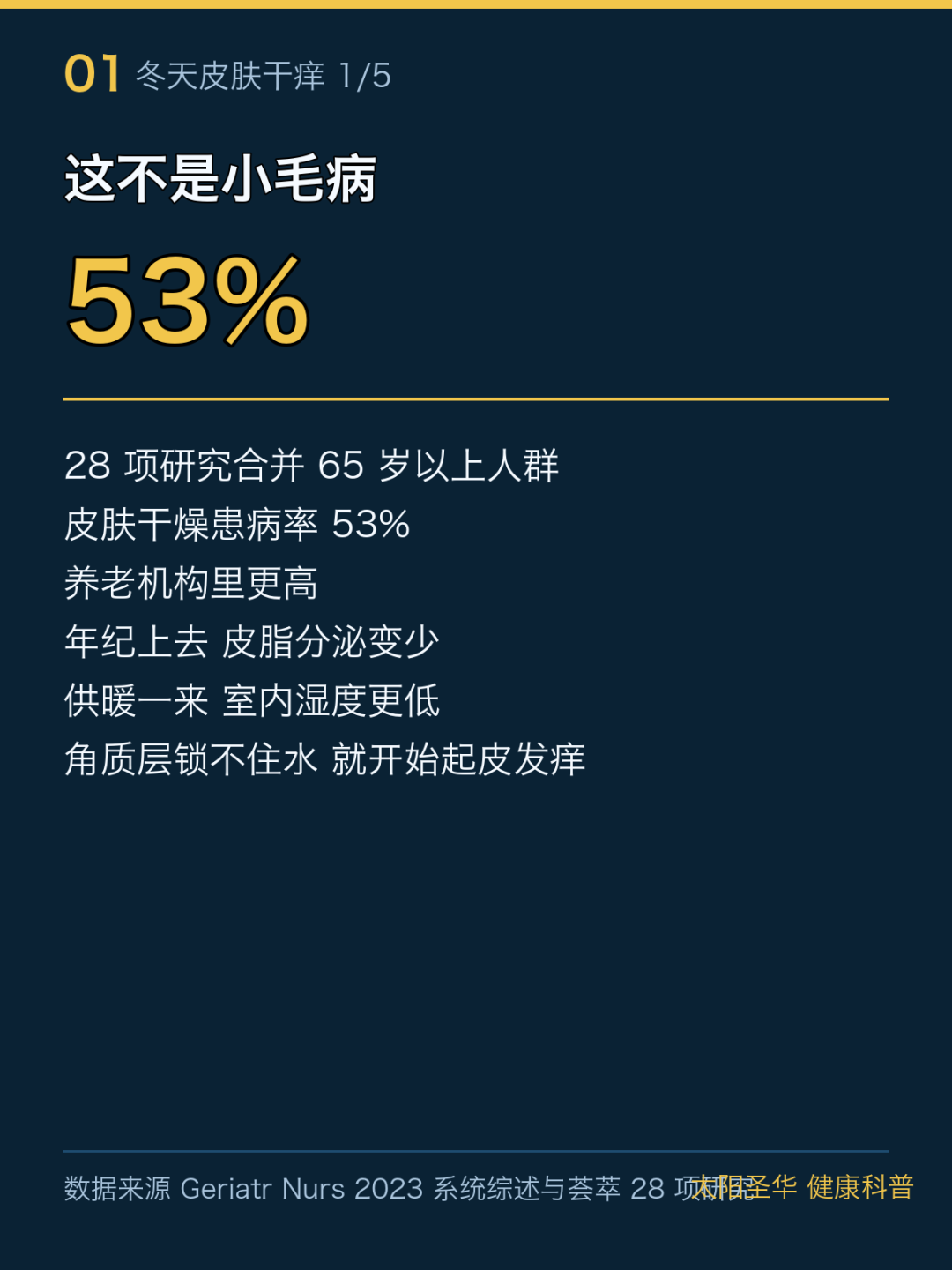
1. This Is Not a Minor Problem—More Than Half of Older Adults Have It
A 2023 systematic review pooled 28 studies and found that the prevalence of xerosis (dry skin) among people over 65 was 53%, with a 95% confidence interval of 36% to 69%, and even higher in nursing homes [1].
A survey at a dermatology clinic also found that 14% of patients over 65 complained of pruritus (itching), and behind the itching there was almost always an underlying skin condition [3].
As we age, sebum production and stratum corneum water content both decline, and the skin barrier is already thinner. Add heating, low indoor humidity, and hot showers, and the remaining oils get washed away too—leading to flaking and itching.
This is also why the same showering habits that cause no problems for young people make their parents itchier the more they wash.
2. Number One: Water Temperature Under 40 Degrees

A 1995 human trial made a very direct comparison: 10 subjects had four areas on their forearms treated daily with the same concentration of cleanser, with water temperatures set at 4°C, 20°C, and 40°C, for 4 consecutive days.
The results showed that the higher the water temperature, the more severe the skin damage, with more pronounced transepidermal water loss and erythema. The correlation between temperature and irritation level had a P value less than 0.001 [2].
The sample was only 10 people, but the conclusion is simple: with the same washing, the hotter the water, the more damage to the skin barrier.
In plain terms: If sticking your hand in feels "a bit hot but comfortable," that temperature is already too high for your skin. Adjust the water to warm but not hot to the touch, and apply the same standard to baths.
3. Number Two: Showers Around 10 Minutes

The longer you rinse, the more sebum and intercellular lipids are stripped away. Keep showers to around 10 minutes, and don't soak in the bath for half an hour.
You don't need to use body wash all over every time. Focus on washing the areas that have odor—underarms, groin, feet—and just rinse your limbs with plain water.
Loofahs, exfoliation, and long hot soaks—these three things are all unkind to dry skin.
Showering every day is fine; the problem is scrubbing your whole body with cleanser every day. People with dry skin can switch to using cleanser every other day or as needed.
4. Number Three: Moisturize Within 3 Minutes After Bathing

Timing matters more than brand. Apply while skin is still slightly damp and the stratum corneum is hydrated—moisturizer can lock the water in. Wait until skin is completely dry and the effect is diminished.
A 2025 review of moisturizer therapy gave usage amounts larger than many people imagine: it can be applied multiple times a day, and very dry skin may need up to about 600 grams per week [4]. Another concurrent review also emphasized that moisturizers work by hydrating and repairing the barrier, and are the foundation of treatment for dry skin [5].
As for texture, very dry skin should choose ointments (petroleum jelly-based types), while milder dryness can be managed with creams or lotions; the texture you can stick with consistently is the right one for you.
Apply after washing hands or doing dishes as well, and in winter you can apply more often.
5. Number Four: If It Doesn't Improve in Two Weeks, See a Dermatologist

If proper moisturizing for two weeks still doesn't bring relief, stop switching products on your own and see a dermatologist.
Also consider seeing a doctor if these situations arise: skin cracks, oozing, redness and swelling; itching so severe at night that you can't sleep and feel exhausted during the day; generalized itching accompanied by weight loss or night sweats; a rash that never resolves.
Itching is often a signal of an underlying skin condition rather than simply "being too dry" [3]. Finding the right cause is more useful than piling on more skincare products.
Four Things You Can Do Today
-
Adjust water temperature to warm but not hot to the touch, roughly under 40°C.
-
Keep showers to around 10 minutes, and use body wash only where needed.
-
Apply moisturizer within 3 minutes after drying off, and don't skimp on the amount.
-
Put a hygrometer in the bedroom and keep humidity at 40–60%; turn on a humidifier when it drops lower in heated rooms.
Skin moisture is locked in, not washed in. Less hot water in winter, more patience with moisturizing, and the itching will subside first.
If this is useful for the elders in your family, forward it to them for a look—more practical than buying a new bottle of body lotion.
If this helped you, give it a like or a "reading" click, and feel free to leave a comment telling us what topics you'd like to see.
Disclaimer: This article is for health education purposes only and is intended for informational reference. It does not constitute medical advice; please consult a professional doctor if you have health concerns.
Conflict of Interest Statement: This article does not involve any product promotion or commercial collaboration, and has no conflicts of interest with the research institutions mentioned in the text.
© 2026 Sun Sheng Hua (Beijing) Medical Technology Co., Ltd.
References
-
The prevalence and interventions of xerosis cutis among older adults: A systematic review and meta-analysis. Geriatric Nursing. 2023;54:219-228. PMID:37844538
-
Effects of water temperature on surfactant-induced skin irritation. Contact Dermatitis. 1995;32(2):83-87. PMID:7758326
-
Prevalence of pruritus in the elderly in an outpatient dermatologic clinic: a monocentric pilot study. Dermatology Reports. 2024;16(2):9778. PMID:38957626
-
Optimization of Basic Emollient Therapy for the Management of Xerosis Cutis. International Journal of Dermatology. 2025;64 Suppl 1:53-57. PMID:40444754
-
Clinical Benefits of Basic Emollient Therapy for the Management of Patients With Xerosis Cutis. International Journal of Dermatology. 2025;64 Suppl 1:47-52. PMID:40272060