Winter Blood Pressure Runs About 10 mmHg Higher—It's Really Not Just the Salt
This article is for health education purposes only and is intended for informational reference. It does not constitute medical advice; if you have health concerns, please consult a professional doctor.
Every year as soon as November arrives, the numbers on the blood pressure monitor at home start to misbehave.
Many people explain it this way: it's cold, tastes get heavier, and we're eating more salt.
That explanation isn't wrong, but it can't account for the large chunk of extra blood pressure in winter.
First, let's talk about how big this number is
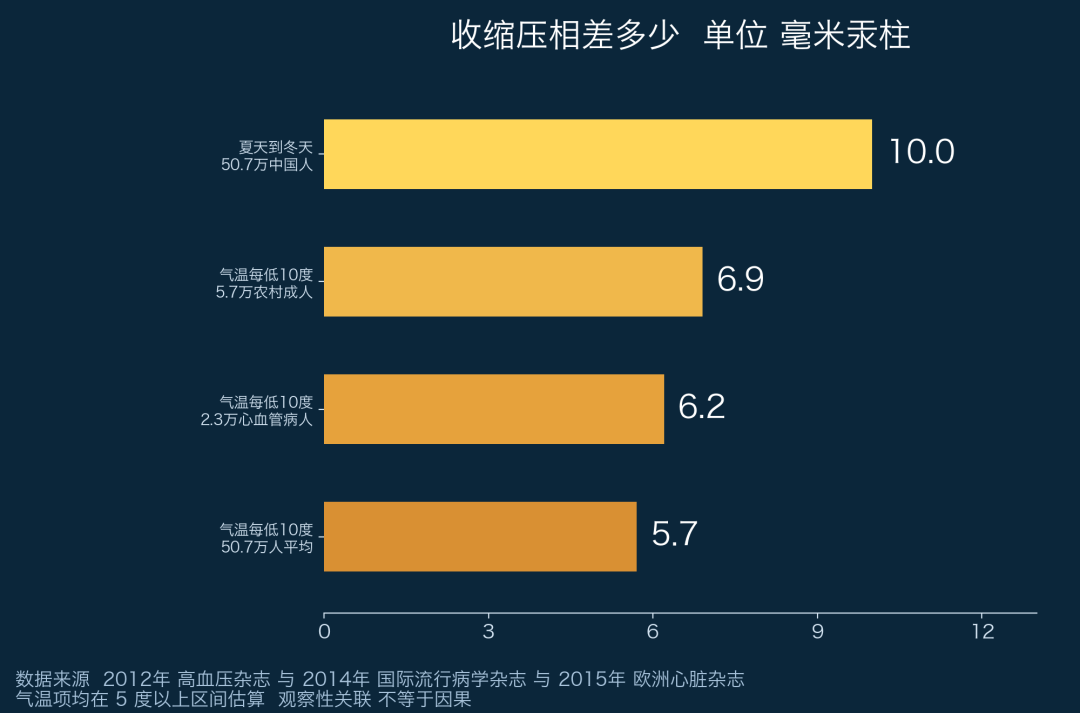
The China Kadoorie Biobank followed 507,000 adults aged 30 to 79 across 10 urban and rural regions. From summer to winter, systolic blood pressure differed by an average of 10 mmHg; rural areas differed by 12, urban areas by 8 [1].
What does 10 mmHg mean? Among people who have had cardiovascular disease, every 10 mmHg higher systolic blood pressure is associated with a 21% higher risk of cardiovascular death [2].
1. Cold itself pushes blood pressure up
In the same study, this time looking only at 23,000 of the participants with prior cardiovascular disease: average systolic blood pressure was 145 in winter and 136 mmHg in summer. For every 10-degree drop in temperature, systolic blood pressure was 6.2 mmHg higher [2].
Even more noteworthy is the second half—the risk of cardiovascular death in winter for this group was 41% higher than in summer [2].
In a county in Zhejiang with 57,000 rural adults, the gap was even larger: January versus July, systolic blood pressure was 19.2 mmHg higher and diastolic 7.7 mmHg higher. For every 10-degree drop in temperature, systolic blood pressure was 6.9 mmHg higher and diastolic 2.9 mmHg higher; the proportion of newly detected hypertension was 14.1% higher, and among those already in treatment, the blood pressure control rate was 13.0% lower [3].
In other words, winter isn't "a few individuals running a bit higher"—it's the entire population's blood pressure scale shifting upward.
2. Salt can't explain a gap this large
Switzerland conducted 24-hour urine testing on 2,845 people: sodium intake did indeed vary by season, highest from February to April, lowest from August to October, with a peak-to-trough difference of 9.2 mmol.
But when these seasonal fluctuations were fed into blood pressure models, sodium's effect on systolic blood pressure was only 0.4 to 1.1 mmHg [5].
Compare that with the numbers above: 5.7, 6.2, 6.9. That's a full order of magnitude apart.
The study's conclusion was direct: seasonal variation in sodium intake cannot explain seasonal variation in blood pressure [5].
This isn't to say cutting salt is useless. Salt reduction should still be done. It's just that the extra points in winter shouldn't all be charged to salt's account—otherwise you'll be cutting salt while wondering why the numbers aren't coming down with it.
3. What really has a switch is temperature
Back to the data on those 507,000 people: in the low-temperature range below 5 degrees, among people with central heating at home, almost no association could be seen between temperature and blood pressure; among those without central heating, the association remained clear [1].
Indoor temperature also has specific numbers. A home-based study of 172 middle-aged and older adults showed: when morning room temperature was below 18 degrees, blood pressure was significantly higher, especially systolic; when morning temperature fluctuated by more than 1.1 degrees, daytime blood pressure variability also increased significantly [6].
Whether your home is warm and whether the temperature gap between morning and evening is large—these are switches you can actually turn, far more direct than "skip another spoonful of salt."
4. Winter blood pressure should be read as winter blood pressure
A meta-analysis of 47 studies including 856,000 people found that blood pressure in summer is generally lower than in winter: clinic measurements differed by 5.6 and 3.3 mmHg, home self-measurements by 6.1 and 3.1, and daytime ambulatory blood pressure by 3.4 and 2.1 [4].
Interestingly, nighttime ambulatory blood pressure showed almost no seasonal difference [4].
Measuring high at home during the day in winter is normal—there's no need to panic over a single reading; but you also shouldn't treat it as background noise and ignore it just because "it's always higher in winter."
The way to judge isn't by looking at any single day—it's by looking at the trend.

Four things you can do this winter
-
Measure at a fixed time: within 1 hour of getting up, sit for 5 minutes, use the same arm every time, and record for 7 consecutive days—far more reliable than measuring occasionally.
-
Treat room temperature as a metric: keep your home at no less than 18 degrees if possible, especially during the getting-up period; avoid large temperature swings when going in and out.
-
Keep controlling salt as usual, but don't blame all blood pressure increases on diet and miss the warmth factor.
-
If readings stay consistently high, or are accompanied by headache, chest tightness, or blurred vision, bring your records to a doctor—don't adjust medications on your own.
One last thing
Winter on the blood pressure monitor is half written by the weather, and half written by your home's room temperature.
We can't change the weather half, but we can change the room temperature half. Consider sharing this with someone in your family who has high blood pressure—make temperature matter this winter too.
If this was helpful, give it a like or a "reading" and feel free to leave a comment telling us what topics you'd like to see.
✦
Disclaimer: This article is for health education purposes only and is intended for informational reference. It does not constitute medical advice; if you have health concerns, please consult a professional doctor. Conflict of interest statement: This article does not involve any drug or product recommendations and has no financial relationship with the research institutions mentioned in the text.
© 2026 Sun Sheng Hua (Beijing) Medical Technology Co., Ltd.
References
[1] Lewington S, Li L, Sherliker P, Guo Y, Millwood I, Bian Z, Whitlock G, Yang L, Collins R, Chen J, Wu X, Wang S, Hu Y, Jiang L, Yang L, Lacey B, Peto R, Chen Z. Seasonal variation in blood pressure and its relationship with outdoor temperature in 10 diverse regions of China: the China Kadoorie Biobank. J Hypertens. 2012;30(7):1383-1391. PMID: 22688260
[2] Yang L, Li L, Lewington S, Guo Y, Sherliker P, Bian Z, Collins R, Peto R, Liu Y, Yang R, Zhang Y, Li G, Liu S, Chen Z. Outdoor temperature, blood pressure, and cardiovascular disease mortality among 23 000 individuals with diagnosed cardiovascular diseases from China. Eur Heart J. 2015;36(19):1178-1185. PMID: 25690792
[3] Su D, Du H, Zhang X, Qian Y, Chen L, Chen Y, Guo Y, Bian Z, Chen Z, Li L, Yu M. Season and outdoor temperature in relation to detection and control of hypertension in a large rural Chinese population. Int J Epidemiol. 2014;43(6):1835-1845. PMID: 25135908
[4] Kollias A, Kyriakoulis KG, Stambolliu E, Ntineri A, Anagnostopoulos I, Stergiou GS. Seasonal blood pressure variation assessed by different measurement methods: systematic review and meta-analysis. J Hypertens. 2020;38(5):791-798. PMID: 32102047
[5] Marti-Soler H, Pommier C, Bochud M, Guessous I, Ponte B, Pruijm M, Ackermann D, Forni Ogna V, Paccaud F, Burnier M, Pechère-Bertschi A, Devuyst O, Marques-Vidal P. Seasonality of sodium and potassium consumption in Switzerland. Data from three cross-sectional, population-based studies. Nutr Metab Cardiovasc Dis. 2017;27(9):792-798. PMID: 28756972
[6] Chen T, Ge J, Luo X. Effects of indoor temperature and its fluctuation on blood pressure and its variability. Int J Biometeorol. 2023;67(8):1279-1290. PMID: 37410169