Weight Gained in Winter Still on You by Next Fall?
This article is for health education purposes only and is intended as general information; it does not constitute medical advice. If you have health concerns, please consult a professional physician.
Once the padded coat goes on, you can't tell yourself whether your waistline has loosened; by the time you step on the scale next spring, the number has quietly climbed another notch.
Many people treat "three pounds heavier after the holidays" as a joke. The real research numbers aren't that dramatic, but they carry a more sobering conclusion: most people never lose the bit of weight they gain over winter—not all year long.
The good news is that winter is also the season where defense costs the least. The 5 habits below can almost wipe out that ledger.
First, the real numbers: not much gained, but never lost
The US National Institutes of Health followed 195 adults, weighing them from late fall through the following fall: during the year-end holiday season they gained an average of 0.37 kg, which doesn't sound like much; but by the following fall, the net gain of 0.48 kg remained almost entirely in place—it wasn't lost during spring or summer either[1].
Adult body weight is accumulated winter after winter like this. The problem isn't "explosive gain," but "input with no output."
Habit 1: Weigh yourself twice a week on a fixed schedule—and daily during party season
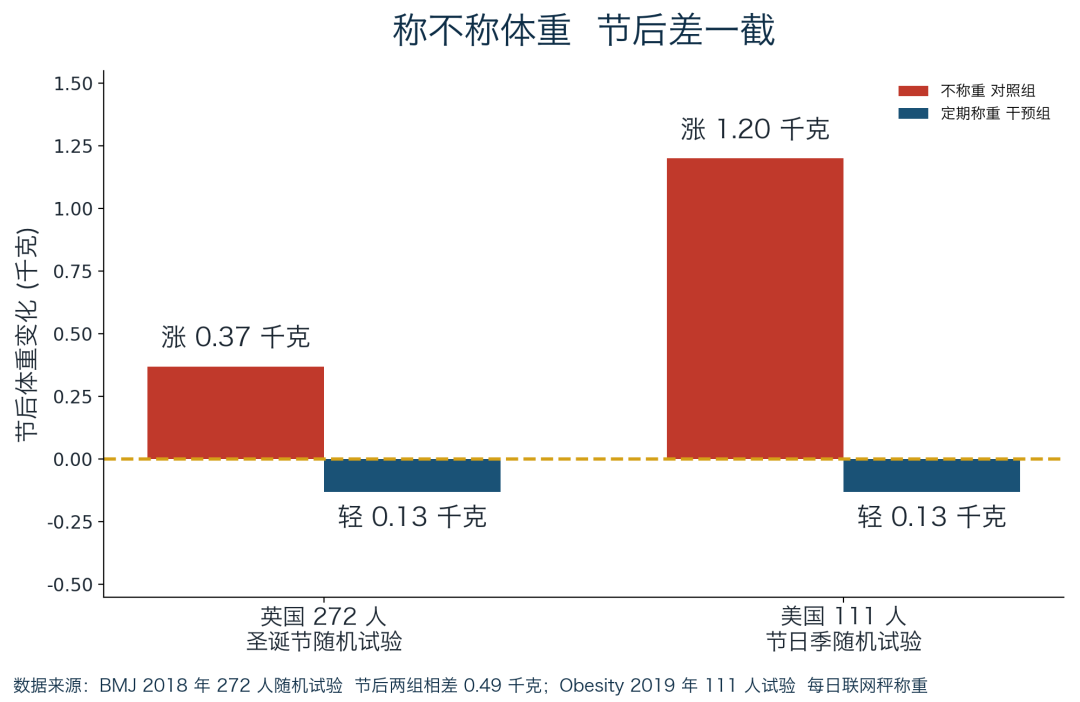
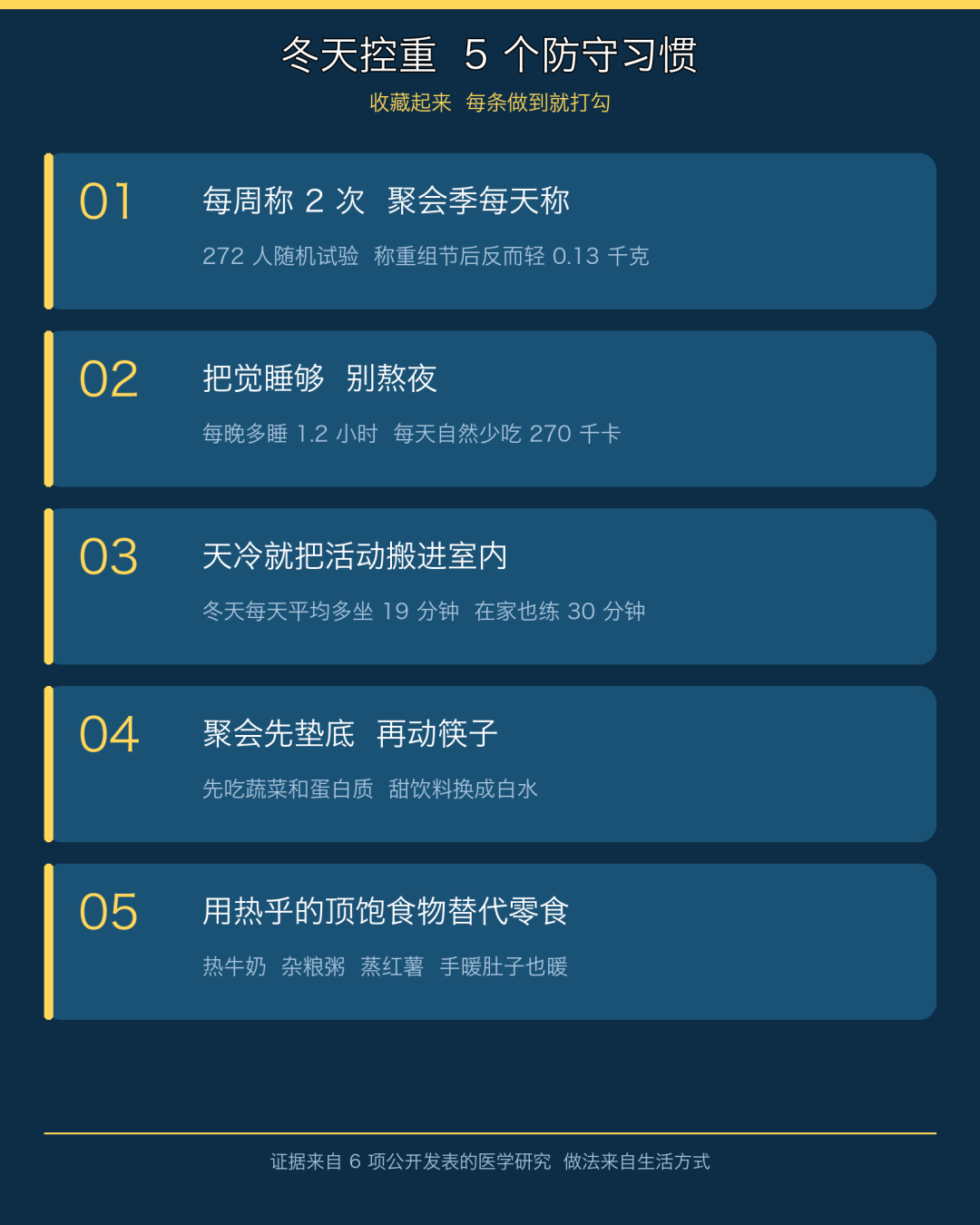
A UK randomized trial of 272 people: those who received only a health leaflet gained an average of 0.37 kg after Christmas; the other group, who learned to weigh themselves regularly, track their curves, and set a goal of "gain no more than 0.5 kg," actually weighed 0.13 kg less after the holidays—a difference of 0.49 kg between the two groups[3].
A US trial of 111 people was even more direct: those who weighed themselves daily on a connected scale and viewed their graphs barely changed weight during the holidays; the control group, who didn't weigh themselves, gained an average of 2.65 pounds, about 1.2 kg, and still retained about 57% of it more than 3 months later[2].
Weighing yourself isn't about creating anxiety—it's about installing a dashboard for your appetite. Aim to weigh yourself on 2 fixed days each week, after getting up and before eating; during months with lots of gatherings, switch to daily weighing.
Habit 2: Getting enough sleep works better than gritting your teeth through a craving
In a randomized trial at the University of Chicago, overweight adults who usually slept less than 6.5 hours received sleep coaching and slept about 1.2 hours more per night on average; without dieting or extra exercise, they naturally ate about 270 kcal less per day[6].
Winter has long nights and is naturally a good season to catch up on sleep. Move your bedtime 30 minutes earlier and put your phone down 1 hour before bed—simply cutting down on late nights is itself a form of limiting energy intake.
Habit 3: When it's cold, move your activity indoors
An analysis pooling data from 17 studies across 14 countries found that people sit about 19 minutes more per day in winter than the annual average, while moderate-to-vigorous activity peaks in summer[4].
Cold weather isn't a reason to lie flat. Following along with workout videos, climbing stairs, brisk walking in a mall, or indoor strength training all count—about 30 minutes per session, accumulating 150 minutes of moderate-intensity activity per week is enough; if it's cold outside, roll out a yoga mat at home and get started.
Habit 4: Lay a base before gatherings, then pick up your chopsticks
Short days and long nights in winter, plus more holiday gatherings and eating out, are the main drivers of higher energy intake during the year[5].
Before heading to a banquet, have a bowl of hot soup or an egg to lay a base; when you sit down, reach first for vegetables and quality protein; pair rich, oily dishes with plain water rather than sweet drinks; and drink as little alcohol as possible. Eating to the same fullness, the calories in that meal can differ by a wide margin.
Habit 5: Replace snacks with hot, satiating foods
When you feel like eating in cold weather, your body is often seeking warmth and comfort. Swap cookies and milk tea for hot milk, whole-grain porridge, steamed sweet potato, or unsweetened hot lemon water—your hands stay warm and your stomach feels warm too; protein and dietary fiber keep you full, so you won't be rummaging through the snack cabinet round after round in the afternoon.
3 things you can do today
First, step on the scale first thing tomorrow morning and record the number in your phone; second, move your bedtime 30 minutes earlier tonight; third, save an indoor follow-along workout video for backup on cold days.
Winter isn't a season where you're destined to gain weight—it's just a season where it's easy to let your guard down. Save this article, check off each habit you complete, and when you weigh yourself in spring you'll thank the you of today; also share it with friends who start talking about "stocking up on fat" as soon as winter arrives.
If this was helpful to you, give it a like or a "Wow," and feel free to leave a comment telling us what topics you'd like to see.
✦ ✦ ✦
Disclaimer: This article is for health education purposes only and is intended as general information; it does not constitute medical advice. If you have health concerns, please consult a professional physician.
Declaration of interests: This article is based on publicly published medical literature, and the author has no relevant conflicts of interest.
References
-
Yanovski JA, et al. A prospective study of holiday weight gain. N Engl J Med. 2000;342(12):861-867. PMID:10727591
-
Kaviani S, vanDellen M, Cooper JA. Daily Self-Weighing to Prevent Holiday-Associated Weight Gain in Adults. Obesity (Silver Spring). 2019;27(6):908-916. PMID:31119881
-
Mason F, et al. Effectiveness of a brief behavioural intervention to prevent weight gain over the Christmas holiday period: randomised controlled trial. BMJ. 2018;363:k4867. PMID:30530821
-
Ferguson T, et al. Annual, seasonal, cultural and vacation patterns in sleep, sedentary behaviour and physical activity: a systematic review and meta-analysis. BMC Public Health. 2021;21(1):1384. PMID:34256712
-
Fujihira K, et al. Factors explaining seasonal variation in energy intake: a review. Front Nutr. 2023;10:1192223. PMID:37545581
-
Tasali E, et al. Effect of Sleep Extension on Objectively Assessed Energy Intake Among Adults With Overweight in Real-life Settings: A Randomized Clinical Trial. JAMA Intern Med. 2022;182(4):365-374. PMID:35129580
© 2026 Sunshenghua (Beijing) Medical Technology Co., Ltd.