This article is for health education purposes only and is intended for informational reference. It does not constitute medical advice; if you have health concerns, please consult a professional doctor.
Can You Eat Fruit While Losing Weight? 5 Common Questions Answered
✦ ✦ ✦
Many people's first step in losing weight is to declare: "I'm quitting fruit." Watermelon is too sweet, grapes are high in sugar, bananas are calorie bombs. But BMJ data tracking 187,000 people says the opposite: eating 3 more servings of blueberries per week lowers type 2 diabetes risk by 26%; more apples/pears lowers it by 7%—what actually raises risk is fruit juice[[2]].
Quitting fruit first when losing weight? You might be quitting the wrong thing. Below are the 5 most frequently asked questions from people trying to lose weight, all answered at once.
✦ ✦ ✦
Question 1: Can I eat fruit while losing weight? Will eating it make me fatter?
Yes, and you should eat it. Fruit is a naturally packaged sweet treat: fiber, water, and polyphenols—none are missing, and its calorie density is far lower than cookies, cake, and sugary drinks.
-
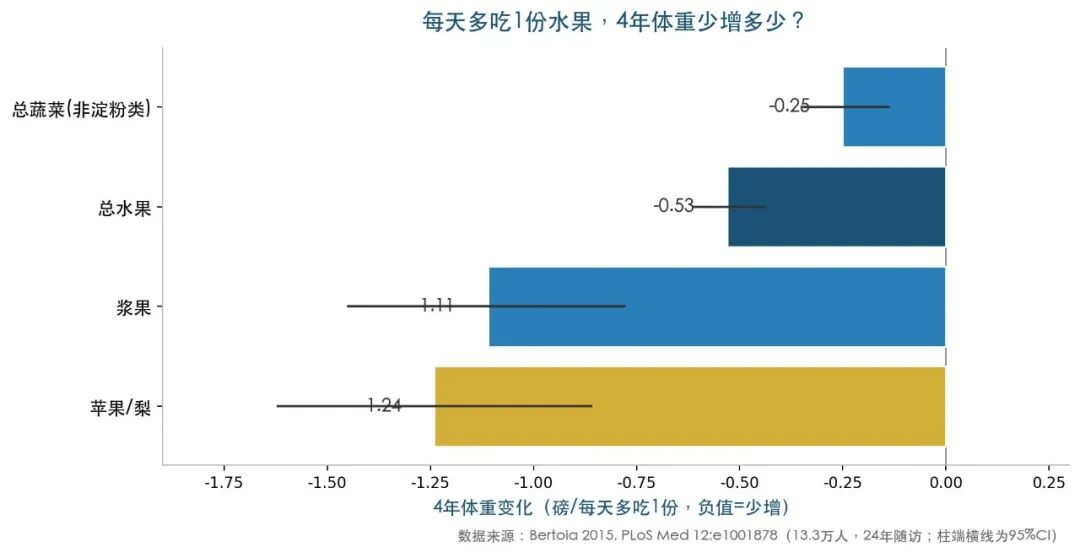
Harvard follow-up of 133,000 people over 24 years: each additional daily serving of fruit was linked to 0.53 fewer pounds gained over 4 years (about 0.24 kg); berries were linked to 1.11 fewer pounds and apples/pears to 1.24 fewer pounds[[1]]
-
Replacing afternoon tea desserts with fruit immediately drops calorie intake by an order of magnitude
-
The key was never "whether to eat fruit," but "what the fruit replaces"
Question 2: Fruit is so sweet—isn't the sugar content very high? Should watermelon be avoided?
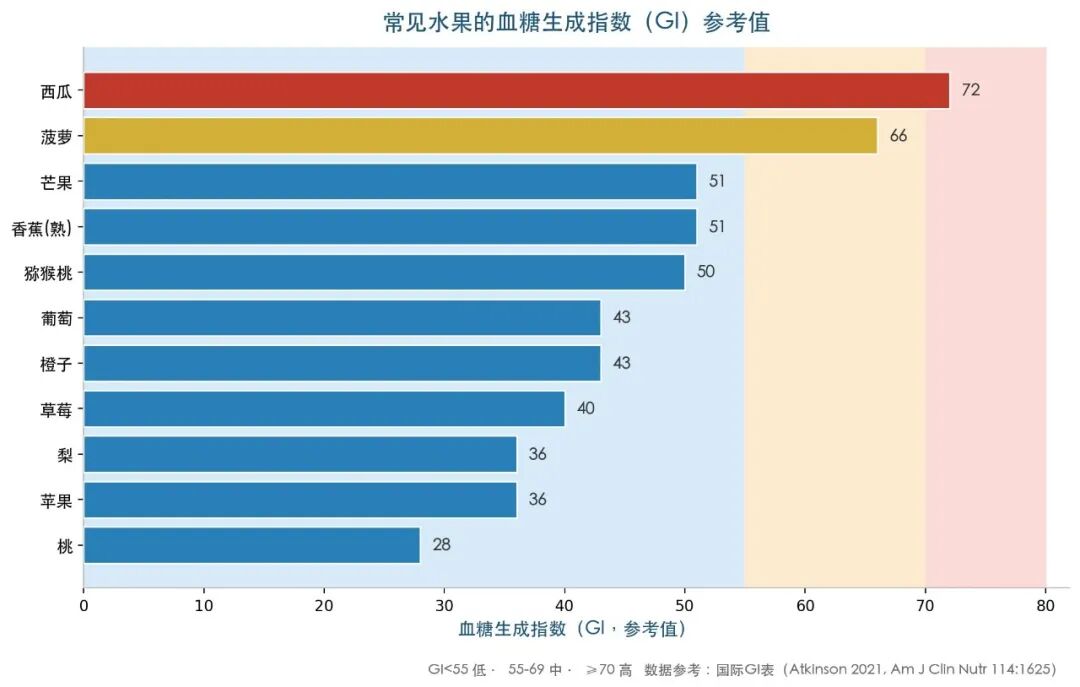
Sweet does not equal fast blood sugar spikes. To judge whether a fruit is suitable during weight loss, looking at the glycemic index (GI) is more reliable than tasting how sweet it is[[3]]:
-
High GI (≥70): watermelon (72)—but watermelon is high in water, so eating 1-2 pieces at a time does not actually create a high glycemic load
-
Medium GI (55-69): pineapple (66), ripe banana (51), mango (51)
-
Low GI (<55): peach (28), apple (36), pear (36), strawberry (40), orange (43), grape (43)
There is no fruit that absolutely cannot be eaten, only fruit whose portion needs to be controlled. Watermelon can be eaten—just don't scoop out half of one.
Question 3: Can replacing meals with fruit help with weight loss?
No, and it harms your body. The "fruit diet" may drop weight quickly in the short term, but most of what is lost is water and muscle:
-
Fruit contains almost no protein or fat. Long-term meal replacement → insufficient protein intake → muscle loss → lower basal metabolic rate
-
Muscle is the engine of metabolism. With less muscle, rebound after returning to a normal diet is faster than with calorie restriction
-
Weight loss depends on the overall nutritional structure of the whole day, not on "which meal gets replaced with fruit"
The right approach: fruit as a snack, not as a meal.
Question 4: Is drinking fruit juice the same as eating fruit?
Completely different. Juicing throws away the most valuable dietary fiber, and sugar goes from being "bound inside cells" to "free sugars," with a completely different absorption speed:
-
BMJ cohort of 187,000 people: each additional 3 servings of fruit juice per week raised type 2 diabetes risk by 8% (HR 1.08)[[2]]
-
WHO explicitly counts the sugar in 100% fruit juice as "free sugars," and recommends that free sugars provide less than 10% of total daily energy[[6]]
-
A cup of orange juice requires 3-4 oranges, and eating the whole fruit would take several sittings, while juice can be drunk in one go
The best way to have fruit: whole fruit, not juiced.
Question 5: So how much per day, and when should I eat it?
200-350 grams per day (about the size of 1-2 fists), placed between meals or before meals[[5]].
-
3-4 p.m.: 1 apple + a small handful of blueberries, replacing afternoon tea cookies
-
20 minutes before a meal: eat half a fruit to take the edge off, and you will naturally eat a few fewer bites at the main meal
-
Prioritize low-GI, high-fiber options: apple, pear, berries, peach; for high-sugar fruits like durian, lychee, and jackfruit, enjoy them occasionally and control the portion
-
Eating enough fruits and vegetables also brings longevity benefits: the higher the intake, the lower the all-cause mortality risk, with the lowest risk at about 800 grams of fruits and vegetables combined per day[[4]]
✦ ✦ ✦
One-sentence action: Starting tomorrow, replace your afternoon cookies with "1 apple + a small handful of blueberries" for 1 week straight, feel the change in satiety, and note your weight along the way—the numbers will give you the answer.
Key line: Losing weight is not about making an enemy of fruit; it is about befriending your own food choices. Save this article and share it with that family member or friend who is "quitting fruit to lose weight."
If this content has been helpful to you, feel free to hit "Like" or "Wow," and leave a comment telling us what topic you'd like to see.
✦ ✦ ✦
References
-
Bertoia ML, et al. Changes in intake of fruits and vegetables and weight change in United States men and women followed for up to 24 years: analysis from three prospective cohort studies. PLoS Med. 2015;12(9):e1001878. PMID: 26394033.
-
Muraki I, et al. Fruit consumption and risk of type 2 diabetes: results from three prospective longitudinal cohort studies. BMJ. 2013;347:f5001. PMID: 23990623.
-
Atkinson FS, et al. International tables of glycemic index and glycemic load values 2021: a systematic review. Am J Clin Nutr. 2021;114(5):1625-1632. PMID: 34258626.
-
Aune D, et al. Fruit and vegetable intake and the risk of cardiovascular disease, total cancer and all-cause mortality: a systematic review and dose-response meta-analysis of prospective studies. Int J Epidemiol. 2017;46(3):1029-1056. PMID: 28338764.
-
Chinese Nutrition Society. Dietary Guidelines for Chinese Residents (2022). Beijing: People's Medical Publishing House, 2022.
-
World Health Organization. Guideline: Sugars intake for adults and children. Geneva: WHO; 2015.
Disclaimer: This article is health education content and is for informational reference only. It does not constitute medical advice or medication guidance; if you have health concerns, please consult a professional doctor. Conflict of interest statement: The author has no financial relationships with the research institutions or publishers cited in this article; all data in the article come from publicly published academic literature.
© 2026 Sun Saint Hua (Beijing) Medical Technology Co., Ltd.