This article is for health education purposes only and is intended for informational reference. It does not constitute medical advice; please consult a professional doctor if you have any health concerns.
Weight Loss Always Rebounds? The Problem May Not Be Your Mouth—It's Your Sleep
Have you ever felt this way: you're eating exactly the same as before, yet your weight is quietly creeping up; you've been strictly watching what you eat and exercising consistently, but the few pounds you lost come bouncing back before long.
The problem may really not be your willpower. Over the past two decades, dozens of high-quality epidemiological studies and randomized controlled trials have repeatedly pointed to a severely underestimated driver of weight gain—sleeping too little.
✦ ✦ ✦
1. The Data Shock: People Who Don't Sleep Enough Are More Prone to Weight Gain
A meta-analysis that pooled dozens of studies worldwide, covering approximately 30,000 participants, showed that adults who sleep less than 6 hours per night have a significantly higher risk of obesity than those who sleep 7–8 hours; among children, the link between short sleep and obesity is even stronger[[2]].
This isn't as simple as "staying up late makes you tired, so you don't want to move." The US CDC recommends that adults get at least 7 hours of sleep per night, but the average sleep duration of Chinese adults is declining year by year, with a considerable proportion getting less than 6.5 hours on weekdays.
Sleep is the body's "master switch" for regulating appetite, metabolism, and energy expenditure. When you cut back on sleep, your body—without you even noticing—begins to "encourage" you at the hormonal level to eat more, burn less, and store more energy as fat.
✦ ✦ ✦
2. Not Sleeping Enough Makes Your Hunger Hormones "Defect"
Why do you crave sweets, fried chicken, and milk tea after pulling an all-nighter? It's not that you're being greedy—it's your hormones forcing you.
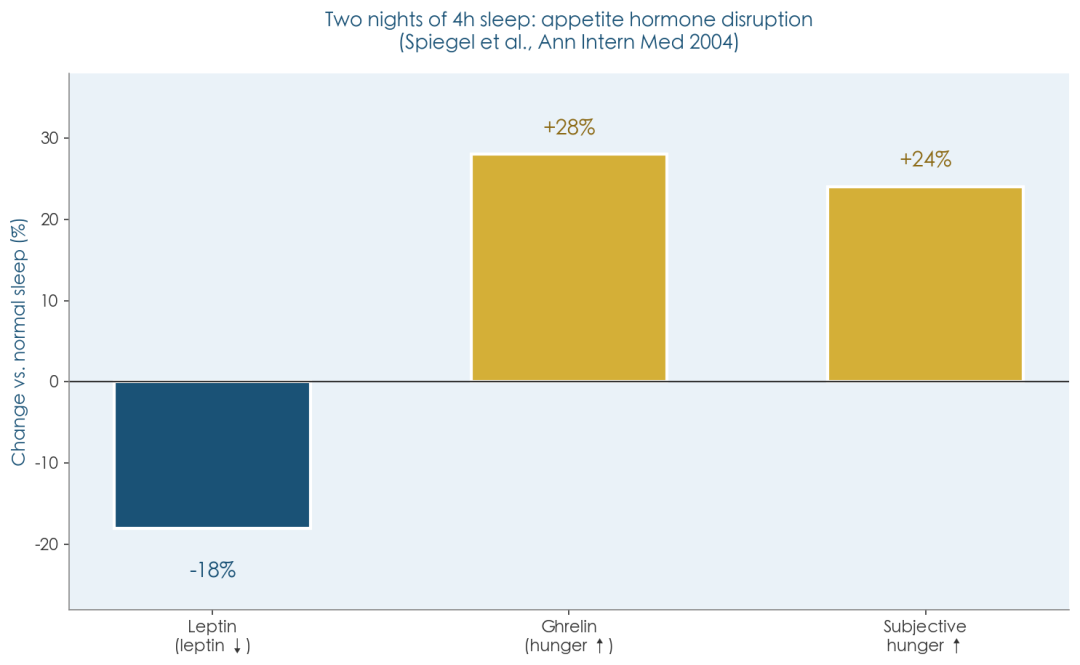
In a classic crossover controlled study, healthy young men were allowed only 4 hours of sleep for two consecutive nights. The results showed:
-
Leptin levels (which suppress appetite) dropped by about 18%
-
Ghrelin levels (which promote hunger) rose by about 28%
-
Participants' self-reported hunger and appetite scores increased by about 24%, with a particular preference for high-sugar, high-carbohydrate foods[[1]]
Simply put, when you sleep too little, your body mistakenly believes you are "in a dangerous environment with food scarcity," so it dials down satiety signals and dials up hunger signals, creating an almost irresistible craving for high-calorie foods. You think it's just your sweet tooth—but it's actually your hormones giving the orders.
✦ ✦ ✦
3. On the Same Diet, Short Sleepers Lose "Lean Tissue" Instead of Fat
What's even more frustrating: even if you manage to control your eating through sheer willpower, insufficient sleep can seriously undermine your weight-loss results.
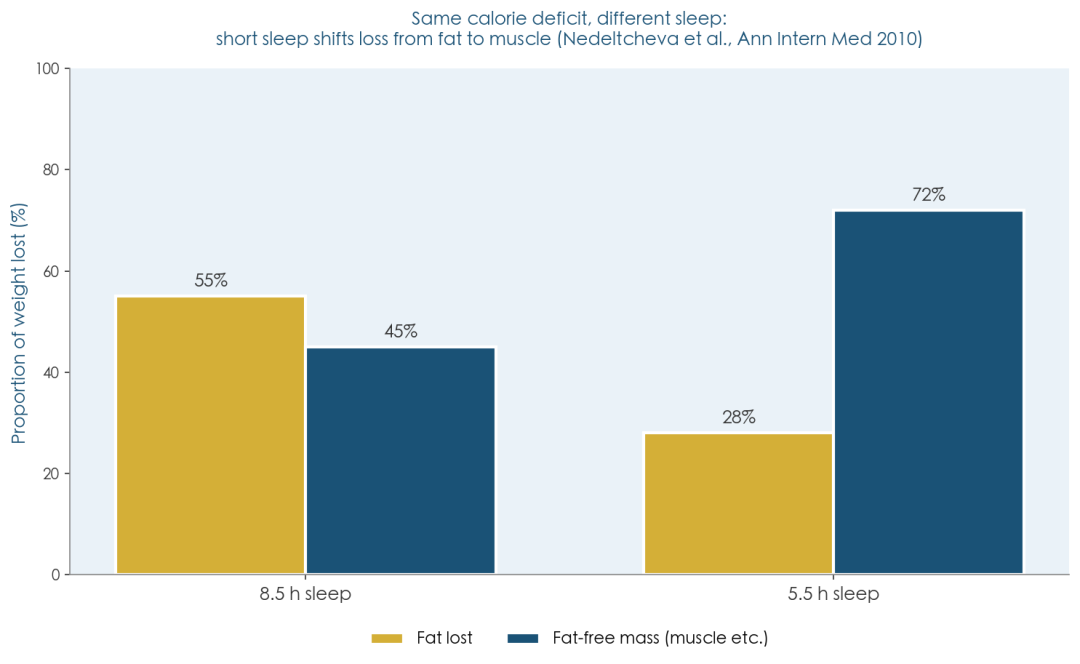
In a widely cited randomized controlled trial from 2010, researchers put overweight participants on the same low-calorie diet, but one group slept 8.5 hours per night while the other slept only 5.5 hours. After two weeks:
-
Both groups lost weight, but those who slept 5.5 hours lost only about half as much fat as the 8.5-hour group
-
In the sleep-deprived group, a larger proportion of the weight lost came from "fat-free mass" such as muscle, rather than fat[[3]]
Metric (Same Calorie Restriction) 8.5 Hours/Night 5.5 Hours/Night
Proportion of fat loss Higher About half of the former
Fat-free mass (muscle, etc.) loss Less Significantly more
Hunger hormone levels Relatively stable Markedly elevated
What does this mean? After two weeks of the same diet, those who slept enough were mainly losing fat, while those who stayed up late were losing muscle. A decline in muscle mass lowers your basal metabolic rate, setting the stage for future weight rebound—this is one of the mechanisms behind why so many people find it "harder and harder to lose weight, and the weight keeps coming back."
✦ ✦ ✦
4. One Bad Night's Sleep Puts Your Body Into a "Prediabetic" State
Insufficient sleep doesn't just make you eat more—it directly interferes with your body's ability to handle sugar.
A study of healthy volunteers found that just one night of partial sleep deprivation (about 4 hours) reduced whole-body insulin sensitivity, impaired insulin response in both the liver and peripheral tissues, and shifted blood sugar regulation toward insulin resistance[[4]].
People who are chronically sleep-deprived have a significantly higher risk of type 2 diabetes—a conclusion that has been repeatedly confirmed by multiple meta-analyses and reviews[[6]]. In other words, chronic sleep deprivation is like keeping your body in a long-term state of "metabolic sub-health," where fat is more easily accumulated, especially in the visceral abdominal area.
✦ ✦ ✦
5. The Flip Side: Sleeping More Really Can Make You Eat Less
The good news is that this causal chain works both ways. If sleeping less makes people eat more, can extending sleep naturally reduce food intake?
A 2022 randomized controlled trial published in JAMA Internal Medicine gave an encouraging answer: when overweight adults who slept less than 6.5 hours per night received a personalized sleep extension intervention, after sleeping about 1.2 hours more per night on average, participants naturally reduced their daily energy intake by about 270 kilocalories—with no dietary restrictions or exercise requirements during the study period[[5]].
The researchers estimated that if this change could be sustained, it could theoretically translate into a weight change of more than 10 kilograms over three years—though in the real world, weight would plateau due to metabolic adaptation. But this result at least shows that improving sleep itself may be an overlooked, low-cost weight intervention.
✦ ✦ ✦
6. Action Steps: Treat Sleep as the "First Prescription" for Weight Loss
If you or a family member are struggling with repeated weight rebound or a waistline that won't shrink, before trying even stricter diets, consider doing these things first:
-
Measure it: Track your actual sleep duration each night for one week (a phone or fitness tracker will do). If your weekday average is under 7 hours, that's a clear signal.
-
Fix your schedule: Go to bed and wake up at the same time every day, including weekends; on weekends, don't sleep in more than 1 hour later than on weekdays.
-
Optimize your bedroom: Keep it quiet, cool (around 18–22°C), and dark; stay away from phones and other glowing screens for 1 hour before bed.
-
Avoid pitfalls before bed: No alcohol, no heavy meals, and no high-intensity exercise within 3 hours of bedtime; avoid caffeine after the afternoon.
-
See a doctor if: You snore heavily every night, feel uncontrollably sleepy during the day, or still feel unrested after getting enough sleep—you should be screened for obstructive sleep apnea (OSA), which is a condition that requires treatment.
✦ ✦ ✦
The first step to losing weight may not be walking into a gym—it may be climbing into bed.
Rather than blaming weight rebound on "poor willpower" or "I gain weight just by drinking water," ask yourself one question first: How many hours did I actually sleep last night?
Consider sharing this article with that family member or friend who is always dieting and always rebounding—sometimes, the key to changing your weight is simply sleeping one more hour.
If you found this content helpful, feel free to hit "Like" or "Wow," and leave a comment telling us what topics you'd like to see.
✦ ✦ ✦
Disclaimer: The content of this article is based on publicly published medical research and is intended for health education and informational reference only. It cannot replace a doctor's in-person consultation, examination, or diagnosis. Those with sleep disorders, obesity, or metabolic diseases should seek care at a qualified medical institution.
Conflict of Interest Statement: The author of this article and Sun Sheng Hua (Beijing) Medical Technology Co., Ltd. have no commercial affiliation with any drugs, devices, or brands mentioned in this article and have received no related sponsorship.
© 2026 Sun Sheng Hua (Beijing) Medical Technology Co., Ltd.
References
-
Spiegel K, Tasali E, Penev P, Van Cauter E. Brief communication: Sleep curtailment in healthy young men is associated with decreased leptin levels, elevated ghrelin levels, and increased hunger and appetite. Ann Intern Med. 2004;141(11):846-850. PMID: 15583226.
-
Cappuccio FP, Taggart FM, Kandala NB, et al. Meta-analysis of short sleep duration and obesity in children and adults. Sleep. 2008;31(5):619-626. PMID: 18517032.
-
Nedeltcheva AV, Kilkus JM, Imperial J, Kasza K, Schoeller DA, Penev PD. Insufficient sleep undermines dietary efforts to reduce adiposity. Ann Intern Med. 2010;153(7):435-441. PMID: 20921543.
-
Donga E, van Dijk M, van Dijk JG, et al. A single night of partial sleep deprivation induces insulin resistance in multiple metabolic pathways in healthy subjects. J Clin Endocrinol Metab. 2010;95(6):2963-2968. PMID: 20371664.
-
Tasali E, Wroblewski K, Kahn E, et al. Effect of sleep extension on objectively assessed energy intake among adults with overweight in real-life settings: a randomized clinical trial. JAMA Intern Med. 2022;182(4):365-374. PMID: 35040879.
-
Reutrakul S, Van Cauter E. Sleep influences on obesity, insulin resistance, and risk of type 2 diabetes. Metabolism. 2018;84:35-46. PMID: 29510167.