This article is for health education purposes only and is intended for informational reference; it does not constitute medical advice. If you have any health concerns, please consult a professional doctor.
✦ ✦ ✦
After the start of autumn, it becomes easier to feel sleepy during the day. After lunch, you lie down on the desk, and by the time you open your eyes again, more than an hour has passed. Your head feels heavier, your chest feels tight, and when you lie down at night, you toss and turn and cannot fall asleep.
If you have also experienced this, the problem is probably not "whether you slept" but "how long you slept."
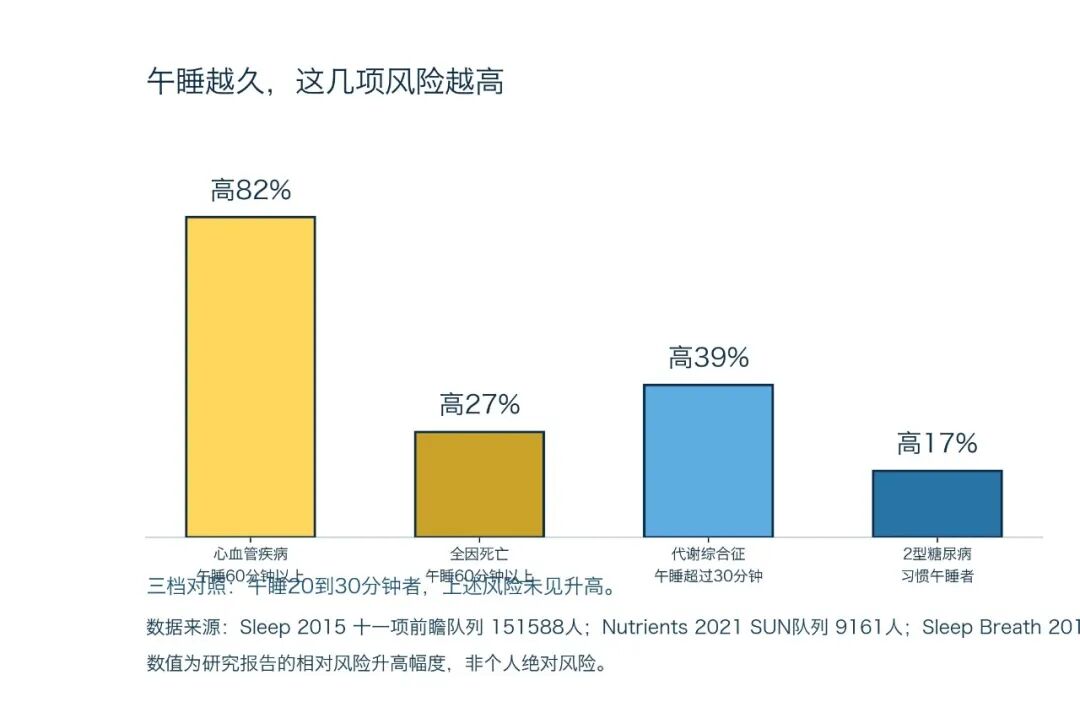
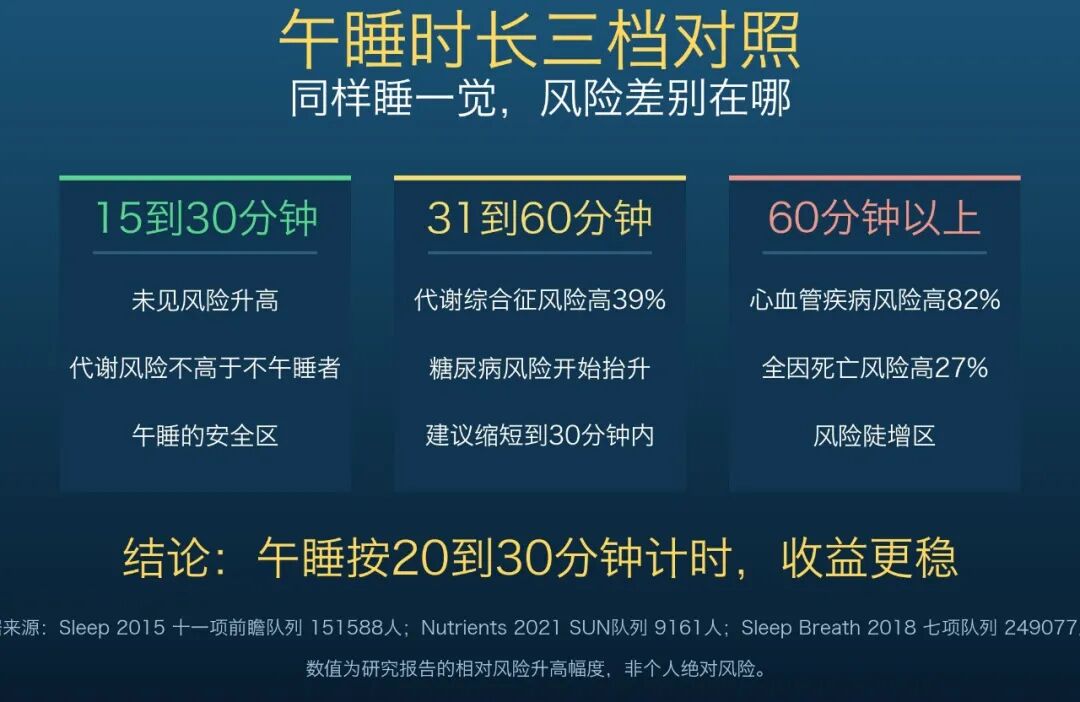
First, look at the data. A meta-analysis pooling 11 prospective cohorts and 151,000 people (5,276 cardiovascular events and 18,966 deaths) showed that people who napped more than 60 minutes per day had an 82% higher risk of cardiovascular disease than non-nappers and a 27% higher risk of all-cause death; among people who napped less than 60 minutes, neither risk was significantly elevated[1].
The following 5 numbers will help clarify, once and for all, "how long should you actually nap?"
✦
Number 1 | 82%: 1 hour is the dividing line where risk rises sharply
The specific numbers from the study above are: compared with no napping, people who napped more than 60 minutes per day had a hazard ratio for cardiovascular disease of 1.82 (95%CI 1.22 to 2.71) and a hazard ratio for all-cause death of 1.27 (95%CI 1.11 to 1.45). Among people who napped less than 60 minutes, there was no statistically significant difference in the risk of cardiovascular disease or all-cause death. The risk curve is J-shaped: it decreases slightly from 0 to 30 minutes, begins to rise after 45 minutes, and rises steeply beyond 1 hour[1].
✦
Number 2 | 39%: beyond 30 minutes, metabolism starts to "keep score"
The Spanish SUN cohort study followed 9,161 adults for an average of 6.8 years: people who napped more than 30 minutes per day had a 39% higher risk of metabolic syndrome than non-nappers (adjusted odds ratio 1.39, 95%CI 1.03 to 1.88); those who napped within 30 minutes showed almost no difference from non-nappers (1.07, 95%CI 0.83 to 1.37); and those who napped less than 15 minutes per day on average may even have had a lower risk[2].
In plain terms: the "safe zone" for napping is 20 to 30 minutes, not "sleeping until you wake up naturally."
✦
Number 3 | 11%: for every additional 30 minutes of sleep, diabetes risk rises further
A study including 7 prospective cohorts, 249,000 people, and 13,237 cases of type 2 diabetes showed that habitual nappers had a 17% higher risk of type 2 diabetes than non-nappers; dose-response analysis suggested that for every additional 30 minutes of daily napping, the risk increased by about another 11%[3].
Another meta-analysis pooling 289,000 people found the same J-shaped relationship: people who napped more than 60 minutes had a 46% higher risk of diabetes (OR 1.46, 95%CI 1.23 to 1.74), while no association was seen within 60 minutes—about 40 minutes is where the curve begins to rise[4].
✦
Number 4 | 0.4: when napping accounts for more than 40% of total daily sleep, blood pressure signals first
A study of 9,247 middle-aged and older Chinese adults found that people whose nap duration accounted for 0.4 or more of total daily sleep had a 71% higher risk of hypertension (OR 1.712, 95%CI 1.129 to 2.594); people who slept less than 6 hours at night also had a 17% higher risk of hypertension[5].
Napping is not an isolated matter; it takes up the quota of nighttime sleep. The longer you sleep during the day and the less you sleep at night, the more dangerous this curve becomes.
✦
Number 5 | 2.05 times: you cannot make up for lost nighttime sleep with napping
The same Chinese study also found that people who napped less than 0.5 hours had a cardiovascular disease risk 2.05 times that of non-nappers (OR 2.053, 95%CI 1.323 to 3.185). The researchers believe that this type of "short nap" is often a passive compensation for insufficient nighttime sleep—when the body is already running a sleep deficit, napping cannot fill that gap[5].
A 2025 meta-analysis including multiple studies confirmed the importance of nighttime sleep: sleeping less than 7 hours at night was associated with an 18% higher risk of type 2 diabetes; poor sleep quality was associated with a 50% higher risk[6].
✦
What to do: treat napping as a "timer," not a "make-up sleep button"
- Set it for 20 to 30 minutes: Set a 25-minute alarm on your phone, and get up when it goes off—don't wait to wake up naturally.
- Finish before 3 p.m.: A nap that's too late will delay your bedtime at night, and the later you sleep, the more disrupted your schedule becomes.
- Don't lie down right after eating: After a meal, stand for a while or take a slow 10-minute walk first, then rest.
- Get 7 to 8 hours of sleep at night: Napping is just a bonus; nighttime sleep is the principal. If no amount of daytime sleep leaves you refreshed, it's advisable to first check for nighttime sleep and snoring problems.
Remember it in one sentence: Naps can be "time-limited." 20 to 30 minutes is the range with more reliable benefits.
If this article has been helpful to you, give it a like or a "Wow," and feel free to leave a comment telling us what topics you'd like to see. You're also welcome to forward it to that family member who insists on napping until they wake up naturally.
✦ ✦ ✦
Disclaimer: This article is health science popularization, provided for informational reference only and does not constitute medical advice; if you have health problems, please consult a professional doctor.
Conflict of interest statement: This article does not involve any drug recommendations and has no conflict of interest with the research institutions mentioned in the text.
References
[1] Yamada T, Hara K, Shojima N, et al. Daytime Napping and the Risk of Cardiovascular Disease and All-Cause Mortality: A Prospective Study and Dose-Response Meta-Analysis. Sleep. 2015;38(12):1945-1953. PMID: 26158892
[2] Gribble AK, Sayón-Orea C, Bes-Rastrollo M, et al. Risk of Developing Metabolic Syndrome Is Affected by Length of Daily Siesta: Results from a Prospective Cohort Study. Nutrients. 2021;13(11):4182. PMID: 34836438
[3] Chen GC, Liu MM, Chen LH, et al. Daytime napping and risk of type 2 diabetes: a meta-analysis of prospective studies. Sleep Breath. 2018;22(3):815-824. PMID: 28612266
[4] Yamada T, Shojima N, Yamauchi T, et al. J-curve relation between daytime nap duration and type 2 diabetes or metabolic syndrome: A dose-response meta-analysis. Sci Rep. 2016;6:38075. PMID: 27909305
[5] Lin L, Huang J, Liu Z, et al. Associations of siesta and total sleep duration with hypertension or cardiovascular diseases in middle-aged and older adults. Clin Cardiol. 2023;46(2):159-170. PMID: 36510696
[6] Liu H, Zhu H, Lu Q, et al. Sleep features and the risk of type 2 diabetes mellitus: a systematic review and meta-analysis. Ann Med. 2025;57(1):2447422. PMID: 39748566
© 2026 太阳圣华(北京)医疗科技有限公司