Eating Too Fast Linked to Nearly 60% Fatty Liver Detection Rate
This article is for health education purposes only and is not intended as medical advice. Please consult a healthcare professional if you have health concerns.
✦ ✦ ✦
What happens to your body when you finish a meal in 5 minutes?
You might not realize it: a "eating speed" you repeat every day is quietly rewriting your liver fat, blood sugar, and weight curves. Today's cards lay out the evidence and the practical steps all at once—consider sharing them with the fastest eater in your family.
✦ ✦ ✦
1 / 5 The Bottom Line: Frequent Fast Eaters Have a Fatty Liver Detection Rate of Nearly 60%
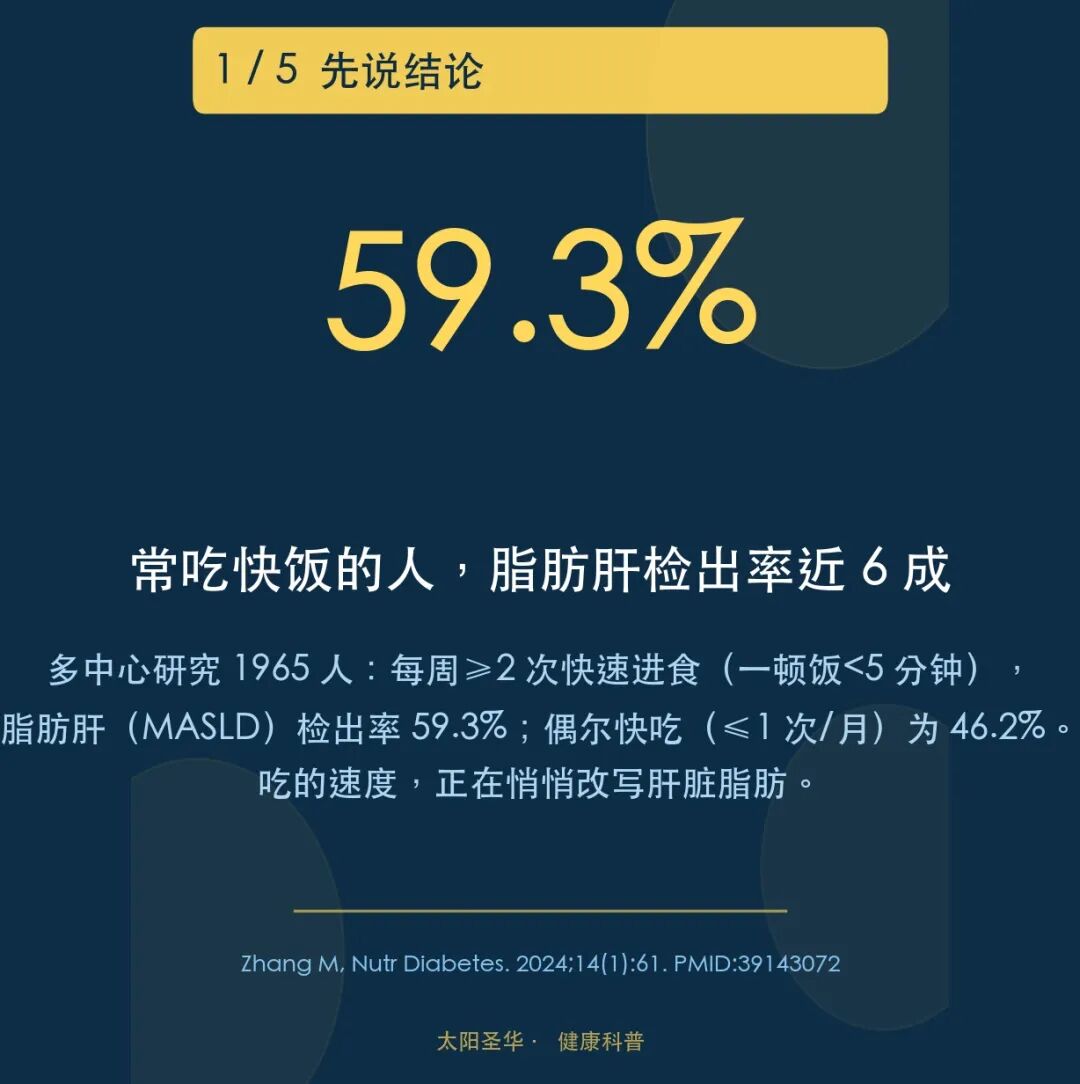
A multicenter study of 1,965 people found that those who ate quickly (finishing a meal in under 5 minutes) at least twice a week had a 59.3% detection rate for fatty liver (MASLD), compared with 46.2% among those who rarely ate fast (no more than once a month)[[1]]. Same meal, but the difference between fast and slow eating is plain to see.
✦ ✦ ✦
2 / 5 The Big Data: The Faster You Eat, the Higher Your Odds of Long-Term Obesity

Health checkup data from 564,198 people in Japan showed a dose-response relationship between fast eating and long-term obesity history—among those who had been obese the longest, the odds of fast eating were 47% higher (OR 1.47 in women, 95% CI 1.40-1.53)[[2]]. In other words, eating fast isn't a sign of a "naturally big appetite"—it's tied to "staying obese longer."
✦ ✦ ✦
3 / 5 Metabolic Warning: Eating Fast Also Raises Diabetes Risk
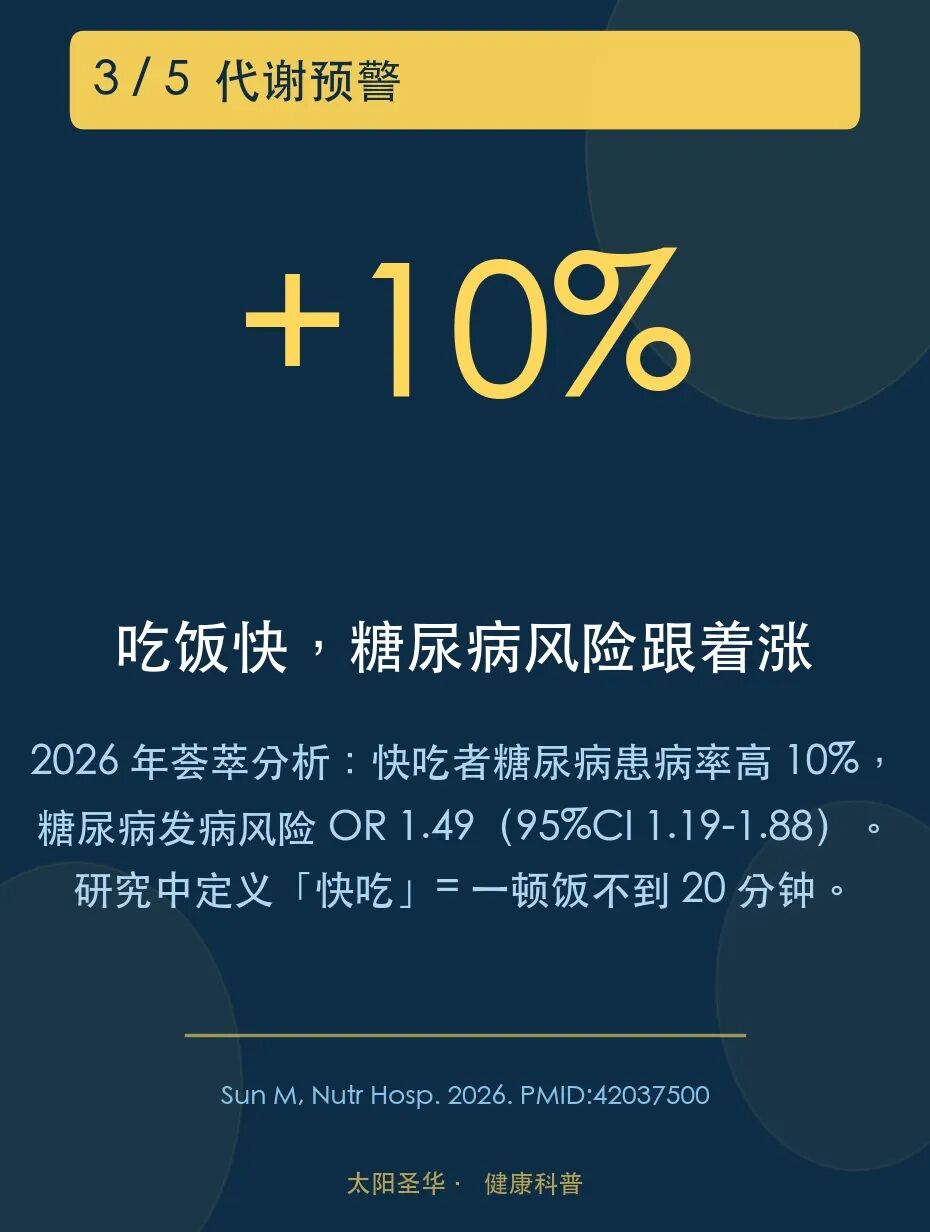
A 2026 meta-analysis pooling multiple studies found that fast eaters had a 10% higher prevalence of diabetes and an OR of 1.49 for diabetes incidence (95% CI 1.19-1.88)[[3]]. In the study, "fast eating" was simply defined as finishing a meal in under 20 minutes. Check yourself—do you qualify?
✦ ✦ ✦
4 / 5 Why: Your Brain Needs Time to Receive the "Full" Signal

A randomized controlled trial showed that a mindfulness plus prolonged chewing intervention sustained for 8 weeks led to reduced BMI, food cravings, and emotional eating, with effects still present after 4 weeks[[4]]. Eating slowly isn't being fussy—it's giving your body time to "receive the satiety signal" and avoid overeating without realizing it.
✦ ✦ ✦
5 / 5 You Can Start Today: Chew Each Bite 20-30 Times

Three small things you can start with tonight's meal: ① Chew each bite 20-30 times; ② Stretch a meal to at least 20 minutes; ③ Put down your phone and focus on eating. One caveat: for adults over 65, while slowing down eating speed, make sure to get enough protein to avoid the risk of sarcopenia[[5]].
✦ ✦ ✦
Action tip: Starting with your next meal, set a 20-minute timer and chew each bite a few more times—no menu changes, no extra spending. Try it for two weeks and see how your body responds.
If you found this helpful, give it a like or a "reading" reaction, and feel free to leave a comment telling us what topics you'd like to see. Consider sharing this with the fastest eater in your family so you can slow down together.
✦ ✦ ✦
Disclaimer: This content is compiled from publicly available academic literature and is for health education reference only. It does not constitute medical advice; please consult a healthcare professional for your individual situation.
Conflict of interest statement: The author has no conflicts of interest with the studies mentioned in this article.
© 2026 Sun Saint Hua (Beijing) Medical Technology Co., Ltd.
References
-
Zhang M, et al. Association between fast eating speed and metabolic dysfunction-associated steatotic liver disease: a multicenter cross-sectional study and meta-analysis. Nutr Diabetes. 2024;14(1):61. PMID:39143072
-
Iizuka K, et al. Self-Reported Eating Speed Is Dose-Dependently and Bidirectionally Associated with Long-Term Underweight- and Obesity-Related Weight-History Groups. Nutrients. 2026;18(15):2412. PMID:42588035
-
Sun M, et al. Meta-analysis of eating speed and outcomes related to diabetes mellitus risk and glycemic control. Nutr Hosp. 2026. PMID:42037500
-
Schnepper R, et al. A combined mindfulness-prolonged chewing intervention reduces body weight, food craving, and emotional eating. J Consult Clin Psychol. 2019;87(1):106-111. PMID:30570305
-
Lee SR, et al. The Effect of Eating Speed on Sarcopenia, Obesity, and Sarcopenic Obesity in Older Adults: A 16-Year Cohort Study Using the Korean Genome and Epidemiology Study (KoGES) Data. Nutrients. 2025;17(6):992. PMID:40290000