This article is for health education purposes only and is intended for informational reference; it does not constitute medical advice. If you have any health concerns, please consult a qualified physician.
✦ ✦ ✦
The number on the scale at 3 months and at 5 years may come from two completely different ways of eating.
The "keto diet" is known for fast weight loss, while the "Mediterranean diet" consistently ranks at the top of healthy eating lists. But if you focus only on weight, you may well choose wrong—what really determines the outcome is whether you can still stick with it six months later.
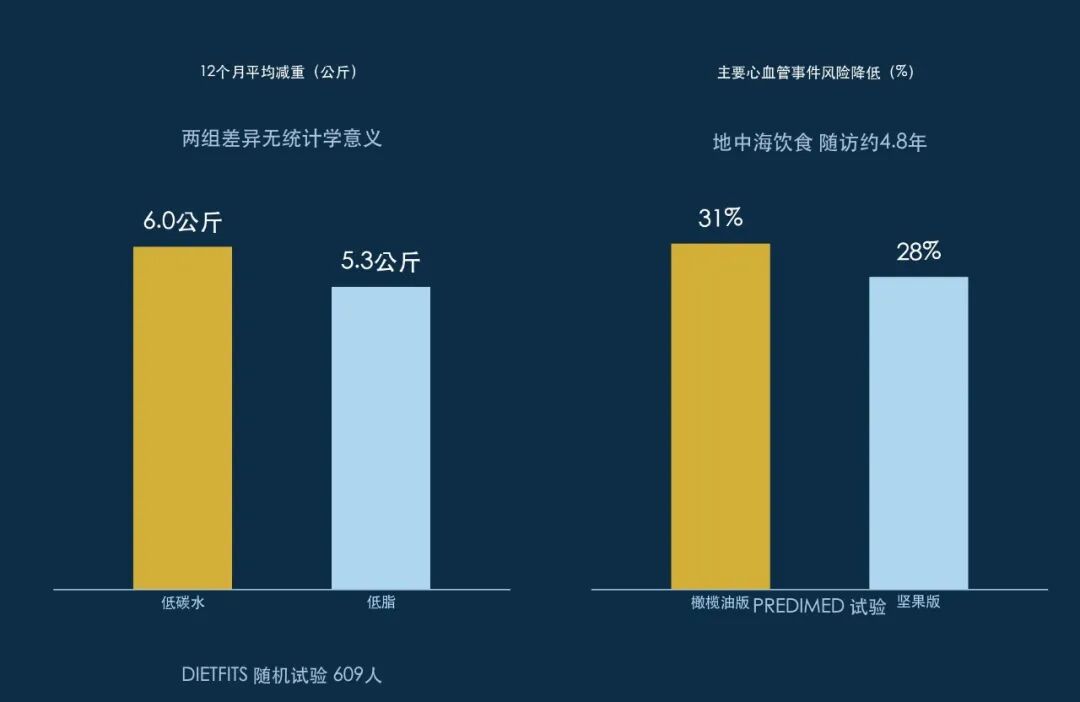
In 2020, The BMJ conducted a network meta-analysis comparing 14 popular diets, and the conclusion was a bit deflating: at 12 months of weight loss, the differences among low-carbohydrate, low-fat, and Mediterranean approaches were mostly only 1 to 2 kg[5]. What the evidence truly separated was cardiovascular outcomes: in the PREDIMED trial, with follow-up of about 4.8 years, those following a Mediterranean diet supplemented with olive oil or nuts had about a 30% lower risk of major cardiovascular events (myocardial infarction, stroke, cardiovascular death)[1].
✦ 1. Comparing speed of weight loss: keto is indeed more impressive in the first 3 months
Very low carbohydrate intake makes the body first use glycogen and water; each gram of glycogen often carries about 3 grams of water with it, so weight loss in the first few weeks often looks very "impressive"[7]. In addition, ketone bodies themselves have some appetite-suppressing effect, so many people can eat considerably less in the first 3 months.
But note: a considerable proportion of this "fast" loss is water, not fat[7].
✦ 2. Comparing the scale after one year: the two curves converge
In the 2018 DIETFITS trial published in JAMA, 609 overweight adults were randomly assigned to a "healthy low-fat" or "healthy low-carbohydrate" group and allowed to eat freely for a full 12 months: the low-fat group lost an average of 5.3 kg, and the low-carbohydrate group an average of 6.0 kg, with no statistically significant difference between the two groups[3].
Another meta-analysis focused on very low-carbohydrate diets also found that after a full 12 months, its weight-loss advantage over low-fat diets disappeared[2].
In other words, the one that wins in the first 3 months is not necessarily the one still ahead after a year.
The table below aligns the two diets across 5 key dimensions at once:
✦ 3. Comparing cardiovascular and lipid outcomes: the Mediterranean diet has "hard endpoints," while keto requires watching LDL
The evidence for the Mediterranean diet is not limited to weight. PREDIMED is a rare diet trial that achieved positive results on the endpoint of cardiovascular events[1]; people who adhere to the Mediterranean diet long term also have lower all-cause mortality[6].
The problem with keto and very low-carbohydrate diets is substantial individual variation: they can improve blood glucose and triglycerides, but in some people low-density lipoprotein cholesterol (LDL-C, commonly called "bad cholesterol") rises, and long-term cardiovascular safety data remain insufficient[7].
Therefore, those planning to follow a very low-carbohydrate approach long term are advised to check blood lipids first and recheck at around 3 months.
Two pieces of head-to-head evidence, presented in one figure:
✦ 4. Comparing sustainability: the Mediterranean diet is more "livable"
The core of the Mediterranean diet is not "eat less of what," but "swap what you eat": vegetables, whole grains, legumes, nuts, olive oil, fish twice a week, and red meat and processed meat only occasionally[1].
Keto requires keeping carbohydrates very low, and takeout, social meals, and family meals all require separate preparation; the social cost is high, and dropping out and regaining weight are also more common[2]. The reason the gaps between diet plans narrow after 12 months is essentially this—the harder a plan is to stick to, the earlier people drop out[5].
✦ 5. How to choose: by goal
If you want rapid short-term weight loss and also have type 2 diabetes or obesity complications: a short-term low-carbohydrate plan may be used under medical supervision; most studies assess effects at 3 to 6 months, with regular checks of blood lipids, uric acid, and kidney function during that period[4][7].
If you want long-term weight control and, along the way, to protect your cardiovascular system: the Mediterranean-style diet is the one with more solid evidence[1][6].
The two paths are not in conflict. Many people first use low-carbohydrate eating to bring weight down, then gradually switch to a Mediterranean-style pattern for maintenance.
3 things you can do today
① Replace part of your cooking oil with olive oil, and eat fish twice a week;
② Replace one-third of the white rice and white flour in your staple foods with whole grains and mixed beans;
③ If you plan to try keto, it is advisable to first check blood lipids and liver and kidney function, and recheck after 3 months; do not mistake "fast weight loss" for "healthier."
Weight is only a midway station; blood lipids and cardiovascular health are the final destination. You may want to save this comparison table, or forward it to family and friends who are struggling with "which diet to choose."
If this was helpful to you, give it a like or a "Wow," and feel free to leave a comment telling us what topics you would like to see.
Disclaimer: This article is for health education purposes only and is intended for informational reference; it does not constitute medical advice. If you have any health concerns, please consult a qualified physician.
Declaration of interests: This article does not involve any drug recommendations and has no conflicts of interest with the research institutions or companies mentioned in the text.
© 2026 太阳圣华(北京)医疗科技有限公司
References
[1] Estruch R, Ros E, Salas-Salvado J, et al. Primary Prevention of Cardiovascular Disease with a Mediterranean Diet Supplemented with Extra-Virgin Olive Oil or Nuts. N Engl J Med. 2018;378(25):e34. PMID: 29897866
[2] Bueno NB, de Melo IS, de Oliveira SL, da Rocha Ataide T. Very-low-carbohydrate ketogenic diet v. low-fat diet for long-term weight loss: a meta-analysis of randomised controlled trials. Br J Nutr. 2013;110(7):1178-1187. PMID: 23651522
[3] Gardner CD, Trepanowski JF, Del Gobbo LC, et al. Effect of Low-Fat vs Low-Carbohydrate Diet on 12-Month Weight Loss in Overweight Adults and the Association With Genotype Pattern or Insulin Secretion: The DIETFITS Randomized Clinical Trial. JAMA. 2018;319(7):667-679. PMID: 29466592
[4] Goldenberg JZ, Day A, Brinkworth GD, et al. Efficacy and safety of low and very low carbohydrate diets for type 2 diabetes remission: systematic review and meta-analysis of published and unpublished randomized trial data. BMJ. 2021;372:m4743. PMID: 33441384
[5] Ge L, Sadeghirad B, Ball GDC, et al. Comparison of dietary macronutrient patterns of 14 popular named dietary programmes for weight and cardiovascular risk factor reduction in adults: systematic review and network meta-analysis of randomised trials. BMJ. 2020;369:m696. PMID: 32238384
[6] Trichopoulou A, Costacou T, Bamia C, Trichopoulos D. Adherence to a Mediterranean diet and survival in a Greek population. N Engl J Med. 2003;348(26):2599-2608. PMID: 12826634
[7] Kirkpatrick CF, Bolick JP, Kris-Etherton PM, et al. Review of current evidence and clinical recommendations on the effects of low-carbohydrate and very-low-carbohydrate (including ketogenic) diets for the management of body weight and other cardiometabolic risk factors. J Clin Lipidol. 2019;13(5):689-711.e1. PMID: 31611148