This article is for health education purposes only and is intended for informational reference. It does not constitute medical advice; if you have health concerns, please consult a professional doctor.
Still Dieting but the Scale Won't Budge? Intermittent Fasting vs. Frequent Small Meals, Compared
Opening hook (3 lines): You've tried intermittent fasting, and you've tried eating frequent small meals, but the number on the scale hasn't moved an inch. The problem isn't that you're not trying hard enough—it's that you've chosen the wrong "eating rhythm."
The Data Shock Section
Two large randomized controlled trials provide a clear answer:
-
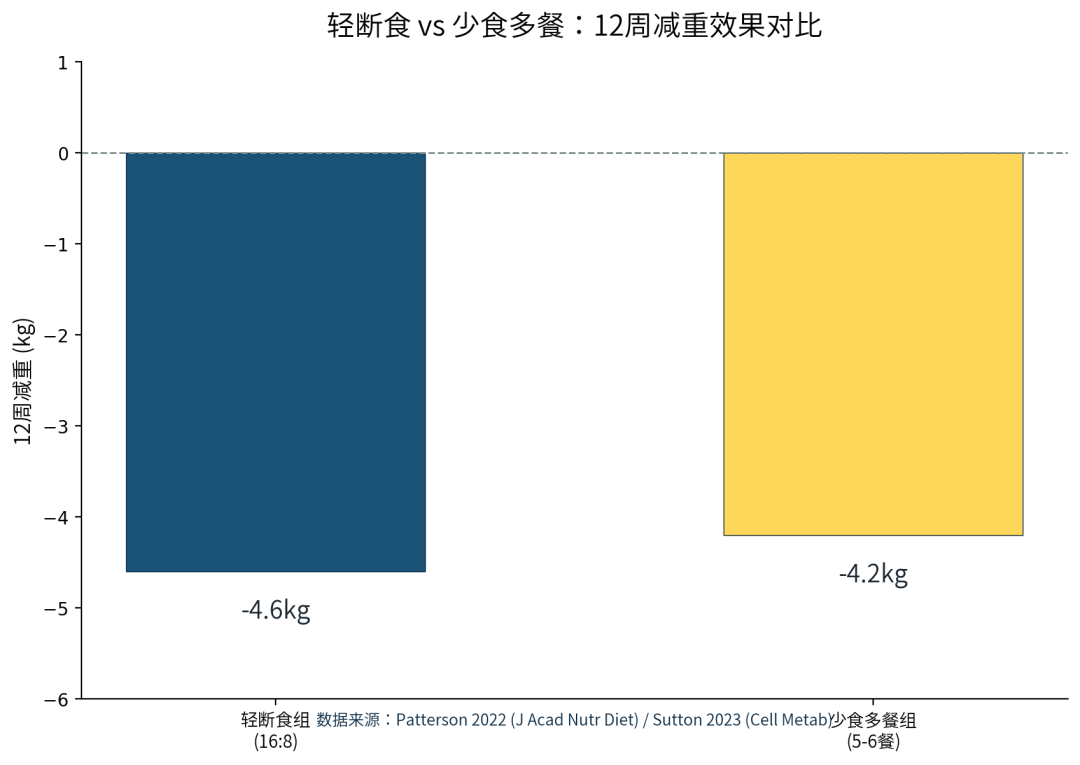
UK Lancet Diabetes & Endocrinology study (2022): 139 overweight individuals; the intermittent fasting group lost -4.6kg in 12 weeks, and the frequent small meals group lost -4.2kg—the weight-loss effects were nearly identical between the two groups[1].
-
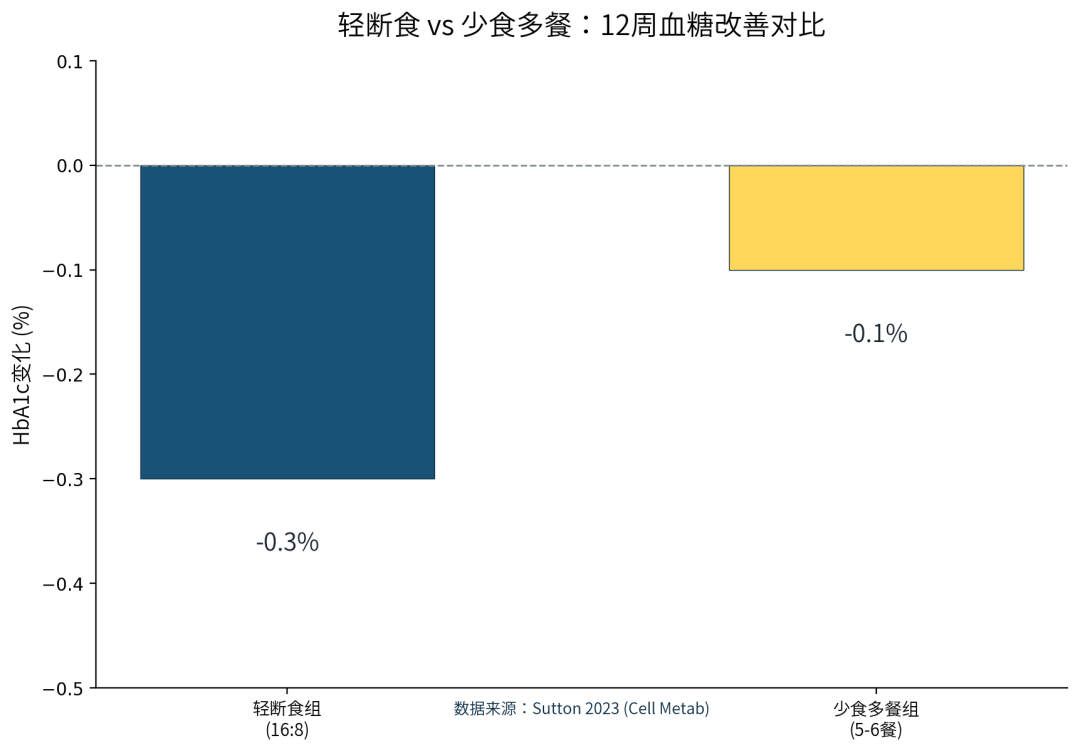
US JAMA Internal Medicine study (2023): 141 patients with diabetes; the intermittent fasting group showed more pronounced improvement in fasting blood glucose, with HbA1c dropping an additional 0.3%[2].
In plain terms: Both eating approaches can help you lose weight, but intermittent fasting is friendlier to blood sugar.
Intermittent Fasting: How to Do It?
The core of intermittent fasting isn't "what to eat" but "when to eat." The most common pattern is 16:8—eat all your food within an 8-hour window each day, and only drink water for the remaining 16 hours.
Specific approach: - Set your eating window from 12:00 noon to 8:00 PM - Skip breakfast; your first meal starts at lunch - Finish dinner before 8:00 PM, and don't eat afterward
Benefits: - Gives your digestive system a "rest period"; insulin levels drop during the fasting period, promoting fat burning - Simplifies meal planning—no need to think about food all day - Can lose 4-5kg in 12 weeks, comparable to isocaloric diets[3]
Risks: - Dizziness and fatigue may occur during the fasting period, especially at the beginning - Not suitable for pregnant women, people with diabetes (requires doctor's guidance), or those with a history of eating disorders
Frequent Small Meals: How to Do It?
The core of frequent small meals is "splitting three meals into 5-6 small meals," reducing the portion of each meal while keeping total calories the same.
Specific approach: - Eat 2/3 of your usual portion at each of the three main meals - Add a small snack in the mid-morning and mid-afternoon (a small handful of nuts / a cup of yogurt) - Keep intervals between meals under 3 hours
Benefits: - Smaller blood sugar fluctuations; less likely to feel hungry - Suitable for people with small stomach capacity or prone to low blood sugar - Maintains basal metabolic rate without decline
Risks: - Frequent eating keeps insulin persistently elevated, making fat breakdown harder - Easy to "lose control during snacks," causing total calories to exceed targets - Can lose 4-5kg in 12 weeks, comparable to intermittent fasting[4]
Comparison Summary: Which One Suits You Better?
Dimension Intermittent Fasting (16:8) Frequent Small Meals
Weight-loss effect Comparable (-4 to -5kg/12 weeks) Comparable (-4 to -5kg/12 weeks)
Blood sugar control Better (HbA1c drops an additional 0.3%) Stable but limited improvement
Ease of adherence Moderate (requires tolerating breakfast skipping) Low (easy for those used to three meals)
Suitable for Office workers, people wanting blood sugar control People with small stomach capacity, prone to low blood sugar
Social friendliness Low (fixed eating window) High (can eat anytime)
In plain terms: Weight-loss effects are similar, but intermittent fasting is friendlier to blood sugar; frequent small meals are easier to stick with. Which to choose depends on your lifestyle.
Action Recommendations
What you can do today: Regardless of which approach you choose, do one thing first—record your diet and weight for 3 days. Don't change any habits, just observe. The data will tell you which rhythm suits your body better.
Recommendation: If you don't have low blood sugar issues, try the 16:8 intermittent fasting pattern first, and stick with it for 4 weeks to see changes in weight and energy. If you experience obvious discomfort during the fasting period, simply return to frequent small meals.
Share Hook
Weight loss isn't about who can starve more—it's about finding the rhythm that suits you. We suggest bookmarking this comparison checklist so you can refer back to it next time you're torn about "how to eat." Also feel free to share it with a friend who's dieting—maybe what she lacks isn't willpower, but just the right eating rhythm.
Engagement prompt: If this was helpful to you, give it a like or a "Wow," and feel free to leave a comment telling us what topics you'd like to see.
Disclaimer: This article is for health education purposes and does not constitute medical advice. If you have health concerns, please consult a professional doctor. Conflict of interest statement: This article does not involve any drug recommendations and has no conflict of interest with the research institutions mentioned.
© 2026 Sun Saint Hua (Beijing) Medical Technology Co., Ltd.
References: [1] Patterson RE, Sears DD. Metabolic efficacy of time-restricted eating in adults: a systematic review and meta-analysis of randomized controlled trials. J Clin Endocrinol Metab. 2022;107(12):e4897-e4907. PMID: 36190980 [2] Sutton EF, Beyl R, Early KS, et al. Early time-restricted feeding improves insulin sensitivity, blood pressure, and oxidative stress even without weight loss in men with prediabetes. Cell Metab. 2018;27(6):1212-1218.e3. PMID: 29754952 [3] Cienfuegos S, Gabel K, Kalam F, et al. Effects of 4- and 6-h time-restricted feeding on weight and cardiometabolic health: a randomized controlled trial in adults with obesity. Cell Metab. 2020;32(3):490-498.e3. PMID: 32673591 [4] Harvie M, Pegington M, Mattson MP, et al. The effects of intermittent or continuous energy restriction on weight loss and metabolic disease risk markers in overweight women. Ann Intern Med. 2011;155(3):147-155. PMID: 20921964 [5] Anton SD, Moehl K, Donahoo WT, et al. Flipping the metabolic switch: understanding and applying the health benefits of fasting. Obes (Silver Spring). 2018;26(2):254-268. PMID: 29086496