Same Meal, 15 Extra Chews Per Bite, 14.8% Less Eaten
This article is for health education purposes only and is not intended as medical advice. Please consult a professional doctor if you have any health concerns.
Shoveling down a takeout meal in five minutes is a daily routine for many office workers.
But have you ever noticed: people who eat fast tend to be more overweight, with bigger bellies?
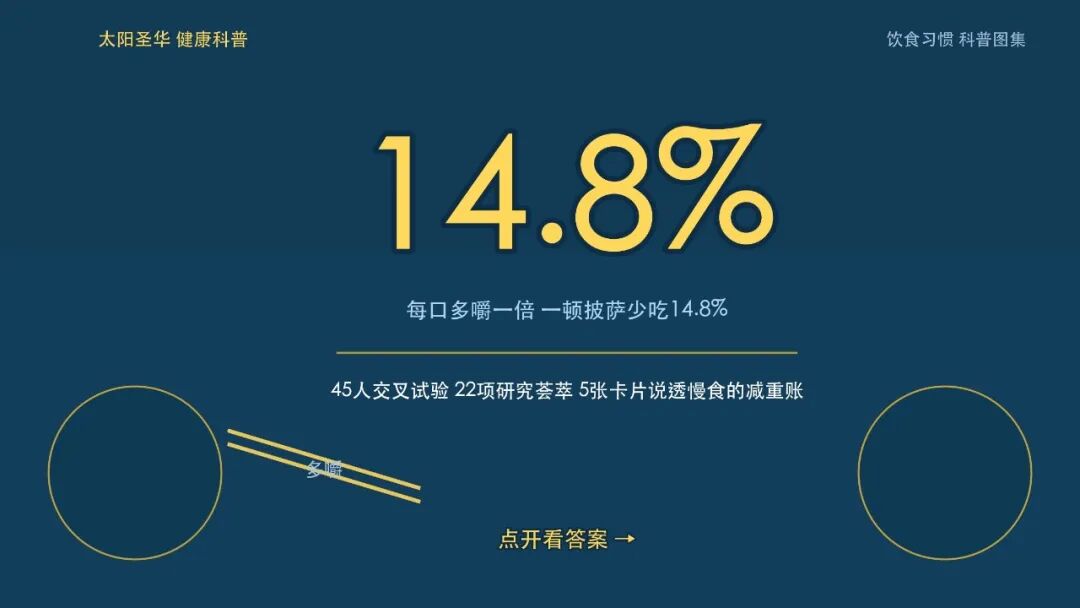
This is not an illusion. A 45-person crossover trial in the United States found that with the same pizza, simply doubling the number of chews per bite led to eating 14.8% less over the entire meal[1]—no change in the food, no restriction on portions, just one changed behavior.
The following 5 cards explain exactly how much "chewing slowly" can help you eat less, why it works, and 4 slow-down actions you can use today. Bookmark this and take a look before your next meal.
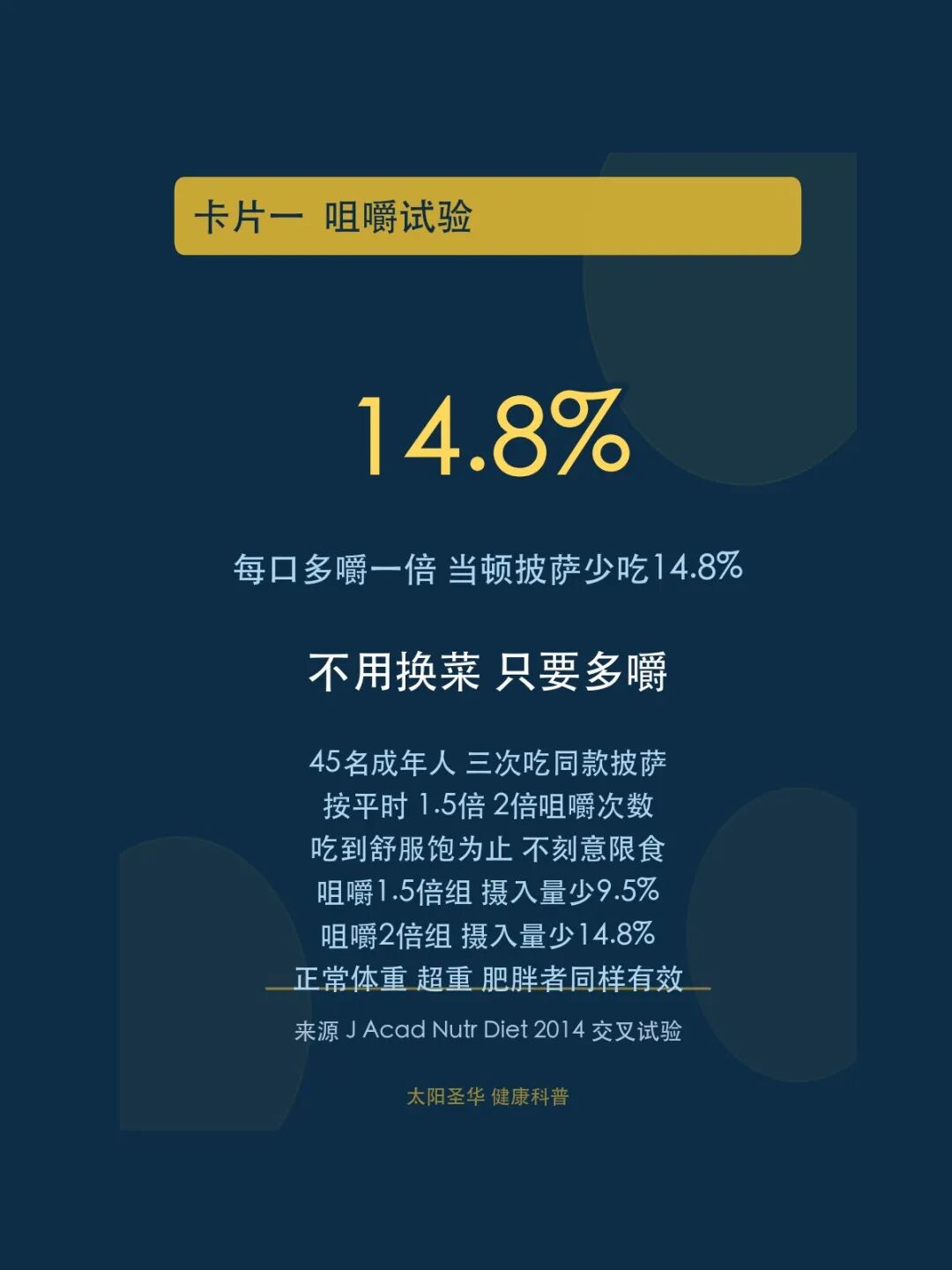
Card One: Double Your Chews, Eat 14.8% Less at That Meal
A team at Iowa State University had 45 adults—normal weight, overweight, and obese—eat the same pizza lunch on three separate occasions, chewing at their normal number of chews, 1.5 times, and 2 times respectively, until comfortably full[1].
Results: at 1.5 times the chews, intake dropped by 9.5%; at 2 times, it dropped by 14.8%. The reduction was significant across normal-weight, overweight, and obese participants.
Card Two: Slowing Down Gives Your Brain 20 Minutes to Receive the Signal
It takes about 20 minutes for the brain to receive the "I'm full" signal. If you finish a meal in five minutes, the satiety signal hasn't even set off yet—by the time you feel full, you've usually already overeaten.
A 30-person crossover trial in China provided harder mechanistic evidence: with the same food, chewing 40 times per bite versus 15 times per bite led to eating 11.9% less over the meal; blood levels of satiety-promoting gut hormones rose while hunger hormones fell[5]. Slowing down isn't just dawdling—it's genuinely changing your body's satiety signals.

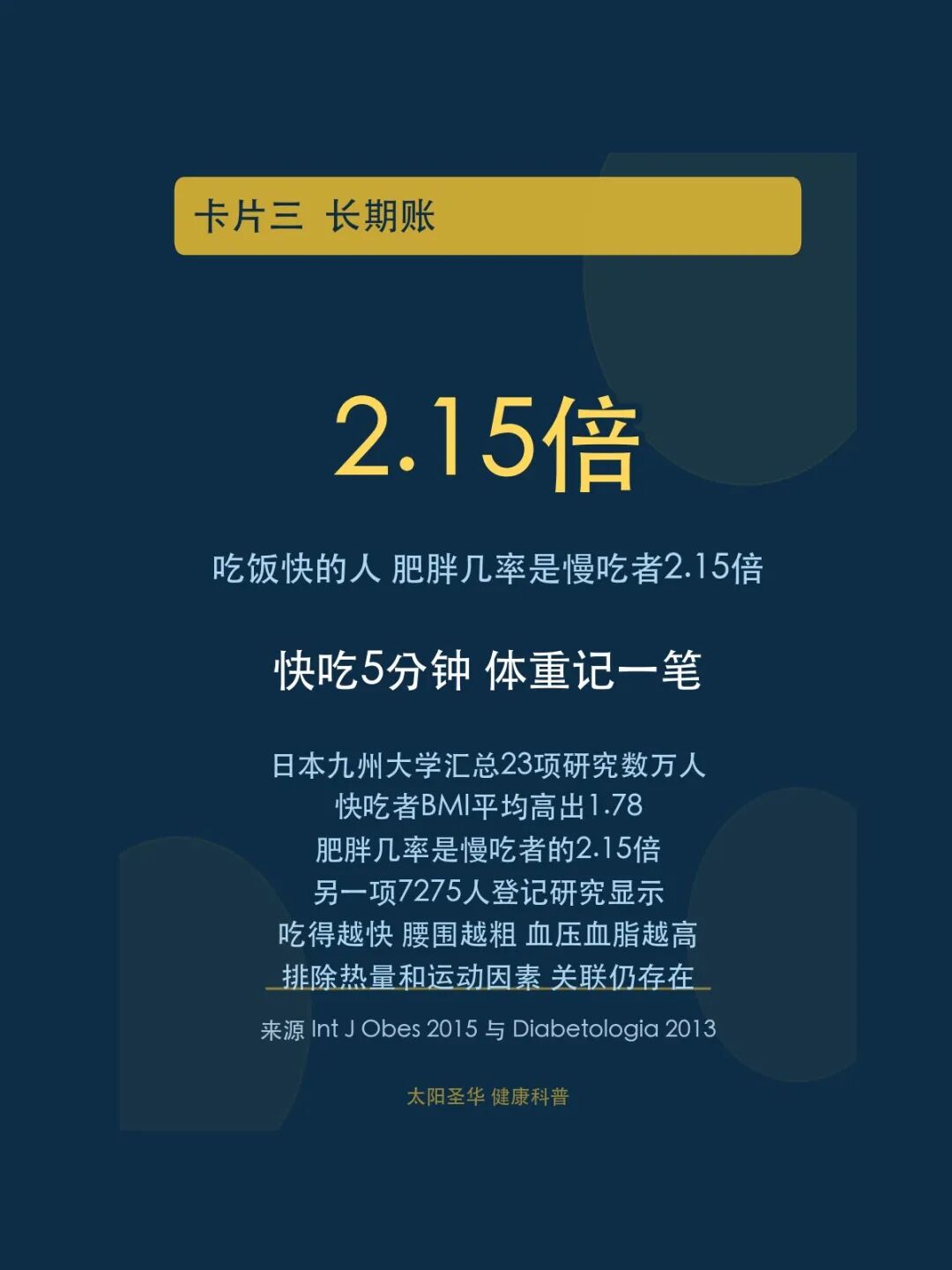
Card Three: The Long-Term Ledger Is Clearer: Fast Eaters Double Their Obesity Risk
Eating a little less in the short term—how much difference does it make long term? A synthesis of 23 studies and data from tens of thousands of people by Kyushu University in Japan found: fast eaters had an average BMI 1.78 higher than slow eaters, and their odds of developing obesity were 2.15 times higher[3].
Another Japanese registry study of 7,275 people showed: the faster people ate, the larger their waist circumference and the higher their blood pressure and blood lipids; even after excluding factors like total calories and exercise, the association remained[4]. Being overweight isn't about weak willpower—it may be that your eating pace is the problem.
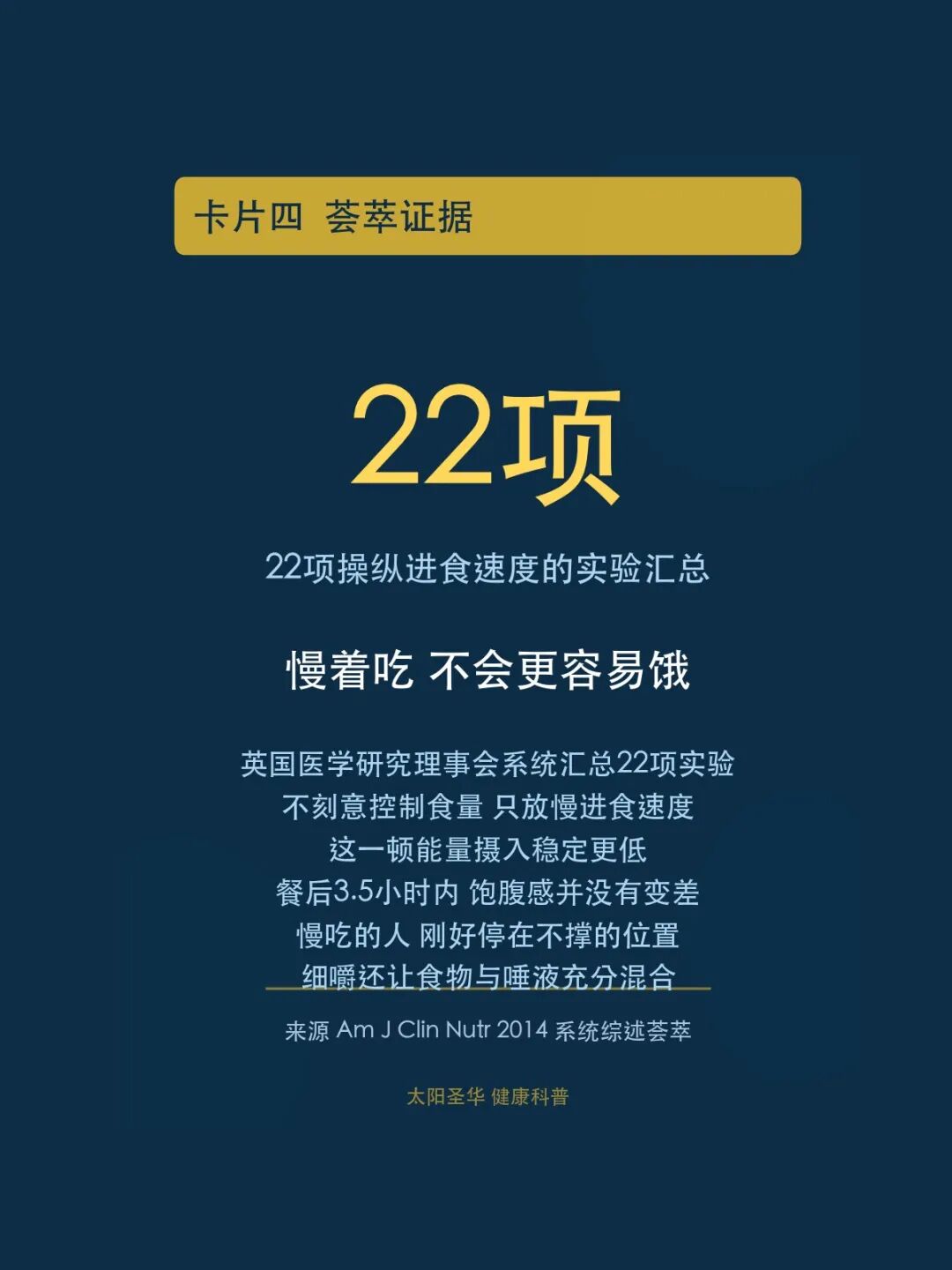
Card Four: Meta-Analysis of 22 Trials: Slow Eating Really Does Mean Eating Less
This isn't a chance conclusion from a single study. The UK Medical Research Council pooled 22 studies that experimentally manipulated eating speed and found: without deliberately restricting food intake, slowing down eating speed consistently led to lower energy intake at that meal, while post-meal satiety was not affected[2].
In other words: eating slowly won't make you hungrier—you just stop right at the point of "not stuffed." Chewing thoroughly also allows food to mix fully with saliva, reducing the grinding burden on the stomach and being friendlier to post-meal blood sugar.
Card Five: 4 Slow-Eating Actions You Can Use Today
No need to count until you're anxious—just pick whichever comes naturally and stick with it:
-
Chew each bite until there are no lumps left: about 20 to 30 chews for solid food, fewer for soft or sticky foods;
-
Put your chopsticks down after each bite: swallow before picking up the next bite—don't keep "restocking" continuously;
-
Focus on eating for the first five minutes: it's easy to inhale like a storm at the start—slow down during the first five minutes;
-
Time your meal to 20 minutes: set a gentle vibration alert—just half a beat slower than the person next to you is enough.

Start Today
Eating speed is one of the few weight-management actions that is "zero cost, no food restrictions, no extra time." It doesn't replace a balanced diet and exercise, but if you always end up overeating without realizing it, start by making each meal last at least 20 minutes.
If you're trying to lose weight, or have a "storm inhaler" child or partner at home, share these 5 cards with your family and bring your eating speed down together. Bookmark this and try it at tonight's meal.
If you found this helpful, give it a like or a "reading" mark, and feel free to leave a comment telling us what topics you'd like to see.
✦
Disclaimer: This article is for health education purposes only and is not intended as medical advice. It cannot replace an in-person consultation and prescription from a professional doctor.
Conflict of Interest Statement: This article does not involve any recommendations for drugs, supplements, or commercial products. The author has no financial relationship with the research institutions mentioned in the text.
References
[1] Zhu Y, Hollis JH. Increasing the number of chews before swallowing reduces meal size in normal-weight, overweight, and obese adults. J Acad Nutr Diet. 2014;114(6):926-931. PMID: 24215801
[2] Robinson E, et al. A systematic review and meta-analysis examining the effect of eating rate on energy intake and hunger. Am J Clin Nutr. 2014;100(1):123-151. PMID: 24847856
[3] Ohkuma T, et al. Association between eating rate and obesity: a systematic review and meta-analysis. Int J Obes (Lond). 2015;39(11):1589-1596. PMID: 26100137
[4] Ohkuma T, et al. Impact of eating rate on obesity and cardiovascular risk factors according to glucose tolerance status: the Fukuoka Diabetes Registry and the Hisayama Study. Diabetologia. 2013;56(1):70-77. PMID: 23064292
[5] Li J, et al. Improvement in chewing activity reduces energy intake in one meal and modulates plasma gut hormone concentrations in obese and lean young Chinese men. Am J Clin Nutr. 2011;94(3):709-716. PMID: 21775556
? 2026 Sun Saint Hua (Beijing) Medical Technology Co., Ltd.