Every 10 dB Worse Hearing, 27% Higher Dementia Risk: Protecting Your Ears Is Protecting Your Brain
This article is for health education and informational purposes only and does not constitute medical advice; please consult a professional doctor if you have any health concerns.
The TV volume keeps creeping up, and you're always asking people to repeat themselves—many people chalk this up to "just getting older."
But over the past decade and more, research from multiple countries all points to the same thing: there is a real line between hearing and memory.
First, two sets of numbers
The China Hearing Health Report (2025) blue book shows that the prevalence of hearing loss among people over 60 in China is about 11.04%, meaning more than 20 million people; the report also notes that it is closely linked to cognitive decline, social isolation, and multiple chronic diseases[4].
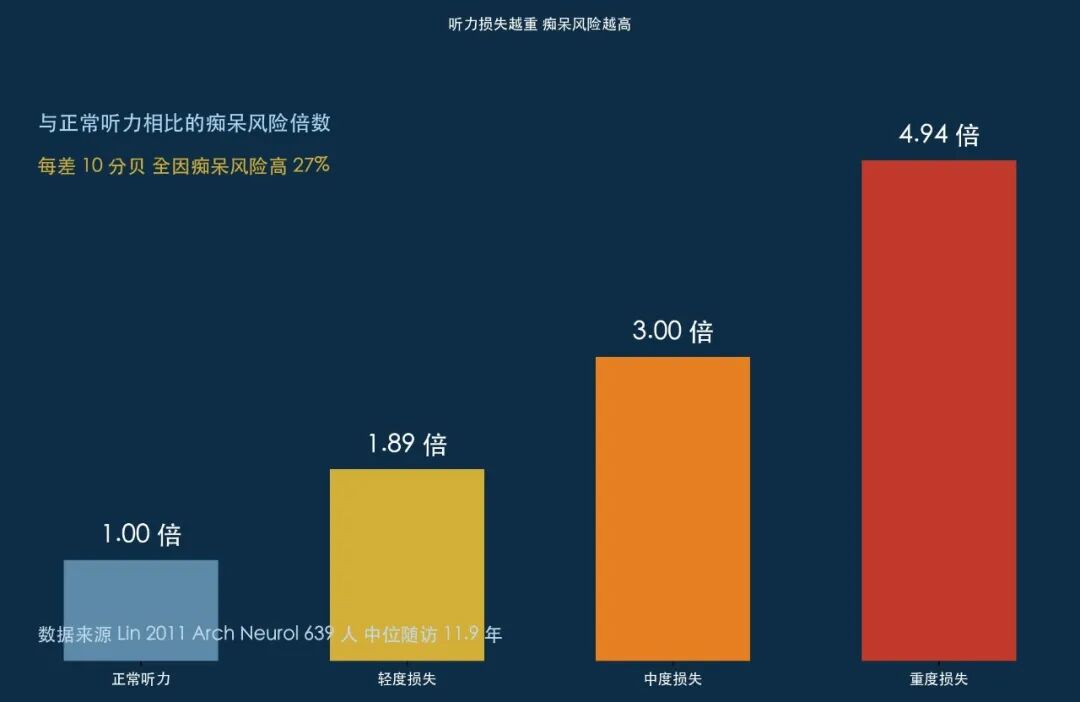
The Baltimore Longitudinal Study of Aging in the United States followed 639 people for a median of 11.9 years and found that every 10 dB worse hearing was associated with a 27% higher risk of all-cause dementia; compared with people with normal hearing, the risk was about 1.89 times higher for mild loss, 3.00 times for moderate loss, and 4.94 times for severe loss[1].
Another cohort study of 1,984 older adults showed that people with hearing loss experienced a 41% faster decline in overall cognitive scores over 6 years than those with normal hearing, and had a 24% higher risk of developing cognitive impairment[2].
Why does something in the ears involve the brain?
Three pathways are currently most discussed.
First, "straining to hear" itself consumes attention. The brain diverts resources to filling in words and guessing meanings, leaving less for memory and thinking—which also explains why people with hearing loss get especially tired in noisy environments.
Second, social withdrawal. Once communication becomes effortful, people instinctively cut back on chatting, meals out, and gatherings; and social isolation and loneliness are themselves well-established drivers of cognitive decline.
Third, changes in brain structure. Imaging studies suggest that hearing-related brain regions shrink faster in people with hearing loss.
It should be noted that observational studies can only show "association," not directly prove "causation." But the direction is clear: hearing is one of the few aging signals in midlife that can be "tested for and acted on."
The Lancet Commission on dementia prevention places midlife hearing loss near the top of modifiable risk factors: among 12 modifiable factors, its weighted population attributable fraction is 8.2%; together these factors are associated with about 40% of dementia worldwide and are theoretically preventable or delayable[3]. The 2024 update report further expanded the modifiable factors to 14[7].
"Being able to hear" is not the same as "hearing clearly"
There are four typical warning signs to watch for:
- You're fine in quiet settings, but struggle in restaurants, family gatherings, or other places with background noise;
- You habitually watch people's lips, using "looking" to supplement "listening";
- Family members repeatedly say your TV or phone volume is too loud;
- You have persistent ringing in your ears like cicadas.
If even one of these appears, it's worth getting a pure-tone audiometry test—a very basic and inexpensive item in routine checkups, yet one that is often put off again and again. Don't wait until you "basically can't hear" before considering a hearing aid; by then, social withdrawal has often already set in.
Why do so many people wait until the last minute to deal with it?
The blue book also points out a reality: China's hearing intervention and rehabilitation system is still under development, with low hearing aid uptake, limited cochlear implant use, and relatively lagging auditory rehabilitation services[4]. In other words, the problem is often not technology, but "not taking it seriously."
Several groups deserve earlier attention: young people who listen to music at high volume through headphones for long periods; people who work in noisy environments such as construction sites, factories, and bars; people with chronic conditions such as diabetes and hypertension; and people with a family history of noticeable hearing loss in midlife.
One more thing to remember: if you experience sudden hearing loss in one ear—hearing clearly worsening within hours to two or three days—this is an ENT emergency. Don't observe and don't wait; get to a hospital as soon as possible.
Do hearing aids help? The evidence says "promising, but don't mythologize them"
A French cohort study of 3,670 people followed for 25 years showed that people with self-reported hearing loss experienced faster cognitive decline; however, among those who wore hearing aids, the rate of cognitive decline did not differ from that of people with normal hearing[6].
Randomized controlled trials give a more sobering answer. The U.S. ACHIEVE study enrolled 977 people aged 70 to 84 with hearing loss but no obvious cognitive impairment, followed them for 3 years, and found no significant difference in overall cognitive change between the hearing intervention group and the health education group; however, in the subgroup at higher risk of cognitive decline, the two groups showed a significant difference (interaction p=0.010)[5].
A reasonable interpretation is: the higher the risk and the earlier the intervention, the more likely the benefit. Waiting until cognition has already clearly declined before fitting hearing aids means the benefits get eaten away by time.
In midlife, two things with very high returns
First, prevent noise. Keep headphone volume within 60% of the device's maximum limit, and after 60 minutes of continuous use, take them off and rest for a while; on the subway, at concerts, or next to square-dancing speakers, wear earplugs whenever you can. The World Health Organization's World Report on Hearing (2021) estimates that more than 1.5 billion people worldwide have hearing loss of varying degrees, of whom about 430 million need rehabilitation services, and many of these cases are related to avoidable factors such as noise exposure.
Second, control chronic diseases. Chronic conditions such as diabetes and hypertension are closely linked to age-related hearing loss[4]. Managing blood pressure and blood sugar well is itself a way of protecting your ears.
One more thing worth mentioning: hearing aids address communication, and communication is tied to emotions, social life, and memory. Treating them as something "shameful" often costs more than you might imagine.
5 things you can do today
- Do a self-check: Do you find that you "can hear when it's quiet, but can't make out speech in noisy places"? If so, book a pure-tone audiometry test.
- Stick to the 60-minute rule for headphones: Keep the volume within 60%, and after 60 minutes of continuous listening, take a few minutes' break.
- Set a fixed volume level: Ask a family member to help you set the TV and phone volume at a level everyone finds comfortable, rather than turning it up louder and louder yourself.
- Track your hearing as a metric: At your chronic disease follow-up visits, note your hearing status as well; trends are more useful than single readings.
- Get hearing aids when needed: Don't delay when a doctor recommends hearing aids—try them for one to three months first; the adjustment period is worth investing in more than the price.
One-sentence action
Hearing decline is never "just a small matter of the ears"—it is a sign of aging that is easily overlooked in midlife yet genuinely open to intervention. Protecting your hearing is giving your brain a way out.
Share this with the person in your family who always says "you're the one speaking softly," or save it and go through it at your next physical exam.
If you found this helpful, give it a like or a "Wow," and feel free to leave a comment telling us what topics you'd like to see.
Disclaimer: This article is health education for informational purposes only and does not constitute medical advice; whether you need audiometry or hearing aids should be based on an individualized assessment by an otolaryngologist and audiology professional.
Conflict of interest statement: This article is based on publicly published medical literature and does not involve any drug or device recommendations; the author has no relevant conflicts of interest.
References
[1] Lin FR, Metter EJ, O'Brien RJ, et al. Hearing loss and incident dementia. Arch Neurol. 2011;68(2):214-220. PMID: 21320988
[2] Lin FR, Yaffe K, Xia J, et al. Hearing loss and cognitive decline in older adults. JAMA Intern Med. 2013;173(4):293-299. PMID: 23337978
[3] Livingston G, Huntley J, Sommerlad A, et al. Dementia prevention, intervention, and care: 2020 report of the Lancet Commission. Lancet. 2020;396(10248):413-446. PMID: 32738937
[4] Guo J, Peng Z, Gong Z, et al. An interpretation of the blue book: the report on hearing health in China (2025). Lin Chuang Er Bi Yan Hou Tou Jing Wai Ke Za Zhi. 2026;40(3):215-219. PMID: 41668483
[5] Lin FR, Pike JR, Albert MS, et al. Hearing intervention versus health education control to reduce cognitive decline in older adults with hearing loss in the USA (ACHIEVE): a multicentre, randomised controlled trial. Lancet. 2023;402(10404):786-797. PMID: 37478886
[6] Amieva H, Ouvrard C, Giulioli C, et al. Self-Reported Hearing Loss, Hearing Aids, and Cognitive Decline in Elderly Adults: A 25-Year Study. J Am Geriatr Soc. 2015;63(10):2099-2104. PMID: 26480972
[7] Livingston G, Huntley J, Liu KY, et al. Dementia prevention, intervention, and care: 2024 report of the Lancet standing Commission. Lancet. 2024;404(10452):572-628. PMID: 39096926
© 2026 Sunsheng Hua (Beijing) Medical Technology Co., Ltd.