When the Weather Turns Cold, Blood Pressure Climbs: Data from 500,000 People, 7 Things That Can Keep It Steady
This article is for health education purposes only and is intended for informational reference; it does not constitute medical advice. If you have health concerns, please consult a professional physician.
Over the past month since autumn began, the blood pressure monitors of many middle-aged and older adults have given the same answer: the numbers are higher than in summer.
Don't panic, and don't add medication on your own. Cold-weather rises in blood pressure are a seasonal phenomenon backed by solid data, and a large part of it involves things you can start changing at home.
First, two sets of data: this is not an illusion, it's a widespread seasonal pattern
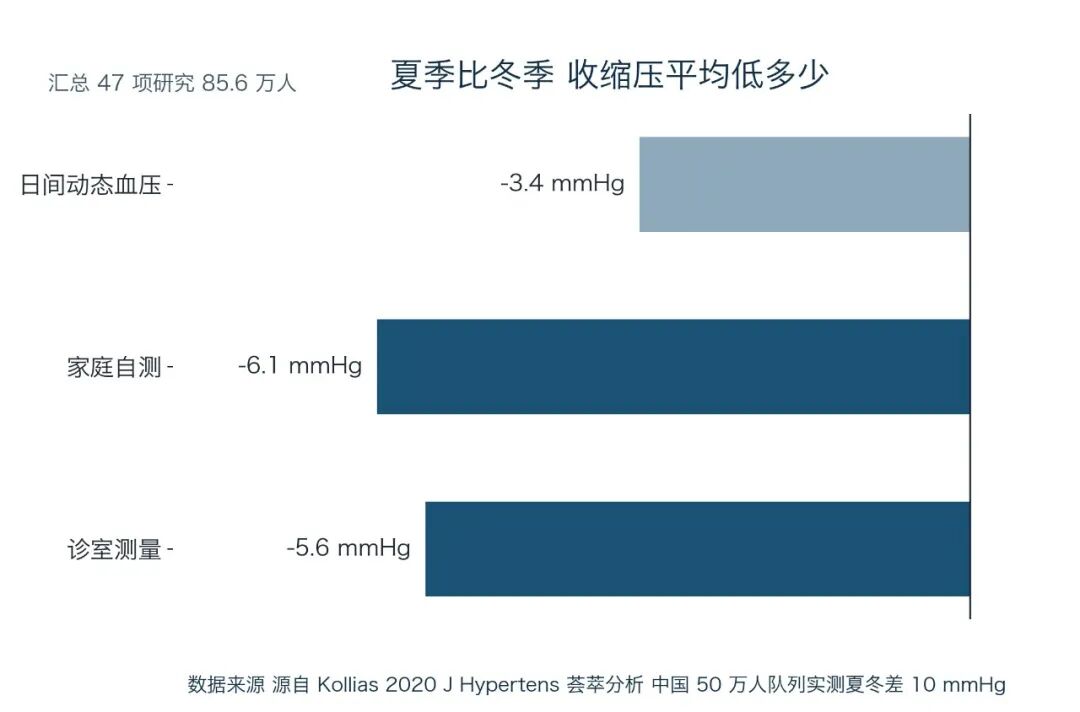
A large Chinese cohort of 500,000 people (10 regions, ages 30 to 79) provided a very direct comparison: the average difference in systolic blood pressure between summer and winter was 10 mmHg, more pronounced in rural areas than urban (12 vs. 8); for every 10°C drop in outdoor temperature, systolic blood pressure was on average 5.7 mmHg higher[1].
A meta-analysis pooling 47 studies and 856,000 people also confirmed: summer versus winter, office systolic blood pressure was 5.6 mmHg lower, and home self-measured systolic blood pressure was 6.1 mmHg lower[2].
In other words, without changing anything, just a change of season can shift the number on the blood pressure monitor by a noticeable margin. The 7 things below are the parts the data show can genuinely pull it back.
1 When it's cold, blood pressure rises—start with "blood vessels meeting cold"
Data from 38,000 people in Harbin with an average follow-up of 7.14 years showed: when the temperature was above 5°C, for every 10°C drop, systolic blood pressure was 6.7 mmHg higher and diastolic blood pressure 2.1 mmHg higher; among the same group, during months with adequate heating, the rise in blood pressure and cardiovascular and cerebrovascular events were both markedly attenuated[3].
In plain terms: blood vessels constrict in the cold, and the sympathetic nervous system becomes more active, so blood pressure naturally rises. This doesn't mean your body has gotten worse—it's adapting to the temperature.
2 The "normal values" measured in summer can't serve as a winter reference
Home blood pressure monitoring of 64,000 people in Japan showed: blood pressure across the year was higher in December and lower in July; the summer-winter difference in morning and evening systolic blood pressure was 6.2 mmHg in men and 7.3 mmHg in women; it was even larger in those over 65 (7.3 in men, 8.7 in women)[4].
A review explicitly warns: low values measured in summer do not mean low risk in winter; when judging cardiovascular risk, the winter readings are what count more[5].
3 During these two weeks of seasonal change, put the blood pressure monitor to use
Twenty-eight prospective studies (5,278 people) with repeated measurements of the same individuals across seasons showed: the seasonal difference in home blood pressure was actually larger—6.4 mmHg systolic and 3.3 mmHg diastolic[2]—home self-measurement makes seasonal changes easier to spot.
The method is simple: for 7 consecutive days, measure once within 1 hour of waking (after urinating, before taking medication) and once before bed; sit for 5 minutes before measuring, keep the cuff at heart level, and record the numbers in a notebook. This record explains more than any single "a bit high" reading.
4 Keeping warm at home is more useful than you think
Actual measurements from 868 older adults from October to April: for every 1°C drop in indoor temperature, daytime systolic blood pressure was on average 0.22 mmHg higher, and the association between indoor temperature and blood pressure was stronger than that of outdoor temperature[11]; the Chinese data on 500,000 people likewise found that among people with central heating at home, the pattern of "the colder the temperature, the higher the blood pressure" was almost undetectable during cold seasons[1].
So: don't tough out low indoor temperatures in winter, and don't go brisk walking or climbing stairs in the cold wind early in the morning; move outdoor exercise to after the sun is up and the temperature has risen.
5 Weight: for every 1 kg lost, systolic blood pressure drops by about 1.05 mmHg
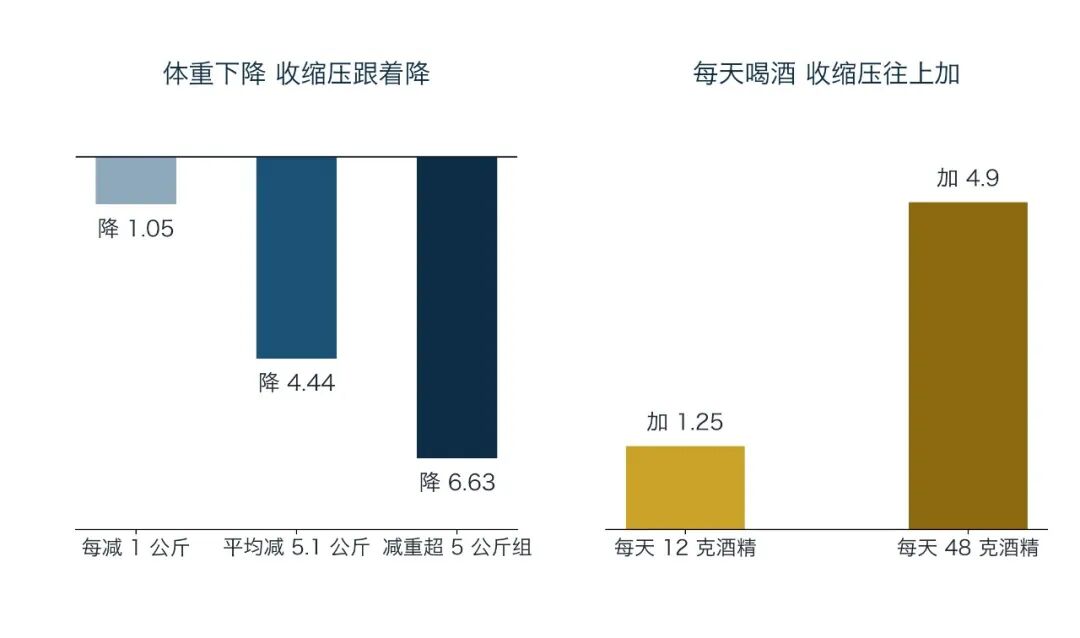
A meta-analysis of 25 randomized controlled trials and 4,874 people: an average weight loss of 5.1 kg lowered systolic blood pressure by 4.44 mmHg and diastolic blood pressure by 3.57 mmHg; in the group that lost more than 5 kg, the systolic reduction reached 6.63 mmHg[6].
Converted to the benefit per kilogram, that's about a 1.05 mmHg drop in systolic blood pressure for every 1 kg lost[6]. Weight gain in autumn is very common—"preventing rebound in autumn and winter" is itself protecting your blood pressure.
6 Housework counts as exercise too, and so do getting enough sleep and drinking less
A follow-up of 9,254 people and more than 80,000 person-years found: people who did 30 to 90 MET-hours per week of household activity (mopping floors, grocery shopping, caring for children, and the like) had a lower risk of new-onset hypertension[7]—you don't have to go to the gym.
On sleep, a meta-analysis of 16 cohorts and 1.04 million people: people who didn't get enough sleep had a 7% higher risk of hypertension, and those sleeping less than 5 hours had an 11% higher risk[8].
On alcohol it's even more direct: 12 grams of alcohol per day was associated with systolic blood pressure on average 1.25 mmHg higher; 48 grams with 4.90 mmHg higher, and there is no safe threshold[9].
7 The morning blood pressure reading deserves closer attention
An analysis of the J-HOP study involving 4,258 people, with a mean follow-up of 6.2 years and 269 cardiovascular events: for every 10 mmHg higher morning home systolic blood pressure, the risk of onset in winter was 22% higher (11% in other seasons) [10].
In plain terms: early morning in winter is a peak period for blood pressure. Don't get up abruptly—sit for 1 to 2 minutes before standing.
✦✦✦
Three things you can start tonight
- Record your morning and evening blood pressure for 7 consecutive days, and bring the record to your doctor to see whether your regimen needs adjustment. If you are taking medication, do not increase the dose, stop, or switch medications on your own.
- Keep warm + delay morning exercise: don't tough out a cold room, and wait until the sun is out and the temperature has risen before exercising in the morning.
- First set a small goal of "no more weight gain": if you can hold steady through winter within 1 to 2 kilograms, your blood pressure will benefit accordingly.
Seasonal variation in blood pressure is not mysticism—it is written in the data of 500,000 people; the part you can change lies in your home, at your dining table, and on your pillow every day.
If this has been helpful to you, give it a like or a "Wow," and feel free to leave a comment telling us what topics you'd like to see.
Disclaimer: This article is health education for informational purposes only and does not constitute medical advice; if you have health concerns, please consult a professional doctor.
Declaration of interests: This article does not involve any drug recommendations and has no conflicts of interest with the research institutions mentioned herein.
© 2026 太阳圣华(北京)医疗科技有限公司
References
[1] Lewington S, Li L, Sherliker P, Guo Y, et al. Seasonal variation in blood pressure and its relationship with outdoor temperature in 10 diverse regions of China: the China Kadoorie Biobank. J Hypertens. 2012;30(7):1383-91. PMID: 22688260
[2] Kollias A, Kyriakoulis KG, Stambolliu E, Ntineri A, et al. Seasonal blood pressure variation assessed by different measurement methods: systematic review and meta-analysis. J Hypertens. 2020;38(5):791-798. PMID: 32102047
[3] Yu B, Jin S, Wang C, Yan S, et al. The association of outdoor temperature with blood pressure, and its influence on future cardio-cerebrovascular disease risk in cold areas. J Hypertens. 2020;38(6):1080-1089. PMID: 32371798
[4] Iwahori T, Miura K, Obayashi K, Ohkubo T, et al. Seasonal variation in home blood pressure: findings from nationwide web-based monitoring in Japan. BMJ Open. 2018;8(1):e017351. PMID: 29306878
[5] Modesti PA, Rapi S, Rogolino A, Tosi B, et al. Seasonal blood pressure variation: implications for cardiovascular risk stratification. Hypertens Res. 2018;41(7):475-482. PMID: 29760460
[6] Neter JE, Stam BE, Kok FJ, Grobbee DE, et al. Influence of weight reduction on blood pressure: a meta-analysis of randomized controlled trials. Hypertension. 2003;42(5):878-84. PMID: 12975389
[7] Li R, Li Q, Zhang S, Zhang Y, et al. Domestic Physical Activity and New-Onset Hypertension: A Nationwide Cohort Study in China. Am J Med. 2022;135(11):1362-1370.e6. PMID: 35584787
[8] Hosseini K, Soleimani H, Tavakoli K, Maghsoudi M, et al. Association between sleep duration and hypertension incidence: Systematic review and meta-analysis of cohort studies. PLoS One. 2024;19(7):e0307120. PMID: 39008468
[9] Di Federico S, Filippini T, Whelton PK, Cecchini M, et al. Alcohol Intake and Blood Pressure Levels: A Dose-Response Meta-Analysis of Nonexperimental Cohort Studies. Hypertension. 2023;80(10):1961-1969. PMID: 37522179
[10] Narita K, Hoshide S, Kario K. Relationship Between Home Blood Pressure and the Onset Season of Cardiovascular Events: The J-HOP Study (Japan Morning Surge-Home Blood Pressure). Am J Hypertens. 2021;34(7):729-736. PMID: 33493266
[11] Saeki K, Obayashi K, Iwamoto J, Tone N, et al. Stronger association of indoor temperature than outdoor temperature with blood pressure in colder months. J Hypertens. 2014;32(8):1582-9. PMID: 24937638