Second Day After a Cold Wave: Heart Attack Risk Up 32%
This article is for health education purposes only and is intended as general information; it does not constitute medical advice. If you have health concerns, please consult a qualified physician.
The day after cold-wave warnings flooded every screen, hospital emergency rooms were unusually busy.
Many people assume this is just a coincidence—"old people feel the cold." But when millions of chest-pain center records nationwide are sorted by weather, the pattern is startlingly clear: cold really does harm the heart, and the high-risk window is not the day temperatures drop.
Even more counterintuitive: for the same cold snap, southerners—and places that are usually not very cold—actually see more heart attacks.
1 Million Cases: Cold Waves and Heart Attacks Are No Coincidence
A 2025 China nationwide study published in the European Heart Journal included 918,000 cases of obstructive myocardial infarction and 84,000 cases of non-obstructive myocardial infarction registered at chest pain centers across China from 2015 to 2021, matched day by day with weather data [1].
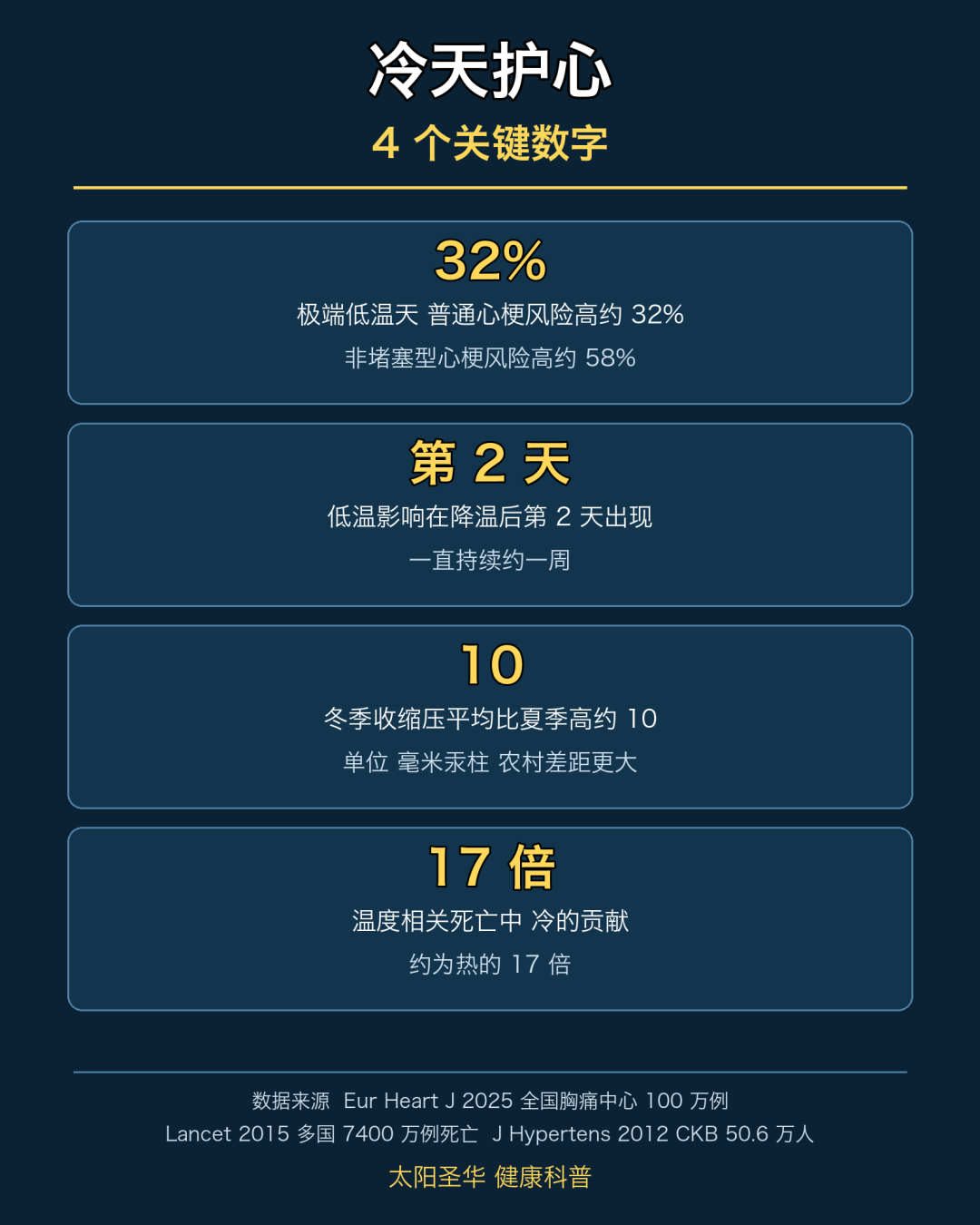
Results: compared with moderate temperatures, on extremely cold days the odds ratio for ordinary heart attack was 1.32—about a 32% higher risk; non-obstructive heart attacks were even more sensitive, with about a 58% higher risk.
The effect of low temperatures appeared on the second day after the temperature drop and persisted for about a week. Adults over 65, women, and southern residents were more noticeably affected. No comparable effect was observed for high temperatures.
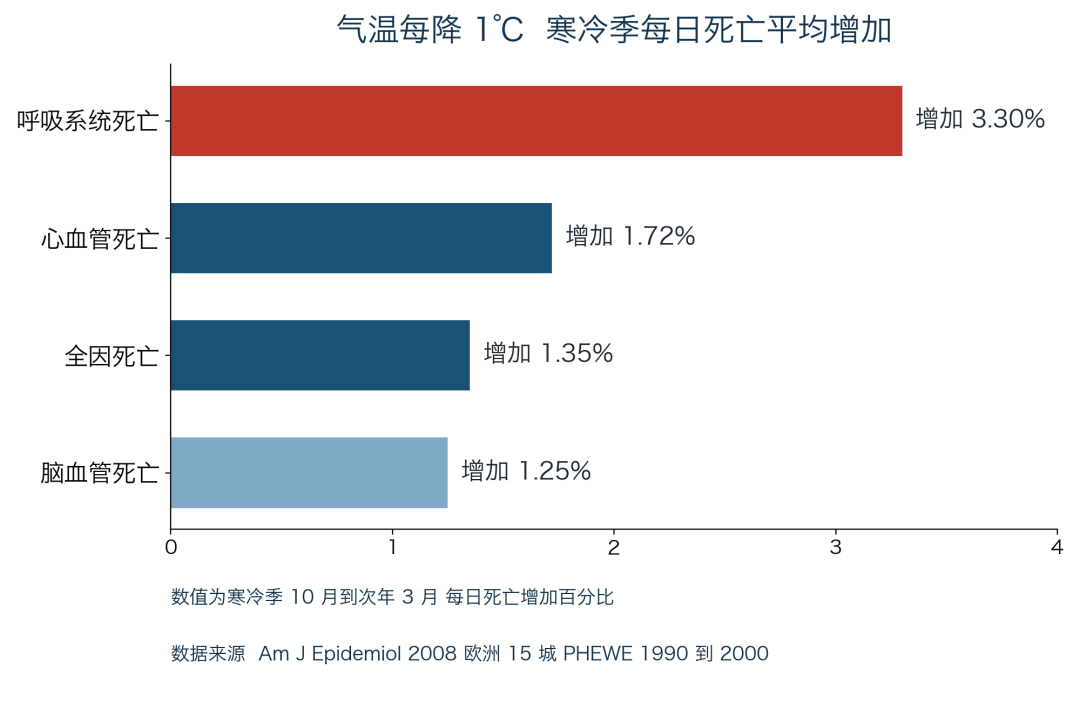
The bigger picture lies beyond. An analysis of more than 74 million deaths across multiple countries showed that about 7.7% of deaths could be attributed to "non-optimal temperature," with cold contributing 17 times more than heat; in China this proportion was about 11% [3]. Data from 15 European cities showed that for every 1°C drop in temperature, cardiovascular deaths increased by about 1.72% per day [4].
Cold is not just background noise—it is a well-documented cardiovascular trigger.
Winter Blood Pressure: 10 mmHg Higher Than Summer
When the heart is under pressure in cold weather, blood pressure is the first metric to rise.
The China Kadoorie Biobank (CKB) study measured 506,000 adults aged 30 to 79 across 10 regions and found that winter systolic blood pressure averaged 10 mmHg higher than in summer, with a larger gap in rural areas (12 vs. 8); when temperatures were above 5°C, each 10°C drop in outdoor temperature was associated with a systolic increase of about 5.7 [2].
The mechanism is not hard to understand: cold causes skin blood vessels to constrict to reduce heat loss, raising peripheral resistance and pushing blood pressure up; at the same time, blood viscosity increases and cardiac workload rises. Add to that the large indoor-outdoor temperature difference in winter and more respiratory infections, and inflammatory and clotting activity in the blood vessels becomes more active as well.
The study also had a key detail: among people with central heating at home, the association between low temperature and blood pressure essentially disappeared [2]. Keeping warm is not folklore—it is a heart-protective measure backed by data from 500,000 people.
Why Southerners Are Actually at Greater Risk
"Northerners live in colder places, so they should be at greater risk"—the data say the opposite.
In the aforementioned Chinese study, cold-related heart attack risk was stronger among southern residents [1]. As early as 1997, the Eurowinter study covering multiple European countries found the same pattern: for every 1°C drop below 18°C, all-cause mortality rose by about 2.15% in Athens, but only about 0.27% in southern Finland [5].
After on-site surveys, researchers found a lifestyle explanation: at the same outdoor temperature of 7°C, the average living room temperature was 19.2°C in Athens versus 21.7°C in Finland; the proportion of people wearing hats outdoors was 13% in Athens versus 72% in Finland [5].
Whether cold harms the heart depends not only on how cold it is, but more on whether the body is prepared. Regions accustomed to severe cold have better home insulation, heating, and clothing habits; while warm regions hit by a sudden cold wave have drafty homes, insufficient clothing, and bodies lacking "cold adaptation"—so the risk window is amplified.
Sudden Shifts From Hot to Cold Also Warrant Caution
During a cold wave, what deserves even more attention is often the "big swings" in temperature.
A Swedish nationwide study of 234,000 hospitalized heart attack patients found that compared with the average temperature of the previous 7 days, for every 1°C abrupt drop in temperature, the risk of heart attack hospitalization on the second day after the drop also rose slightly (overall heart attack odds ratio about 1.003 per 1°C); the risk was also elevated on the day of an abrupt warming shift [6]. The rise or fall itself is not the enemy—"rapid fluctuations the body cannot adapt to in time" are.
This also explains the pattern during seasonal transitions: on days when temperatures swing wildly within a short period, emergency rooms are busier than on days of sustained dry cold. People with underlying cardiovascular disease are especially sensitive to such fluctuations.
On Cold Days, 6 Small Things to Protect Your Heart
-
Focus on keeping head, neck, and hands warm: Wear a hat, scarf, and gloves when going out. A large amount of body heat is lost through the head; in the Eurowinter data, the "proportion of people wearing hats" was itself a marker of regional protective capacity [5].
-
Don't rush outdoors right after waking: Early morning is already a peak period for heart attacks, and adding cold stimulation raises the risk further. Move around indoors for a few minutes after getting up, dress warmly before going out, and slow your pace when walking into the wind.
-
Move exercise indoors or to the afternoon: On cold-wave days, avoid running into the wind before dawn; instead, exercise in the afternoon when temperatures are higher, or do indoor stretching or brisk walking. Exercise should progress gradually—avoid sudden intense bursts.
-
Monitor blood pressure more frequently: After winter begins, people with hypertension can increase the frequency of home measurements—at a fixed time, after sitting quietly for 5 minutes. If you notice sustained elevation, bring your records to your doctor to adjust your regimen; do not stop medication or change doses on your own.
-
Keep your home warm: In areas with heating, use it on schedule; in the south without central heating, use air conditioning or electric heaters on cold-wave days to keep main rooms in a warm range, especially at bedtime and in the morning [2].
-
Manage infections and underlying conditions: Get flu vaccines on schedule, pay attention to hand hygiene—colds and fevers increase the burden on the heart; for diabetes, high cholesterol, and coronary heart disease, medications should be taken even more regularly in winter.
If These Signals Appear, Don't Wait to "See If It Passes"
The typical presentation of a heart attack is chest pain, chest tightness, or a squeezing sensation that may radiate to the left shoulder, back, or jaw, accompanied by cold sweats, shortness of breath, and nausea; older adults, women, and people with diabetes may have atypical symptoms, presenting only as unexplained fatigue, upper abdominal discomfort, toothache, or sudden shortness of breath.
Once symptoms persist for more than 10 to 15 minutes without relief, call 120 immediately, lie still and wait for rescue—do not drive yourself to the hospital. Time is myocardium: the sooner the vessel is opened, the more heart muscle survives.
Conclusion
Cold is part of the four seasons—there is no need to panic; but the attitude of "just tough it out and it will pass" does not sit well with the heart.
Data from 500,000 people tell us: blood pressure quietly rises by 10 mmHg in winter; 1 million cases tell us: in the week starting the day after a cold wave, heart attack risk stays elevated. Fortunately, the evidence also points to simple answers—dress warmly, keep your home warm, monitor blood pressure, take medications regularly, and recognize the signals.
Consider sharing this with the elders in your family who tend to "tough it out": a scarf and a hat may be the most cost-effective heart-protective investment of the winter.
If this was helpful to you, give it a like or a "Wow," and feel free to leave a comment telling us what topics you'd like to see.
Disclaimer: This article is for health education purposes only and is intended as general information; it does not constitute medical advice. The research data cited come from publicly published medical literature. For individual circumstances, please consult a qualified physician.
Conflict of interest statement: This article does not involve any drug, product, or brand recommendations and has no financial relationship with the research institutions mentioned.
© 2026 Sunshenghua (Beijing) Medical Technology Co., Ltd.
References
[1] Huang J, et al. Low ambient temperature and incident myocardial infarction with or without obstructive coronary arteries: a Chinese nationwide study. Eur Heart J. 2025;46(5):439-450. PMID:39468415
[2] Lewington S, et al. Seasonal variation in blood pressure and its relationship with outdoor temperature in 10 diverse regions of China: the China Kadoorie Biobank. J Hypertens. 2012;30(7):1383-1391. PMID:22688260
[3] Gasparrini A, et al. Mortality risk attributable to high and low ambient temperature: a multicountry observational study. Lancet. 2015;386(9991):369-375. PMID:26003380
[4] Analitis A, et al. Effects of cold weather on mortality: results from 15 European cities within the PHEWE project. Am J Epidemiol. 2008;168(12):1397-1408. PMID:18952849
[5] The Eurowinter Group. Cold exposure and winter mortality from ischaemic heart disease, cerebrovascular disease, respiratory disease, and all causes in warm and cold regions of Europe. Lancet. 1997;349(9062):1341-1346. PMID:9149695
[6] Ni W, et al. Short-term exposure to ambient temperature variability and myocardial infarction hospital admissions: A nationwide case-crossover study in Sweden. PLoS Med. 2025;22(5):e1004607. PMID:40392899