Seeing Fewer People Linked to 42% Higher Death Risk: 8-Year Follow-Up of 8,000 Older Adults in China
This article is for health education purposes only and is intended for informational reference; it does not constitute medical advice. If you have health concerns, please consult a professional physician.
There is no box labeled "socializing" on a medical checkup report.
But two studies published this year remind us that this unmeasured indicator may matter as much to lifespan as blood lipids.
First, let's look at the numbers, then discuss how much it can be changed.
I. 8,000 Older Adults, 8-Year Follow-Up, 42% Calculated
In April 2026, a team from Beijing Aerospace Center Hospital and Beijing University of Chinese Medicine published a dual-cohort study of China and the United States in BMC Public Health [4].
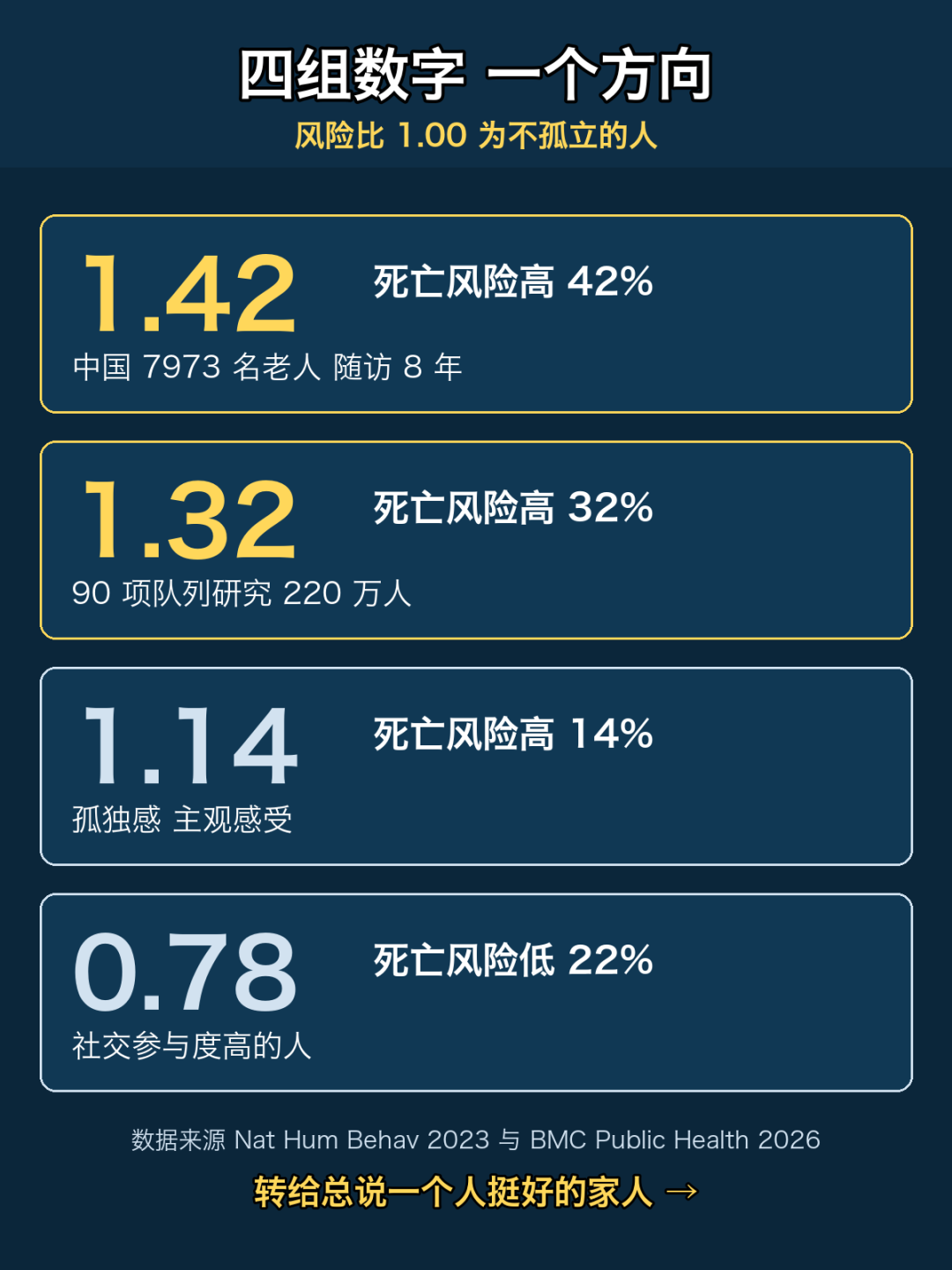
On the Chinese side were 7,973 older adults (the CHARLS cohort), with an average follow-up of 8.18 years, during which 910 people died; on the US side were 6,207 older adults (the HRS cohort), with an average follow-up of 10.84 years, during which 2,182 people died.
They defined "social isolation" using four things: how many people live in the same household, the frequency of participating in social activities, the frequency of contact with others, and whether one has a spouse.
Result: socially isolated older adults had a 42% higher risk of all-cause death; in the US cohort it was 54% [4].
Two countries, two different social structures, pointing in the same direction.
II. Not a Small-Sample Coincidence: 2.2 Million People Considered Together
A 2023 meta-analysis in Nature Human Behaviour pooled 90 prospective cohorts and 2,205,199 people: the combined risk ratio of social isolation with all-cause death was 1.32, and with cardiovascular death was 1.34 [3].
An earlier classic meta-analysis covering 148 studies and more than 300,000 people concluded that people with strong social relationships had a 50% higher likelihood of survival [1].
The authors' original wording was: its effect on mortality risk is comparable to classic risk factors already written into guidelines [1].
III. An Easily Overlooked Detail: Objective Contact Is Harder Than Subjective Feelings
A 2015 meta-analysis calculated three things separately: social isolation (objective—others really do rarely see you) risk ratio 1.29; loneliness (subjective—you yourself feel there is no one to talk to) 1.26; living alone 1.32 [2].
The three numbers are close, but independent of one another: a person saying "I'm doing fine, I'm not lonely" and seeing only a few people a month are two different things, and both are quietly counted into risk.
In the 2023 analysis of 2.2 million people, the layers were clearer: objective social isolation was 1.32, subjective loneliness was 1.14 [3].
So "staying in touch more" cannot rely on self-comfort alone; there must be contact that others can truly see.
IV. Reversal: Participation Frequency Can Be Increased
Reading this, it is easy to feel discouraged: I am naturally not fond of socializing—am I beyond help?
A meta-analysis published online in August 2026 specifically answered this question: 25 prospective cohort studies showed that older adults with high social participation had a 22% lower risk of all-cause death than those with low participation (adjusted risk ratio 0.78) [5].
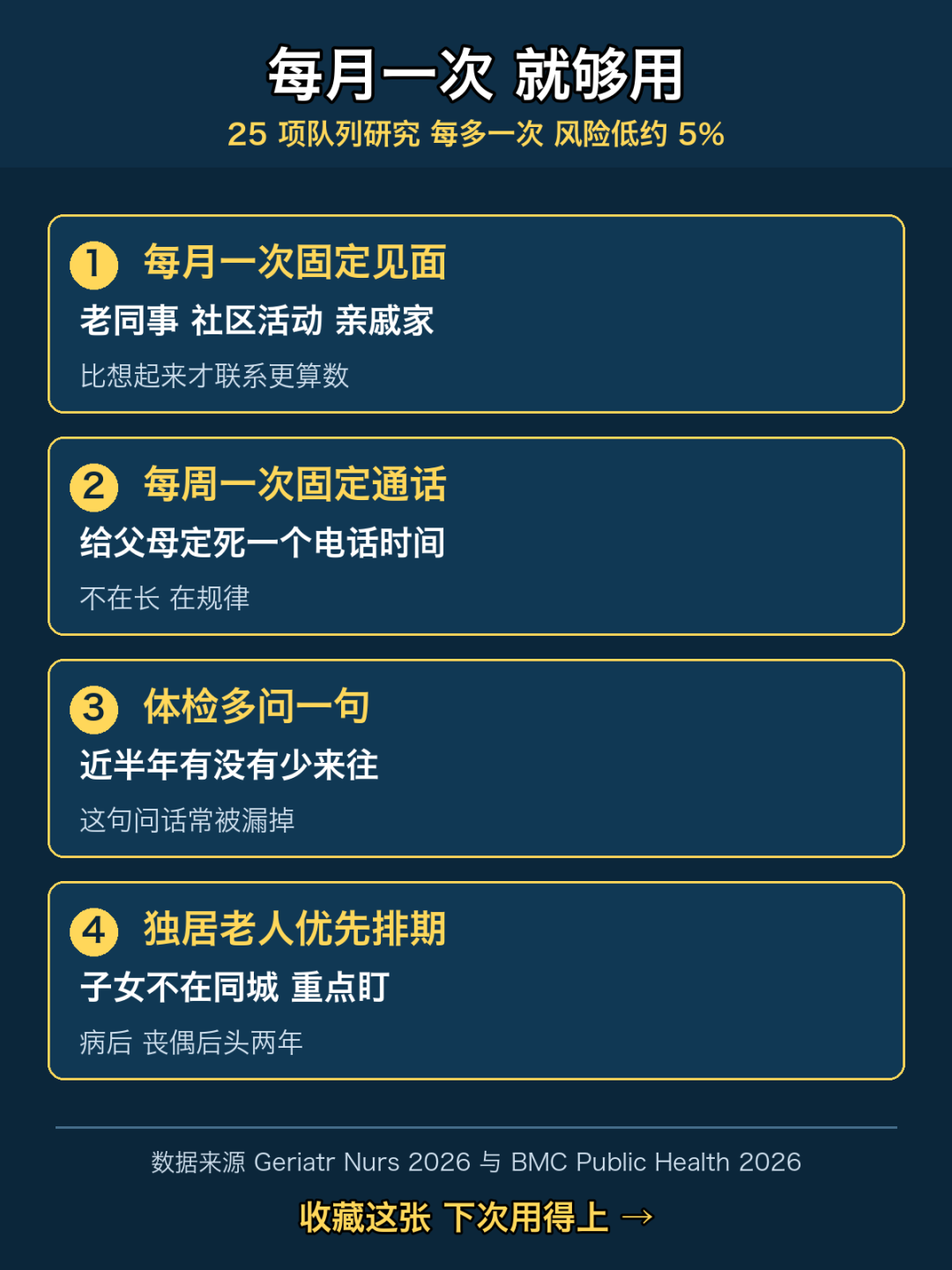
More practical is the dose. The researchers converted participation frequency into "times per month" and found that for each additional participation, the relative risk of death was about 5% lower (0.946) [5].
It must be made clear: this is still observational research and cannot prove causation—people who like going out may already be healthier. But "one more time per month" costs almost nothing.
V. Why? The Mechanism in Plain Language
The researchers' explanation is roughly threefold: people who socialize less are more likely to eat carelessly alone and be disinclined to move; when they feel unwell, no one urges them to go to the hospital; and with long-term lack of interpersonal interaction, the body's stress and inflammatory responses are harder to return to baseline.
None of the three is mysterious; all land on everyday behaviors—which is actually good news: they can be changed.
VI. These Groups Are at Higher Risk
-
People who live alone and whose children are in another city
-
People who have just retired and suddenly lost colleagues they used to see every day
-
The family member providing long-term care for others, who is often overlooked themselves
-
The first two years after childbirth, after illness, or after widowhood
VII. Three Things You Can Do Today
-
Turn "once a month" into a fixed action: get together once with former colleagues, sign up for a community activity, visit a relative's home. According to the data above, even one time counts [5].
-
Keep one fixed weekly call: set an unshakable phone time for your parents; it is more direct than a big red envelope during holidays [4].
-
Ask one more question at checkups: in the past six months, has the older adult at home noticeably reduced their contact with others? The value of this question is often higher than checking one more indicator.
A meal alone can be eaten well, but days alone are hard to live healthily.
Forward this article to that family member who always says "I'm fine on my own."
If it helps you, give it a like or a "Wow," and feel free to leave a comment telling us what topics you would like to see.
Disclaimer: This article is for health education purposes only and is intended for informational reference; it does not constitute medical advice. If you have health concerns, please consult a professional physician.
Conflict of interest statement: This article does not involve any drug or product recommendations and has no conflict of interest with the research institutions and journals mentioned in the text.
© 2026 Taiyang Shenghua (Beijing) Medical Technology Co., Ltd.
References
[1] Holt-Lunstad J, Smith TB, Layton JB. Social relationships and mortality risk: a meta-analytic review. PLoS Med. 2010;7(7):e1000316. PMID: 20668659
[2] Holt-Lunstad J, Smith TB, Baker M, et al. Loneliness and social isolation as risk factors for mortality: a meta-analytic review. Perspect Psychol Sci. 2015;10(2):227-237. PMID: 25910392
[3] Wang F, Gao Y, Han Z, et al. A systematic review and meta-analysis of 90 cohort studies of social isolation, loneliness and mortality. Nat Hum Behav. 2023;7(8):1307-1319. PMID: 37337095
[4] Yao N, Li W, Duan N, et al. The combined impact of social isolation and unhealthy risk score on mortality risk: a study from two prospective cohorts. BMC Public Health. 2026;26(1):1808. PMID: 42021260
[5] Xiao Y, Liu R, Xu X, et al. Social participation as a modifiable social determinant of health: a systematic review and dose-response meta-analysis of all-cause mortality in older adults. Geriatr Nurs. 2026;73:104322. PMID: 42641335