This article is for health education purposes only and is for informational reference only; it does not constitute medical advice. If you have health concerns, please consult a professional doctor.
As soon as Lidong arrives, the lines at hot pot restaurants form again.
That line on the health check report reading "elevated uric acid" makes many people hesitate in front of the pot: can I still eat this meal?
First, the conclusion: you can eat. But how you eat, and how you wrap up afterward, affects your next flare-up more than whether you eat at all.
First, two numbers
A national survey of 78,130 adults across 31 provinces shows that the prevalence of hyperuricemia among Chinese adults is 17.7%, and gout is 3.2%[1]. Another meta-analysis pooling 108 papers and more than 800,000 people put hyperuricemia in the general population at 17.4%, ranging from 15.5% to 24.6% across regions[2].
At a table of ten, one or two people have elevated uric acid. This is not a problem for a minority.
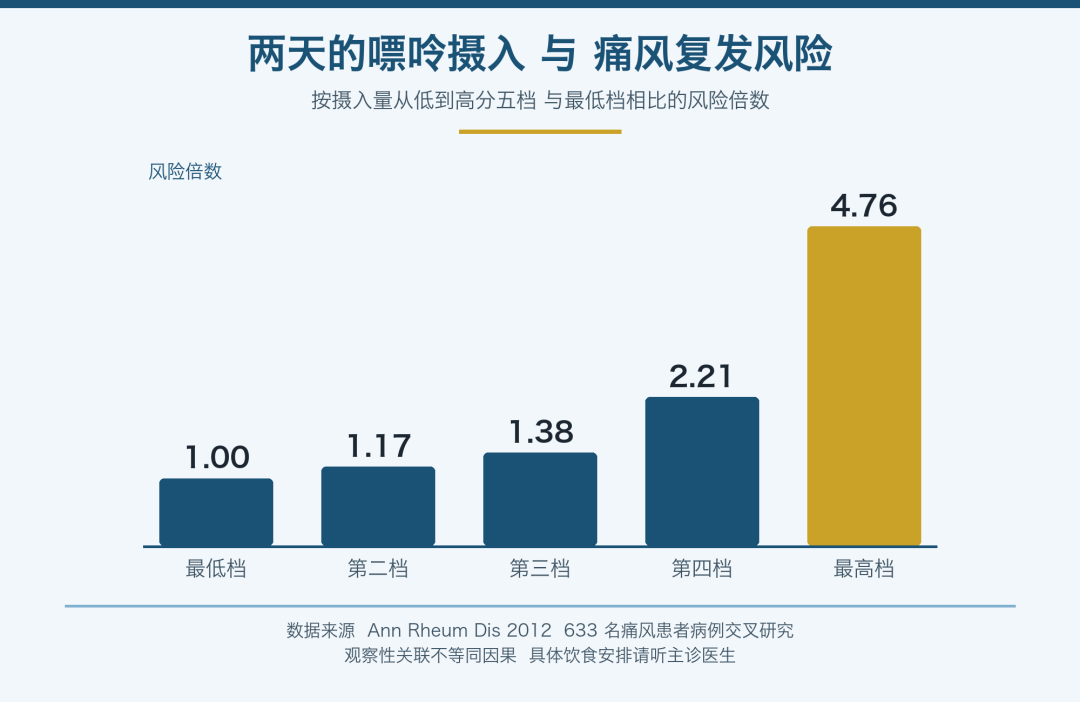
Figure caption: Divided into five tiers by two-day purine intake, gout patients' risk of recurrence rises tier by tier, with the highest tier at 4.76 times the lowest.
Question 1: Does elevated uric acid mean gout?
No.
Elevated uric acid means the uric acid concentration in the blood exceeds the reference range; gout is the flare in which urate crystals deposit in joints and trigger redness, swelling, heat, and pain. There is a gap between the two: 17.7% of people have elevated uric acid, while only 3.2% actually have gout[1].
Some people whose uric acid is not particularly high still have a flare after a single bout of heavy eating and drinking. So when you see elevated uric acid, don't scare yourself, and don't ignore it either. Look at two things: how far the value is from the reference range, and whether you have ever had a flare.
Question 2: Can you eat hot pot or not?
You can, but you need to know what you're eating.
A case-crossover study of 633 gout patients gave a very specific answer: divided into tiers by two-day purine intake, compared with the lowest intake tier, the risk of gout recurrence in the highest tier was 4.76 times higher, with the middle tiers at 1.17, 1.38, and 2.21 times[3].
More interesting is the source: the highest tier of animal purine carried a risk of 2.41 times, while plant purine was 1.39 times[3].
Another study following 47,150 men for 12 years confirmed this: the highest tier of meat intake carried a gout risk of 1.41 times, seafood 1.51 times; while purine-rich vegetables and total protein intake had no significant relationship with gout risk[7].
So the key to eating hot pot is not abstaining, but three things:
-
Order meat and seafood in moderation; don't eat a week's worth in one meal
-
Don't drink the long-simmered broth like water; purines are water-soluble, and the longer it simmers, the more ends up in the broth
-
Swap accompanying drinks for plain water or weak tea; skip beer and sugary drinks
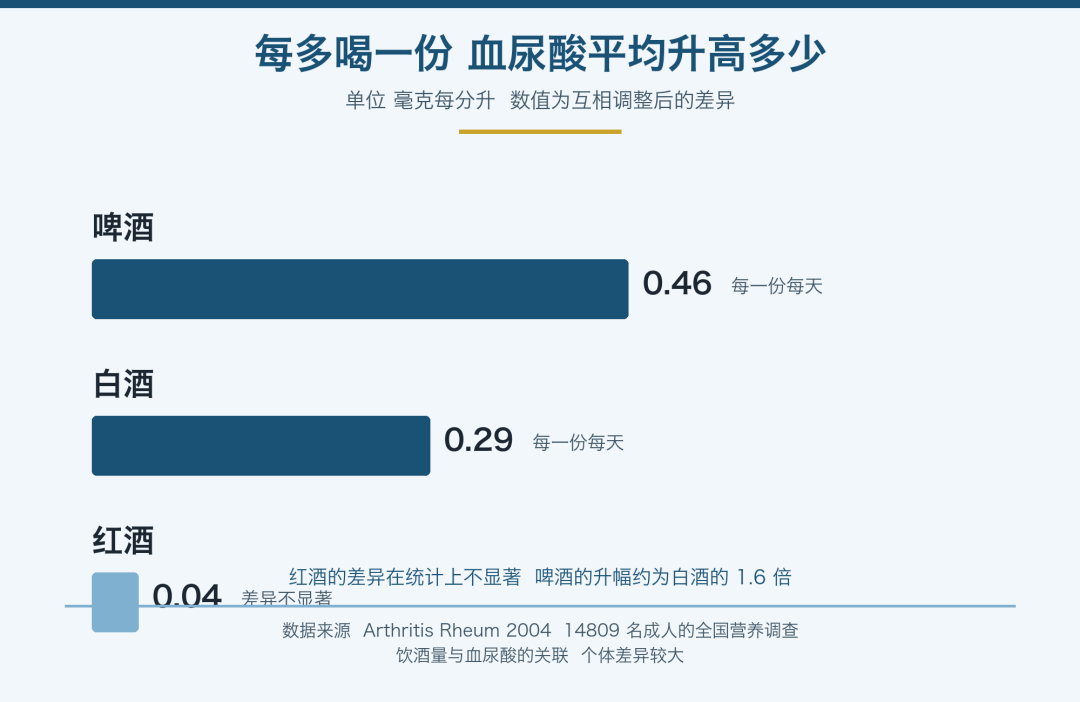
Figure caption: For each additional serving of beer, blood uric acid is on average 0.46 mg/dL higher; baijiu 0.29; red wine shows no significant association.
Question 3: Beer or baijiu—which raises uric acid more?
Beer.
A national nutrition survey of 14,809 adults provided quantified differences: after mutual adjustment, each additional serving of beer per day was associated with blood uric acid on average 0.46 mg/dL higher; each additional serving of baijiu was 0.29; the difference for red wine was not significant[4].
Beer ranks first, due both to the effect of alcohol and to purines from yeast.
Easier to overlook than alcohol are sugary drinks. A study following 78,906 women for 22 years showed that, compared with less than one serving of sugar-sweetened beverages per month, those having two or more servings per day had a gout risk of 2.39 times; one or more glasses of orange juice per day was 2.42 times; artificially sweetened drinks had no relationship with gout risk[5].
Fructose raises uric acid production when it is broken down in the body—a pathway separate from alcohol.
Question 4: I eat very lightly—why is my uric acid still high?
Because diet's effect on uric acid is smaller than most people think.
A joint gene-diet analysis of 16,760 people did something very direct: it took various dietary patterns and food items and used them to explain individual differences in blood uric acid, and the result was that no single healthy eating score explained more than 0.3%; while common genomic variants explained 23.9%[6].
This is not to say diet doesn't matter. It shows two things: among people with high uric acid, many have a foundation in genes and metabolism, not just a love of food; diet accounts for only a small part, so don't expect to push the number down by avoidance alone.
What truly drives uric acid higher also includes body weight, kidney function, and certain medications that affect uric acid excretion—leave these for a doctor to assess.
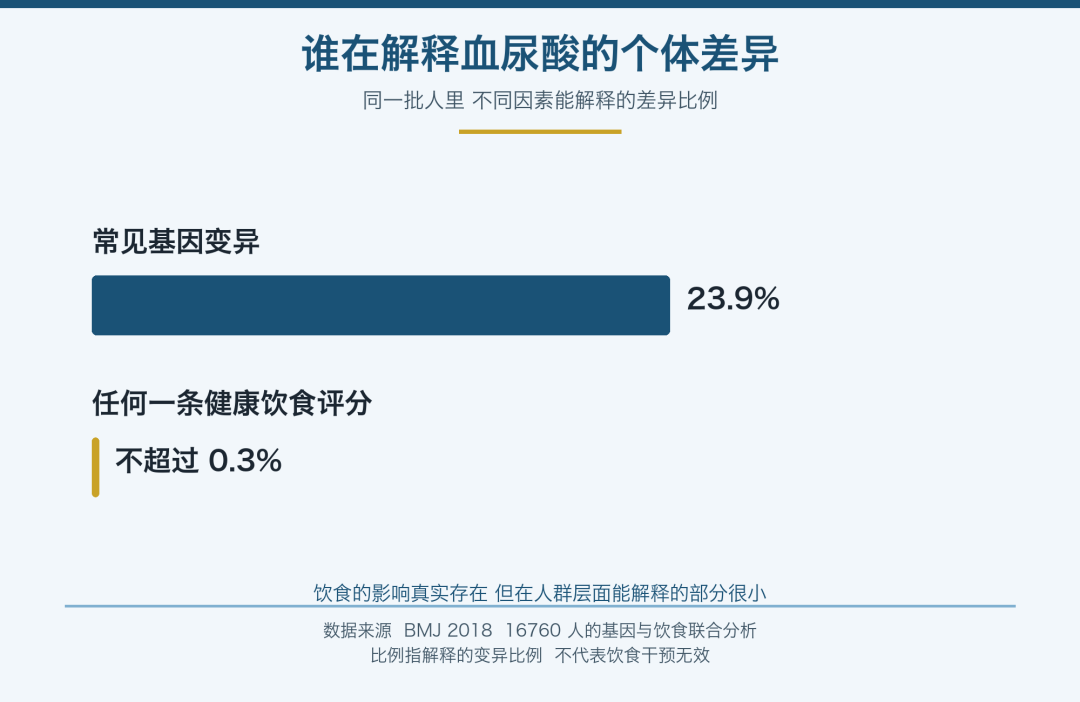
Figure caption: Dietary patterns explain no more than 0.3% of individual differences in blood uric acid; common gene variants explain 23.9%.
Question 5: Starting today, what can be done?
Four concrete things:
First, cut out sugary drinks and alcohol first. This is a high-value step; the risk relationship for sugar-sweetened beverages is relatively clear[5], and beer's impact is also large[4].
Second, get your weight down a bit. People who are overweight often see uric acid drop after losing weight. Don't aim for rapid loss; about half a kilogram per week is easier to sustain.
Third, have one serving of dairy daily. In the study of 47,150 people above, the highest tier of dairy intake had a gout risk of 0.56 times—lower risk within the same population[7].
Fourth, no need to avoid vegetables. Purine-rich vegetables have been separately verified to have no significant relationship with gout risk[7]. Giving up greens to avoid purines is not worth the loss.
One more bottom line: if you have already had a gout flare, or your uric acid is clearly elevated along with kidney stones or abnormal kidney function, don't tough it out alone—go to rheumatology or endocrinology to assess whether standardized treatment is needed. Whether to use medication and which one is for the doctor to decide.
Finally
Uric acid is more like a long-term bill—every meal adds to it, but it's not too late to change.
Lidong hot pot can be eaten; just don't make every time a sprint.
If this was helpful to you, give it a like or a "Wow," and feel free to leave a comment telling us what topics you'd like to see. Share it with that person whose health check report this year says elevated uric acid.
✦ Disclaimer: This article is for health education purposes only and is for informational reference only; it does not constitute medical advice. If you have health concerns, please consult a professional doctor. Conflict of interest statement: This article does not involve any drug or product recommendations and has no conflict of interest with the research institutions mentioned in the text. © 2026 Sunsaint Hua (Beijing) Medical Technology Co., Ltd.
References
[1] Song J, Jin C, Shan Z, Teng W, Li J. Prevalence and Risk Factors of Hyperuricemia and Gout: A Cross-sectional Survey from 31 Provinces in Mainland China. J Transl Int Med. 2022;10(2):134-145. PMID: 35959454
[2] Huang J, Ma ZF, Zhang Y, Wan Z, Li Y, Zhou H, Chu A, Lee YY. Geographical distribution of hyperuricemia in mainland China: a comprehensive systematic review and meta-analysis. Glob Health Res Policy. 2020;5(1):52. PMID: 33292806
[3] Zhang Y, Chen C, Choi H, Chaisson C, Hunter D, Niu J, Neogi T. Purine-rich foods intake and recurrent gout attacks. Ann Rheum Dis. 2012;71(9):1448-1453. PMID: 22648933
[4] Choi HK, Curhan G. Beer, liquor, and wine consumption and serum uric acid level: the Third National Health and Nutrition Examination Survey. Arthritis Rheum. 2004;51(6):1023-1029. PMID: 15593346
[5] Choi HK, Willett W, Curhan G. Fructose-rich beverages and risk of gout in women. JAMA. 2010;304(20):2270-2278. PMID: 21068145
[6] Major TJ, Topless RK, Dalbeth N, Merriman TR. Evaluation of the diet wide contribution to serum urate levels: meta-analysis of population based cohorts. BMJ. 2018;363:k3951. PMID: 30305269
[7] Choi HK, Atkinson K, Karlson EW, Willett W, Curhan G. Purine-rich foods, dairy and protein intake, and the risk of gout in men. N Engl J Med. 2004;350(11):1093-1103. PMID: 15014182