Frequently Eating Late-Night Snacks Linked to 20% Higher Obesity Risk? A 9,474-Person Follow-Up Provides the Answer
This article is for health education purposes only and is intended for informational reference; it does not constitute medical advice. If you have health concerns, please consult a professional physician.
✦ ✦ ✦
Working overtime until ten, a bowl of instant noodles; binge-watching until midnight, a plate of barbecue. Many people know deep down that late-night snacks aren't a great "deal"—they just don't realize that what it adds may be more than just calories.
The same dinner, eaten at six in the evening versus ten at night, is handled differently by the body.
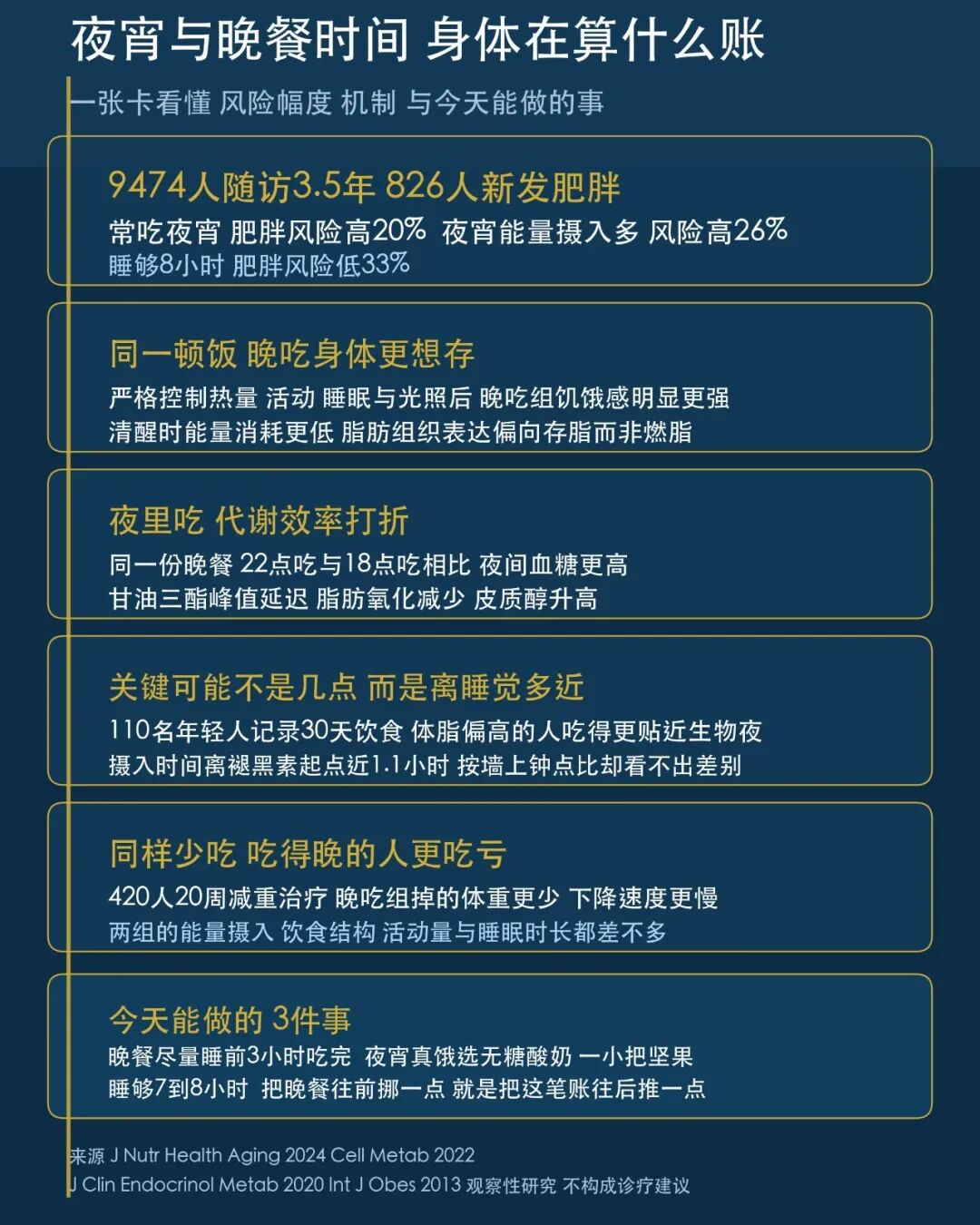
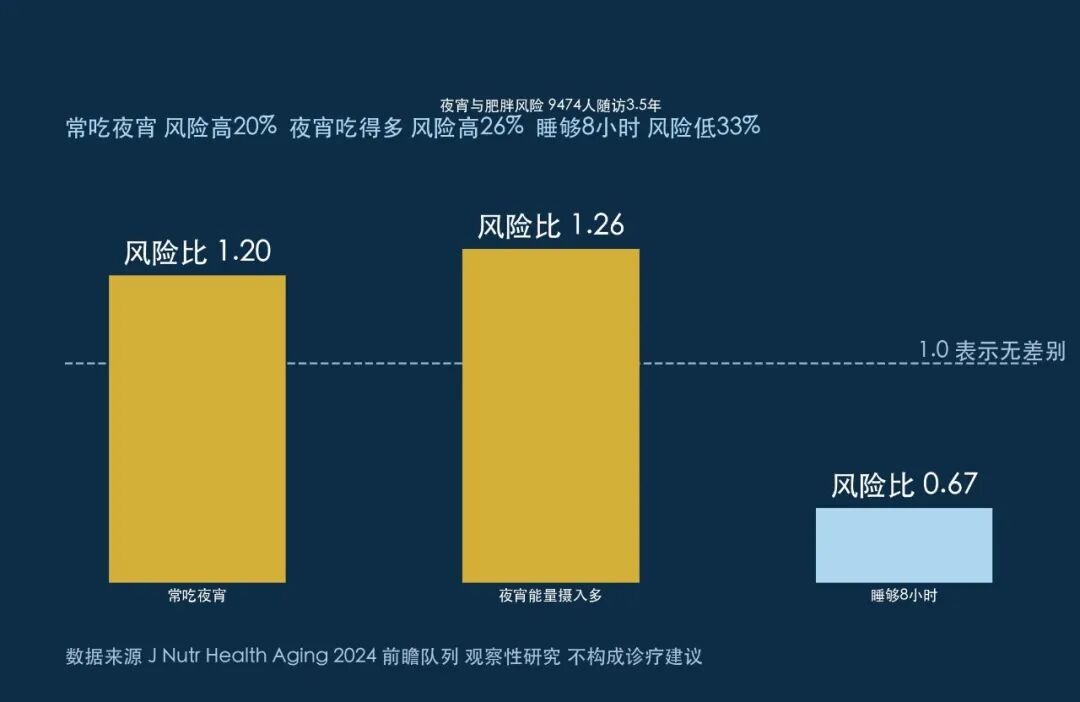
First, some numbers. A prospective cohort study from Korea that included 9,474 adults with an average follow-up of 3.5 years found that people who habitually ate late-night snacks had a 20% higher risk of new-onset obesity; those who consumed more energy from late-night snacks had a 26% higher risk; and those who slept at least 8 hours per night had a 33% lower obesity risk [1].
A card to see the full picture at a glance:
The figure below puts the risk changes side by side:
1. The Same Meal—Why Eating It Late Makes It Easier to Store Fat
A randomized crossover trial scheduled the same group of people with the same calories, the same activity, and the same sleep into two conditions, changing only the timing of meals. The results: in the late-eating round, hunger was noticeably stronger, and appetite-regulating hormones changed accordingly; energy expenditure while awake was lower, and core body temperature was also lower; gene expression related to lipid metabolism in adipose tissue shifted toward "storing fat" rather than "burning fat" [2].
In plain terms: the same meal, eaten later, makes the body more inclined to store it.
2. At Night, Metabolic Efficiency Is Already Compromised
A randomized crossover trial from Johns Hopkins University is even more intuitive: 20 healthy volunteers were given the same dinner at 6 p.m. and 10 p.m. respectively, with sleep fixed from 11 p.m. to 7 a.m. the next day. After the 10 p.m. meal, nighttime blood glucose was higher, the triglyceride peak came later, fat oxidation decreased, and cortisol rose; among habitual early sleepers, the changes were more pronounced [3].
In plain terms: it's not a matter of willpower—it's that at night, the body's ability to handle sugar and fat is already reduced.
3. The Key May Not Be "What Time" but "How Close to Bedtime"
One study had 110 young adults aged 18 to 22 photograph every meal with their phones for 30 consecutive days while measuring the time their melatonin secretion began. The results: in the group with higher body fat, the timing of most of the day's calorie intake was about 1.1 hours closer to melatonin onset; but when compared by clock time, there was no difference between the two groups [4].
In plain terms: rather than obsessing over "what time you must finish eating," look at how long the interval is between "finishing eating" and "getting into bed." Eating at ten at night and sleeping at eleven is not the same as eating at ten and sleeping at one in the morning.
4. Those Trying to Lose Weight Should Pay Even More Attention to Timing
A Spanish study followed 420 people through a 20-week weight-loss treatment: the late-eating group lost less weight and lost it more slowly. Interestingly, the two groups were similar in energy intake, diet composition, estimated energy expenditure, and sleep duration [5].
In plain terms: eating less the same way, those who eat late fare worse—this isn't a calorie ledger, it's a timing ledger.
5. Those with Already Elevated Blood Sugar Should Pay Particular Attention
A cohort study of 409 patients with type 2 diabetes in Japan showed that 23.2% ate dinner later than 8 p.m.; this group had an average HbA1c of 7.5%, compared with 7.2% in the earlier-dinner group. After adjusting for age, body mass index, disease duration, exercise, smoking, alcohol consumption, sleep duration, and other factors, late eating remained independently associated with poor glycemic control [6].
6. Three Things You Can Do Today
- Move dinner earlier. Try to finish eating 3 hours before bedtime to give your body time to process the meal.
- If you're genuinely hungry for a late-night snack, skip the barbecue and instant noodles. Opt for sugar-free yogurt, a small handful of nuts, or a boiled egg—small portions, protein first.
- Prioritize catching up on sleep. Getting 7 to 8 hours of sleep is easier to sustain long-term than "toughing it out" without eating.
The aroma of a late-night snack is real, and so is the body's ledger. Moving dinner a little earlier is simply pushing that ledger a little later.
If you found this helpful, give it a like or a "Wow," and feel free to leave a comment telling us what topics you'd like to see.
✦ ✦ ✦
References
[1] Lyu J, Lee K, Jung S, Park YJ. Associations of meal timing and sleep duration with incidence of obesity: a prospective cohort study. J Nutr Health Aging. 2024;28(6):100220. PMID: 38564828
[2] Vujović N, Piron MJ, Qian J, et al. Late isocaloric eating increases hunger, decreases energy expenditure, and modifies metabolic pathways in adults with overweight and obesity. Cell Metab. 2022;34(10):1486-1498. PMID: 36198293
[3] Gu C, Brereton N, Schweitzer A, et al. Metabolic Effects of Late Dinner in Healthy Volunteers-A Randomized Crossover Clinical Trial. J Clin Endocrinol Metab. 2020;105(8):2789-2802. PMID: 32525525
[4] McHill AW, Phillips AJ, Czeisler CA, et al. Later circadian timing of food intake is associated with increased body fat. Am J Clin Nutr. 2017;106(5):1213-1219. PMID: 28877894
[5] Garaulet M, Gómez-Abellán P, Alburquerque-Béjar JJ, et al. Timing of food intake predicts weight loss effectiveness. Int J Obes (Lond). 2013;37(4):604-611. PMID: 23357955
[6] Sakai R, Hashimoto Y, Ushigome E, et al. Late-night-dinner is associated with poor glycemic control in people with type 2 diabetes: The KAMOGAWA-DM cohort study. Endocr J. 2018;65(4):395-402. PMID: 29375081
✦ ✦ ✦
Disclaimer: This article is for health education purposes only and is intended as general information; it does not constitute medical advice. If you have any health concerns, please consult a qualified physician.
Declaration of Interests: This article does not recommend any medications and has no conflicts of interest with the research institutions mentioned herein.
© 2026 Sun Sheng Hua (Beijing) Medical Technology Co., Ltd.