Sleeping With the Lights On: 53% Higher Diabetes Risk? Data From 84,000 People Over 7.9 Years
This article is for health education purposes only and is intended for informational reference; it does not constitute medical advice. If you have health concerns, please consult a professional doctor.
Some people need a night light to fall asleep; others habitually scroll on their phones until the screen dims and locks itself.
On the surface, this seems like nothing more than "not sleeping quite as deeply."
But there is a set of data that links it to diabetes: 84,000 people, 13 million hours of light exposure records, and 7.9 years of follow-up.
First, the Numbers
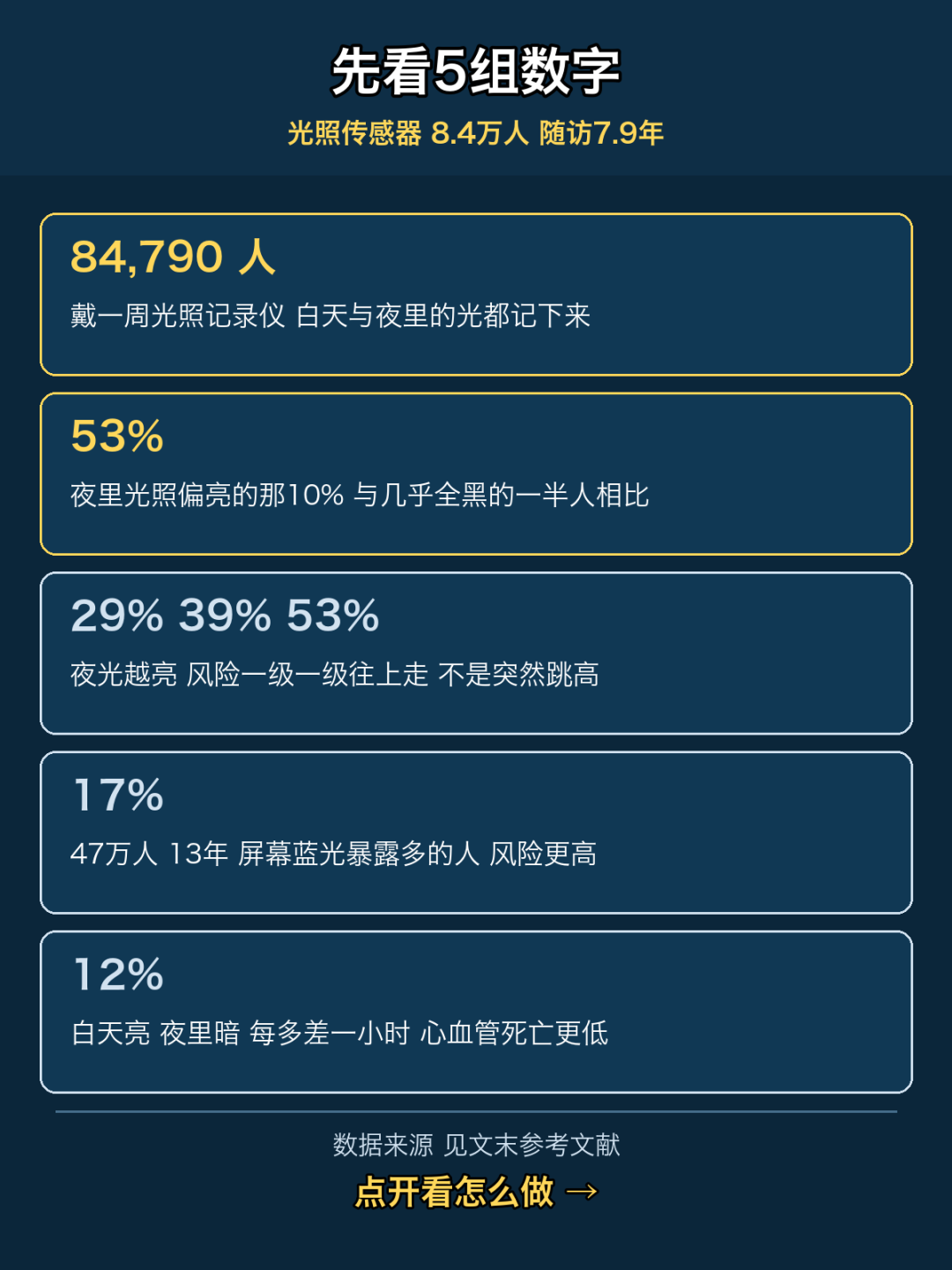
In the UK Biobank, 84,790 participants each wore a light-recording device for one week, capturing both daytime and nighttime light exposure. They were then followed for 7.9 years, during which 1,997 new cases of type 2 diabetes were recorded. After adjusting for age, sex, socioeconomic status, lifestyle, and genetic risk: the 10% with the brightest nighttime light exposure had a 53% higher diabetes risk compared with the half of participants who experienced near-total darkness at night; the two middle tiers had 29% and 39% higher risk, respectively [1].
The risk climbed step by step rather than fluctuating unpredictably. The research team also provided a reference point: the gap between bright nights and dark nights was roughly comparable to the gap between "high genetic risk" and "moderate risk" [1]. That bit of light at night is not an inconsequential backdrop.
5 Key Points
1 The Body Treats Nighttime Light as "It's Not Time to Sleep Yet"
Light is the calibration signal for the biological clock. Exposure to light at night suppresses melatonin secretion, delays the circadian clock, and throws metabolic rhythms out of sync. In an inpatient experiment, healthy adults slept just one night in a room at 100 lux (roughly equivalent to a dim desk lamp); compared with a night in near-total darkness, they had higher nighttime heart rates, lower heart rate variability, and greater insulin resistance the next morning [2]. One night was enough.
2 The Brighter the Light, the Higher the Risk — No Safe Step in Between
The three tiers of 29%, 39%, and 53% make one thing clear: this is not a binary choice between "lights on" and "lights off" — the brighter the light, the greater the risk [1]. So swapping a 100-watt ceiling light for a 5-watt night light is a step in the right direction.
3 Screen Blue Light Counts Too
Another analysis of 470,000 people with 13 years of follow-up found that those with greater blue light exposure — such as from screens — had a 17% higher diabetes risk [3]. The stratified results are worth noting: the association was stronger among those at high genetic risk, with a 24% higher risk; among those at low genetic risk, the association was not significant [3]. Light does not hit everyone equally hard, but it is certainly having an effect.
4 It's Not Just About "Sleeping a Little Less"
People who read glowing e-readers before bed take longer to fall asleep, secrete less melatonin, experience a delayed circadian clock, and are less alert the next morning [4]. So "I get a full 8 hours" does not mean there is no effect — both sleep timing and sleep quality are affected.
5 Shift Workers Should Pay Extra Attention
Shift work itself means long-term exposure to nighttime light. In two large cohorts, women who had done shift work for more than 20 years had a 58% higher risk of type 2 diabetes; however, after adjusting for body weight, this association weakened markedly [5]. Read in reverse, that is good news: part of the risk is mediated through the body-weight pathway, and body weight is something you can change.

Three Things You Can Do Tonight
One: turn off the lights when you sleep and draw blackout curtains. If you are afraid of the dark when getting up at night, wear an eye mask — it is less hassle than leaving a light on.
Two: switch the night light to a warm color, place it low, and adjust the brightness to just enough to see the floor — don't let it shine on your face.
Three: get more light during the day. In a study of US adults, each additional hour of difference between bright daytime and dark nighttime was associated with approximately 12% lower cardiovascular mortality risk [6]. A 20-minute morning walk is cheaper than any supplement.
If you have a larger waist circumference, a family history of diabetes, or elevated blood pressure, consider getting a fasting blood glucose test once a year. Early detection makes management much simpler.
A little darker at night, a little brighter during the day. This is a metabolic intervention that costs very little.
Consider sharing this with that family member who "can only fall asleep with the light on."
If you found this helpful, give it a like or a "reading" — and feel free to leave a comment telling us what topics you'd like to see.
Disclaimer: This article is for health education purposes only and is intended for informational reference; it does not constitute medical advice. If you have health concerns, please consult a professional doctor.
Conflict of interest statement: This article does not involve any product recommendations or commercial partnerships, and the author has no financial relationship with the research institutions mentioned in the text.
© 2026 Sunshenghua (Beijing) Medical Technology Co., Ltd.
References
[1] Windred DP, Burns AC, Rutter MK, et al. Personal light exposure patterns and incidence of type 2 diabetes: analysis of 13 million hours of light sensor data and 670,000 person-years of prospective observation. Lancet Reg Health Eur. 2024;42:100943. PMID: 39070751
[2] Mason IC, Grimaldi D, Reid KJ, et al. Light exposure during sleep impairs cardiometabolic function. Proc Natl Acad Sci U S A. 2022;119(12):e2113290119. PMID: 35286195
[3] Wang C, Zhao Y, Hong Q, et al. The association between blue light exposure and incidence of type 2 diabetes: A prospective study of UK biobank. Environ Res. 2024;246:118070. PMID: 38157962
[4] Chang AM, Aeschbach D, Duffy JF, Czeisler CA. Evening use of light-emitting eReaders negatively affects sleep, circadian timing, and next-morning alertness. Proc Natl Acad Sci U S A. 2015;112(4):1232-1237. PMID: 25535358
[5] Pan A, Schernhammer ES, Sun Q, Hu FB. Rotating night shift work and risk of type 2 diabetes: two prospective cohort studies in women. PLoS Med. 2011;8(12):e1001141. PMID: 22162955
[6] Dai J, Dai W, Zong X, et al. Objectively Measured Individual-Level Daytime Versus Nighttime Light Exposure and Cardiovascular Disease Mortality in U.S. Adults. Eur J Prev Cardiol. 2026;zwag303. PMID: 42258634