This article is for health education purposes only and is intended for informational reference; it does not constitute medical advice. If you have any health concerns, please consult a professional physician.
✦ ✦ ✦
That quiet resting heart rate number on your smartwatch may be the "metronome" for every organ in your body. It tells you earlier than weight or waist circumference: at what speed this body system is running. Today, we'll use data from a large population sample to explain "resting heart rate" thoroughly.
✦ ✦ ✦
First, the data: every 10 extra beats per minute is linked to a 17% higher risk of all-cause death
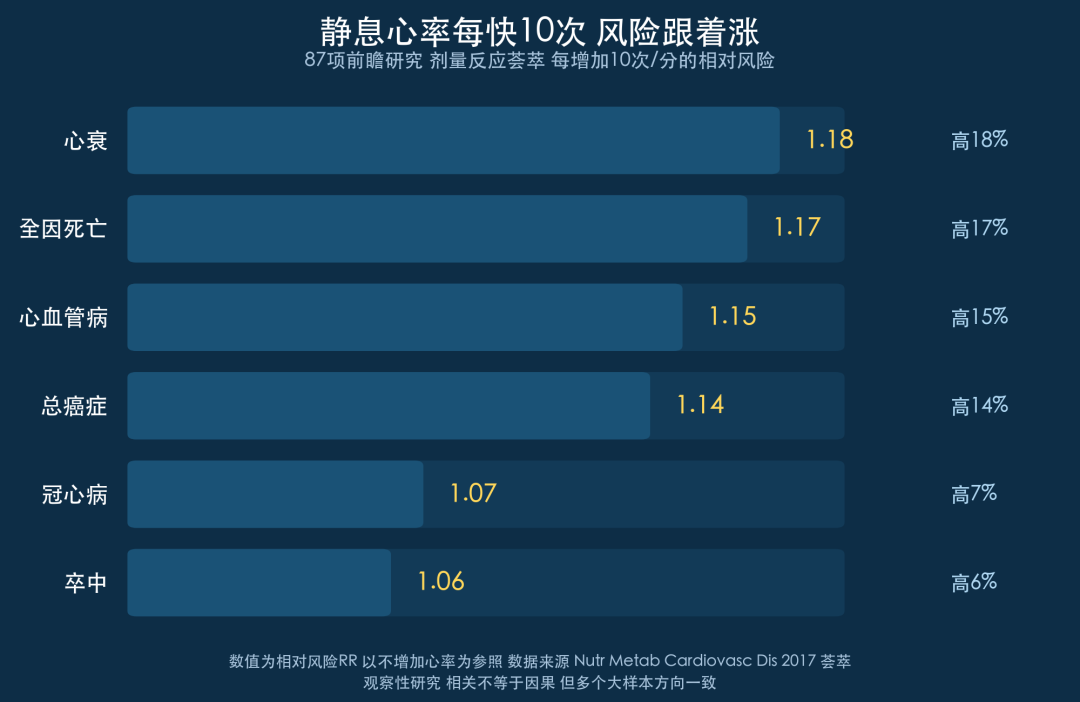
A 2017 dose-response meta-analysis that pooled 87 prospective studies covering millions of people found that for every 10-beat/min increase in resting heart rate, the risk of all-cause death rose by about 17% (RR 1.17), the risk of cardiovascular death rose by 15% (RR 1.15), and the risk of heart failure rose by 18% (RR 1.18) [1]. Another 2016 meta-analysis of 45 cohort studies in the Canadian Medical Association Journal likewise showed that for every 10-beat/min faster heart rate, the risk of coronary heart disease was 12% higher (RR 1.12), and the risk of non-cardiovascular death was 16% higher (RR 1.16) [2].
In plain terms: the faster your heart beats at rest, the higher your long-term risk of death from all causes, and the relationship is linear—a little faster means a little higher risk, with no "safe turning point." (Note: the above are observational studies; correlation does not equal causation, but multiple independent large samples point in the same direction.)
Key finding: above 80 beats/min, risk starts to rise noticeably
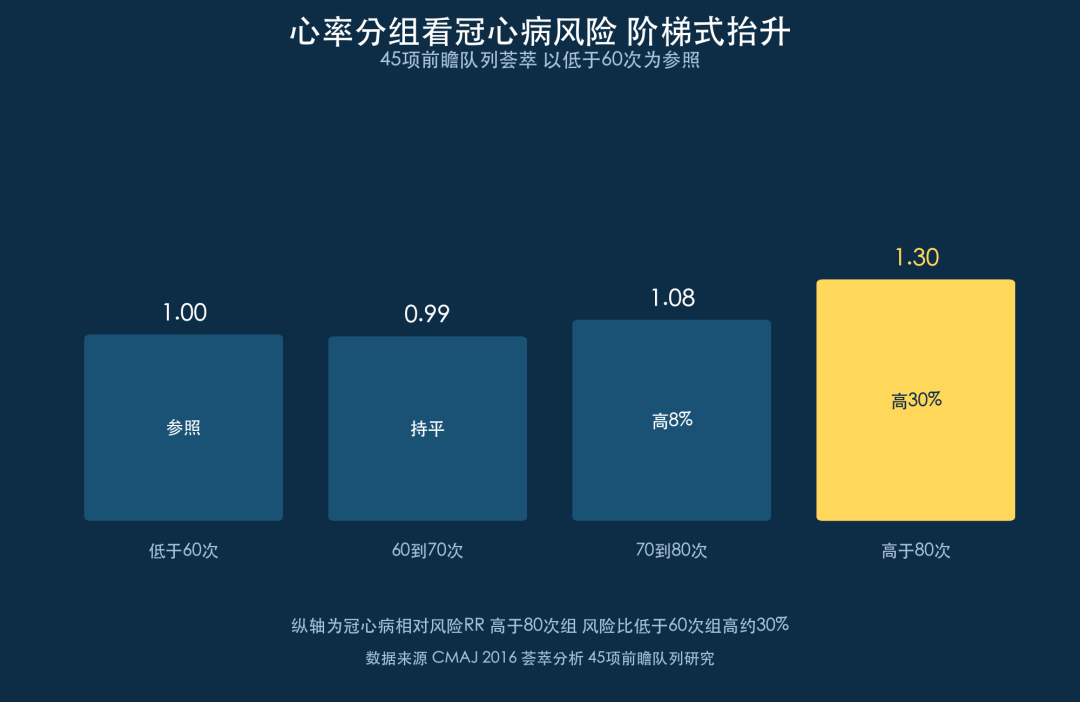
After grouping resting heart rate into "below 60, 60 to 70, 70 to 80, and above 80," the rise in risk becomes clearer [2]: with below 60 beats as the reference, the relative risks of coronary heart disease were 1.00, 0.99, 1.08, and 1.30, respectively—meaning people with a heart rate above 80 beats had about a 30% higher risk of coronary heart disease than those below 60 beats; the risk of non-cardiovascular death climbed all the way from 1.00 to 1.57, about 57% higher.
China's own data support this direction as well: the Kailuan study followed more than 90,000 Chinese adults and found that compared with the lowest group, the group with the highest resting heart rate had an 18% higher risk of all-cause death (HR 1.18) and a 10% higher risk of myocardial infarction (HR 1.10) [3].
In plain terms: "anything under 100 is normal" is a misconception—risk starts climbing from 80 beats, and the 90s or around 100 deserve even more serious attention.
How do you measure resting heart rate accurately? Three conditions are essential
Many people measure casually and get nervous, but if the method is wrong, the number is meaningless. A proper resting heart rate requires three conditions:
- Quiet: sit quietly for 5 minutes before measuring, do not talk or play on your phone, and avoid coffee, strong tea, and the hour after exercise.
- Relaxed: sit or lie down, keep your arm at heart level, and measure at the wrist or chest.
- Average multiple readings: a single reading fluctuates a lot, so it is recommended to measure for 3 consecutive days at the same time each day (on waking or before bed) and take the average for better reference value.
The "resting heart rate" function on smartwatches automatically excludes active periods through its algorithm, making it closer to the true level than a casual measurement, but devices need regular calibration, and abnormal values should still be confirmed by a hospital electrocardiogram.

In plain terms: heart rate should be measured while "at rest"—sit quietly for 5 minutes first, then measure for 3 days and look at the average.
First, a common misunderstanding: medical textbooks list the "normal range" for adult resting heart rate as 60 to 100 beats/min, meaning that most people in this range do not have structural heart disease; it does not mean that 100 beats and 60 beats are "equally healthy." The population data above already show that risk climbs continuously—over the long term, there is a considerable difference between 80 beats and 60 beats.
In plain terms: 60 to 100 is a "safe range," not an "ideal range"; within the safe range, the lower end generally means the heart is being used more sparingly.
A fast heart rate is not just a heart matter: the brain is affected too
A 2022 follow-up study of 340,000 people in the UK Biobank had an easily overlooked finding: people with a resting heart rate above 80 beats/min had an 18% higher risk of all-cause dementia (HR 1.18) and a 29% higher risk of vascular dementia (HR 1.29) than those below 80 beats/min; a relatively fast heart rate was also associated with declines in memory and reaction speed, as well as a smaller hippocampal volume in the brain [4]. A meta-analysis that same year pooling prospective studies of more than 50,000 people also suggested that people with a relatively high resting heart rate had an 18% higher risk of cognitive decline (RR 1.18) [5].
In plain terms: a persistently fast heartbeat may not mean "the heart is overexcited," but rather that the whole body, including the brain, is running under a high load.
Why does a fast heartbeat "harm the body"? Three mechanisms worth knowing
- The heart itself works harder: The faster the heartbeat, the more oxygen the heart muscle consumes, and the shorter the diastolic phase (the time when the heart rests and the blood vessels are supplied with blood). Over the long term, this is like making the heart work overtime all the time.
- Long-term sympathetic nervous system activation: A fast heart rate is often a signal that the body's "fight mode" is switched on—stress, anxiety, and lack of sleep all let the sympathetic nervous system gain the upper hand, and it also pushes up blood pressure and raises inflammation levels.
- It is often the "result" of poor physical condition: Anemia, hyperthyroidism, infection with fever, sleep apnea, lack of exercise, and obesity all cause a compensatory increase in heart rate. So a fast heart rate does not necessarily mean "heart disease," but it is worth treating as a reminder signal from the body and investigating.
In plain terms: a fast heart rate is both a cause and a result—it is a hint that you should check your sleep, stress, hemoglobin, and thyroid.
How do you "nurse" your heart rate back? Exercise is the most cost-effective move
Regular aerobic exercise can strengthen the heart's stroke volume—each heartbeat pumps more blood, so at rest it does not need to beat as fast. The World Health Organization recommends that adults get 150 to 300 minutes of moderate-intensity aerobic exercise per week (brisk walking, jogging, swimming, and cycling all count), or 75 to 150 minutes of high-intensity exercise[6].
In addition, improving sleep, losing weight, quitting smoking and limiting alcohol, and stress management (mindfulness, deep breathing) can all help bring resting heart rate back down. Conversely, if the heart rate stays high for a long time, or is clearly below 50 beats/min and accompanied by dizziness, fatigue, or chest tightness, it is recommended to have an evaluation in the cardiology department to rule out problems such as arrhythmia and abnormal thyroid function—this is not something you can solve on your own by "resting more."
In plain terms: take 5 days a week and walk briskly for 30 minutes each day; after two or three months, many people will see their resting heart rate drop noticeably.
Action recommendations
Do two things before bed tonight: before taking off your watch, take a look at what your resting heart rate is today; tomorrow morning when you wake up, do not rush to get out of bed—lie still for 1 minute and measure your morning heart rate once. Record it for 3 days in a row; if the average is above 80 beats/min, start adjusting with "150 minutes of brisk walking per week."
Sharing hook
Your heart rate does not lie—it is one of the body's most honest dashboards. Consider sharing this with the older relatives and colleagues around you who wear a smart band but have never seriously looked at the number "resting heart rate," and save the measurement method—you can use it tonight.
If this was helpful to you, give it a like or a "Wow," and feel free to leave a comment telling us what topics you would like to see.
References
- Aune D, Sen A, ó'Hartaigh B, et al. Resting heart rate and the risk of cardiovascular disease, total cancer, and all-cause mortality: a systematic review and dose-response meta-analysis of prospective studies. Nutr Metab Cardiovasc Dis. 2017;27(6):504-517. PMID: 28552551
- Zhang D, Wang W, Li F. Association between resting heart rate and coronary artery disease, stroke, sudden death and noncardiovascular diseases: a meta-analysis. CMAJ. 2016;188(15):E384-E392. PMID: 27551034
- Wang A, Chen S, Wang C, et al. Resting heart rate and risk of cardiovascular diseases and all-cause death: the Kailuan study. PLoS One. 2014;9(10):e110985. PMID: 25343354
- Deng YT, Kuo K, Wu BS, et al. Associations of resting heart rate with incident dementia, cognition, and brain structure: a prospective cohort study of UK Biobank. Alzheimers Res Ther. 2022;14(1):147. PMID: 36199126
- Kim HB, Jung YH, Han HJ. Resting heart rate and cognitive decline: a meta-analysis of prospective cohort studies. J Clin Neurol. 2022;18(6):619-627. PMID: 36367059
- World Health Organization. WHO guidelines on physical activity and sedentary behaviour. Geneva: WHO; 2020.
Disclaimer: This article is for health education purposes only and is intended for informational reference; it does not constitute medical advice. If you have any health concerns, please consult a qualified physician. The data cited in this article come from publicly published medical research; conclusions from observational studies indicate association only, not causation, and individual circumstances should be assessed by a physician.
Conflict of Interest Statement: The content of this article represents the author's views only and has no conflict of interest with any commercial entity.
© 2026 Sun Shenghua (Beijing) Medical Technology Co., Ltd.