Do People Who Feel Cold Easily Gain Weight More Easily? Brown Fat Holds the Answer
This article is for health education purposes only and is intended for informational reference; it does not constitute medical advice. If you have health concerns, please consult a professional doctor.
✦ ✦ ✦
When the weather turns cold, some people have icy hands and feet, their appetite grows, and the fat around their waist creeps up.
Most people attribute this to "moving less and eating more in winter." That is the main cause, but there is also a small piece of tissue in the body that gets overlooked—it specifically burns fat to produce heat when exposed to cold, and it is called brown fat.
It really exists, and it really can be "trained" into being more active. But whether it is a shortcut to weight loss requires laying out the numbers and taking a look.
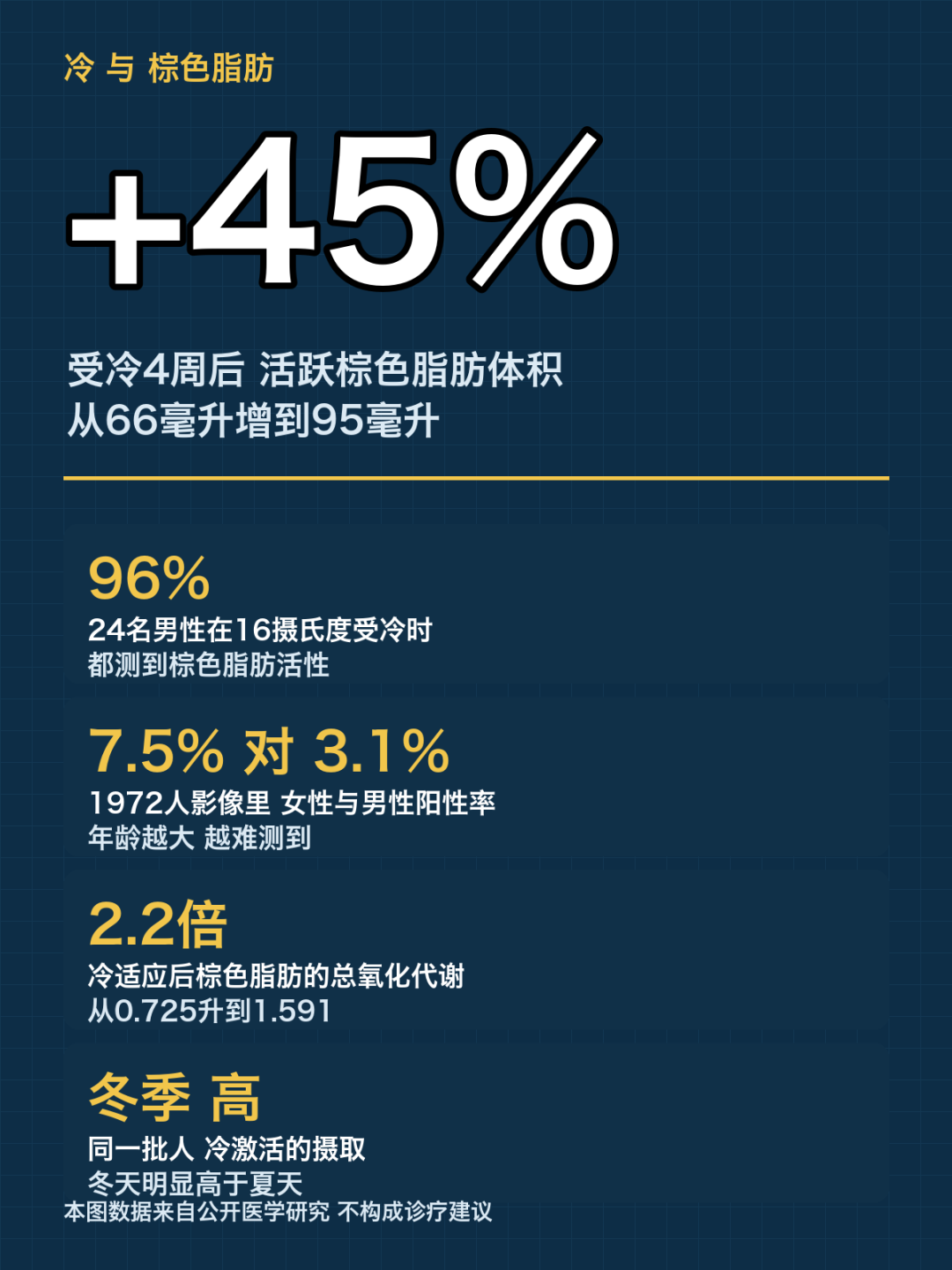
A 2009 study in the New England Journal of Medicine placed 24 adult men in environments of 22°C and 16°C respectively for imaging examinations: when exposed to cold, brown fat activity was detected in 23 of them (96%), while in the warm environment not a single one showed activity; and activity in the overweight and obese group was significantly lower than in the leaner group[1]. Another imaging screening of 1,972 people the same year showed a positive rate of 7.5% in women and 3.1% in men; the older the age, the harder it was to detect, and the higher the outdoor temperature on the day of the scan, the harder it was to detect as well[2].
1. It Can Be "Trained," and the Cost Is Clearly Written
Six men spent 2 hours per day in a 10°C environment for 4 consecutive weeks: the volume of active brown fat increased from 66 mL to 95 mL, a rise of 45%; total oxidative metabolism under cold stimulation increased 2.2-fold[5].
In another study, people who originally had low activity spent 2 hours per day at 17°C for 6 weeks; brown fat activity and cold-induced thermogenesis rose in tandem, body fat decreased, and the changes in the two were negatively correlated[4].
2. It Is Easier to Detect in Cold Weather, and It Is Inversely Related to Body Fat
After 56 healthy adults were exposed to cold for 2 hours, obvious uptake appeared in 17 of the 32 people in the younger group, but in only 2 of the 24 people in the older group; uptake measured in the same people was significantly higher in winter than in summer; the lower the uptake, the higher the BMI and visceral fat[3].
3. Is "Freezing Yourself to Lose Weight" Reliable?
Frankly, it is not worth it. The total amount of brown fat in adults is inherently small, and it decreases with age and obesity. The gains from "training" it in studies came at the cost of two hours per day for several consecutive weeks, and most studies had sample sizes of only single digits to a few dozen people.
More importantly, there are costs: cold can raise blood pressure and increase the risk of cardiovascular and cerebrovascular events, and it is especially unsuitable for older people and those with underlying diseases to tough it out. Using cold as a weight-loss method carries risks far greater than the benefits.
Four Things You Can Do Today
-
Do not set indoor temperatures so high that you need short sleeves; 18 to 22°C is enough, and it lets the body produce some heat on its own.
-
Replace "exposure to cold" with a 10- to 15-minute brisk outdoor walk; you get cold stimulation and exercise at the same time, which is the cost-effective approach.
-
Washing your face with cold water is fine, but for prolonged cold exposure such as cold showers or winter swimming, ask a doctor first.
-
If your hands and feet are cold year-round and your weight rises for no apparent reason, get your thyroid function and a complete blood count checked once, and do not attribute it solely to a "cold constitution."
Brown fat is real. It is a small furnace in the body, not a shortcut to weight loss. Share this with that friend who gains three jin every winter.
If this has been helpful to you, give it a like or a "Wow," and feel free to leave a comment telling us what topics you would like to see.
✦ ✦ ✦
Disclaimer: This article is for health education purposes only and is intended for informational reference; it does not constitute medical advice. If you have health concerns, please consult a professional doctor. People with cardiovascular disease or poorly controlled blood pressure should not undertake prolonged cold exposure such as cold showers or winter swimming.
Declaration of Interests: The content of this article is based on publicly published medical literature, has no conflict of interest with the research institutions mentioned in the text, and does not involve any product recommendations.
References
-
van Marken Lichtenbelt WD, Vanhommerig JW, Smulders NM, et al. Cold-activated brown adipose tissue in healthy men. N Engl J Med. 2009;360(15):1500-1508. PMID:19357405
-
Cypess AM, Lehman S, Williams G, et al. Identification and importance of brown adipose tissue in adult humans. N Engl J Med. 2009;360(15):1509-1517. PMID:19357406
-
Saito M, Okamatsu-Ogura Y, Matsushita M, et al. High incidence of metabolically active brown adipose tissue in healthy adult humans: effects of cold exposure and adiposity. Diabetes. 2009;58(7):1526-1531. PMID:19401428
-
Yoneshiro T, Aita S, Matsushita M, et al. Recruited brown adipose tissue as an antiobesity agent in humans. J Clin Invest. 2013;123(8):3404-3408. PMID:23867622
-
Blondin DP, Labbé SM, Tingelstad HC, et al. Increased brown adipose tissue oxidative capacity in cold-acclimated humans. J Clin Endocrinol Metab. 2014;99(3):E438-E446. PMID:24423363
© 2026 太阳圣华(北京)医疗科技有限公司