This article is for health education purposes only and is intended for informational reference. It does not constitute medical advice; if you have health concerns, please consult a professional doctor.
Always Feeling Worn Out, Winded After Two Flights of Stairs: It's Not Laziness, It Might Be Not Enough Iron
You slept more than eight hours, but you still feel like you didn't recharge in the morning.
You used to bound up five flights of stairs in one go; now you have to stop and catch your breath after two.
Every line on your routine blood test says "normal," so this gets filed under suboptimal health, lack of exercise, or simply laziness.
But for some people, the problem isn't willpower or lung capacity—it's a shortage of the oxygen-carrying component inside hemoglobin: iron.
First, Let's Put the Data Up Front
Iron deficiency is one of the major contributors to the global disease burden. More importantly, it can cause functional impairment before it ever develops into anemia—meaning your routine blood test can look normal while your body is already running in an iron-deficient state (Lancet 2021 review [1]).
In China, the number of people with dietary iron deficiency in 2021 was approximately 79.6 million, a 40.86% decrease from 1990, but the burden among women aged 20 to 49 is rising [2].
Now a more direct trial: 144 women who were not anemic but had long-standing unexplained fatigue took iron daily for four weeks, and their fatigue scores dropped by 29%, while the placebo group dropped only 13% [3]. Moreover, only those with ferritin below 50 micrograms/liter showed significant improvement.
Seven Signals—Check Yourself Against Them
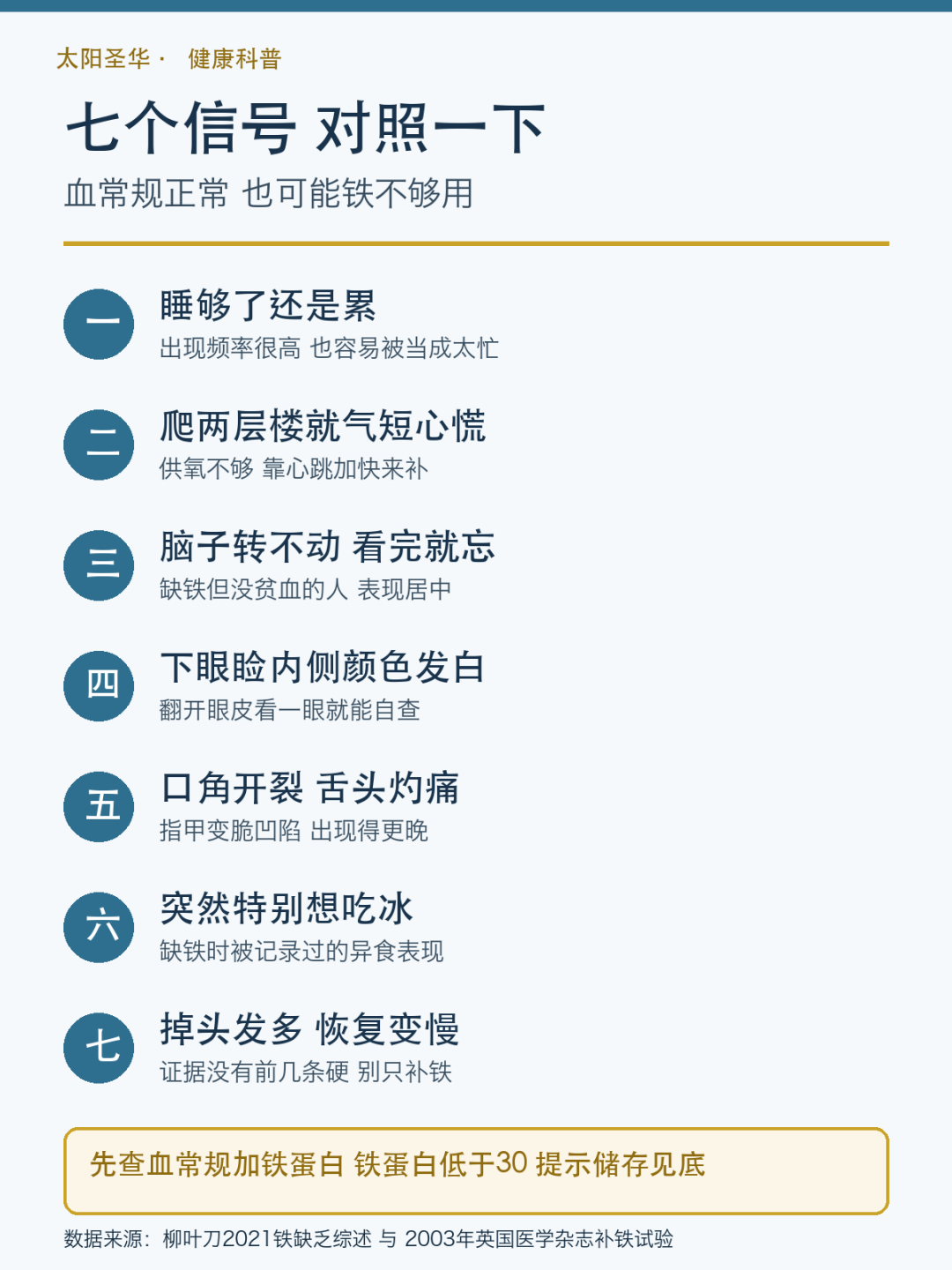
1. Tired even after enough sleep This is a very commonly reported one, and it's easily explained away as having too much on your plate. The trial above recruited exactly this type of person: normal hemoglobin, just exhausted. After four weeks of iron supplementation, fatigue scores dropped from 6.37 to 4.55.
2. Short of breath and heart racing after walking a stretch or climbing two flights When iron is insufficient, hemoglobin is low, and the same trip requires a faster heart rate to compensate for oxygen delivery. So the presentation is breathlessness and heart palpitations together, not just a simple decline in physical fitness.
3. Your brain won't cooperate In cognitive tests of 149 women aged 18 to 35, the iron-sufficient group performed better than the iron-deficiency anemia group, and the iron-deficient-but-not-yet-anemic group fell right in the middle [6]. Forgetting what you just read or struggling with calculations may not be entirely a focus problem.
4. Pale complexion, inner lower eyelids, and palm creases Hemoglobin itself is red. Opening your lower eyelid in the mirror or looking at your palm creases—if the color is on the pale, whitish side, that's a clue clinicians will take a look at.
5. Cracked corners of the mouth, burning tongue, brittle nails These are all relatively common signs of long-term iron deficiency. The nail change where the center becomes concave, like a small spoon, tends to appear later.
6. Suddenly craving ice People with iron deficiency sometimes inexplicably want to chew ice, or even crave non-nutritive substances—this is a pica behavior that has been documented clinically.
7. Increased hair shedding, slower recovery after exercise These two need to be stated clearly: there are reports of an association with iron deficiency, but the evidence isn't as strong as the previous points. Don't assume hair loss means iron deficiency, and don't just take iron without investigating the cause.
Why People Today Are Prone to Deficiency
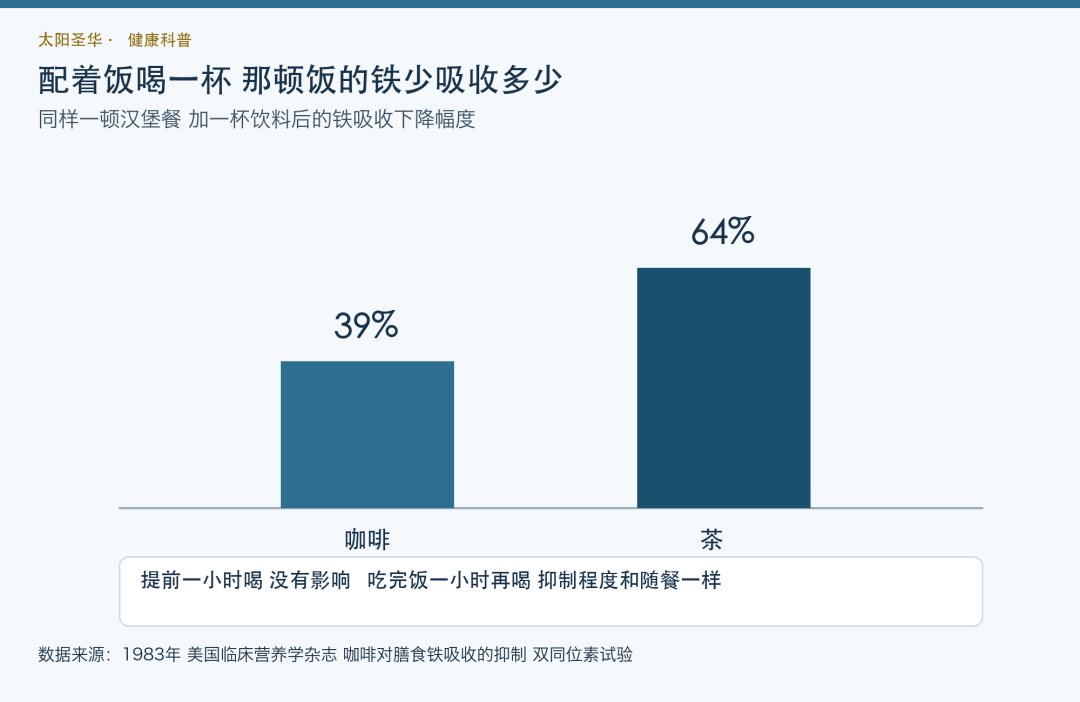
Drinking tea and coffee at the wrong time Drinking a cup of coffee with a meal reduces iron absorption from that meal by 39%; with tea, it drops by 64%. More notably, coffee consumed one hour before a meal had no effect, but consumed one hour after a meal, the inhibition was the same as drinking it with the meal [4]. So the key isn't whether you drink it, but not drinking it right around meals.
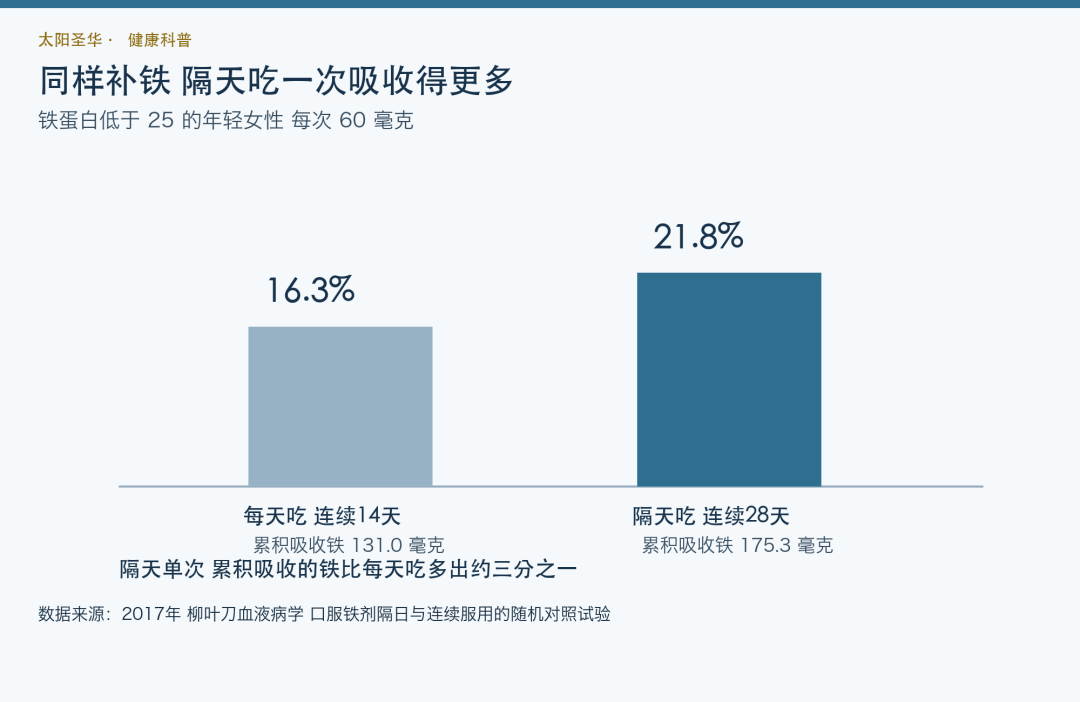
Supplementing iron the wrong way Taking it every day, split into multiple doses a day, sounds more diligent but actually results in worse absorption. In young women with ferritin below 25, taking 60 mg every other day for 28 days yielded a cumulative absorption rate of 21.8%; taking it daily for 14 consecutive days yielded only 16.3%. In total absorbed amounts, that's 175.3 mg versus 131.0 mg—every-other-day dosing actually delivered about one-third more [5]. The reason is that iron supplementation raises hepcidin levels in the body, essentially closing the door on the next round of absorption.
Trying to solve it with a glass of orange juice The idea that vitamin C helps iron absorption comes from single-meal experiments; in measured studies of complete diets, the magnitude of this enhancement was too small to detect a significant difference [7]. Orange juice isn't useless, but don't treat it as the solution.
Cutting out all meat, heavy menstrual bleeding, chronic gastrointestinal blood loss During weight loss, replacing all meat and eggs with salads, long-term vegetarianism, and heavy periods are all common causes of intake falling short of needs. For men or postmenopausal women diagnosed with iron deficiency, follow recommendations to get the gastrointestinal tract checked—don't just supplement without investigating [1].
Four Things You Can Do Today
-
Move tea and coffee to between meals, at least one hour apart from main meals.
-
Plan red meat, animal blood, or liver two to three times a week, paired with dark-colored vegetables.
-
If you suspect iron deficiency, check a complete blood count plus ferritin before deciding whether to supplement. Ferritin below 30 micrograms/liter indicates your stores are already depleted.
-
Don't take high-dose iron supplements on your own long-term. Iron supplementation works best as a single dose every other day—leave the dosage and duration to your doctor; iron deficiency in men and postmenopausal women is itself a signal that warrants investigating the cause.
Iron isn't a supplement—it's a porter. When it can't carry the oxygen, the first thing to collapse isn't your willpower—it's those two flights of stairs.
If someone around you always says they're tired and keeps being called lazy, consider forwarding this to them. Save this signal checklist, and add ferritin to your next checkup.
If this was helpful to you, give it a like or a "reading" mark, and feel free to leave a comment telling us what topics you'd like to see.
✦ Disclaimer: This article is for health education purposes only and is intended for informational reference. It does not constitute medical advice; if you have health concerns, please consult a professional doctor. Conflict of interest statement: This article does not involve any drug or product recommendations and has no financial relationship with the research institutions mentioned in the text. © 2026 Sunshenghua (Beijing) Medical Technology Co., Ltd.
References
[1] Pasricha SR, Tye-Din J, Muckenthaler MU, Swinkels DW. Iron deficiency. Lancet. 2021;397(10270):233-248. PMID: 33285139
[2] Qiu Y, Long Z, Long Z. Epidemiology of dietary iron deficiency in China from 1990 to 2021: findings from the global burden of disease study 2021. BMC Public Health. 2025;25(1):596. PMID: 39948490
[3] Verdon F, Burnand B, Stubi CL, Bonard C, et al. Iron supplementation for unexplained fatigue in non-anaemic women: double blind randomised placebo controlled trial. BMJ. 2003;326(7399):1124. PMID: 12763985
[4] Morck TA, Lynch SR, Cook JD. Inhibition of food iron absorption by coffee. Am J Clin Nutr. 1983;37(3):416-420. PMID: 6402915
[5] Stoffel NU, Cercamondi CI, Brittenham G, Zeder C, et al. Iron absorption from oral iron supplements given on consecutive versus alternate days and as single morning doses versus twice-daily split dosing in iron-depleted women: two open-label, randomised controlled trials. Lancet Haematol. 2017;4(11):e524-e533. PMID: 29032957
[6] Murray-Kolb LE, Beard JL. Iron treatment normalizes cognitive functioning in young women. Am J Clin Nutr. 2007;85(3):778-787. PMID: 17344500
[7] Cook JD, Reddy MB. Effect of ascorbic acid intake on nonheme-iron absorption from a complete diet. Am J Clin Nutr. 2001;73(1):93-98. PMID: 11124756